Discover Student Events in Würzburg
Discover Student Events in Würzburg: Your Compass Through Campus and City
Lecture, workshop, or lecture series? Student events in Würzburg will make studying, campus life, and the city come alive in the future – from study orientation and health offerings to science and cultural formats.
For whom: Pupils (study orientation), students (everyday study life, scientific practice), interested citizens and guests (public lectures & culture).
Why Würzburg Offers So Many Formats for Pupils and Students
As a university and cultural city, Würzburg closely connects campus life, research, and the city community. This results in a diverse program of student events: You can get a taste of university life even before starting your studies, participate in short health and learning formats during your studies, or get involved academically and socially through public lectures, workshops, and lecture series.
This guide classifies the most important types of events, shows you typical procedures, and gives concrete decision aids for selection and registration – without listing individual dates. For current data and capacities, always refer to the official event pages (see sources at the end).
Hands-On Campus: Orientation for Pupils
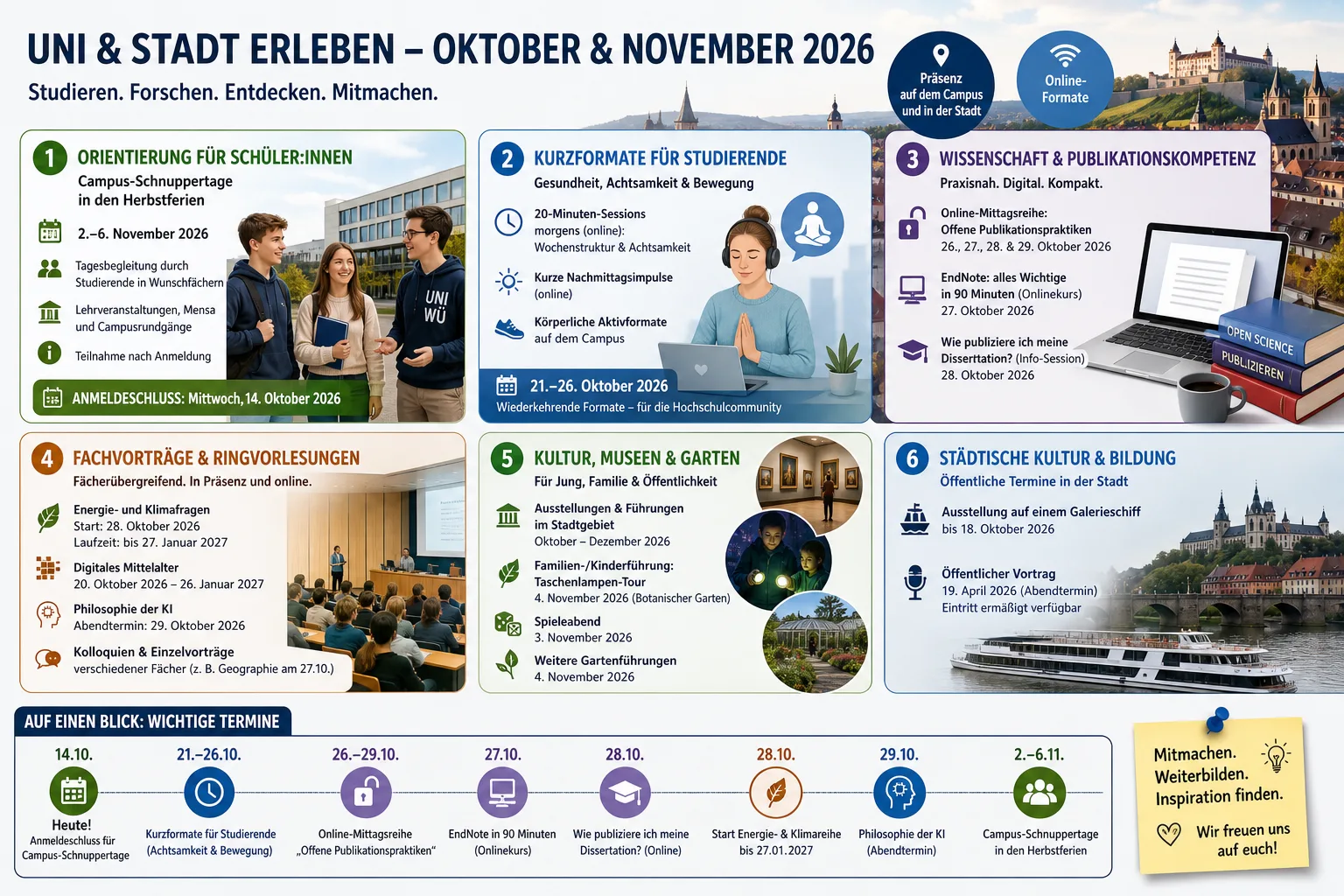
If you are considering studying in Würzburg, you can get to know university life even before graduating from high school. Common formats include taster offers, campus days, introductory events, and mentoring-like programs, where you gain insights into subject areas, learning spaces, and study organization.
What You Can Typically Expect
- Participation in teaching formats: you experience how lectures, seminars, and exercises are structured (duration, learning objectives, participation).
- Campus logistics: orientation in the library, cafeteria, central service facilities, and typical learning spaces.
- Questions that really help: study choice, transition from school to university, time management, exam formats, contact points.
What to Watch Out for When Registering
Many orientation formats work with limited group sizes. Therefore, register early, check participation requirements (e.g., grade level, interest profile), and clarify in advance whether there are waiting lists or selection procedures. If accompanying persons (e.g., parents) are allowed, this is usually stated in the official announcement.
Staying Healthy During Your Studies: Short Formats, Mindfulness, and Exercise
During your studies, short, easily integrable formats become especially valuable: They are designed to help you regulate stress, stabilize learning routines, and keep you mentally and physically agile – without disrupting your schedule.
Typical Formats to Keep in Mind for the Future
- Short online sessions (e.g., in the morning or between events) on weekly structure, focus, mindfulness, and realistic planning.
- Afternoon impulses on topics such as exam stress, procrastination, recovery, and sustainable learning.
- Exercise offers on campus, which are deliberately designed to be low-threshold (short units, clear instructions, no high entry barriers).
Important: Such offers do not replace medical or psychotherapeutic treatment. If you have acute or persistent complaints, use professional contact points (e.g., general practitioner, university psychological counseling centers, or medical emergency services).
Living Science: Publishing, Open Access, Tools & Methods
At the latest in term papers, theses, or a doctorate, the question arises of how scientific work functions in practice. In Würzburg, workshops, short series, and advisory formats focusing on research, citation, data management, and publication are especially relevant.
What You Can Take Away from These Events
- Understanding publication paths: What options are there (e.g., open access), what rights and obligations are typical, and what should you look out for in contracts?
- Organizing literature: Introduction to literature management programs and proper citation practice, so that sources remain traceable.
- Transparency & traceability: Good scientific practice, reproducible work, and clear documentation.
If you attend events on open access and research information, it is worthwhile to clarify your own goals in advance: Do you want to publish faster, act legally secure, increase visibility, or simply avoid mistakes? With a clear question, you usually get much more out of 60–90 minutes of input.
Lecture Series, Seminar, Lecture: Discourse Between City and Lecture Hall
Public science formats are among the most sustainable ways to bring research into the city community. Lecture series, evening lectures, and panel discussions often address future topics – such as climate, energy, digitalization, health, ethics, or social change – and bundle different perspectives.
How to Make the Most of Public Formats
- Prior knowledge is rarely required: Many events are designed so that interested laypeople can easily follow.
- Prepare questions: If there is a discussion round, write down 1–2 concrete questions that will really help you.
- Check hybrid & online: Especially for series, check whether recordings, livestreams, or collections of materials are announced.
For students, such dates can be an ideal supplement to seminars: You learn how experts argue, which terms prevail, and how uncertainties in research are made transparent.
Culture, Gardens, Museums: Learning Outside the Seminar Room
In addition to lecture halls and libraries, cultural and natural sites in Würzburg also make educational offerings visible. In the future, guided tours, hands-on formats, themed evenings, and educational programs that combine science, history, art, and city experience will be especially relevant.
Examples of Typical Offer Logics (Without Fixed Dates)
- Museums & exhibitions: Guided tours, scientifically accompanied discussions, and formats that translate seminar content to the public.
- Botany & biodiversity: Themed tours and seasonal focuses, often with vivid explanations and a focus on research & species knowledge.
- Low-threshold encounters: Open evenings, campus or city tours, and formats that bring together students, families, and guests.
If you want to participate with children or in a group, pay particular attention to notes on age groups, accessibility, duration, and any registration or capacity rules.
Practical Tips: How to Find the Right Event
Because programs can change each semester, the safest way is through official calendars and pages of the organizing institutions. With this short checklist, you can find the right event faster:
- Set your goal: Orientation (school→university), health & everyday life, scientific skills, or public lectures?
- Choose a format: In-person (lecture hall/location) or online (low threshold, often easier to integrate)?
- Check participation requirements: Target group, language, prior knowledge, costs/discounts, registration deadlines, capacity limits.
- Use a reputable source: Event announcement from the university, library, student services, or official culture/institution channels.
- Set up a calendar routine: Set fixed times to check event calendars (e.g., once a week) and subscribe to newsletters if offered.
If you are external (e.g., as a pupil, parent, or guest), it is worth briefly checking in the announcement whether the event is public. Many scientific lectures are explicitly open – for workshops, the target group is often more narrowly defined.