Interreligious Events & Festivals in Würzburg
Interreligious Events & Cultural Festivals in Würzburg (Outlook)
Würzburg thrives on encounters: When people of different backgrounds celebrate, pray, discuss, and experience art together, diversity becomes visible in everyday life. This overview consistently looks ahead and describes formats that typically take place or regularly recur throughout the year in Würzburg.
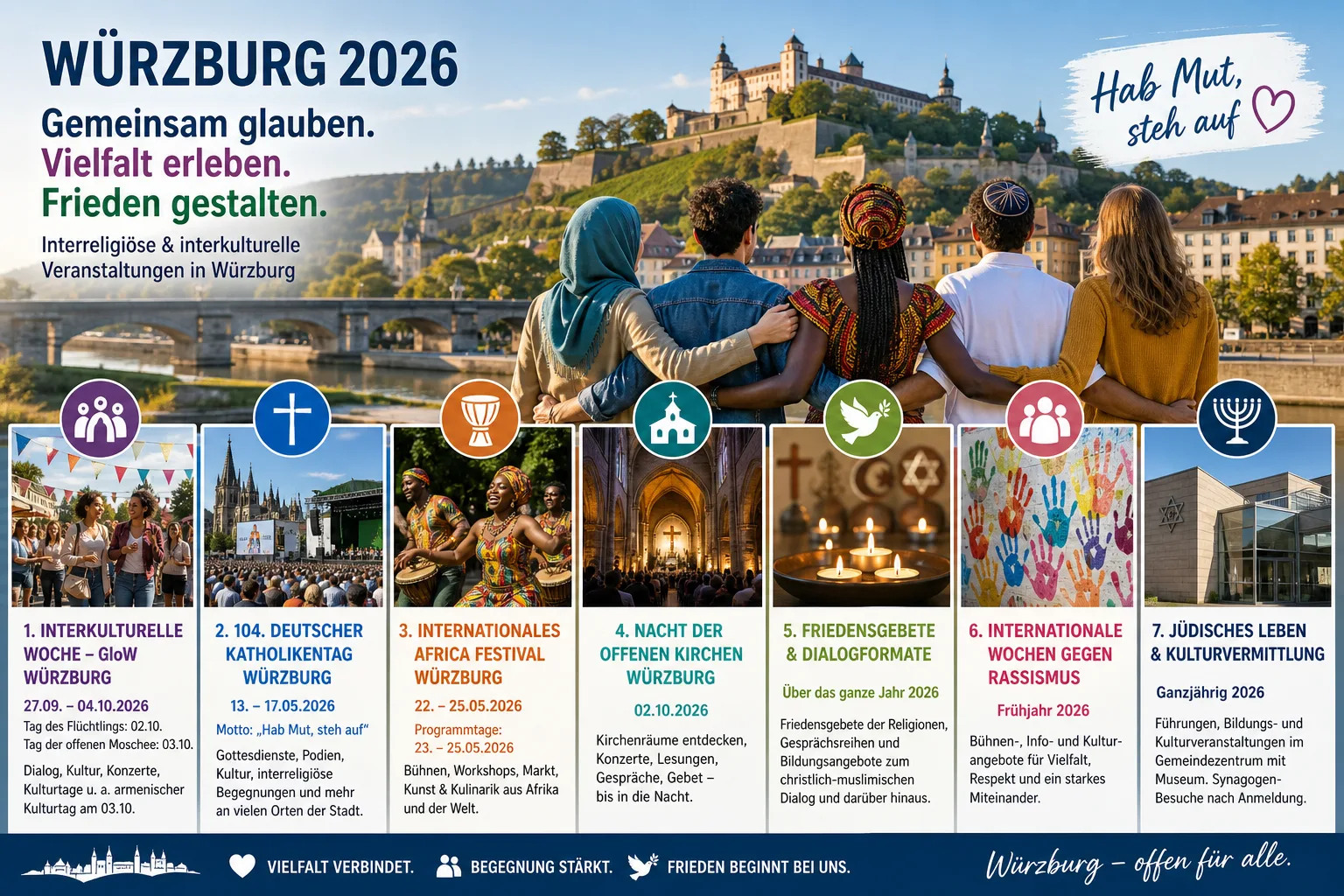
Intercultural Week “GloW”: Würzburg in Dialogue
In late summer and early autumn, Würzburg often bundles its offerings for the Intercultural Week under a local program name such as “GloW” (as an idea: “Global Würzburg” and “glow” in the sense of shining). During this time, places of encounter emerge throughout the city: in community halls, cultural centers, schools, clubs, and public spaces.
Those who visit GloW can expect the following components in the future—depending on the program year:
- Dialogue and discussion evenings with representatives of various religions and worldviews (e.g., on neighborhood, belonging, migration, education, social cohesion).
- Cultural events such as concerts, readings, film evenings, or exhibitions that make intercultural perspectives tangible.
- Community focuses (e.g., cultural days of individual communities), where music, history, cuisine, and religious traditions are presented together.
A frequently closely linked program point is the Open Mosque Day (coordinated nationwide): Visitors have the opportunity to get to know mosque spaces, ask questions, and engage in conversation in a calm atmosphere. Especially for people without prior experience, this is a low-threshold access that can break down prejudices and promote understanding.
International Africa Festival: Global Culture on the Main
On the banks of the Main, a temporary festival world can unfold again in the coming years: stages, market stalls, workshops, and exhibitions presenting African cultures and diaspora perspectives. The International Africa Festival is often perceived not only as a music event but as a place of intercultural education and encounter.
What visitors can typically expect at the next festival edition:
- Live music with international artists who combine traditional styles with jazz, pop, hip-hop, or electronic influences.
- Supporting program (depending on the year): discussions, readings, film screenings, or workshops on contemporary topics such as migration, remembrance, social cohesion, or cultural self-representation.
- Bazaar and market area with handicrafts, fashion, and cuisine, facilitating encounters beyond clichés.
For locals, the festival can be a recurring highlight of the year; for guests, it is an opportunity to experience Würzburg as a cosmopolitan cultural city—especially if you plan time for concerts and for the discussion and workshop formats.
Night of Open Churches & Prayers for Peace of the Religions
In addition to large events, consciously quiet formats often shape the interreligious landscape in Würzburg. This can include a Night of Open Churches: Churches remain open until late hours, often with music, readings, meditations, and opportunities for conversation. Such evenings are usually ecumenically supported and are explicitly aimed at people who otherwise rarely visit religious places.
Throughout the year, there can also be Prayers for Peace of the Religions. These meetings are often simply designed (texts, music, silence) and focus on a common sign: religious communities can take responsibility for the social climate without blurring differences. Those who wish to participate can usually find information in parish programs, local event calendars, or from interreligious initiatives.
International Weeks Against Racism: Würzburg Takes a Stand
In spring, the International Weeks Against Racism can also set a clear accent in Würzburg: educational institutions, clubs, religious communities, and civil society initiatives coordinate events that address exclusion and strengthen democratic culture.
For upcoming editions—depending on the local program—the following formats are often to be expected:
- Information and discussion events on discrimination, options for action in everyday life, and prevention work.
- Art and stage formats (e.g., theater, music, spoken word) that make experiences and perspectives visible.
- Opportunities for encounter, where initiatives present their work and initiate cooperations.
Interreligious perspectives can play a key role here, for example through joint statements, educational evenings, or cooperative projects with schools and youth groups.
Jewish Life & Cultural Mediation in Würzburg
Anyone wishing to understand Würzburg's religious diversity will also continue to encounter offerings on Jewish history, culture, and present. Cultural mediation is particularly successful through guided tours, educational offerings, and event series that relate religion, history, and current issues (e.g., remembrance culture, democratic education, antisemitism prevention).
Typical formats that may remain relevant in Würzburg in the future:
- Tours and learning opportunities (e.g., on holidays, rituals, everyday culture, and historical context).
- Programs for school classes and multipliers focusing on prevention and educational work.
- Lectures, readings, or concerts that make Jewish perspectives in art, philosophy, and contemporary culture visible.
Early planning is recommended for participation, as some formats (especially educational and group offerings) in many cities may require registration and security concepts.
How Locals and Guests Can Experience Würzburg's Diversity in the Future
Those who wish to attend interreligious events and cultural festivals benefit from a mix of planning and openness. These approaches have proven helpful:
- Check programs early: Many formats publish their details only a few weeks before they start (locations, times, access rules, ticketing).
- Plan for discussion formats: Not only concerts and festivals shape the exchange, but also tours, workshops, and moderated dialogue evenings.
- Respectful participation: In religious spaces, there are sometimes rules regarding clothing, photography, or seating arrangements; on-site information supports good coexistence.
- Check accessibility & family-friendliness: Organizers increasingly indicate access, language, sign language, or child-friendly offers.
As an outlook: In a city undergoing change, interreligious and intercultural events are not an “extra,” but a resonance space for cohesion. Those who participate experience Würzburg not just as a backdrop, but as a conversation—and as a learning urban society.