Discover Children's University Würzburg & Science Events
Children's University & Science Events in Würzburg (Outlook)
Children's University Würzburg, hands-on labs, interactive exhibitions, and family formats: A forward-looking overview of science events for young researchers in Würzburg and the surrounding area.
Children's University Würzburg 2026/27: University atmosphere for ages 6 to 13
The Children's University Würzburg is one of the best-known science formats for children in the region. Scientists explain topics in a way that is understandable, sparks curiosity, and remains scientifically accurate.
Framework & Procedure (Series 2026/27)
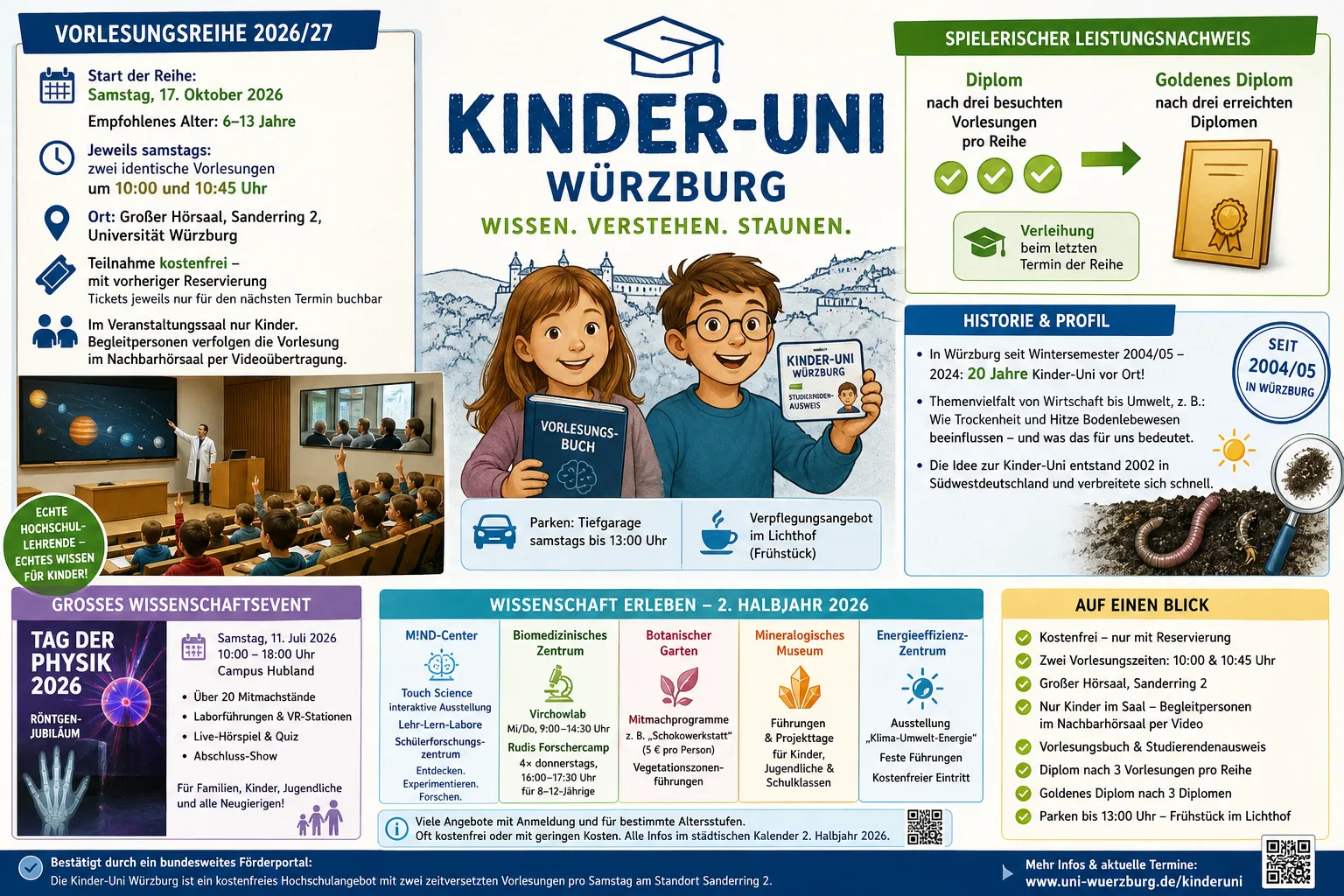
The upcoming 2026/27 series is scheduled to start on October 17, 2026. The Children's University is usually recommended for children aged about 6 to 13 years. The official information from the organizers on the official website is binding.
A typical procedure includes two identical lectures on the same morning (to spread out attendance). In Würzburg, a large lecture hall at Sanderring is used as the venue. Usual time slots are:
- 1st lecture: 10:00 am
- 2nd lecture: 10:45 am
Participation is generally free of charge, but requires reservation or ticketing. Often, tickets are only issued for the next event. This keeps planning manageable for families, and spontaneous participation is possible if spots become available.
Children in the lecture hall, parents next door
A special feature is the clear focus on the children: The young students sit in the lecture hall, while accompanying persons can follow the lecture separately (depending on organizational arrangements), for example via video transmission in a neighboring room. This supports independence without neglecting safety and supervision.
- Welcome materials: There is often a lecture booklet and a child-friendly "student ID card".
- On-site convenience: Depending on the location, catering options (e.g., in the atrium) can make the morning more family-friendly.
- Arrival: For specific parking or public transport planning, the university's current information is decisive.
Diploma and "Golden Diploma": playful recognition
Instead of grades, the Children's University often relies on motivation through participation. The usual practice: Those who attend several lectures within a series (e.g., three events) receive a diploma. Those who collect several diplomas over multiple series often receive an additional award (known in many programs as the "Golden Diploma"). The exact thresholds are officially published for each series.
For many children, the ceremonial presentation at the end of the series is a highlight: They experience that curiosity, perseverance, and asking questions are valued.
Day of Physics at Hubland: What to expect at the next event
Another highlight in Würzburg's science calendar is the Day of Physics at the Hubland campus. It is aimed at families, school classes, young people, and anyone who wants to experience experiments live. Since the date, focus, and program vary each year, the following applies: The next specific event day will be officially announced by the faculty.
Typical program points (Outlook)
- Hands-on booths and experiment stations where children can measure, test, and compare themselves
- Laboratory tours (by registration or depending on capacity), providing insights into research and equipment
- Interactive digital offerings (e.g., visualizations, simulations, VR/AR elements – depending on the year)
- Stage shows, short lectures, or science formats that translate physics into stories
- Quiz and puzzle stations for different age groups
Who benefits most from attending?
The Day of Physics is especially strong when children and young people can try things out themselves rather than just watch. For teachers, the format can be a good building block to deepen classroom topics (e.g., energy, optics, electricity) and at the same time initiate career and study orientation.
Touch Science, M!ND Center & Virchowlab: Participation in everyday school life
In addition to major individual events, it is often the regular hands-on formats that make science continuously visible in Würzburg. Especially in the second half of 2026 and beyond, it is worth keeping an eye on the calendars of the participating institutions, as many workshops, lab days, and tours are scheduled according to the school rhythm.
Touch Science and teaching-learning labs at the M!ND Center
In the context of the M!ND Center, "Touch Science" stands for a hands-on approach: Phenomena are not explained first and then shown, but the other way around. Children turn, push, measure, observe – and develop their own questions from this. Accompanied formats (e.g., for classes) combine this joy of experimentation with didactic structure.
Virchowlab and research camps
The Virchowlab is an example of biomedical hands-on offerings that translate laboratory practice in an age-appropriate way: sample preparation, microscopy, simple evaluations, and the question of how research results can later be incorporated into diagnostics and everyday medicine. Depending on the program, offerings are aimed at school classes, project groups, or defined age groups (e.g., elementary/middle school).
Important for planning: Many lab formats have limited spots and require early registration, especially if entire classes or clubs are to participate.
Botanical Garden, Mineralogical Museum & Climate Exhibition
Science does not only take place in the lecture hall. In Würzburg, collections, gardens, and exhibitions also offer programs that are particularly suitable for family outings or project days.
Botanical Garden: Experiencing botany
The Botanical Garden combines nature experiences with knowledge about biodiversity, adaptation strategies, and ecological relationships. Family formats and group offerings (e.g., tours or workshops) are well suited to make topics such as pollination, crops, or global supply chains understandable. Participation conditions, age information, and any fees are published for each event.
Mineralogical Museum: Crystals, rocks, and Earth's history
In the Mineralogical Museum, rocks and minerals become the starting point for questions that often immediately captivate children: Why do some stones sparkle? How do crystals form? And where do we encounter minerals in everyday life? Tours and museum education programs are especially suitable when children are to grasp things literally.
Climate, environment, energy: Interactive exhibitions
Formats around climate, environment, and energy make connections between energy consumption, greenhouse gases, and everyday decisions tangible. Interactive stations work particularly well for mixed age groups because they offer different levels of entry: from "What happens if...?" to "How is that measured?"
Practical information for families, schools, and groups
Registration, costs, and time slots
Many science offerings in Würzburg are free of charge or have moderate fees, but almost always: places are limited. Especially for labs and workshops, binding registration is standard.
- Children's University: Reservation/tickets required; modalities may change from series to series.
- Teaching-learning labs & Virchowlab: often planned for groups/schools; inquire in good time.
- Museums & Botanical Garden: Programs according to schedule; sometimes with age requirements.
- Science days (e.g., Physics): Program is published before the event; individual offerings may have time slots.
How to turn a weekend into a little research trip
- Choose a focus topic: e.g., "Light & Vision" (Physics/Optics), "Life in the Small" (Biology/Microscopy), or "Climate & Energy".
- Plan a main format: Children's University or a workshop as a fixed point.
- Add a complementary destination: Museum/garden/exhibition that deepens the topic in a playful way.
- Build in buffers: Many children need breaks; short distances and snacks increase the joy of learning.
Note on up-to-dateness: Times, locations, and participation conditions may change at short notice. The current information from the organizers (official websites, newsletters, announcements from the university or institutions) is binding.
Sources & further links
- Julius-Maximilians-Universität Würzburg (JMU): Children's University — official information on dates, ticketing, and procedure (accessed 2026-08-26)
- JMU: Faculty of Physics and Astronomy — announcements of public events and action days (accessed 2026-08-26)
- JMU Würzburg: Homepage — central entry point to institutions, news, and event information (accessed 2026-08-26)