
Cabaret (Musical)
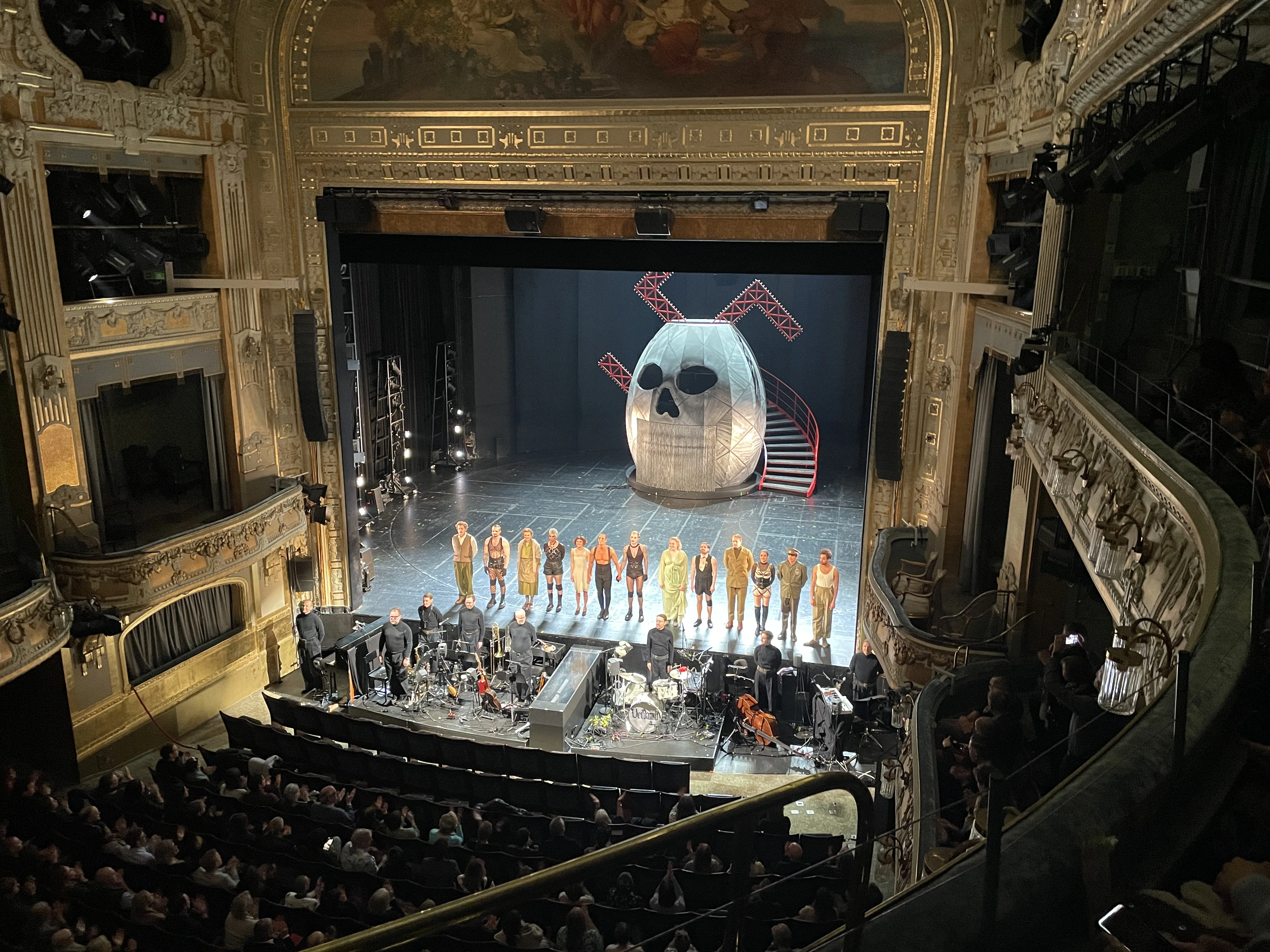
Image from Wikipedia
Image from Wikipedia
Cabaret (Musical) – From "Welcome" to "Farewell, Berlin": The Icon of Musical Theater
Why Cabaret has shaped audiences, critics, and culture since 1966
Cabaret is more than just a musical – it's an artistic time capsule that captures Berlin in the late 1920s and early 1930s with musical brilliance, political awareness, and radical stage aesthetics. Premiering on Broadway in 1966, with music by John Kander, lyrics by Fred Ebb, and a book by Joe Masteroff based on John Van Druten's I Am a Camera and the autobiographical Berlin stories of Christopher Isherwood, Cabaret tells a story of love, illusion, and the looming darkness of fascism. Since its premiere, the work has established its musical career as a milestone of the genre – featuring award-winning revivals, groundbreaking productions, and a catalog of songs that have become part of the DNA of modern musical theater. (de.wikipedia.org)
Origin and Premiere: A New Soundscape for Broadway and the West End
On November 20, 1966, the curtain rose at the Broadhurst Theatre in New York: Producer and director Harold Prince shaped a musical that renewed the form – with an Emcee as both mirror and distorted lens, featuring revue-like tableaux in the Kit Kat Club and tender, fragile scenes outside the stage. Joel Grey defined a stage figure as the Master of Ceremonies that set the genre standard; Lotte Lenya brought an unmistakable urgency as Fraulein Schneider. The West End premiere followed in 1968 at the Palace Theatre in London, where Judi Dench electrified the audience as Sally Bowles. The early years marked Cabaret as a work of artistic development – a musical that understood its stage as a moral resonance chamber. (de.wikipedia.org)
Plot and Characters: Between Ecstasy and Reality
The plot takes place in 1929/30 Berlin, where American writer Cliff Bradshaw and British singer Sally Bowles meet at the Kit Kat Club. The Emcee guides the audience through a kaleidoscope of pleasure and danger, while Fraulein Schneider and Herr Schultz experience the fragility of private hope. The stage intertwines cabaret numbers and intimate scenes into a dual perspective: The show light dazzles, yet in the shadows, the threat grows. This dramaturgical composition – revue in the club, narrative outside – is one of the most influential arrangements in musical history. (de.wikipedia.org)
Musical DNA: From "Welcome" to "Cabaret"
The music of Kander and Ebb oscillates between ragtime, jazz, and Weimar tones, but always carries the hallmark of precise composition and pointed lyrics. Classics like "Willkommen", "Don’t Tell Mama", "Two Ladies", "If You Could See Her", "Maybe This Time", "Money", and the title song "Cabaret" form a discography that retains its reference status to this day through thematic condensation. The numbers are dramaturgically placed like spotlight beams: They entertain, expose, and comment – an arrangement that made Cabaret the blueprint for the "conceptual" musical. (de.wikipedia.org)
Award-Winning Success Story: Tonys, Oliviers, and Milestones
The original production (1966–1969) firmly anchored Cabaret in the canon: Eight Tony Awards in 1967 – including Best Musical, Best Score, Direction, Choreography, Costume, and Scenic Design – testify to the artistic authority of the work. More than three decades later, the 1998 Broadway revival directed by Sam Mendes and Rob Marshall renewed its aesthetic sharpness: Four Tony Awards, including Best Revival of a Musical, plus acting awards for Alan Cumming (Emcee) and Natasha Richardson (Sally), set new standards of interpretation. (de.wikipedia.org)
Internationally, the London “Kit Kat Club” revival (Playhouse Theatre, since 2021) has shaped the latest Cabaret era: The immersive transformation of the venue into a nightclub context, table seating around an in-the-round stage, and a radically condensed directorial language made the production a sensation. In 2022, it won a record-breaking seven Olivier Awards, including Best Musical Revival, thus making West End history. (en.wikipedia.org)
Cinematic Iconization: Bob Fosse's Adaptation (1972)
With Bob Fosse's film adaptation (1972), Cabaret became a global symbol: Liza Minnelli as Sally Bowles and Joel Grey as Emcee created icons, while the cinematic form moved the songs almost entirely into the world of the club. Eight Oscars in 1973 cemented Cabaret in the collective memory of pop culture; since then, numbers like "Mein Herr", "Maybe This Time", and "Money" are regarded as signature songs even outside the stage context. The cinematic adaptation influenced later stage versions – not least through the inclusion of individual songs into the repertoire of modern revivals. (de.wikipedia.org)
Current Projects: The “Kit Kat Club” Era in London and New York
The London production at the Playhouse Theatre – consistently branded as the Kit Kat Club – continues as an immersive event and is officially communicated as a multi-award-winning, ongoing performance series. The approach: a darkened prologue, performative interactions, and a soundscape that emphasizes closeness between orchestra, ensemble, and audience. The official site anchors this aesthetic as a trademark and refers to the record series of Olivier awards. (kitkat.club)
In New York, Cabaret at the Kit Kat Club will transfer to Broadway in 2024 and occupy a transformed theater space with a club character. The production features a prominent cast in 2024–2025 and continues the immersive concept; the Broadway venue appearance documents the creative handwriting with detailed credits and casting information, clearly marking the production as a contemporary grand project of the musical theater season 2024/25. (augustwilsonbroadway.com)
Discography: Cast Recordings, Soundtrack, and Curatorial Diversity
The discography of Cabaret includes several defining recordings: The Original Broadway Cast Recording (1966) – now documented over Masterworks/Legacy – serves as the historical reference with the voices of Joel Grey, Lotte Lenya, and the original ensemble. The soundtrack of the film (1972) featuring Liza Minnelli and Joel Grey evolved into a standalone reference recording, wherein Ralph Burns’ arrangements restructure the Kander/Ebb sound for the screen. The latest milestone is the London 2021 cast recording (released 2023, Decca; KKC Rights Limited), which curatorially compiles the sound aesthetics and phrasing of the “Kit Kat Club” production. This recording triplet – Broadway, film, London 2021 – enables a genuine style analysis over 60 years of Cabaret's sound history. (masterworksbroadway.com)
Style and Artistic Development: Composition, Arrangement, Production
Kander's compositions and Ebb's lyrics form a complementary structure of melodic catchiness, harmonic finesse, and lyrical point. Orchestrations and arrangements – historically as well as in the revivals – utilize brass, woodwinds, and rhythm sections to create a sharply defined but flexible sound architecture: The sound shifts between chanson, jazz, and revue-like attack. Production-wise, Cabaret works with contrasts: Numbers like "Two Ladies" or "Money" unfold an aggressive grotesque, while "Maybe This Time" stretches time and makes Sally's inner life audible like a close-up. This artistic development explains why Cabaret remains both entertaining, disturbing, and unsettlingly relevant. (de.wikipedia.org)
Cultural Influence: Mirror of History, Echo of the Present
Cabaret has re-coded the portrayal of political upheavals in musical theater: It shows how entertainment can become a mask – and how music can tear that mask apart. In the history of reception, the figure of the Emcee serves as a commentary on the susceptibility of the masses; Sally Bowles’ “life is a cabaret” ethos has become a catchphrase oscillating between self-determination and self-denial. The fact that revivals – from the Mendes/Marshall era to the Kit Kat Club – continually dare new interpretations speaks to the authority of this work, allowing history and the present to collide in a theatrical space. (playbill.com)
Directorial Modernity: Immersion, Prologue, and “In-the-round”
The London Kit Kat Club concept (since 2021) transforms the theater space into a vibrant nightclub with an in-the-round stage, table seating, pre-program, and scenic prologues. Dramaturgically, the production focuses on closeness, sight lines, and musical presence – a stage presence that dissolves the boundaries between audience and performance. This aesthetic not only resulted in record Oliviers but also sparked a wave of international adaptations and discussions about the future of immersive musical productions. (en.wikipedia.org)
Fans’ Voices
The fans’ reactions clearly show: Cabaret delights people around the world. On Instagram, a visitor enthuses: “This production pulls you into the whirlwind – from the first ‘Willkommen’ to the last chord.” A listener writes on Facebook: “A musical has rarely felt so intense – a cabaret that sings the truth.” Such enthusiasm reflects what the music press states: Cabaret combines musical excellence, scenic boldness, and emotional depth into an unforgettable experience. (omdkc.com)
Conclusion: Why Experience Cabaret Live?
Cabaret is a total work of art that combines composition, text, direction, and space into an experience – a musical that stirs and seduces, tells history, and comments on the present. Those wanting to hear and see the artistic development of a work over six decades will find here a lively archive: from the original sound of the 1960s through Fosse’s film to the immersive modernity of the Kit Kat Club. The ensemble's stage presence, the precision of the arrangements, and the dramatic impact of the songs make Cabaret an essential live experience. Step inside – and let the world outside fade away for a few hours.
Official Channels of Cabaret (Musical):
- Instagram: https://www.instagram.com/kitkatclubnyc
- Facebook: https://www.facebook.com/kitkatclubnyc
- YouTube: No official profile found
- Spotify: https://open.spotify.com/album/3yoIvyvz2xMvQAS4OxENnI
- TikTok: https://www.tiktok.com/@kitkatclubnyc
Sources:
- Wikipedia (DE) – Cabaret (Musical)
- Wikipedia (EN) – Cabaret (musical)
- Kit Kat Club London – Official Production Site
- Kit Kat Club London – About/Production & Awards
- August Wilson Theatre – Cabaret at the Kit Kat Club (Broadway)
- The Guardian – Cabaret wins seven Olivier Awards (April 10, 2022)
- DKC/O&M – Official PR Update with Social Links (NYC)
- Masterworks Broadway – Original Broadway Cast Recording (1966)
- Apple Music – Cabaret (2021 London Cast Recording)
- Playbill – 1998 Broadway Revival (Retrospective, Tonys)
Upcoming Events
Cabaret – Musical at D’haus Düsseldorf
In the mood for jazz euphoria and goosebumps? Cabaret at D’haus combines wit, Weimar glamour, and clear stance. March 24, 7:30 PM, accessible, parking €10. Experience, cheer, swing along. #CabaretDUS
Cabaret - Theater Bielefeld
Glamour, Goosebumps, and an Evening with Sharp Stage Wit: Cabaret conquers the Bielefeld City Theater. On 04/06/2026 from 7:30 PM. #TheaterBielefeld
Cabaret
Glitter, jazz, and an evening with a bitter echo: Cabaret at D’haus Düsseldorf. Experience it live on 19.04.2026, from €54. #Cabaret #Düsseldorf
Cabaret
An evening between glitter, jazz, and abyss: Cabaret at D’haus sets Düsseldorf vibrating. On 16.05.2026 at 19:30 hrs in the Grand House. #Cabaret #Düsseldorf
Cabaret in Düsseldorf: Musical Classic at D'haus
Berlin 1929 meets Düsseldorf: Cabaret at D'haus delivers shine, jazz, and abyss in an evening full of pull. On 08.07.2026 at 19:30. #Cabaret #Düsseldorf
Cabaret – Musical Premiere in Bayreuth
Bayreuth gets Cabaret at the Reichshof: Musical with glamour, sharpness, and goosebumps. 06.11.2026, in the Grand Hall of the cultural stage. Note it now! #Bayreuth #Theater
Cabaret in Bayreuth: The Musical at Reichshof
Bayreuth experiences Cabaret at Reichshof: Glamour, Songs, and a Bitter Play with History. 14.11.2026, 8:00 PM, Tickets starting from 15 €. #Cabaret
Cabaret in Bayreuth: Musical with Dance, Glamour, and Goosebumps
Cabaret in Bayreuth brings shine, danger, and great songs to the Kulturbühne Reichshof. On 28.11.2026 from 20:00 from €15. #TheaterLove
Cabaret in Bayreuth: Musical classic with dark glamour at Reichshof
Bayreuth receives a musical evening full of glamour and abysses: Cabaret at Reichshof combines show, tension, and strong songs. 06.12.2026, from €15. #Bayreuth
Cabaret in Bayreuth
Bayreuth gets with Cabaret an evening full of splendor, excitement, and musical theater with attitude. On 12.12.2026 at 20:00 in the Reichshof. #Bayreuth