
Chris Boettcher
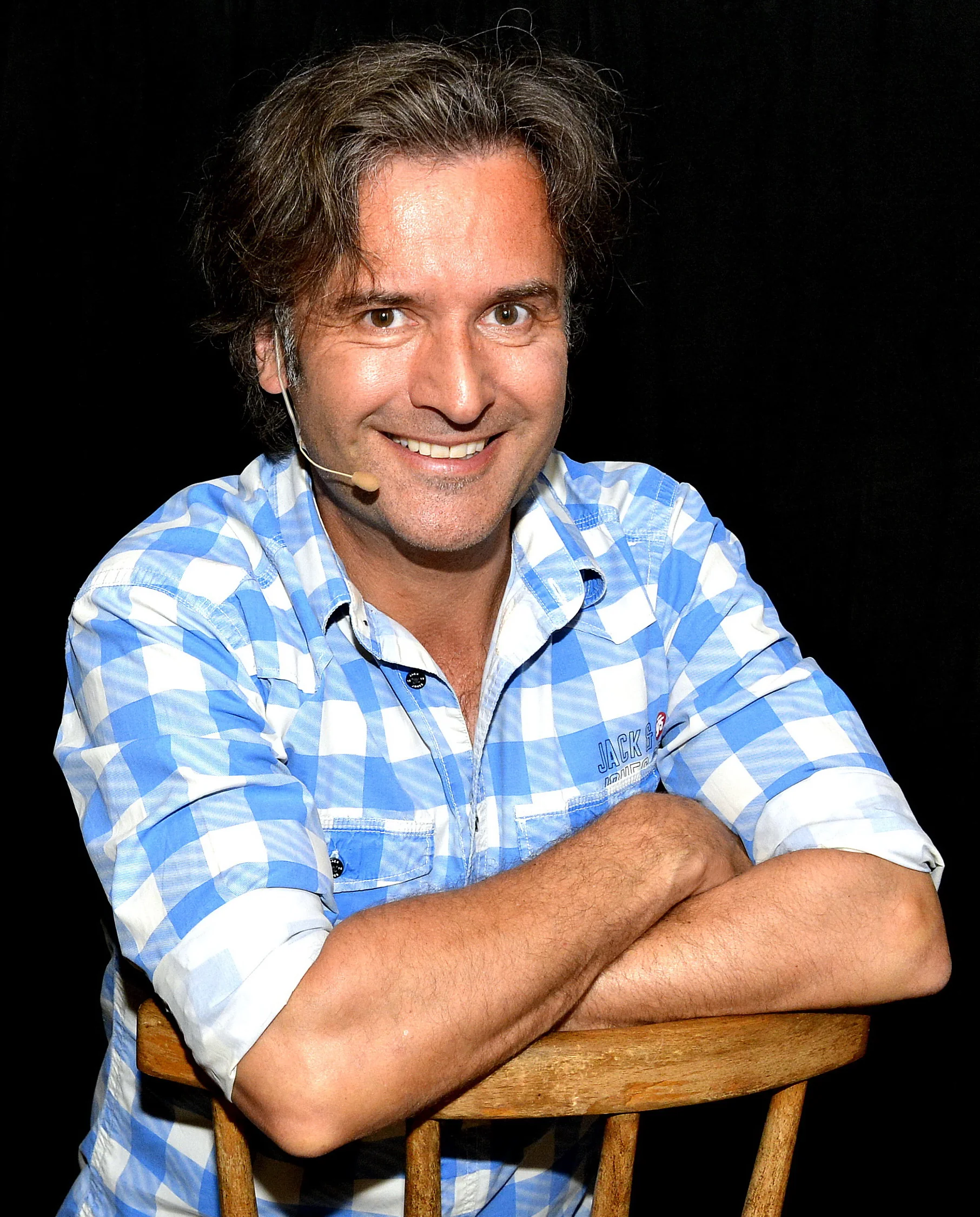
Image from Wikipedia
Image from Wikipedia
Chris Boettcher – Music Comedy with Heart, Brain, and Big Band Sound
An Entertainer between Radio Culture, Cabaret Stage, and Big Band
Chris Boettcher, born on April 11, 1964, in Ingolstadt, is one of the most distinctive voices in German humor and music culture. The radio presenter, comedian, and music entertainer initially gained fame through his punchline-perfect parodies on the radio before conquering cabaret and festival stages with his own programs and songs. With his Wiesn hit “10 Meter geh’,” he made it into the German charts in 2009; since then, he has combined satirical observational skills, musical craftsmanship, and Bavarian wit into an unmistakable stage presence. In recent years, Boettcher has consistently expanded his repertoire—including a gala format with a 17-piece big band, where he shines as a singer, host, and composer.
Biography: From “Singing Master Brewer” Childhood to the Voice of Bavaria
Growing up as the son of a master brewer who was known in the region as the “singing master brewer,” music and performances shaped Boettcher’s self-understanding as a stage person from an early age. After graduating from high school in 1984, he founded his first band, Slip 33, while simultaneously gaining experience as a musical dancer, singer, and extra at the Ingolstadt City Theatre. Key turning points occurred through radio: After initial steps at Radio IN, he moved to Radio Xanadu in 1989, hosted talk formats, and developed his comedic profile. In 1994, he joined Antenne Bayern; in 1999, he began a significant collaboration with Bayerischer Rundfunk that continues to this day.
Boettcher's music career and artistic development have always run parallel to his radio work. He released his debut single “Ganz egal” in 1993 and won 2nd place at the national competition XENOS – Songs Against Xenophobia with “One Heart, One Soul.” His early stage programs were followed by albums, tours, and TV appearances, marking him as an all-rounder between composition, arrangement, and performance. This versatility forms the foundation of his ongoing stage presence.
Breakthrough on the Radio: Parodies, Football Satire, and Cult Series
In the radio landscape, Boettcher set new standards with his spot-on parodies. Following the Champions League drama of FC Bayern in 1999, “Lothar & Franz” emerged, a masterful double parody on Lothar Matthäus and Franz Beckenbauer that aired regularly on Bayern 3 from 2000, reaching cult status. From the same universe come series like “Chris Boettcher's Incredible Football Task Force” and “Fränglisch mit Loddar,” which established his voice as a distinctive instrument of football satire. In 2010, he parodied national coach Joachim Löw with “Högschde Disziplin (Jogi Jogi Joo)” and accompanied game-day TV formats as a costume artist—a prime example of his mix of timing, musical quotation, and humorous character play.
The radio parodies were characterized by precise language observation, melodic miniatures, and a fine sense for timing and dramatic structure. From a music journalistic perspective, Boettcher combines voice imitation with song structure here: refrain hooks, rhythmic spoken passages, and harmonic twists carry the punchline rather than merely illustrating it. Thus, a radio art emerged that is firmly rooted in the German pop and humor tradition of the 2000s.
Chart Success and Live Presence: “10 Meter geh’” and the Cabaret Stages
With “10 Meter geh’,” Boettcher scored a nationwide hit in 2009 that satirically condensed the contemporary model and casting culture. The song climbed to number 38 on the German singles chart and remained on the charts for eight weeks—a remarkable achievement for a satirical title from the cabaret scene. This success acted as a catalyst for his live career: programs like “Spieltrieb,” “s’Beste,” and “Highlights” showcased the entertainer as a multi-talent at the piano, as a storyteller of everyday life, and as a music-comedian who transforms pop, chanson, couplets, and stadium singing into a distinctive stage aesthetic.
In Munich, he has frequently performed at Circus Krone; TV recordings at BR document the resonance of his shows. His musicality enhances the density of punchlines: he varies tempos, switches from ballads to uptempo, uses breaks as punchlines, and modulates his voice between characters—an arrangement thinking that supports the live dramaturgy and captivates his audience in short beats.
Discography Overview: Albums, Singles, Video Albums
Boettcher's discography reflects his development from satirical songwriter to multi-dimensional entertainer. His studio and live albums include “Chris Boettchers Liederwahnsinn” (1999), “Be a Star” (2001), “Single” (2005), “Chris Boettchers unglaubliche Fußball Task Force” (2008), “Live im Schlachthof” (2009), “Fränglisch mit Loddar” (2010), “Paparazzo” (2011), “Boettcher hoaß+koid” (2012), and “Highlights” (2013). The singles range from “Ganz egal” (1993) to “Männer über 40” (2009), “10 Meter geh’” (2009), “Högschde Disziplin (Jogi Jogi Joo)” (2010), “Pubertät” (2013), “Mamas” (2015), and “Bonjour la France” (2016). The video albums “Bavarian Superhero” (2010) and “Highlights” (2013) complete the audiovisual oeuvre and showcase the stage energy in long-form format.
In parallel, Boettcher maintains the intersection of radio and sound recording work. Releases on Apple Music make the range of his works—ranging from the radio cut to live versions—comprehensible. Variants of “10 Meter geh’” can be compared in radio version, karaoke, and live adaptation, providing valuable insight into his production and arrangement decisions: density in radio, sing-along character live, instrumental focus in karaoke context.
The Big Band Step: “Not Without My Big Band”
With “Not Without My Big Band,” Chris Boettcher set a programmatic milestone in 2023. The CD featuring 18 songs and swinging, jazz-influenced arrangements showcases him as the frontman of a large ensemble. Stylistically, he draws on the tradition of crooner sounds à la Frank Sinatra and the contemporary entertainment pop of Michael Bublé, all while maintaining his humorous DNA. This results in a format that combines big band glamor with cabaret-style observation: elegant brass sections, walking bass grooves, sharp rhythm group interplay—and over it all, Boettcher’s clear articulation that musically embeds the punchline and the joke.
The live entertainment featuring the 17-member Boettcher Big Band demonstrates his quality standards in production and performance. The arrangements—masterfully executed and placed with a sense of dramaturgy—allow room for interludes, call-and-response passages, and spontaneous audience interaction. At festivals like Nachsommer Schweinfurt, this setup underscores Boettcher's status as a versatile music-comedian who masters the grand format while preserving intimate humor.
Current Stage, TV Presence, and Projects (2024–2026)
Even recently, Boettcher remains present: in 2025, he was featured in a musical performance in the BR series “Bestes Kabarett! – Vereinsheim”; regional charity and cabaret dates document his constant live proximity to the audience. His website continuously announces programs and already alludes to big band gala concepts with new songs and elevated entertainment ambition. The combination of tour activity, TV clips, and the big band project highlights a mature phase of his music career, where production, arrangement, and stage presence are strategically intertwined.
For 2026, big band dates and cabaret stages are visible in the program preview. The parallel operation of these formats illustrates Boettcher's artistic development: he remains true to sharp cabaret and expands his portfolio with orchestrated sound that elevates his voice and narrative stance onto a larger sonic canvas.
Style, Genre, and Musical Signature
Boettcher's style draws from three sources: firstly, parody and voice imitation with precise prosody; secondly, the pop and chanson tradition with piano foundations, clear hooks, and dramaturgically placed bridges; thirdly, the big band idioms with swing grooves, brass riffs, and call-and-response saxophone passages. His compositions think humor musically—punchlines land on the beat, pauses accentuate wordplay, and melodic twists reflect the irony of the lyrics. This interplay makes his pieces strong for performance and radio-friendly.
In terms of content, he addresses everyday observations, football mythologies, and pop phenomena, oscillating between affectionate satire and pointed social commentary. Songs like “Pubertät” or “Mamas” act as intergenerational anthems that become self-sustaining in family and school contexts—a pattern that explains his cultural influence beyond the cabaret scene.
Cultural Influence and Reception
The success of “10 Meter geh’” demonstrates how strongly satirical music can impact the mainstream. As a humorous distillation of the casting boom of the late 2000s, the song resonated with the debate on self-presentation and media culture—and made Boettcher known nationwide. His football parodies are part of the sound landscape of German-speaking sports reporting in the 2000s and early 2010s: they showed how irony, voice, and musical quotation loosened the myth of football.
Boettcher's big band works also place him in a longer tradition of German-speaking entertainment: from orchestrated radio entertainment of the post-war period to large TV soundtracks and current crooner revival tendencies. When his Boettcher Big Band performs gala formats today, it connects to a culture of elegant evening programs—with modern sound aesthetics, precise production, and a palpable respect for big band history.
Awards and Recognitions
Official honors include the Schlappmaul Award from the Kitzingen Carnival Society (2009). Even more pronounced is the resonance of his chart and media presence: TV recordings at BR, festival invitations, and continuous radio formats underscore his authority and relevance. Industry and press announcements regarding his big band shows regularly emphasize the quality of the ensemble, the sovereignty of the moderation, and the high entertainment value in live arrangements.
Works Beyond the Stage: Books, TV, and Radio
In addition to sound recordings, Boettcher has published books such as “Fränglisch mit Loddar” (2010) and the novel “Die Krone der Erschöpfung” (2011). These texts also reflect his observational skills in literary form and show how he transfers his characters from the radio cosmos to prose. In the TV and radio context, he is regularly featured in BR programs; the transfer of his numbers from the stage to broadcast formats is successful due to clear structuring and pointed condensation.
Conclusion: Why Experience Chris Boettcher Live?
Chris Boettcher combines musical accuracy, comedic precision, and warm closeness to the audience. His programs are carefully composed shows in which punchline, hook line, and arrangement reinforce each other. Whether at the piano, in the radio mic, or in front of the big band—Boettcher delivers entertainment with integrity: humorous, musically skilled, and always close to the audience. Those who love music-comedy with a grand sound should check out his big band program. Those who appreciate satirical pop miniatures will find in his songs and parodies a resonant chronicle of the last two decades of cultural and football history. Live, this mix unfolds its greatest effect—a night that swings, laughs, and resonates long after.
Official Channels of Chris Boettcher:
- Instagram: No official profile found
- Facebook: No official profile found
- YouTube: No official profile found
- Spotify: No official profile found
- TikTok: No official profile found
Sources:
- Wikipedia – Chris Boettcher
- Chris Boettcher – Official Website
- Apple Music – Artist Profile Chris Boettcher
- Apple Music – Album “Nicht ohne meine Big Band” (2023)
- Nachsommer Schweinfurt – Chris Boettcher & Big Band (Archive, 13.09.2024)
- ARD Mediathek/BR – Vereinsheim: Performance by Chris Boettcher (03.04.2025)
- Artistcamp – Single “10 Meter geh’” (Release Info)
- Wikipedia: Image and text source
Upcoming Events
Chris Boettcher – Joy Giver
Laugh experience at the Comödie Fürth: Chris Boettcher with music comedy, parodies, and perfect timing. 11.01.2026, 19:30, €33. Good access, cultural parking rate, accessible in the stalls. Get your tickets now! #JoyGiver
BELIEVE – The Tribute To The Life And Music Of Cher
Glitter, emotion, and cult songs in the Max-Littmann-Saal: BELIEVE celebrates Cher with a spectacular live show. Wed., 04.03.2026, 19:30, Tickets from €44.90. Book now. #BelieveTour
BELIEVE – The Tribute To The Life And Music Of Cher
An evening full of Cher magic in the Cottbus City Hall: big voices, LED show, iconic hits. Friday, 10.04.2026, 19:30, tickets from 48.40 €. Experience, sing along, marvel. #CottbusLive
BELIEVE - The Tribute To The Life And Music Of Cher
Born as Cherilyn Sarkisian on May 20, 1946, in California, she is one of the most famous...
Chris Boettcher - Baby Boomer
An evening full of music, wit, and recognition: Chris Boettcher comes with Baby Boomer to Munich. 06/19/2026 at the Schlachthof. Discover now! #Munich