
David Bowie
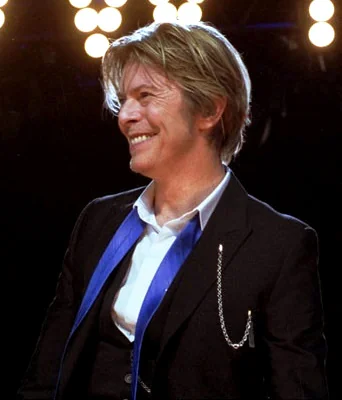
Image from Wikipedia
Image from Wikipedia
David Bowie – the adaptable genius of pop culture
An artist's life between sound, concept, and radical transformation
David Bowie was born on January 8, 1947, in London as David Robert Jones and died on January 10, 2016, in New York City. For over five decades, he shaped the history of rock and pop as a singer, songwriter, producer, and actor. His music career was characterized by inexhaustible curiosity, consistent artistic development, and a stage presence that understood pop as a total artwork. With iconic alter egos like Ziggy Stardust, the Thin White Duke, or Halloween Jack, Bowie created the blueprint for genre and role changes that continue to inspire generations of artists today.
His discography includes milestones from Space Oddity (1969) through Hunky Dory (1971) and The Rise and Fall of Ziggy Stardust and the Spiders from Mars (1972) to the albums of the Berlin phase – Low (1977), “Heroes” (1977), and Lodger (1979) – as well as the global pop phenomenon Let’s Dance (1983). He wrote a late, triumphant chapter with The Next Day (2013) and the artwork Blackstar (2016), which was released two days before his death and is considered a radical, dense sound and farewell gesture.
Early years and artistic spark
After initial singles in the 1960s, Bowie first reached a large audience in 1969 with Space Oddity – a composition that combined folk, orchestral textures, and the science fiction metaphor as an existential self-inquiry. Hunky Dory (1971), with songs like Changes and Life on Mars?, marked Bowie's rise as a composer with melodic sophistication, artful harmonies, and poetic lyrics. The production of these albums highlights Bowie's knack for arrangement and sound dramaturgy: string voices are used as a narrative element, and acoustic and electric instruments interlock organically.
The breakthrough as Ziggy Stardust: Glam, concept, and performance
With Ziggy Stardust (1972), Bowie perfected the symbiosis of songwriting, concept, and performance. The alter ego – an androgynous, extraterrestrial rock figure – redefined glam rock and shaped an aesthetic that merged music, fashion, makeup, and stage design into a coherent narrative. Compositionally, hard riffs and hook melodies meet finely balanced harmonic progressions; in the studio, the guitar sound is layered with nuance, while the vocals oscillate between crooning intimacy and theatrical projection. Ziggy was a cultural watershed: pop as an idea became at least as important as pop as a sound.
The Berlin Trilogy: Radical sound exploration with Eno and Visconti
Between 1976 and 1979, Bowie worked in Berlin with Brian Eno and Tony Visconti on Low, “Heroes,” and Lodger – albums that connected rock, electronics, ambient, minimalism, and experimental production techniques into a new sound language. The A-sides provide succinct, often fragmented pop songs; the B-sides explore instrumental landscapes, tape experiments, and microtonal color spaces. This phase significantly influenced post-punk, new wave, industrial, and electronic music. Bowie’s artistic evolution is evident here as a research lab where studio, city, and zeitgeist became expanded instruments.
Global pop and stylistic reinvention: Let’s Dance and the 1980s
With Let’s Dance (1983), Bowie reached a new mainstream dimension. Under the production of Nile Rodgers, distinctive guitar figures, driving bass lines, and glassy drum sounds combine into danceable pop anthems. The success was not based on adaptation but on clever reduction: clear song architecture, flawless production, and a voice that masters both soul and new wave. At the same time, Bowie remained a curator of himself – Jazzin’ for Blue Jean, numerous collaborations, and film roles expanded his artistic profile beyond the album format.
The 1990s to the 2010s: Digital avant-garde, conceptual art, and late work
In the 1990s, Bowie entered terrains between industrial, drum and bass, and conceptual art with Outside (1995) and Earthling (1997). The production utilizes cut-up techniques, alienated textures, and complex rhythms. In 2013, he made a spectacular return with The Next Day – an album that reflects his early work without sounding nostalgic. Blackstar (released on January 8, 2016) completed the circle as art music between jazz ensemble, art rock, and cryptic poetry. Harmonic ambivalences, asymmetric sections, and pointed saxophone colors demonstrate Bowie’s unbroken modernity up to the very end.
Current projects and posthumous releases (2024–2026)
Bowie's legacy remains alive through curated archives, remasters, box sets, and documentaries. In 2024, the extensive box Rock ’n’ Roll Star! was released, delving into the Ziggy Stardust era with demos, live tracks, and a 5.1 mix. In 2025, I Can’t Give Everything Away (2002–2016) followed, which bundles the late studio albums, EPs, and rarities, structurally unfolding Bowie's final years of creativity. A BBC documentary about the Berlin years has been announced for fall 2026 – another building block in the cultural-historical processing of a work that intertwines music, fashion, and media history.
Discography and reception: Chart successes, awards, canonization
Bowie's most significant albums include, besides the ones mentioned, The Man Who Sold the World (1970), Aladdin Sane (1973), Station to Station (1976), Scary Monsters (1980), and his soundtrack work for Labyrinth. His single history – from Starman through “Heroes” to Ashes to Ashes, Let’s Dance, and Modern Love – encompasses signature songs that have long shaped pop aesthetics and studio production. Posthumously, Blackstar received multiple Grammy Awards; Bowie’s albums dominated the British charts in the week following his death, underscoring his status as a century artist. The music press continues to recognize his innovative power between composition, production, and performance.
Style, voice, production: Why Bowie’s music sounds timeless
Bowie's voice fluctuated between dark baritone and cutting heights, between crooning and declamatory speaking. Stylistically, he wove together mod, glam, soul, krautrock, ambient, new wave, industrial, jazz, and electronics. His production emphasized sonic semantics: guitars as narrative figures, synthesizers as atmospheric spaces, drums as architectural statics. In the arrangement work, consciously set empty spaces are found, maximizing the impact of harmonic changes and timbres. This interplay of composition, arrangement, and production makes the discography a textbook of popular sound dramaturgy.
Cultural influence: Identity, fashion, and the stage as a laboratory
Bowie revolutionized pop as a cultural practice. He opened spaces for queerness, androgyny, and performative identity, bringing ambivalence and role changes into mainstream awareness, sending both aesthetic and social signals. In fashion and visual art, he served as a trendsetter; his collaboration with designers, photographers, and video directors established the idea that music counts equally as visual art. Countless artists in rock, pop, electronic, and hip-hop cite Bowie’s work – not just in sound but as an attitude towards their own freedom.
Stage presence and live aesthetics
Whether it was Ziggy's stadium drama, the controlled coolness of the Thin White Duke, or the elegant pop opulence of the Serious Moonlight Tour (1983): Bowie's live performances combined precise dramaturgy with charismatic presence. The setlists often followed conceptual arcs; lighting and costumes enhanced the narrative effect. His concerts demonstrated how staging, band chemistry, and sound design can transcend the studio experience. This desire for experience explains why Bowie is not just a myth of recorded music, but also of live performance.
Voices of the fans
Fans’ reactions clearly show: David Bowie excites people worldwide. On Instagram, a fan raves: "Bowie's music touches my soul – each decade sounds new yet unmistakable." A YouTube comment reads: "One of the best artists of our time – every album is a portal to another world." A listener writes on Facebook: "Bowie's songs are the soundtrack of my life – bold, beautiful, and limitless." On TikTok, we read: "#TheStarman unites generations – from Space Oddity to Blackstar."
Conclusion: Why David Bowie endures
David Bowie remains fascinating because he understood pop as research: He tested the boundaries of genre, identity, and technology – and found the future in risk. His discography is a map of artistic development; his musicality ranges from classic songwriting to avant-garde sound poetry. Those who experienced him live know the magnetic power of his performance; those who listen to his albums today discover new details in composition, arrangement, and production with each listen. Recommendation: Rediscover Bowie in the studio and on stage – from Ziggy to Blackstar, from the intimate ballad to the monumentally floating sound space.
Official channels of David Bowie:
- Instagram: https://www.instagram.com/davidbowie/
- Facebook: https://www.facebook.com/davidbowie/
- YouTube: https://www.youtube.com/@davidbowie
- Spotify: https://open.spotify.com/artist/0oSGxfWSnnOXhD2fKuz2Gy
- TikTok: https://www.tiktok.com/@davidbowie
Sources:
- DavidBowie.com – Official Website
- Universal Music Germany – David Bowie Biography
- Wikipedia (EN) – David Bowie
- Wikipedia (EN) – Rock ’n’ Roll Star! (Boxset, 2024)
- Wikipedia (EN) – I Can’t Give Everything Away (2002–2016) (Boxset, 2025)
- Official Charts Company – David Bowie Chart History
- TikTok Newsroom – Official @DavidBowie Account (Announcement)
- TIME – Grammy Winners 2017 (Blackstar)
Upcoming Events
Lazarus: A Musical by David Bowie and Enda Walsh
Let yourself be enchanted by Lazarus, the musical by David Bowie, at the State Theatre Darmstadt. Secure tickets now!
Bowie Experience at Circus Krone-Bau
Experience the ultimate Bowie tribute show at Circus Krone-Bau Munich. A must for all Bowie fans!
Lazarus: A Musical by David Bowie and Enda Walsh
Immerse yourself in David Bowie's musical legacy with the musical 'Lazarus'. Experience it now at the Staatstheater Darmstadt!
Rebel Rebel
Dive into the world of David Bowie with the music theater production Rebel Rebel at the Jahrhunderthalle Bochum.
Rebel Rebel
Visit the music theater “Rebel Rebel” with songs by David Bowie, directed by Ivo Van Hove at the Jahrhunderthalle Bochum.
Rebel Rebel
Rebel Rebel brings David Bowie's classics live to the stage at the Jahrhunderthalle Bochum.
Rebel Rebel
Immerse yourself in 'Rebel Rebel', a moving music theatre with songs by David Bowie. 20.08.2026 in Bochum.
Rebel Rebel in Bochum
David Bowie's Rebel Rebel meets Bochum's industrial backdrop: musical theater, dance, and great emotions at the Ruhrtriennale. 22.08.2026, from 31 Euros. #Ruhrtriennale
Rebel Rebel
Bochum experiences a world premiere full of sound, movement, and dark beauty: Rebel Rebel at the Ruhrtriennale. 23.08.2026, 20:30. #Ruhrtriennale #Bochum
Rebel Rebel
Bowie, dance, and dark poetry in Bochum: Rebel Rebel makes the Ruhrtriennale 2026 an experience. 26.08.2026, from 16 €. #Ruhrtriennale