
Freddie Mercury
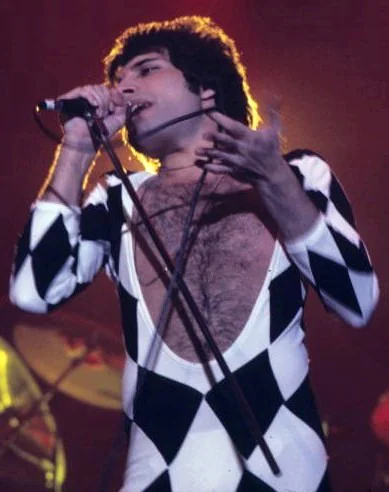
Image from Wikipedia
Image from Wikipedia
Freddie Mercury – The Icon Who Changed Rock and Pop Forever
From Zanzibar to Wembley: How Freddie Mercury Became the Unmatched Voice of Rock
Freddie Mercury, born on September 5, 1946, as Farrokh Bulsara in Zanzibar and died on November 24, 1991, in London, is considered one of the most significant rock singers of the 20th century. As co-founder, songwriter, and lead vocalist of Queen, he shaped an entire era with compositions like Bohemian Rhapsody, We Are the Champions, and Don’t Stop Me Now, setting standards in stage presence, vocal range, and artistic development. Alongside the band, he released an independent body of work as a solo artist and collaborated with opera star Montserrat Caballé. To this day, Mercury exerts a tremendous cultural influence – his music, performances, and unparalleled charisma inspire generations of artists and music lovers.
Childhood, Background, and Early Influences
Mercury was raised in a Parsi-Zoroastrian family, spent parts of his youth in India, and moved to England in the late 1960s. From an early age, his instinct for composition, harmony, and melody emerged, which would later characterize his distinctive songwriting. The shift from Farrokh Bulsara to Freddie Mercury marked not only a name change but also a self-design: an artistic persona that stylistically navigated between rock, glam, pop, and – later – disco and electronic sound aesthetics. This versatility laid the groundwork for a music career that combined innovation, experimentation, and a special closeness to the audience.
Queen: Formation Years, Breakthrough, and Global Fame
In 1970, Mercury met Brian May and Roger Taylor; with John Deacon, the quartet Queen was completed. Their albums from the 1970s and early 1980s combined hard riffs, opulent arrangements, and multi-part vocal harmonies with theatrical drama. Mercury utilized his enormous vocal arsenal – from a velvety baritone to piercing tenor heights – and led the band live and in the studio with uncompromising quality standards. Legendary is Queen's performance at Live Aid on July 13, 1985, at Wembley: a 20-minute, perfectly proportioned set, widely regarded as the greatest live moment in rock history, which cemented Queen's status – not least due to Mercury's overwhelming stage presence.
The Live Aid Moment: Stage Magic in 20 Minutes
The 1985 Live Aid performance demonstrated how precise set design, dynamic tempo drama, and interaction with a mass audience could create a collective rush of goosebumps. Mercury structured the sequence like a dramatic short work: a condensed journey through Bohemian Rhapsody, Radio Ga Ga, Hammer to Fall, Crazy Little Thing Called Love, We Will Rock You, and We Are the Champions. The double handclaps, the vocal call-and-response with 70,000 people, and Mercury's flawless intonation condensed into a historiographical reference moment, which to this day is regarded as a benchmark for live performance in press, literature, and rankings.
Solo Career I: Mr. Bad Guy (1985) – Disco, Pop, and Studio Alchemy
In 1985, Mercury released Mr. Bad Guy, his first and only official solo studio album. The production and arrangements, in collaboration with Reinhold Mack, relied on synthesizers, drum machines, string arrangements, and a pop/disco-oriented pull that consciously set itself apart from Queen's rock focus. The singles Love Kills (previously released as a solo debut in 1984), I Was Born to Love You, Made in Heaven, and Living on My Own revealed Mercury's affinity for hook lines, harmonic richness, and dance-friendly grooves. Compositionally, he worked with layers of lead and choir voices, dense keyboard textures, and melodies that effortlessly oscillated between intimacy and pathos.
Solo Career II: Barcelona (with Montserrat Caballé) – Crossover with Operatic Brilliance
From 1987 to 1988, Mercury realized his long-cherished dream of a classical/rock crossover alongside the Catalan soprano Montserrat Caballé. The single Barcelona and the album of the same name combined opulent orchestral and choral arrangements, operatic arcs, and pop-friendly structuring. Mercury used his timbre for legato lines, while Caballé set radiant high notes – a meeting at eye level that remained significant both culturally (as a prominent bridge between pop and high culture) and in charts. Live recordings from the La-Nit Festival in 1988 document this enchanting, theatrical vision between stadium pathos and opera house.
Charts, Hits, and Critical Reception
Love Kills reached number 10 in the UK Singles Chart in 1984 and established Mercury as a solo act. The album Mr. Bad Guy peaked at number 6 on the British Album Chart in 1985. A remarkable success story emerged in 1993 with the No More Brothers remix of Living on My Own: it posthumously soared to number 1 in the UK and numerous European territories, demonstrating how adaptable Mercury's compositions could function in the contemporary club context. The posthumously released The Freddie Mercury Album (1992) compiled solo gems and remixes; later editions and box sets, including Never Boring (2019), curated his solo oeuvre in audiovisual depth for the streaming age.
Awards, Positioning, and Legacy
With Queen, Mercury was inducted into the Rock & Roll Hall of Fame in 2001; in 2003, he was honored in the Songwriters Hall of Fame. These accolades frame his dual profile as an exceptional performer and influential songwriter. His voice – often cited as spanning four octaves – combined technical mastery with emotional immediacy. In the studio, Mercury lived perfection: meticulous multi-track vocals, carefully listened-to voicings, and a vocal line that oscillated between portamento, vibrato, and radiant belting passages. Live, he supplemented this with phrased spontaneity, timing intuition, and charismatic communication that transformed shows into experiences.
Style, Technique, and Artistic Development
Mercury's style encompassed influences from rock’n’roll, hard rock, music hall, glam, disco, and opera. In composition, he relied on dramatic structure – modulated key changes, contrasting song sections, instrumental interludes – and the interplay of intimacy and grandeur. His use of studio technology, from band arrangements to synthesizers, was never an end in itself but a question of sound dramaturgy. That Queen’s versions of his solo songs (like I Was Born to Love You and Made in Heaven) later acquired new textures as band recordings underscores Mercury's ability to write melodies that breathe in different production aesthetics.
Latter Years, Legacy, and Cultural Influence
Mercury died on November 24, 1991, due to complications from bronchial pneumonia caused by AIDS. His public statement one day prior heightened awareness of HIV/AIDS and contributed to breaking down stigma. The Freddie Mercury Tribute Concert in 1992, worldwide chart resonances, later reissues, and the ongoing presence in pop culture and media (up to Bohemian Rhapsody, 2018) testify to his unbroken impact. In fan communities, music press, and among experts, Mercury is regarded as a prime example of the symbiosis of compositional expertise, iconic stage presence, and vocal excellence – an artistic legacy that not only nostalgically reflects on the present but actively shapes it.
Current Projects, Editions, and Curatorial Activities (2024–2026)
Even decades after his death, Mercury's work remains vibrant: a recently launched YouTube miniseries sheds new light on his solo debut Mr. Bad Guy and accompanies reissue activities. Simultaneously, the official platform surrounding the "Official Freddie Mercury Birthday Party" gathers fans in Montreux each year – the 2026 event sold out early. These curatorial initiatives bring archival treasures, interviews, and remastered video content into the present in the best possible quality, enhancing the discography and sharpening the music-historical positioning for new listeners.
Discography – Solo Works (Selection)
Albums: Mr. Bad Guy (1985); Barcelona (with Montserrat Caballé, 1988); The Freddie Mercury Album (1992, posthumous, Compilation). Box/Edits: Never Boring (2019, Box with Audio, Video, Book). Important Singles: Love Kills (1984); I Was Born to Love You (1985); Made in Heaven (1985); Living on My Own (1985/Remix 1993). Chart Highlights: Love Kills (UK #10); Mr. Bad Guy (UK #6); Living on My Own (Remix 1993, UK #1 and multiple #1 across Europe). These milestones show how Mercury's solo catalog unfolds between club culture, pop balladry, and operatic gestures – a panorama that expands rather than repeats the band biography.
Fan Voices
Fans' reactions clearly show that Freddie Mercury captivates people worldwide. On Instagram, a listener writes that Mercury's music "fits every mood – from euphoria to melancholy." On YouTube, a comment praises the "timeless power of his voice" and the "goosebump moments" in live recordings that couldn't be simulated in any studio. The resonance among new reissue clips often emphasizes how fresh the arrangements sound and how precisely Mercury delivers dynamics, articulation, and emotion in every line – an impression that continues to grow through high-resolution remasters and careful archival work.
Conclusion: Why Freddie Mercury Remains
Freddie Mercury brings together what rarely aligns so congruently in pop history: a distinctive timbre, an exceptional vocal range, a highly musical instinct for form, harmony, and hook – and a stage presence that instantly creates closeness. His discography as a soloist and with Queen showcases compositional breadth and production quality; his legacy fosters cultural community far beyond genres, scenes, and generations. Those who want to understand how music history imprints itself in collective memory at the moment of performance should experience this voice live – through concert films, restored recordings, and high-quality reissues. Freddie Mercury remains the epitome of artistic freedom, elegance, and energy.
Official Channels for Freddie Mercury:
- Instagram: https://www.instagram.com/mercury_motg
- Facebook: No official profile found
- YouTube: https://www.youtube.com/@FreddieMercury
- Spotify: https://open.spotify.com/artist/4M1FpEWs2PeYfJe7xxJfhH
- TikTok: No official profile found
Sources:
- FreddieMercury.com – Official Artist Website
- QueenOnline – Official Freddie Mercury Instagram (News)
- History.com – The Real Story Behind Queen’s Iconic Live Aid Performance
- Der Spiegel – Queen's Live Aid Performance: The Most Popular Live Performance in Pop History
- Official Charts – Mr. Bad Guy (Album) Chart History
- Official Charts – Love Kills (Single) Chart History
- Wikipedia – Living on My Own (Remix 1993, Chart Success)
- Wikipedia – Mr. Bad Guy (Album Background)
- Wikipedia – Barcelona (with Montserrat Caballé)
- Rock & Roll Hall of Fame – Queen (Induction 2001)
- Songwriters Hall of Fame – Freddie Mercury (Induction 2003)
- ABC Audio – YouTube Series on Mr. Bad Guy (2025)
- FreddieMercury.com – Official Freddie Mercury Birthday Party (Updates)
- Wikipedia: Image and text source
Upcoming Events
Freddie
Last chance in Cottbus: Freddie as an energetic ballet evening at the chamber stage. March 29, 2026, 19:00, from €21.80. Big feelings, strong sound, close experience – experience it now! #Cottbus
Being Freddie Mercury
Freddie Mercury as a poetic theater evening in FOYER III: Music, myth, and intimacy in Duisburg. An evening full of sound and feeling. #Theater #Duisburg
3-2-1 Liftoff!
Family adventure at Sparkassen-Planetarium Augsburg: 3-2-1 Liftoff connects humor, knowledge, and stunning dome images. April 29, 2026, 3:00 PM, price information to follow. Secure your seats now! #Augsburg
Mercury
Immerse yourself in Freddie Mercury's Munich years with the premiere of the play "Mercury" on April 30, 2026, at Residenztheater.
3-2-1 Liftoff! at Sparkassen-Planetarium Augsburg
A hamster, a robot, and the journey into space: 3-2-1 Liftoff! at Sparkassen-Planetarium Augsburg promises awe for the whole family. #Augsburg #Planetarium
3-2-1 Liftoff!
Eddie takes off in Augsburg: 3-2-1 Liftoff! combines fantasy, knowledge, and dome magic. May 23, 2026, 3:00 PM, only €3. #Augsburg #Planetarium
3-2-1 Liftoff! at S-Planetarium Augsburg
A Hamster, a Robot, and the Big Adventure in Space: 3-2-1 Liftoff! delights families in Augsburg. 20.06.2026, from 7 Euros. #Augsburg #Planetarium
Being Freddie Mercury
Freddie Mercury up close: In FOYER III of Theater Duisburg, glamour meets stage, voice meets biography. 25.06.2026, 19:30. #TheaterDuisburg #FreddieMercury
Live Stage: The Champions - Tribute to Queen at Parapluie
Queen magic at Parapluie Weiden: The Champions bring Freddie Mercury live to the stage. 07.08.2026, free admission with hat donation. #Weiden #QueenTribute
3-2-1 Liftoff! - Eddie Takes Off!
A luminous family adventure under the dome: 3-2-1 Liftoff! at the Augsburg Planetarium takes children aged 7 and up into space. #Augsburg #Planetarium