
Karsten Krampitz
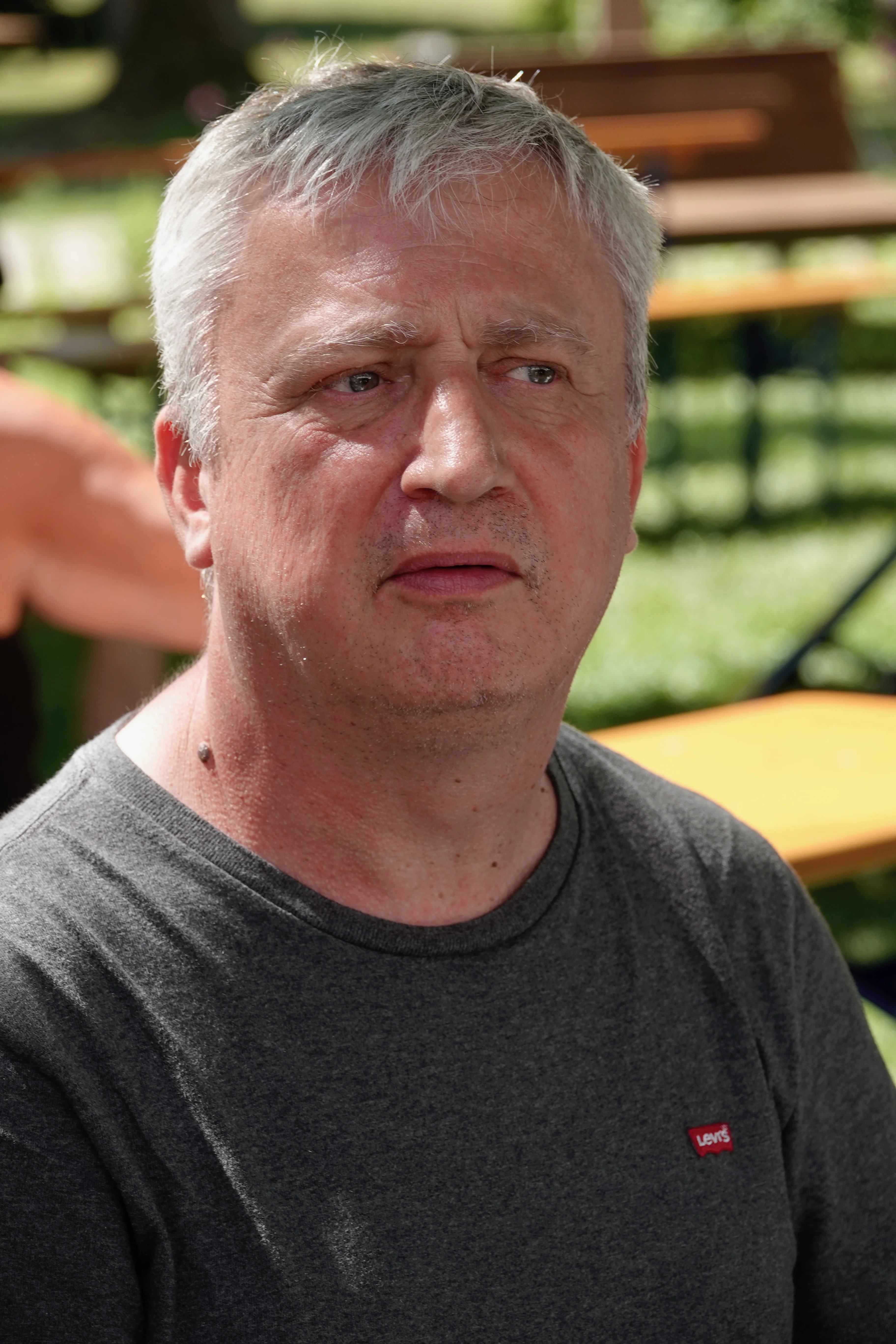
Image from Wikipedia
Image from Wikipedia
Karsten Krampitz – Writer, Journalist, and Historian
A Chronicler of Change: How Karsten Krampitz Literary and Essayistically Explores Germany's Recent History
Karsten Krampitz, born on December 24, 1969, in Rüdersdorf near Berlin, is one of the distinctive voices in contemporary German literature and journalism. As a writer, journalist, and Ph.D. historian, he combines narrative power with source-critical precision, analyzing the interplay between everyday experience, power, and morality in both East and West. His books and essays revolve around the artistic development of a biography shaped by the upheavals of the turning point era and an intellectual curiosity that tests the sustainability of societal narratives. In novels, stories, and scientifically grounded monographs, Krampitz creates a body of work that brings together literary imagination, archival research, and political diagnostics.
Early Years and Influences
Growing up in Brandenburg, Krampitz quickly learns how societal structures directly affect biographies. After training with a focus on economics, he explores an academic space at Humboldt University in Berlin: History, German Studies, and Political Science provide the framework in which he connects his historical curiosity with literary formation. This dual perspective – empirical evidence and narrative – shapes his stage presence as a public intellectual, as well as his long-term musical career in the broader sense of the cultural scene: he does not perform as a musician but as a cultural actor who arranges discourses, composes perspectives, and unites voices into a multi-voiced arrangement of memory.
Early journalistic positions lead him to the editorial offices of Berlin street newspapers. Here, he sharpens his insight into the social fabric of the city, focusing on margins and milieus often overshadowed in public discourse. His work in these contexts, as well as his engagement in projects with and for marginalized groups, lays the thematic groundwork from which his later artistic development emerges: solidarity, dissent, and careful research.
Academic Training and Doctorate
Krampitz deepens his expertise with a dissertation on the spectacular self-immolation of Pastor Oskar Brüsewitz in 1976 – an event that illuminated the intertwining of church and state in the GDR. The completion of his Ph.D. marks not only an academic milestone but also forms the methodological basis for many of his later works. His approach is characteristic: instead of one-dimensional theses, he crafts nuanced, source-saturated analyses that clarify complex historical situations while respecting the ambiguities of political biographies.
This scholarly work reveals what makes his journalistic voice so distinctive: the composition and arrangement of historical materials, precise terminology, a sense of linguistic economy, and a critically empirical engagement with myths and memory politics.
Breakthrough, Scholarships, and Awards
His literary potential is recognized early on by esteemed institutions. The Alfred Döblin Scholarship from the Akademie der Künste (2004) honors the narrative strength of his prose. The audience award at the Ingeborg Bachmann Competition in 2009 in Klagenfurt opens him up to a broad readership – a breakthrough moment that amplifies the resonance of his voice beyond the literary scene. A year later, he serves as the city writer for Klagenfurt; between 2010 and 2013, he is supported by the Rosa-Luxemburg-Stiftung with a doctoral scholarship. These stages reflect authority and continuity in his artistic development and firmly establish him within contemporary German literature.
His awards are more than mere milestones: they mark turning points in a body of work that unites literary and scholarly writing styles. In 2025, his novel "Gesellschaft mit beschränkter Hoffnung" receives the Matthias Vernaldi Prize from the Kaspar Hauser Foundation – a signal of how strongly his literature negotiates social participation, self-determination, and human dignity.
Journalistic Work and Public Voice
As a journalist, Krampitz writes for major German-language media and magazines. His essays, columns, and reports combine observational sharpness with historical depth. He does not write "about" history but shows how it continues to resonate: in neighborhoods, in institutions, in family histories. This dual competency – lived experience and academic expertise – makes him an authority when it comes to the critical rereading of GDR history, the turning years, and the post-reunification transformation period.
His stage is the public sphere, his genre is the well-founded essay, his arrangement is precisely crafted argumentation. Articles and feuilletons become resonance spaces where the past, present, and possible future converse.
Key Works and Selected Bibliography
Krampitz's discography in the literary sense – his bibliography – showcases the range of his forms: novel, short story, literary feature, historical monograph. Early works like "Affentöter" (2000) and "Der Kaiser vom Knochenberg" (2002) address personal and social vulnerabilities and translate them into stylistically pointed, atmospherically dense prose. With "Heimgehen" (2009), he succeeds in a narrative condensation of origin, body, and memory.
His historical works – such as "Der Fall Brüsewitz. Staat und Kirche in der DDR" or "1976. Die DDR in der Krise" – combine archival findings with narrative clarity. With "Pogrom im Scheunenviertel. Antisemitismus in der Weimarer Republik und die Berliner Ausschreitungen 1923," he addresses a crucial point of the German interwar period. His literary publications also include "Wasserstand und Tauchtiefe," a novel that explores the emotional and social currents of its characters in precise language.
Style, Themes, and Poetics
Krampitz’s style thrives on the tension between documentary sobriety and literary condensation. His language remains unadorned and rhythmic; his prose develops a pull from precise observation, subcutaneous humor, and a refusal to simplify complex realities. The author works with narrative counterpoints: scene changes, shifts in perspective, precisely placed details, and semantic leitmotifs create a sound space that unfolds between reportage, essay, and novel.
In terms of content, he addresses experiences of power and powerlessness, the reliability of memory, and the dialectic of adaption and rebellion. Recurring motifs include civil courage, social precariousness, and the individual’s stubbornness against institutional pressures. His artistic development illustrates how literary composition and historical research can mutually enrich one another.
Historical Research and Critical Reception
As a historian, Krampitz applies careful source criticism and places events in larger discursive contexts. His works on GDR history, political culture, and lines of conflict between church and state have been recognized in the press for their nuance and contextualization. Critics emphasize his ability to unfold complex historical situations analytically rather than morally – an approach that builds trust and opens discussions.
Reception and impact are evidenced not least by the fact that his themes – self-determination, responsibility, memory – resonate in academic debates, feuilletons, and readings. Krampitz writes against templates and facilitates new reflections on long-held narrative patterns.
Engagement, Projects, and Curatorial Energy
Beyond writing, Krampitz acts as an initiator and co-founder of cultural-political projects. In the realm of street newspapers, literary collectives, and independent publication contexts, he serves as a driving force who initiates discourses, gathers voices, and creates public engagement. The anthology "Kaltland – Eine Sammlung," which he co-edits, documents the violence of the post-reunification years and opens a collective archive against oblivion.
This curatorial aspect of his work can be understood as artistic practice in a broad sense: he composes text and voice landscapes, arranges perspectives, and creates resonances – a labor on cultural memory that connects societal relevance with aesthetic stance.
Current Projects and Publications (2024–2025)
Recent milestones include renewed attention to his historical research and narrative prose in publishing programs and discussion formats. His novel "Gesellschaft mit beschränkter Hoffnung" will be awarded the Matthias Vernaldi Prize in 2025 – an acknowledgment of literature that places self-determination and the voices of those affected at its center. Simultaneously, interviews, publishing previews, and dossiers will appear, contextualizing his work anew and making it accessible to a wider audience.
Readings, debate contributions, and journalistic essays underline that Krampitz continues to work at the intersections where literature, contemporary history, and present-day politics converge. In this endeavor, his signature remains unmistakable: clear research, concise language, social cadence.
Cultural Influence and Positioning
Karsten Krampitz stands in a tradition of German-speaking authors who interrogate social and political imaginaries with documentary accuracy. In a musical-historical analogy, his work corresponds to a clever chamber music of memory: few means, much resonance; clarity in tone, complexity in the nuances. His texts help to understand the GDR and post-reunification period beyond stereotypical oppositions. They illustrate how closely individual experiences, institutional power, and cultural self-images are intertwined.
In this way, Krampitz acts as an authority in the public discourse surrounding history and the present. For readers who wish to connect literary quality with political thought, his work opens doors: to archives, to vulnerable biographies, to questions that will continue to concern us as a society.
Conclusion: Why Read Karsten Krampitz Now?
Because his prose touches us and sharpens our perspective. Because his historical analysis withstands complexity. Because he shows that literature can be more than decoration: a school of perception, empathy, and dissent. Those who read Krampitz hear the pulse of contemporary history – and better understand how memory politics works. His work is recommended for all who do not want to think about the present without considering its past.
Experience Karsten Krampitz live – at readings, discussions, debates. His texts gain additional depth in dialogue. An author who not only writes but listens and risks answers.
Official Channels of Karsten Krampitz:
- Instagram: No official profile found
- Facebook: No official profile found
- YouTube: No official profile found
- Spotify: No official profile found
- TikTok: No official profile found
Sources:
- Wikipedia – Karsten Krampitz
- Verbrecher Verlag – Author Page Karsten Krampitz
- Edition Nautilus – Author Page Karsten Krampitz
- Edition Nautilus – Press/Excerpt "Gesellschaft mit beschränkter Hoffnung" (Matthias-Vernaldi-Preis 2025)
- Federal Foundation for Reappraisal – Profile of Dr. Karsten Krampitz
- Blätter für deutsche und internationale Politik – Contributions by Karsten Krampitz
- Verbrecher Verlag – Event/Info "Der Fall Brüsewitz"
- Wikimedia Commons – Photo of Karsten Krampitz
Upcoming Events
Inclusion Days 2026: Reading with Karsten Krampitz
Discover an engaging reading with Karsten Krampitz at the City and State Library of Potsdam. Topic: Inclusion and societal participation.
Inclusion Days 2026: Reading with Karsten Krampitz – Society with Limited Hope
An evening about freedom, inclusion, and language: Karsten Krampitz reads in the Science Floor Potsdam. 05.05.2026, 7 PM. Intense literary experience – discussion possible. Mark your calendar now! #Reading
Reading with Karsten Krampitz: Society with Limited Hope
An evening full of literature and stance in Potsdam: Karsten Krampitz reads from Society with Limited Hope. Reading, conversation, and participation on 5.5.2026. #Literature
Karsten Krampitz: Reading and Discussion on Society with Limited Hope
An evening about literature, memory, and participation: Karsten Krampitz reads in Potsdam from Society with Limited Hope. May 5, 2026, free admission. #Literature #Potsdam