
Long Tall Ernie & the Shakers
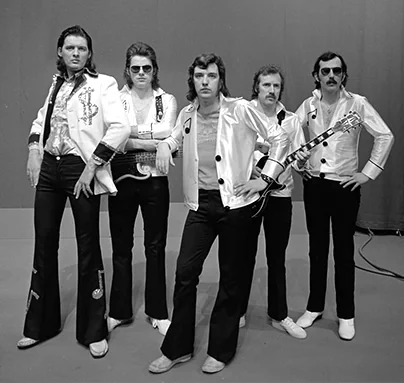
Image from Wikipedia
Image from Wikipedia
Long Tall Ernie & the Shakers – The Dutch Rock’n’Roll Revivalists with Cult Status
From Student Joke to Hit Factory: How Long Tall Ernie & the Shakers Reignited the Fifties
Long Tall Ernie & the Shakers were more than just a band: They represented a promise of pure Rock’n’Roll energy, a stage for excellent musicians, and one of the most influential revival formations in Dutch pop history. Emerging from the progressive formation Moan in 1972 in Arnhem, charismatic singer Arnie Treffers – better known as “Long Tall Ernie” – transformed nostalgic references into chart-ready pop art with his group. Through powerful singles, virtuoso stage presence, and cleverly arranged medleys, the band wrote a chapter that gave European Rock’n’Roll in the 1970s a fresh pulse.
The musical career of the Shakers combined show and substance: rough guitars, boogie-driven piano, straightforward backbeat – all accented by an entertainment quality that worked just as well in TV studios as it did in sweaty clubs. Their discography reflects this artistic development: from early Rockabilly-blues tones to straight-up Rock’n’Roll numbers to elaborately produced medleys that conquered the charts in the Netherlands and beyond.
Arnhem, Art Academy, Moan: The Formative Beginnings
In the mid-1960s, the band The Moans (later Moan) emerged in Arnhem, a creative collective of art academy students. In this environment, early careers began to cross paths, laying the foundation for future milestones in Dutch music history: Among the early members and associates were names like Herman Brood, Jaap Dekker, and Jaap van Eik. From performances where the group played progressive rock music before the break, only to transform into Long Tall Ernie & the Shakers to cover Rock’n’Roll in 50s attire afterwards, a playful second identity was initially born in 1972.
The crucial step followed in 1973: Under manager Rein Muntinga, the Rock’n’Roll aspect moved to the forefront while the progressive-psychedelic framework faded away. Against the zeitgeist, the Shakers consistently focused on authenticity, humor, and pointed provocation. Rumors of wild stage escapades circulated, followed by TV appearances and tours in Germany. In no time, the gag became the brand core – and Long Tall Ernie & the Shakers began to perform solely under their new name.
Profile, Personnel, Precision: The Ensemble and Its Roles
The lineup read like a who's who of Dutch rock in the 1970s. Frontman Arnie Treffers provided the project with voice, figure, and attitude; Jan “Jumping Johnny” Rietman shaped the early years with his piano runs; Henk “The Knife” Bruysten provided the bass foundations; Alfons “Alfie Muscles” Haket was responsible for robust guitar work; and Alan “Tenderfoot” Macfarlane sat behind the drums. Later, saxophonist Tony Britnell, guitarist Karl Buskohl (later known as Carl Carlton), bassist Ruud van Buuren, and drummer Jan Pijnenburg joined in. This personnel dynamics strengthened the band – their sound remained stylistically true while gaining arrangement finesse.
The stage presence was a trademark. Long Tall Ernie & the Shakers utilized choreography, humorous announcements, and a compact, hard-grooving band sound to not just quote Rock’n’Roll but to stage it. The result: shows with a rapid repertoire flow that immediately engaged the audience and breathed new life into the classic material.
Breakthrough with Singles: From Rock’n’Roll Update to Hit Machine
From 1973 to 1976, the Shakers laid the foundation for their later chart success with distinct Rock’n’Roll pieces: “Big Fat Mama,” “Get Yourself Together,” “Allright (Makin’ Love in the Middle of the Night),” and “Operator, Operator (Get Me A Line)” established a signature style characterized by driving beats, call-and-response hooks, and intricate guitar figures. Several of these songs became Top 40 successes in the Netherlands, deeply embedding the band in pop culture.
The turning point toward a national peak position came in 1977 with “Do You Remember.” The single – a succinctly arranged medley collage of classic fifties hits, connected by its own hook and modern studio finesse – reached number 1 on the Dutch Top 40 in October 1977 and remained on the list for 14 weeks. In doing so, Long Tall Ernie & the Shakers set a style standard that gave a contemporary production aesthetic to the revival concept.
The Medley Era: “Do You Remember” (1977) and “Golden Years Of Rock ’n’ Roll” (1978)
“Do You Remember” was musically more than nostalgia: The production focused on tight tempos, distinctly contoured snare, prominently placed piano, and guitar riffs that organically connected the quotes. Arranged as a dramatic journey through the Rock’n’Roll repertoire, the song served both as homage and as a standalone pop track of the late 1970s. The success paved the way for “Golden Years Of Rock ’n’ Roll” (1978), also designed as a medley, which reached the Top 10 of the Dutch charts and was present in several European markets.
The single pairings, the credits of the quoted classics, and the precise production reinforced the impression: This was a band that cherished history and knew technically how to translate it into the present. Producer Jaap Eggermont, who later set global standards for chart-friendly medley productions with Stars on 45, refined together with the Shakers the art of creating stylistic continuity from heterogeneous material – with genuine band energy rather than mere studio gimmickry.
Discography – Albums, Singles, Milestones
Between 1972 and 1979, Long Tall Ernie & the Shakers released a series of studio albums that marked the journey from raw revival sound to polished pop-rock'n'roll. “Put On Your Rockin’ Shoes” (1972) showcases the band in its early stages; “It’s a Monster” (1973) and “Shubiduda Shubi-Du-Dad!” (1974) expand the stylistic vocabulary; “In the Night” (1976) and “Those Rockin’ Days” (1978) ground the powerful live sound in studio logic; “Do You Remember” (1977) encapsulates the medley success; “Meet the Monsters” (1979) plays with thematic concept ideas. In 1994, “The Demo Recordings” documented the band’s workshop. Collections like “The Best” (1979) and “The Golden Years of Dutch Pop Music” (2015) keep the oeuvre present in the catalog.
On the single level, besides the medleys, standout entries in the Dutch Top 40 included “Big Fat Mama,” “Get Yourself Together,” “Allright (Makin’ Love in the Middle of the Night),” “Turn Your Radio On,” “You Should Have Seen Me (Rock ’n’ Rollin’),” “Rockin’ Rocket,” “Ballerina,” and “Operator, Operator (Get Me A Line).” These titles form the backbone of the Shakers' setlists – compact, hook-laden, and arranged for high recognizability.
Style & Sound Design: Between Rockabilly Foundation and Pop Arrangement
The band's genre was Rock ’n’ Roll – but in a 1970s texture: crisp snare, dry bass, guitar clarity, piano voicings with boogie drive, and vocal arrangements that employed the choir and shout character of fifties pop. The production worked with clear stereo images to vibrantly intertwine quotation passages and original material. This approach explains the sustainability of the singles on the radio: The tracks sound both familiar and modernized, nostalgic yet contemporary and punchy.
In composition and arrangement, Long Tall Ernie & the Shakers combined simple, effective song forms with dramatic curation: The medleys were constructed so that tempos, keys, and rhythmic patterns seamlessly transitioned. This made the band appear not like a cover ensemble, but rather like a curating collective – an important distinction that established artistic authority and made the live transmission to the stage possible.
Production, Collaborations, and Songwriting Expertise
A key aspect of the Shakers was their professional production environment. Jaap Eggermont was known for a sound that balanced transparency and impact. Together with saxophonist/keyboardist Tony Britnell, Arnie Treffers also wrote songs for other artists – a testament to how deeply the band was embedded in the Dutch pop industry. This dual existence as a live act and as a creative pool amplified their influence beyond their own releases.
The fact that a Dutch Rock’n’Roll act of the 1970s conquered the national number 1 position shows how coherently artistic development and production know-how intertwined. Long Tall Ernie & the Shakers reached their greatest scope when their medley aesthetic coincided with a broad nostalgia trend – and simultaneously stood out from the crowd through its craftsmanship.
Cultural Context: Revival with Reach and a Lasting Legacy
In the international context, the Shakers reflect the cyclical nature of pop history: In the late 1970s, Rock’n’Roll returned to many stages – sometimes as purist Rockabilly, other times as a pop-oriented update. The Shakers represented the latter manifestation: They paid respect to the originals but modernized structure and sound. This made Rock’n’Roll mass-compatible again without losing its essence.
The legacy resonates in two ways. Firstly, the medley successes served as a blueprint for later projects that brought the principle of seamless, legally sound produced quotation collages into the mainstream. Secondly, the back catalog – whether in reissues, collections, or playlists – keeps the band's presence alive to this day. When Arnie Treffers passed away prematurely in 1995, the band had long since dissolved (in 1982), but their sound remained alive in radio archives, TV recordings, and collectors' shelves. In 2012, original members reunited for a tribute concert in Arnhem – a strong sign of the undiminished popularity.
Conclusion: Why Long Tall Ernie & the Shakers Still Captivate Today
Long Tall Ernie & the Shakers are a reference for energetic storytelling in Rock’n’Roll format. Their music career demonstrates how to blend genre traditions with pop instinct, and their stage presence proved that entertainment and musical integrity are not opposites. Those who love the impact of classic riffs, the sparkle of a boogie piano, and the dramatic pleasure of clever medleys will find a band here that perfectly unites heart and craftsmanship. It’s time to turn up the classics again – and hear the Shakers where they shine the most: on a stage that echoes with gasoline, summer nights, and sing-along refrains.
Official Channels of Long Tall Ernie & the Shakers:
- Instagram: No official profile found
- Facebook: No official profile found
- YouTube: No official profile found
- Spotify: No official profile found
- TikTok: No official profile found
Sources:
- Wikipedia (de) – Long Tall Ernie & the Shakers
- Long-Tall-Ernie.nl – Biography, Line-ups, History (Fan Archive)
- Stichting Nederlandse Top 40 – Do You Remember (1977), Peak #1
- Stichting Nederlandse Top 40 – Golden Years Of Rock ’n’ Roll (1978)
- hitparade.ch – Golden Years Of Rock ’n’ Roll (Data Sheet)
- Muziekweb – The Golden Years of Dutch Pop Music (Compilation, 2015)
- Nederpop Encyclopedia (alexgitlin.com) – Long Tall Ernie & Shakers (History, Discography)
- Apple Music – Long Tall Ernie & the Shakers (Catalog Overview)
- Wikipedia (en) – Dutch Top 40 Number-One Singles 1977 (Do You Remember)
- Wikipedia: Image and text source