
Sieger Köder
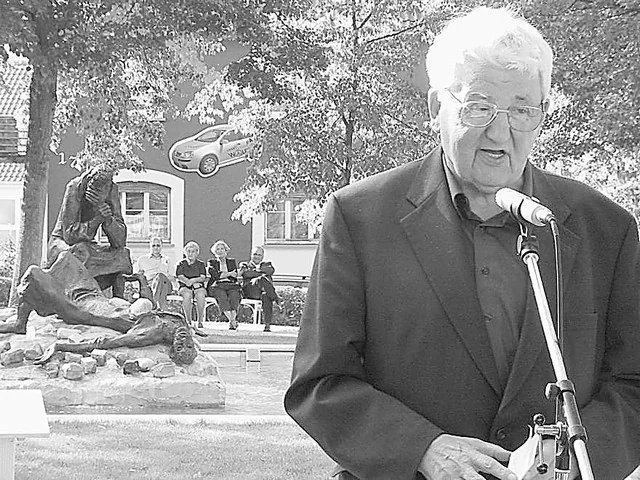
Image from Wikipedia
Image from Wikipedia
Sieger Köder – Priest, Painter, "Preacher with Images"
An artist-priest who preached with color and created faithful visual worlds for generations
The life story of Sieger Köder begins on January 3, 1925, in Wasseralfingen and leads through experiences of war, artistic education, and the teacher's room to his ordination as a priest in the early 1970s. This unusual path shaped his musical career of faith – understood as stage presence in the church space – his artistic development, and his distinctive visual language. Until his death on February 9, 2015, in Ellwangen, he created altars, stained glass windows, bronze works, panel paintings, and illustrations that brought biblical stories to life with vibrant color dramaturgy. As a "Preacher with Images," he combined theology, composition, and visual arrangement into an art that emotionally touches viewers as much as it challenges them intellectually.
Early Years and Education: From Metalworking to Painting
Growing up in the Ostalbkreis, Sieger Köder graduated from the Peutinger Gymnasium Ellwangen in 1943. After serving in the Reich Labor Service, military service, and being a prisoner of war, the post-war period took him first to the State Higher Technical School for Precious Metals in Schwäbisch Gmünd, where he studied chasing and silver smithing. From 1947, he deepened his knowledge of painting and art history at the Academy of Fine Arts in Stuttgart – a foundation that permanently shaped his later signature in composition, material mastery, and application of color. An English interlude in Tübingen complemented his education before he changed to the Schubart Gymnasium in Aalen as an art educator in 1954.
Teaching Years and Early Artistic Successes
The years 1954 to 1965 as an art teacher mark a productive phase between pedagogy and the studio. During this time, Köder sharpened his sensitivity for iconographic clarity, the dramaturgy of light, and the didactic condensation of biblical motifs. Illustrations – such as for the youth songbook "Der Köcher" – and early image cycles show how he linked narration and symbolism. The exchange with students nourished a practice in which art always also meant mediation: artworks became open spaces for interpretation and dialogue.
From the Easel to the Pulpit: Theology Studies and Ordination
In 1965, Köder decided to study theology in Tübingen – a step that brought aesthetic and spiritual exploration together. In 1971, he received priestly ordination and initially served as a vicar in Ulm (St. Maria Suso), and from 1975 as a pastor in Rosenberg and Hohenberg. The pastoral practice intensified his artistic development: The church space became a resonance body for his works, and the liturgy became the score in which his visual compositions – altars, stained glass windows, stations of the cross – sounded like carefully arranged phrases of a theologically grounded "visual music."
Style and Visual Language: Color as Theology, Symbol as Dramaturgy
Köder's works are characterized by a powerful yet contemplative visual language. Deep blues and reds create sacred tension; expressive surfaces, clear contours, and symbolic condensations draw focus to core themes such as mercy, reconciliation, and resurrection. His compositions follow an internal liturgy: foreground motifs carry the narrative, while backgrounds create atmospheres that resonate with fresco and stained glass traditions. Technically, he combined panel painting and stained glass, bronze and mural; in his "production" in the artisanal sense, he remained committed to precise material handling, which he mastered since his studies in precious metals.
Works and Places of Influence: Ostalbkreis, Ellwangen, and the Camino de Santiago
The Ostalbkreis forms a dense network of his works: In Ellwangen, he furnished the Holy Spirit Church and designed the Francis Chapel in the Marian Care with doors, tabernacle, and stained glass windows. In Hohenberg, he redefined the Jakobs Church – with thematic windows that evoke hope and morning light. Stained glass cycles, bronzes such as the Stephen-Saul fountain, and numerous panel paintings demonstrate how consistently Köder translated biblical scenes into a contemporary language. His connection to pilgrimage was embodied as a co-initiator of the Franconian-Swabian Camino de Santiago and as a pilgrim to Santiago de Compostela; iconographic references to the pilgrimage permeate his oeuvre.
Institutions and Remembrance: The Sieger Köder Museum Ellwangen
A milestone of institutional recognition is the opening of the "Sieger Köder Museum Ellwangen – Image and Bible" in May 2011. The permanent exhibition presents around 150 exhibits over a large area, making the connection between theological reflection and artistic arrangement tangible. Sketches, studies, and completed works illustrate the path from the first stroke to liturgical integration. The museum serves as a center of expertise for research, mediation, and preservation – a reliable address for curatorial projects, specialists, and pilgrimage groups alike.
Anniversary Year 2025: Retrospectives, New Insights, and Regional Networks
For the 100th birthday in 2025, Aalen-Wasseralfingen, Ellwangen, and Rosenberg combined exhibitions, tours, lectures, and excursions. Exhibitions like "The Silent Sound III" placed life and work in extended contexts of the south-west German art landscape. At the same time, curatorial projects uncovered previously unknown materials from his estate – such as caricatures and sketches that demonstrate Köder's drawing virtuosity and humorous observation skills. The anniversary program made clear how nachhaltig Köder's visual worlds continue to connect communities, museums, and cultural initiatives to this day.
Catalog of Works and Publications: Biblical Images, Art Books, Thematic Cycles
Instead of a classical discography, Köder's oeuvre includes extensive groups of works: stained glass cycles related to creation and prophets, Passion and Easter images, Madonna motifs, portrayals of saints, as well as altar furnishings and bronzes. Accompanying book publications – including art books like "The Bible with Images by Sieger Köder," meditative editions of biblical cycles, and thematic catalogs – document motifs, techniques, and theological depth of interpretation. These publications serve as "studio recordings" of his visual language: they capture sequences, structure themes, and make the formal development visible.
Artistic Method: Iconographic Condensation and Pastoral Communication
Köder worked cyclically with motifs: recurring symbols – bread, fish, cross, door, light – appeared in varying compositions that ranged from the liturgical calendar to community catechesis. The clear visual language supports an "arrangement" of visual guidance: core motifs in the foreground, theological resonance spaces in the background. In the production of stained glass works, he combined artisanal precision with deliberately placed color cuts; bronze sculptures acquired a narrative texture that creates intimacy. In this way, a communicative art emerged that is catechetically effective and historically innovative.
Reception and Influence: Art That People Can Read
Church and regional cultural institutions recognized Köder's contribution to the renewal of religious visual worlds in the 20th century. His work facilitates access to biblical content and strengthens a visual theology that mediates between mysticism and everyday relevance. In communities, his cycles act as "living archives": they structure devotions, shape festive times, and open spaces for dialogue about grace, suffering, and hope. Museums and foundations have established his works as a reference for contemporary sacred art, through which his influence continues to resonate in art mediation, liturgical practice, and cultural historical research.
Cultural Context: Between Modernity and Tradition of Sacred Art
In the tension between modernity and church image tradition, Köder developed a visual grammar that connects to Romanesque and Gothic window art while harnessing the expressiveness of modernity. His color palette evokes Fauvism and Expressionism without imitating their break aesthetics; instead, a dialogical principle dominates: color and form serve readability – the "proclamation" through images. In this way, he positioned himself as an authority in German-speaking sacred art, whose relevance he reaffirmed through consistent pastoral practice.
Places of Legacy: Rosenberg, Wasseralfingen, Ellwangen
Rosenberg with the Sieger Köder Center, Wasseralfingen with thematic paths, and Ellwangen with its basilica and museum form the topography of his posthumous reputation. In these places, the interplay of local history, community life, and exhibition activities becomes evident. The anniversary year 2025 strengthened these collaborations and introduced new generations to Köder's work – from nursery projects to thematic tours and academic overviews. Thus, the work remains alive, embedded in a cultural region that understands its preservation as a communal task.
Material, Technique, Impact: Why These Images Endure
The longevity of glass, bronze, and well-primed panel paintings gives Köder's works physical durability; the theological image logic ensures conceptual viability. Composition and color dramaturgy create illuminating accesses: sight lines lead to the symbolic core, and details invite contemplation. This dual temporality – immediate comprehensibility and deep reflection – explains the enduring success of his art in communities, pilgrimage traditions, and museums. Köder's images speak without coercing; they interpret without trivializing.
Conclusion: An Artistic Shepherd Whose Images Continue to Preach
Sieger Köder united artistic expertise, pastoral experience, and a distinctive visual language into a body of work that makes faith visible. His works are rooted in liturgical practice and simultaneously open cultural-historical horizons – from the local community to the grand form of museums. Anyone today who walks through his church spaces, passes through his windows, or lingers before his bronzes experiences: This art accompanies, comforts, and challenges. Take part in a tour at the museum or one of the retrospectives – and experience live how Köder's images continue to speak in the 21st century.
Official Channels of Sieger Köder:
- Instagram: No official profile found
- Facebook: No official profile found
- YouTube: No official profile found
- Spotify: No official profile found
- TikTok: No official profile found
Sources:
- Wikipedia – Sieger Köder
- Sieger Köder Museum Ellwangen – Events
- City of Aalen – Kickoff for the Anniversary Year 100 Years of Sieger Köder
- City of Aalen – Sieger Köder would be 100 years old today
- Wasseralfingen – Artworks Needed (Retrospective Preparation)
- Schwäbische Post – Unknown Caricatures in Rosenberg (2025)
- Diocese of Rottenburg-Stuttgart – Sieger Köder Year 2025 Opens
- Wikipedia – Basilica of St. Vitus, Ellwangen
- Wikipedia – Jakobs Church, Hohenberg
- Wikipedia: Image and Text Source
Upcoming Events
Art Pieces – Exhibition at the Sieger-Köder-Haus Wasseralfingen
Celebrate Easter Monday with Art Pieces at the Sieger-Köder-Haus Aalen: concentrated works, clear curation, calm spatial effect. April 6, 2026, 2 PM. Aesthetic experience on-site – mark your calendar now. #AalenArt
Sieger-Köder-Studio Open
A special art afternoon in Aalen-Wasseralfingen: experience Sieger Köder, local history, and studio atmosphere live. 06/21/2026. #Aalen #Culture
Sieger-Köder-Studio Open
A special Art Sunday in Wasseralfingen: The Sieger-Köder-Studio opens its original rooms. On 07/19/2026 from 2 to 5 PM, free entry. #Aalen #Art
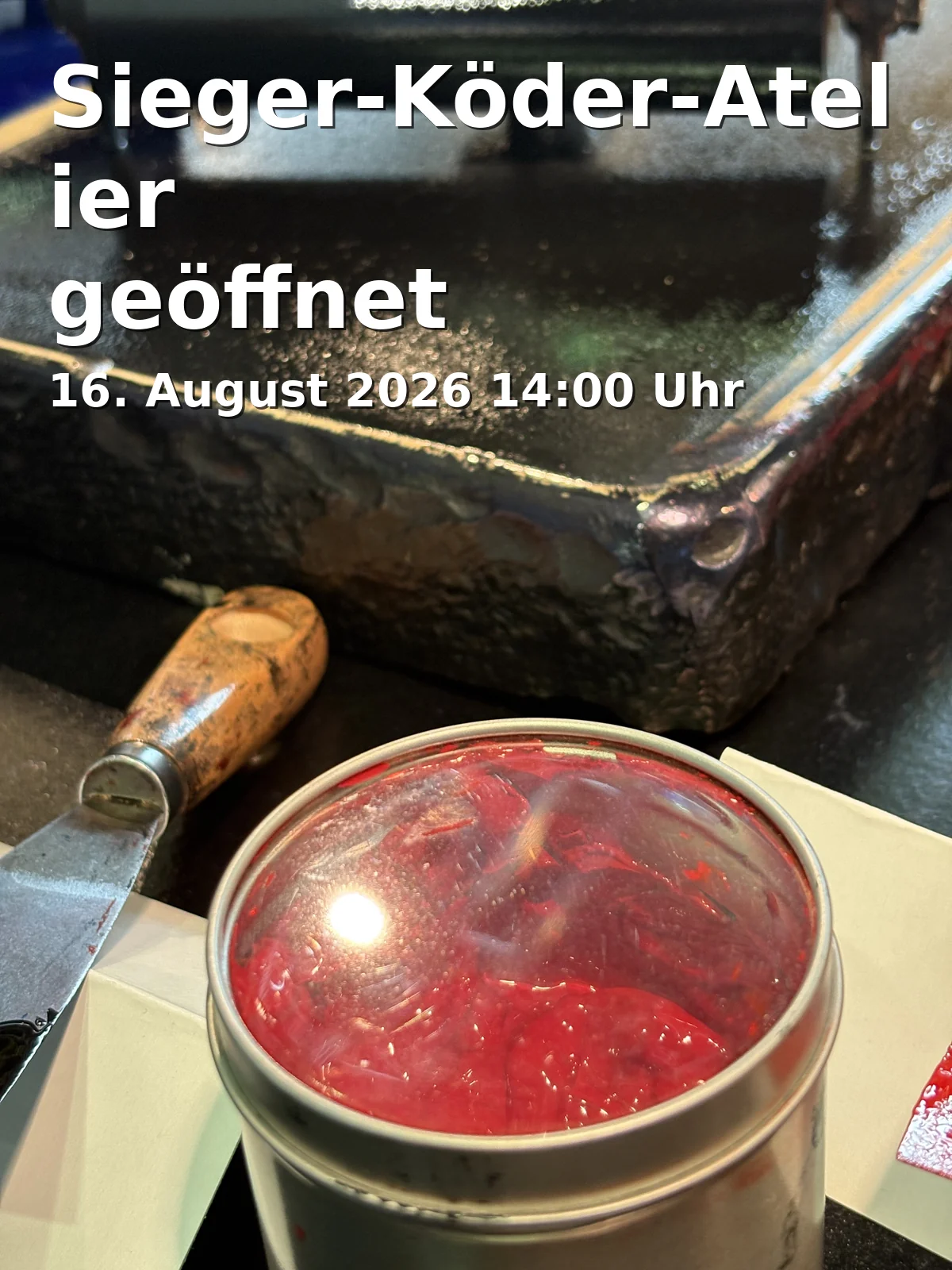
Winner Köder Studio Open
A free art afternoon with a special atmosphere: The Winner Köder Studio in Wasseralfingen opens on 16.08.2026 from 2 PM to 5 PM. #Aalen #Art
Sieger-Köder-Atelier open
The Sieger-Köder-Haus in Wasseralfingen opens its doors. Experience the fascinating works of the artist up close.