
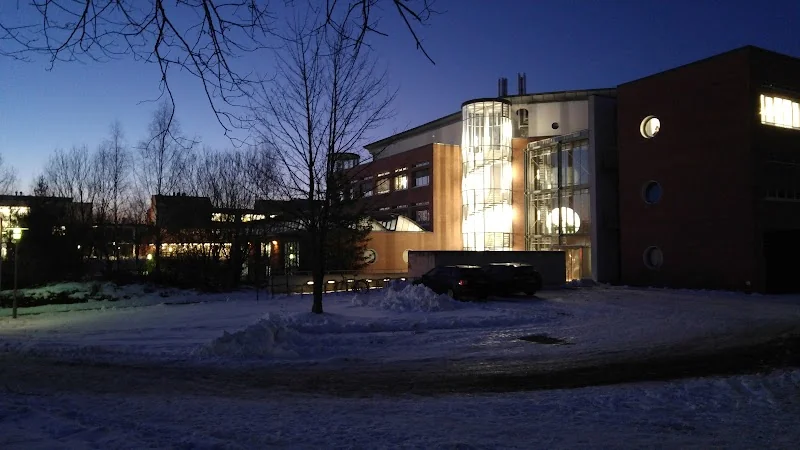
Bayerisches Geo-Institut, Universitätsstraße 30, Bayreuth-Frankengut
Bayerisches Geo-Institut, Universitätsstraße 30, 95447 Bayreuth, Germany
Bavarian Geoinstitut | Events & Tickets
The Bavarian Geoinstitut at the University of Bayreuth is not a traditional event venue with concert halls, shows, or ticket offices, but a renowned research institute for experimental geochemistry and geophysics. This is precisely what makes it special: Those looking for events, lectures, or scientific courses will find a place here where research, teaching, and international guest culture come together closely. The institute investigates the structure, composition, and dynamics of the Earth's interior and combines high-pressure experiments, analytics, and geoscientific interpretation. The official pages currently show the seminar series, semester programs, and the DMG Short Course; thus, it is clear that while the BGI is not a classic event hall, it is indeed an active place for professional events, lectures, and specialized courses. ([bgi.uni-bayreuth.de](https://www.bgi.uni-bayreuth.de/))
Events at the Bavarian Geoinstitut: Seminars, Lectures, and Short Course
The event page of the BGI is deliberately structured scientifically and refers to the seminar series Experimental Geochemistry and Geophysics as well as the current semester pages for the summer semester 2026 and winter semester 2025/2026. This structure shows that the institute does not view its events as public shows but as professionally oriented formats. For interested parties, this means: Those who enter the name of the institute along with the search term events will land on topics such as expert lectures, research seminars, academic lectures, and specialized courses that delve deeply into the geosciences. The event pages are currently maintained and were updated in spring 2026, which speaks for a lively, continuously managed event landscape. ([bgi.uni-bayreuth.de](https://www.bgi.uni-bayreuth.de/?lng=en&page=7))
Particularly notable is the DMG Short Course, which focuses on High-Pressure Experimental Techniques and Applications to the Earth’s Interior. According to the official description, it is a five-day course that provides an introduction to modern experimental methods in mineralogy, geochemistry, and geophysics. Topics covered include high-pressure and high-temperature methods, spectroscopy, X-ray diffraction under pressure, electron microscopy, thermodynamics, phase equilibria, crystal chemistry, state equations, as well as diffusion and deformation. The course takes place in the laboratories of the Bavarian Geoinstitut and is thus not only theoretical but intentionally practical. ([bgi.uni-bayreuth.de](https://www.bgi.uni-bayreuth.de/?lng=en&page=7&view=shc))
Tickets and Registration: What Visitors Should Know About the BGI
Those looking for tickets for the Bavarian Geoinstitut should read the term somewhat differently than at a classic cultural or sports venue. From the structure of the official pages, it can be inferred that the institute primarily works with registration, participation, and course organization, not with typical ticket sales. This makes the search interesting in the SEO context: The keyword tickets is relevant, but the appropriate answer here is not admission ticket, but scientific participation or registration for an event. This is helpful for visitors as it sets the right expectations: The focus is on content, research, and academic exchange, not a regular box office. ([bgi.uni-bayreuth.de](https://www.bgi.uni-bayreuth.de/?lng=en&page=7))
For the DMG Short Course, participation is even explicitly free of charge. The official description does not mention a course fee but points out that teaching materials and catering during the course are supported by the BGI. The number of participants is limited to 30 people, the official course language is English, and the course is primarily aimed at advanced students and doctoral candidates, but is also open to postdocs. Those who additionally want an ECTS certificate can earn two ECTS points after completing the course and passing a written exam. For those looking for tickets, this is the most important practical insight: At the BGI, events are mostly about professional qualification, not admission prices. ([bgi.uni-bayreuth.de](https://www.bgi.uni-bayreuth.de/?lng=en&page=7&view=shc))
Directions and Parking at the University of Bayreuth Campus
Traveling to the Bavarian Geoinstitut is clearly described and leads through the campus of the University of Bayreuth. The university is located on the southern outskirts and is only about 900 meters from the Bayreuth-South motorway exit of the A9. For driving directions, the official instructions mention the Bayreuth-South exit, followed by driving towards the university and entering the campus via Universitätsstraße. The institute is located at Universitätsstraße 30 in 95447 Bayreuth. This places it in a campus environment that is easily accessible for visitors of the geosciences and suitable for recurring professional events. ([bcg.uni-bayreuth.de](https://www.bcg.uni-bayreuth.de/de/kontakt_anfahrt/index.html))
The connection with public transport is also well documented for the campus. From the main train station Bayreuth, bus line 316 goes directly to the campus or to the Geowissenschaften stop; alternatively, one can reach the campus via the central bus station with lines 304 and 306. The university also names the stops Mensa, Geowissenschaften, and Uni-Verwaltung for the campus areas. Those arriving by car will find parking spaces south, west, and east of the Geowissenschaften II building at Universitätsstraße 30, according to the official campus description. For a scientific institute, this is a practical combination of campus location, bus connections, and nearby parking spaces. ([bcg.uni-bayreuth.de](https://www.bcg.uni-bayreuth.de/de/kontakt_anfahrt/index.html))
Especially for professional events, lectures, or the Short Course, this location is a plus. Those traveling for the first time benefit from the clear orientation via Bayreuth-South, the main campus access, and the Geowissenschaften stop. Long-distance bus and train travelers also find hints on the official pages: For long-distance traffic, the stops Bayreuth Bf and Bayreuth University are mentioned, and from the ICE hub in Nuremberg, there are regular regional connections to Bayreuth. This information helps not only guests but also students, visiting researchers, and speakers who want to plan their participation in events efficiently. ([bcg.uni-bayreuth.de](https://www.bcg.uni-bayreuth.de/tagungen_veranstaltungen_konferenzen/ak-entwicklungstheorien/de/organisation/raeume-anfahrt/index.html))
History and Research Profile Since 1986
The Bavarian Geoinstitut was founded in 1986 and has since been established as a central research facility of the University of Bayreuth. The official descriptions emphasize that the institute was created to investigate processes in the Earth's interior using experimental methods. The focus has always been on high-pressure and high-temperature research, that is, on conditions as they exist deep within the Earth. This historical orientation is still visible today: The BGI connects mineralogy, petrology, geochemistry, and geophysics and works intentionally interdisciplinary. Thus, it is not only a laboratory location but a scientific hub for the exploration of planetary processes. ([bgi.uni-bayreuth.de](https://www.bgi.uni-bayreuth.de/organization/bgibrochure/FromCrustToCore/FromCrustToCore_HR040421_web.pdf?utm_source=openai))
In terms of content, the research profile extends far beyond individual rocks or minerals. The official pages mention, among other things, the formation of the Earth's core and mantle, processes in subducting lithospheric plates, the dynamics of volcanic eruptions and their emissions, as well as the transport of heavy metals in supercritical fluids. In the same vein, the scientific relevance for deep-focus earthquakes, the risk of volcanic eruptions, natural concentrations of greenhouse gases, and the formation of ore deposits is highlighted. The BGI thus works on questions that go far beyond pure laboratory physics and have direct significance for understanding our planet. ([bgi.uni-bayreuth.de](https://www.bgi.uni-bayreuth.de/index.php?lng=en&page=2&view=1))
The research focuses are also SEO-relevant because they explain why visitors and searchers encounter terms like experimental geochemistry, experimental geophysics, or high-pressure research at the BGI. The institute is not a general exhibition space but an internationally oriented research site with a clear professional identity. Those searching for the name of the institute along with events are often actually looking for a scientific program, lectures, or a specialized course that opens the view behind the scenes of modern earth sciences. This mixture makes the location particularly special. ([bgi.uni-bayreuth.de](https://www.bgi.uni-bayreuth.de/))
Facilities and Laboratories: High-Pressure Research at an International Level
The technical equipment of the Bavarian Geoinstitut is exceptionally broad. Key apparatuses include several high-pressure presses and multi-anvil systems, including a 1500-ton Kawai-type multi-anvil press, a 5000-ton multi-anvil press, additional multi-anvil presses of various sizes, several piston-cylinder presses, cold-seal vessels, internally heated autoclaves, and devices for diamond anvil cells. This is complemented by extensive analytical instruments such as X-ray powder diffractometers, single-crystal diffractometers, Mössbauer spectrometers, FTIR systems, FEG-TEM, FEG-STEM, and FEG-SEM. This range shows that the institute is capable of not only producing materials under extreme conditions but also characterizing them structurally and chemically with precision. ([bgi.uni-bayreuth.de](https://www.bgi.uni-bayreuth.de/?lng=en&page=5&view=3))
In-situ techniques further enhance the research's dynamism. The official pages mention, among other things, gigahertz ultrasound interferometry, a freeze-heating stage for fluid inclusions, devices for measuring electrical conductivity, apparatus for determining thermal diffusivity under high pressure and high temperature, as well as laser heating systems for diamond anvil cells. This makes the BGI suitable for questions where materials are to be observed not only afterward but during loading. Such measurements are central to understanding how rocks, minerals, and fluids react in the Earth's interior. ([bgi.uni-bayreuth.de](https://www.bgi.uni-bayreuth.de/?lng=en&page=5&view=3))
The infrastructure also includes well-equipped workshops, an electronics workshop, sample preparation laboratories, and access to supercomputing resources at the university as well as at the Leibniz computing centers. This is particularly relevant for external researchers, as the Geoinstitut opens its high-pressure laboratories as part of a DFG Core Facility to external users. This turns the location into a scientific hub that not only advances its own projects but also enables collaborations. For those searching for special event venues, this is interesting because the place itself becomes an experience: Here, academic expertise meets real laboratory infrastructure. ([bgi.uni-bayreuth.de](https://www.bgi.uni-bayreuth.de/?lng=en&page=5&view=3))
For Guests, Students, and External Researchers
The Bavarian Geoinstitut is not only a place for its own research work but also open to guests, young scientists, and international collaborations. The official pages provide information on a Visitors Program, Postdoctoral Fellowships, Ph.D. Studentships, and Internships. This shows: Those who come into contact with the BGI encounter an environment that actively promotes scientific exchange and is not a closed laboratory fortress. Especially for visitors who want to attend an event, a lecture, or a specialized course, this is a good signal. The institute thrives on people who travel temporarily, collaborate, and contribute expertise. ([bgi.uni-bayreuth.de](https://www.bgi.uni-bayreuth.de/))
The academic young talent is also clearly addressed. The BGI refers to the Master's program in Experimental Geosciences, where students are integrated into small research groups from the beginning, and the courses are conducted in English. This international orientation fits the research identity of the institution and explains why one often encounters English technical language, cross-border collaborations, and academic formats with high specialization in Bayreuth. From an SEO perspective, this is important: The search term events is always associated here with scientific quality, internationality, and laboratory practice. ([master.bgi.uni-bayreuth.de](https://www.master.bgi.uni-bayreuth.de/en/study-program.php?utm_source=openai))
Overall, the Bavarian Geoinstitut is therefore a location with a special profile: not a classic event space, but a vibrant research institute with events, courses, lectures, modern infrastructure, and international appeal. Those looking for tickets will find more participation, registration, and academic exchange at the BGI; those looking for directions will find a clear campus location with good public transport and car access; those looking for special features will discover a place where high-pressure research, the Earth's interior, and scientific practice come together. This mixture makes the institute exciting for visitors, researchers, and search engines alike. ([bgi.uni-bayreuth.de](https://www.bgi.uni-bayreuth.de/))
Sources:
- Bavarian Geoinstitut - Homepage
- Bavarian Geoinstitut - Events
- Bavarian Geoinstitut - DMG Short Course 2026
- Bavarian Geoinstitut - Contact Address
- Bavarian Geoinstitut - Facilities
- Faculty BCG - Contact & Directions
- Faculty BCG - Conference Rooms & Directions
- Master in Experimental Geosciences - Study Program
Show moreShow less
Bavarian Geoinstitut | Events & Tickets
The Bavarian Geoinstitut at the University of Bayreuth is not a traditional event venue with concert halls, shows, or ticket offices, but a renowned research institute for experimental geochemistry and geophysics. This is precisely what makes it special: Those looking for events, lectures, or scientific courses will find a place here where research, teaching, and international guest culture come together closely. The institute investigates the structure, composition, and dynamics of the Earth's interior and combines high-pressure experiments, analytics, and geoscientific interpretation. The official pages currently show the seminar series, semester programs, and the DMG Short Course; thus, it is clear that while the BGI is not a classic event hall, it is indeed an active place for professional events, lectures, and specialized courses. ([bgi.uni-bayreuth.de](https://www.bgi.uni-bayreuth.de/))
Events at the Bavarian Geoinstitut: Seminars, Lectures, and Short Course
The event page of the BGI is deliberately structured scientifically and refers to the seminar series Experimental Geochemistry and Geophysics as well as the current semester pages for the summer semester 2026 and winter semester 2025/2026. This structure shows that the institute does not view its events as public shows but as professionally oriented formats. For interested parties, this means: Those who enter the name of the institute along with the search term events will land on topics such as expert lectures, research seminars, academic lectures, and specialized courses that delve deeply into the geosciences. The event pages are currently maintained and were updated in spring 2026, which speaks for a lively, continuously managed event landscape. ([bgi.uni-bayreuth.de](https://www.bgi.uni-bayreuth.de/?lng=en&page=7))
Particularly notable is the DMG Short Course, which focuses on High-Pressure Experimental Techniques and Applications to the Earth’s Interior. According to the official description, it is a five-day course that provides an introduction to modern experimental methods in mineralogy, geochemistry, and geophysics. Topics covered include high-pressure and high-temperature methods, spectroscopy, X-ray diffraction under pressure, electron microscopy, thermodynamics, phase equilibria, crystal chemistry, state equations, as well as diffusion and deformation. The course takes place in the laboratories of the Bavarian Geoinstitut and is thus not only theoretical but intentionally practical. ([bgi.uni-bayreuth.de](https://www.bgi.uni-bayreuth.de/?lng=en&page=7&view=shc))
Tickets and Registration: What Visitors Should Know About the BGI
Those looking for tickets for the Bavarian Geoinstitut should read the term somewhat differently than at a classic cultural or sports venue. From the structure of the official pages, it can be inferred that the institute primarily works with registration, participation, and course organization, not with typical ticket sales. This makes the search interesting in the SEO context: The keyword tickets is relevant, but the appropriate answer here is not admission ticket, but scientific participation or registration for an event. This is helpful for visitors as it sets the right expectations: The focus is on content, research, and academic exchange, not a regular box office. ([bgi.uni-bayreuth.de](https://www.bgi.uni-bayreuth.de/?lng=en&page=7))
For the DMG Short Course, participation is even explicitly free of charge. The official description does not mention a course fee but points out that teaching materials and catering during the course are supported by the BGI. The number of participants is limited to 30 people, the official course language is English, and the course is primarily aimed at advanced students and doctoral candidates, but is also open to postdocs. Those who additionally want an ECTS certificate can earn two ECTS points after completing the course and passing a written exam. For those looking for tickets, this is the most important practical insight: At the BGI, events are mostly about professional qualification, not admission prices. ([bgi.uni-bayreuth.de](https://www.bgi.uni-bayreuth.de/?lng=en&page=7&view=shc))
Directions and Parking at the University of Bayreuth Campus
Traveling to the Bavarian Geoinstitut is clearly described and leads through the campus of the University of Bayreuth. The university is located on the southern outskirts and is only about 900 meters from the Bayreuth-South motorway exit of the A9. For driving directions, the official instructions mention the Bayreuth-South exit, followed by driving towards the university and entering the campus via Universitätsstraße. The institute is located at Universitätsstraße 30 in 95447 Bayreuth. This places it in a campus environment that is easily accessible for visitors of the geosciences and suitable for recurring professional events. ([bcg.uni-bayreuth.de](https://www.bcg.uni-bayreuth.de/de/kontakt_anfahrt/index.html))
The connection with public transport is also well documented for the campus. From the main train station Bayreuth, bus line 316 goes directly to the campus or to the Geowissenschaften stop; alternatively, one can reach the campus via the central bus station with lines 304 and 306. The university also names the stops Mensa, Geowissenschaften, and Uni-Verwaltung for the campus areas. Those arriving by car will find parking spaces south, west, and east of the Geowissenschaften II building at Universitätsstraße 30, according to the official campus description. For a scientific institute, this is a practical combination of campus location, bus connections, and nearby parking spaces. ([bcg.uni-bayreuth.de](https://www.bcg.uni-bayreuth.de/de/kontakt_anfahrt/index.html))
Especially for professional events, lectures, or the Short Course, this location is a plus. Those traveling for the first time benefit from the clear orientation via Bayreuth-South, the main campus access, and the Geowissenschaften stop. Long-distance bus and train travelers also find hints on the official pages: For long-distance traffic, the stops Bayreuth Bf and Bayreuth University are mentioned, and from the ICE hub in Nuremberg, there are regular regional connections to Bayreuth. This information helps not only guests but also students, visiting researchers, and speakers who want to plan their participation in events efficiently. ([bcg.uni-bayreuth.de](https://www.bcg.uni-bayreuth.de/tagungen_veranstaltungen_konferenzen/ak-entwicklungstheorien/de/organisation/raeume-anfahrt/index.html))
History and Research Profile Since 1986
The Bavarian Geoinstitut was founded in 1986 and has since been established as a central research facility of the University of Bayreuth. The official descriptions emphasize that the institute was created to investigate processes in the Earth's interior using experimental methods. The focus has always been on high-pressure and high-temperature research, that is, on conditions as they exist deep within the Earth. This historical orientation is still visible today: The BGI connects mineralogy, petrology, geochemistry, and geophysics and works intentionally interdisciplinary. Thus, it is not only a laboratory location but a scientific hub for the exploration of planetary processes. ([bgi.uni-bayreuth.de](https://www.bgi.uni-bayreuth.de/organization/bgibrochure/FromCrustToCore/FromCrustToCore_HR040421_web.pdf?utm_source=openai))
In terms of content, the research profile extends far beyond individual rocks or minerals. The official pages mention, among other things, the formation of the Earth's core and mantle, processes in subducting lithospheric plates, the dynamics of volcanic eruptions and their emissions, as well as the transport of heavy metals in supercritical fluids. In the same vein, the scientific relevance for deep-focus earthquakes, the risk of volcanic eruptions, natural concentrations of greenhouse gases, and the formation of ore deposits is highlighted. The BGI thus works on questions that go far beyond pure laboratory physics and have direct significance for understanding our planet. ([bgi.uni-bayreuth.de](https://www.bgi.uni-bayreuth.de/index.php?lng=en&page=2&view=1))
The research focuses are also SEO-relevant because they explain why visitors and searchers encounter terms like experimental geochemistry, experimental geophysics, or high-pressure research at the BGI. The institute is not a general exhibition space but an internationally oriented research site with a clear professional identity. Those searching for the name of the institute along with events are often actually looking for a scientific program, lectures, or a specialized course that opens the view behind the scenes of modern earth sciences. This mixture makes the location particularly special. ([bgi.uni-bayreuth.de](https://www.bgi.uni-bayreuth.de/))
Facilities and Laboratories: High-Pressure Research at an International Level
The technical equipment of the Bavarian Geoinstitut is exceptionally broad. Key apparatuses include several high-pressure presses and multi-anvil systems, including a 1500-ton Kawai-type multi-anvil press, a 5000-ton multi-anvil press, additional multi-anvil presses of various sizes, several piston-cylinder presses, cold-seal vessels, internally heated autoclaves, and devices for diamond anvil cells. This is complemented by extensive analytical instruments such as X-ray powder diffractometers, single-crystal diffractometers, Mössbauer spectrometers, FTIR systems, FEG-TEM, FEG-STEM, and FEG-SEM. This range shows that the institute is capable of not only producing materials under extreme conditions but also characterizing them structurally and chemically with precision. ([bgi.uni-bayreuth.de](https://www.bgi.uni-bayreuth.de/?lng=en&page=5&view=3))
In-situ techniques further enhance the research's dynamism. The official pages mention, among other things, gigahertz ultrasound interferometry, a freeze-heating stage for fluid inclusions, devices for measuring electrical conductivity, apparatus for determining thermal diffusivity under high pressure and high temperature, as well as laser heating systems for diamond anvil cells. This makes the BGI suitable for questions where materials are to be observed not only afterward but during loading. Such measurements are central to understanding how rocks, minerals, and fluids react in the Earth's interior. ([bgi.uni-bayreuth.de](https://www.bgi.uni-bayreuth.de/?lng=en&page=5&view=3))
The infrastructure also includes well-equipped workshops, an electronics workshop, sample preparation laboratories, and access to supercomputing resources at the university as well as at the Leibniz computing centers. This is particularly relevant for external researchers, as the Geoinstitut opens its high-pressure laboratories as part of a DFG Core Facility to external users. This turns the location into a scientific hub that not only advances its own projects but also enables collaborations. For those searching for special event venues, this is interesting because the place itself becomes an experience: Here, academic expertise meets real laboratory infrastructure. ([bgi.uni-bayreuth.de](https://www.bgi.uni-bayreuth.de/?lng=en&page=5&view=3))
For Guests, Students, and External Researchers
The Bavarian Geoinstitut is not only a place for its own research work but also open to guests, young scientists, and international collaborations. The official pages provide information on a Visitors Program, Postdoctoral Fellowships, Ph.D. Studentships, and Internships. This shows: Those who come into contact with the BGI encounter an environment that actively promotes scientific exchange and is not a closed laboratory fortress. Especially for visitors who want to attend an event, a lecture, or a specialized course, this is a good signal. The institute thrives on people who travel temporarily, collaborate, and contribute expertise. ([bgi.uni-bayreuth.de](https://www.bgi.uni-bayreuth.de/))
The academic young talent is also clearly addressed. The BGI refers to the Master's program in Experimental Geosciences, where students are integrated into small research groups from the beginning, and the courses are conducted in English. This international orientation fits the research identity of the institution and explains why one often encounters English technical language, cross-border collaborations, and academic formats with high specialization in Bayreuth. From an SEO perspective, this is important: The search term events is always associated here with scientific quality, internationality, and laboratory practice. ([master.bgi.uni-bayreuth.de](https://www.master.bgi.uni-bayreuth.de/en/study-program.php?utm_source=openai))
Overall, the Bavarian Geoinstitut is therefore a location with a special profile: not a classic event space, but a vibrant research institute with events, courses, lectures, modern infrastructure, and international appeal. Those looking for tickets will find more participation, registration, and academic exchange at the BGI; those looking for directions will find a clear campus location with good public transport and car access; those looking for special features will discover a place where high-pressure research, the Earth's interior, and scientific practice come together. This mixture makes the institute exciting for visitors, researchers, and search engines alike. ([bgi.uni-bayreuth.de](https://www.bgi.uni-bayreuth.de/))
Sources:
- Bavarian Geoinstitut - Homepage
- Bavarian Geoinstitut - Events
- Bavarian Geoinstitut - DMG Short Course 2026
- Bavarian Geoinstitut - Contact Address
- Bavarian Geoinstitut - Facilities
- Faculty BCG - Contact & Directions
- Faculty BCG - Conference Rooms & Directions
- Master in Experimental Geosciences - Study Program
Bavarian Geoinstitut | Events & Tickets
The Bavarian Geoinstitut at the University of Bayreuth is not a traditional event venue with concert halls, shows, or ticket offices, but a renowned research institute for experimental geochemistry and geophysics. This is precisely what makes it special: Those looking for events, lectures, or scientific courses will find a place here where research, teaching, and international guest culture come together closely. The institute investigates the structure, composition, and dynamics of the Earth's interior and combines high-pressure experiments, analytics, and geoscientific interpretation. The official pages currently show the seminar series, semester programs, and the DMG Short Course; thus, it is clear that while the BGI is not a classic event hall, it is indeed an active place for professional events, lectures, and specialized courses. ([bgi.uni-bayreuth.de](https://www.bgi.uni-bayreuth.de/))
Events at the Bavarian Geoinstitut: Seminars, Lectures, and Short Course
The event page of the BGI is deliberately structured scientifically and refers to the seminar series Experimental Geochemistry and Geophysics as well as the current semester pages for the summer semester 2026 and winter semester 2025/2026. This structure shows that the institute does not view its events as public shows but as professionally oriented formats. For interested parties, this means: Those who enter the name of the institute along with the search term events will land on topics such as expert lectures, research seminars, academic lectures, and specialized courses that delve deeply into the geosciences. The event pages are currently maintained and were updated in spring 2026, which speaks for a lively, continuously managed event landscape. ([bgi.uni-bayreuth.de](https://www.bgi.uni-bayreuth.de/?lng=en&page=7))
Particularly notable is the DMG Short Course, which focuses on High-Pressure Experimental Techniques and Applications to the Earth’s Interior. According to the official description, it is a five-day course that provides an introduction to modern experimental methods in mineralogy, geochemistry, and geophysics. Topics covered include high-pressure and high-temperature methods, spectroscopy, X-ray diffraction under pressure, electron microscopy, thermodynamics, phase equilibria, crystal chemistry, state equations, as well as diffusion and deformation. The course takes place in the laboratories of the Bavarian Geoinstitut and is thus not only theoretical but intentionally practical. ([bgi.uni-bayreuth.de](https://www.bgi.uni-bayreuth.de/?lng=en&page=7&view=shc))
Tickets and Registration: What Visitors Should Know About the BGI
Those looking for tickets for the Bavarian Geoinstitut should read the term somewhat differently than at a classic cultural or sports venue. From the structure of the official pages, it can be inferred that the institute primarily works with registration, participation, and course organization, not with typical ticket sales. This makes the search interesting in the SEO context: The keyword tickets is relevant, but the appropriate answer here is not admission ticket, but scientific participation or registration for an event. This is helpful for visitors as it sets the right expectations: The focus is on content, research, and academic exchange, not a regular box office. ([bgi.uni-bayreuth.de](https://www.bgi.uni-bayreuth.de/?lng=en&page=7))
For the DMG Short Course, participation is even explicitly free of charge. The official description does not mention a course fee but points out that teaching materials and catering during the course are supported by the BGI. The number of participants is limited to 30 people, the official course language is English, and the course is primarily aimed at advanced students and doctoral candidates, but is also open to postdocs. Those who additionally want an ECTS certificate can earn two ECTS points after completing the course and passing a written exam. For those looking for tickets, this is the most important practical insight: At the BGI, events are mostly about professional qualification, not admission prices. ([bgi.uni-bayreuth.de](https://www.bgi.uni-bayreuth.de/?lng=en&page=7&view=shc))
Directions and Parking at the University of Bayreuth Campus
Traveling to the Bavarian Geoinstitut is clearly described and leads through the campus of the University of Bayreuth. The university is located on the southern outskirts and is only about 900 meters from the Bayreuth-South motorway exit of the A9. For driving directions, the official instructions mention the Bayreuth-South exit, followed by driving towards the university and entering the campus via Universitätsstraße. The institute is located at Universitätsstraße 30 in 95447 Bayreuth. This places it in a campus environment that is easily accessible for visitors of the geosciences and suitable for recurring professional events. ([bcg.uni-bayreuth.de](https://www.bcg.uni-bayreuth.de/de/kontakt_anfahrt/index.html))
The connection with public transport is also well documented for the campus. From the main train station Bayreuth, bus line 316 goes directly to the campus or to the Geowissenschaften stop; alternatively, one can reach the campus via the central bus station with lines 304 and 306. The university also names the stops Mensa, Geowissenschaften, and Uni-Verwaltung for the campus areas. Those arriving by car will find parking spaces south, west, and east of the Geowissenschaften II building at Universitätsstraße 30, according to the official campus description. For a scientific institute, this is a practical combination of campus location, bus connections, and nearby parking spaces. ([bcg.uni-bayreuth.de](https://www.bcg.uni-bayreuth.de/de/kontakt_anfahrt/index.html))
Especially for professional events, lectures, or the Short Course, this location is a plus. Those traveling for the first time benefit from the clear orientation via Bayreuth-South, the main campus access, and the Geowissenschaften stop. Long-distance bus and train travelers also find hints on the official pages: For long-distance traffic, the stops Bayreuth Bf and Bayreuth University are mentioned, and from the ICE hub in Nuremberg, there are regular regional connections to Bayreuth. This information helps not only guests but also students, visiting researchers, and speakers who want to plan their participation in events efficiently. ([bcg.uni-bayreuth.de](https://www.bcg.uni-bayreuth.de/tagungen_veranstaltungen_konferenzen/ak-entwicklungstheorien/de/organisation/raeume-anfahrt/index.html))
History and Research Profile Since 1986
The Bavarian Geoinstitut was founded in 1986 and has since been established as a central research facility of the University of Bayreuth. The official descriptions emphasize that the institute was created to investigate processes in the Earth's interior using experimental methods. The focus has always been on high-pressure and high-temperature research, that is, on conditions as they exist deep within the Earth. This historical orientation is still visible today: The BGI connects mineralogy, petrology, geochemistry, and geophysics and works intentionally interdisciplinary. Thus, it is not only a laboratory location but a scientific hub for the exploration of planetary processes. ([bgi.uni-bayreuth.de](https://www.bgi.uni-bayreuth.de/organization/bgibrochure/FromCrustToCore/FromCrustToCore_HR040421_web.pdf?utm_source=openai))
In terms of content, the research profile extends far beyond individual rocks or minerals. The official pages mention, among other things, the formation of the Earth's core and mantle, processes in subducting lithospheric plates, the dynamics of volcanic eruptions and their emissions, as well as the transport of heavy metals in supercritical fluids. In the same vein, the scientific relevance for deep-focus earthquakes, the risk of volcanic eruptions, natural concentrations of greenhouse gases, and the formation of ore deposits is highlighted. The BGI thus works on questions that go far beyond pure laboratory physics and have direct significance for understanding our planet. ([bgi.uni-bayreuth.de](https://www.bgi.uni-bayreuth.de/index.php?lng=en&page=2&view=1))
The research focuses are also SEO-relevant because they explain why visitors and searchers encounter terms like experimental geochemistry, experimental geophysics, or high-pressure research at the BGI. The institute is not a general exhibition space but an internationally oriented research site with a clear professional identity. Those searching for the name of the institute along with events are often actually looking for a scientific program, lectures, or a specialized course that opens the view behind the scenes of modern earth sciences. This mixture makes the location particularly special. ([bgi.uni-bayreuth.de](https://www.bgi.uni-bayreuth.de/))
Facilities and Laboratories: High-Pressure Research at an International Level
The technical equipment of the Bavarian Geoinstitut is exceptionally broad. Key apparatuses include several high-pressure presses and multi-anvil systems, including a 1500-ton Kawai-type multi-anvil press, a 5000-ton multi-anvil press, additional multi-anvil presses of various sizes, several piston-cylinder presses, cold-seal vessels, internally heated autoclaves, and devices for diamond anvil cells. This is complemented by extensive analytical instruments such as X-ray powder diffractometers, single-crystal diffractometers, Mössbauer spectrometers, FTIR systems, FEG-TEM, FEG-STEM, and FEG-SEM. This range shows that the institute is capable of not only producing materials under extreme conditions but also characterizing them structurally and chemically with precision. ([bgi.uni-bayreuth.de](https://www.bgi.uni-bayreuth.de/?lng=en&page=5&view=3))
In-situ techniques further enhance the research's dynamism. The official pages mention, among other things, gigahertz ultrasound interferometry, a freeze-heating stage for fluid inclusions, devices for measuring electrical conductivity, apparatus for determining thermal diffusivity under high pressure and high temperature, as well as laser heating systems for diamond anvil cells. This makes the BGI suitable for questions where materials are to be observed not only afterward but during loading. Such measurements are central to understanding how rocks, minerals, and fluids react in the Earth's interior. ([bgi.uni-bayreuth.de](https://www.bgi.uni-bayreuth.de/?lng=en&page=5&view=3))
The infrastructure also includes well-equipped workshops, an electronics workshop, sample preparation laboratories, and access to supercomputing resources at the university as well as at the Leibniz computing centers. This is particularly relevant for external researchers, as the Geoinstitut opens its high-pressure laboratories as part of a DFG Core Facility to external users. This turns the location into a scientific hub that not only advances its own projects but also enables collaborations. For those searching for special event venues, this is interesting because the place itself becomes an experience: Here, academic expertise meets real laboratory infrastructure. ([bgi.uni-bayreuth.de](https://www.bgi.uni-bayreuth.de/?lng=en&page=5&view=3))
For Guests, Students, and External Researchers
The Bavarian Geoinstitut is not only a place for its own research work but also open to guests, young scientists, and international collaborations. The official pages provide information on a Visitors Program, Postdoctoral Fellowships, Ph.D. Studentships, and Internships. This shows: Those who come into contact with the BGI encounter an environment that actively promotes scientific exchange and is not a closed laboratory fortress. Especially for visitors who want to attend an event, a lecture, or a specialized course, this is a good signal. The institute thrives on people who travel temporarily, collaborate, and contribute expertise. ([bgi.uni-bayreuth.de](https://www.bgi.uni-bayreuth.de/))
The academic young talent is also clearly addressed. The BGI refers to the Master's program in Experimental Geosciences, where students are integrated into small research groups from the beginning, and the courses are conducted in English. This international orientation fits the research identity of the institution and explains why one often encounters English technical language, cross-border collaborations, and academic formats with high specialization in Bayreuth. From an SEO perspective, this is important: The search term events is always associated here with scientific quality, internationality, and laboratory practice. ([master.bgi.uni-bayreuth.de](https://www.master.bgi.uni-bayreuth.de/en/study-program.php?utm_source=openai))
Overall, the Bavarian Geoinstitut is therefore a location with a special profile: not a classic event space, but a vibrant research institute with events, courses, lectures, modern infrastructure, and international appeal. Those looking for tickets will find more participation, registration, and academic exchange at the BGI; those looking for directions will find a clear campus location with good public transport and car access; those looking for special features will discover a place where high-pressure research, the Earth's interior, and scientific practice come together. This mixture makes the institute exciting for visitors, researchers, and search engines alike. ([bgi.uni-bayreuth.de](https://www.bgi.uni-bayreuth.de/))
Sources:
- Bavarian Geoinstitut - Homepage
- Bavarian Geoinstitut - Events
- Bavarian Geoinstitut - DMG Short Course 2026
- Bavarian Geoinstitut - Contact Address
- Bavarian Geoinstitut - Facilities
- Faculty BCG - Contact & Directions
- Faculty BCG - Conference Rooms & Directions
- Master in Experimental Geosciences - Study Program

Frequently Asked Questions
Reviews
kai zhou
19. October 2025
Biao Wang
11. July 2023
Marija Putak Juriček
12. May 2022
Jana Michaelis (Bunny)
7. February 2022
Anna Dinius
7. December 2021