
Eremitage 1, Bayreuth
Eremitage 1, 95448 Bayreuth, Germany
Eremitage Bayreuth | Opening Hours & Directions
The Eremitage Bayreuth is one of the most impressive park landscapes in Franconia, combining garden art, architecture, and courtly history in a way that one immediately feels upon first visit. Entering the grounds, one experiences not an ordinary city park, but a historical ensemble of the Old Palace, New Palace, Sun Temple, Orangery, grottos, water features, and extensive paths along the Red Main. The special charm lies in the fact that everything comes together to form a calm, generous, and at the same time representative total work of art. For those searching for Eremitage Bayreuth, opening hours, parking, water features, or café, this page is therefore more than just a brief info: it shows why the Eremitage is a destination for walks, culture, photography, and family time. The court garden is accessible year-round, the Old Palace can only be visited as part of a guided tour, and during the summer months, water features, cultural events, and the historical ambiance create special moments. The grounds are also well connected: there are free parking options, the address is clearly signposted, and the Eremitage is located on the eastern outskirts of Bayreuth. ([bayreuth-tourismus.de](https://www.bayreuth-tourismus.de/sehenswertes/gaerten-und-parks/eremitage/))
What does Eremitage mean and how did the park come about?
The search term Eremitage leads in the case of Bayreuth directly into the baroque court and garden world of the Margrave era. The word refers to a hermitage, thus a place of retreat, contemplation, and a secluded way of life. This concept was consciously adopted in Bayreuth. The present Eremitage emerged from a historical forest enclosure, which was converted into a zoo in 1664 under Margrave Christian Ernst. Later, Margrave Georg Wilhelm further developed the site and had the Old Palace built in 1715 as the centerpiece of a courtly hermitage. Thus, the complex was not initially just a pleasure garden, but rather a symbolically charged retreat and representation project. When Margrave Friedrich gifted the grounds to his wife Wilhelmine in 1735, the actual flourishing period began: Wilhelmine transformed the complex with great ambition into a baroque and later almost fairy-tale-like garden ensemble. She had the Old Palace expanded, water features and fountain systems created, the New Palace built with the Sun Temple, and the Orangery completed. It is precisely this interplay of strict concept, courtly staging, and landscape openness that makes the Eremitage so special today. The complex is considered a model example of 18th-century garden art and simultaneously shows how closely history, architecture, and courtly self-representation were connected in Bayreuth. Thus, those who stroll there today are not only moving through a beautiful park but through a piece of cultural history that dates back to the early 18th century. ([bayreuth-tourismus.de](https://www.bayreuth-tourismus.de/sehenswertes/gaerten-und-parks/eremitage/))
Old Palace Eremitage: Grotto, Marble Hall, and Tours
The Old Palace is the historical heart of the Eremitage Bayreuth and for many visitors the most impressive part of the entire ensemble. It is located a few kilometers outside the city on the wooded slopes above the Red Main and dominates the entire complex with its location. Even the access is extraordinary: instead of a classic representative staircase, the path leads into a darker, grotto-like area that was meant to embody the original idea of the hermitage and spiritual gathering. In the grotto, one encounters a room concept that consciously works with contrasts. After that, the interior opens up with a courtyard, hermit residences, and the historic apartments of the Margrave and Margravine. Particularly well-known are the Marble Hall, the Japanese Cabinet, the Music Room, and the Chinese Mirror Cabinet. The Marble Hall is located between the gentlemen's and ladies' wings, is the banquet hall of the Old Palace, and still largely displays the original decor from the time of construction. The logic of the tours is also clearly regulated: the Old Palace can only be visited as part of a guided tour, which typically starts every 45 minutes and lasts about 45 minutes. For groups, prior registration is recommended, and there are handouts available in several languages. This is particularly helpful for visitors because the sequence of rooms is very rich and detail-oriented, allowing for a better understanding of the history of the margravial living culture. The opening hours also follow a clear seasonal rhythm: from April to September, the Old Palace is open daily, in October only limited hours, and then it remains closed until spring. Therefore, those who want to truly experience the Eremitage should firmly include the Old Palace in their planning, as it most clearly showcases the historical depth of the complex. ([bayreuth-wilhelmine.de](https://www.bayreuth-wilhelmine.de/deutsch/tourist/oeffnung.htm))
New Palace, Sun Temple, and Café
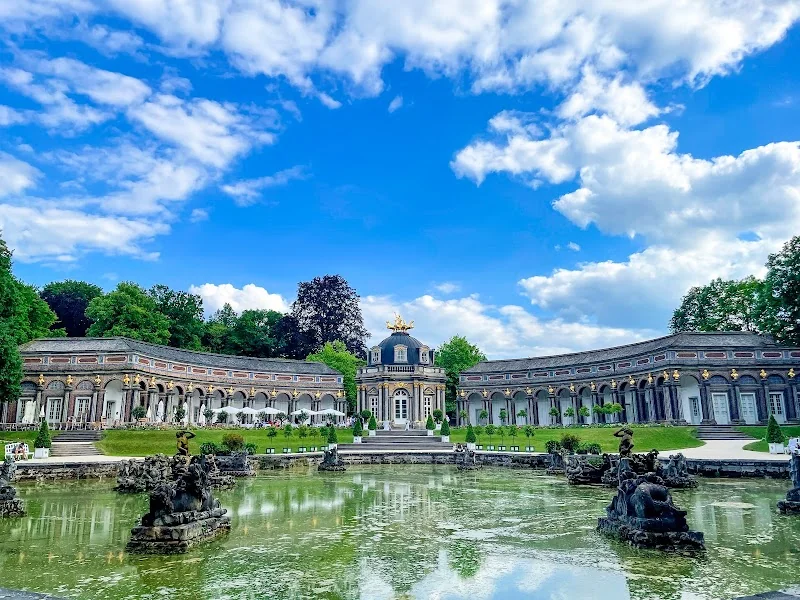
The New Palace Eremitage does not simply complement the Old Palace but sets its own distinct accent. Wilhelmine had it built around 1750 in place of an earlier hedge maze, and the design was oriented towards stage designs by the theater architects Galli Bibiena, who were temporarily active in Bayreuth. As a result, the New Palace appears less like a classic residential building and more like a staged backdrop of architecture, light, and symbolism. The Sun Temple forms the centerpiece of the complex, while the Orangery rounds off the overall effect with its arcade wings and winter houses for exotic plants. Today, the New Palace Eremitage houses event rooms and a café, keeping the complex open for modern uses. For organizers and cultural formats, it is particularly interesting that the Sun Temple can be used as a space with limited area; it is not intended for every form of catering but primarily for cultural events such as concerts, readings, exhibitions, or weddings. In the area of the Orangery, there is also a café that pleasantly extends the stay and makes the Eremitage a place where one not only looks but also sits, enjoys, and lingers. This is particularly relevant for keyword searches for Eremitage Bayreuth Café, as the café is indeed a real part of the historical ensemble and not an incidental addition. The summer aspect is also important: the Orangery is additionally enlivened with art exhibitions during the summer months. Thus, the historical garden architecture is combined with a contemporary cultural and leisure offer. Therefore, those who want to experience the complex completely should not see the New Palace as merely an addition but as its own highlight that spatially and atmospherically expands the staging of the Eremitage. ([bayreuth-wilhelmine.de](https://www.bayreuth-wilhelmine.de/deutsch/eremitag/n_schloss.htm))
Water Features, Summer Night Festival, and Culture
The water features are among the major attractions of the Eremitage Bayreuth. They give the park landscape its lively, almost theatrical movement and make the visit particularly appealing in spring, summer, and early autumn. According to official information, the water features take place from May to mid-October, on the hour. At the Great Basin in front of the New Palace, they run from 10 a.m. to 5 p.m., and at the Lower Grotto, they start 15 minutes later. Additionally, there is the historical principle of water staging in the grotto tower of the Old Palace during the tours. It is precisely this connection of technology, representation, and surprise that makes the Eremitage so remarkable. The water installations are not only decorative but part of the original overall concept of the complex, which worked with baroque order, artificial ruins, arbors, hedge quarters, and fountain systems. For many visitors, the Eremitage is therefore primarily a place for strolling, marveling, and photographing. But the complex is also culturally vibrant. Since 1970, it has annually become the venue for the Bayreuth Summer Night Festival, which is among the most famous and romantic events in Bayreuth. Additionally, regular theater performances take place, including in the old Roman theater and on the stage at the water tower. Thus, the Eremitage is not limited to the role of a historical backdrop but remains a place for culture in the green to this day. It has also gained attention as a film location, for example, through filming related to the Netflix series The Empress. For visitors, it is useful to know that the complex appears very differently depending on the season: in spring and summer, water, blooming, and cultural programs dominate the picture, while autumn and winter bring more tranquility, clear lines, and a walking atmosphere. ([bayreuth-tourismus.de](https://www.bayreuth-tourismus.de/sehenswertes/gaerten-und-parks/eremitage/))
Directions, Parking, and Opening Hours 2026
For practical planning, the Eremitage Bayreuth is very well accessible. The address is Eremitage 4, 95448 Bayreuth, in the district of St. Johannis, and the complex is located on the eastern outskirts of the city. By car, Bayreuth can be reached via the A 9 and A 70 as well as the federal roads B 2, B 22, and B 85. Officially, there are parking spaces for cars and buses at the entrance to the park; the Bayreuth tourism site explicitly points out free parking for buses and cars. It is also possible to arrive by public transport: from Bayreuth main station, bus line 303 goes to the stop Ochsenhut, and from the central bus station, line 302 goes directly to the stop Eremitage. Those planning a visit in 2026 can refer to the official seasonal times: the Old Palace Eremitage is open daily from April to September from 9 a.m. to 6 p.m. and from October 1 to 18 from 10 a.m. to 4 p.m.; from October 19 to March, it remains closed. The court garden Eremitage itself is always accessible, so a walk is also possible outside the palace opening hours. Additionally, the Bavarian Palace Administration has announced the summer season starting April 1, 2026. This is particularly important for search queries regarding Eremitage Bayreuth opening hours 2026, as visitors can thus adjust to the seasonal logic: there are hardly any restrictions for free park visits, but there are indeed for the Old Palace. Therefore, those planning only a short stay can visit the park at any time; those who want to see the interior of the Old Palace should definitely check the tour times and seasonal closures in advance. ([bayreuth-wilhelmine.de](https://www.bayreuth-wilhelmine.de/deutsch/tourist/anfahrt.htm))
Visiting Tips for a Successful Tour
The Eremitage is large enough to make a whole excursion out of it, and at the same time, it is clear enough to find one's way even during a shorter visit. Those coming for the first time should plan a bit more time than just for a quick photo stop, as the paths between the Old Palace, New Palace, Orangery, grottos, and viewpoints make the charm of the complex. A visit is particularly beautiful when one combines the water features with a leisurely walk and does not just focus on a single point. The complex thrives on perspectives, thus on sight axes, transitions, and surprising spatial situations. For this reason, it is worth walking slowly and letting the different areas have an effect on you one after the other. Those interested in history should plan to visit the Old Palace with a guided tour; those seeking atmosphere, café, and garden architecture will particularly benefit from the New Palace, the Orangery, and the open park areas. The Eremitage is also attractive for families and groups because culture and nature can be easily combined. In summer, the water features and events are the main attraction, while spring and autumn often provide ideal conditions for walks and photos. Even with larger crowds, the complex usually remains pleasantly spacious, allowing one to find quiet zones time and again. It is precisely through this mix of free park, historical palace interior, and cultural-historical staging that the Eremitage Bayreuth is so strongly represented in searches. It is not just a mere sight but a complete experience space for people seeking park art, baroque architecture, historical depth, and relaxed quality of stay in one place. Therefore, those visiting Bayreuth should not consider the Eremitage as an additional program but as one of the most important components for a successful stay in the city. ([bayreuth-tourismus.de](https://www.bayreuth-tourismus.de/sehenswertes/gaerten-und-parks/eremitage/))
Sources:
- Bayreuth Tourism - The Eremitage
- Bavarian Palace Administration - Opening Hours
- Bavarian Palace Administration - Directions and Parking
- Bavarian Palace Administration - Old Palace Eremitage
- Bavarian Palace Administration - New Palace Eremitage
- Bavarian Palace Administration - Sun Temple
- Bavarian Palace Administration - Season Start 2026
Show moreShow less
Eremitage Bayreuth | Opening Hours & Directions
The Eremitage Bayreuth is one of the most impressive park landscapes in Franconia, combining garden art, architecture, and courtly history in a way that one immediately feels upon first visit. Entering the grounds, one experiences not an ordinary city park, but a historical ensemble of the Old Palace, New Palace, Sun Temple, Orangery, grottos, water features, and extensive paths along the Red Main. The special charm lies in the fact that everything comes together to form a calm, generous, and at the same time representative total work of art. For those searching for Eremitage Bayreuth, opening hours, parking, water features, or café, this page is therefore more than just a brief info: it shows why the Eremitage is a destination for walks, culture, photography, and family time. The court garden is accessible year-round, the Old Palace can only be visited as part of a guided tour, and during the summer months, water features, cultural events, and the historical ambiance create special moments. The grounds are also well connected: there are free parking options, the address is clearly signposted, and the Eremitage is located on the eastern outskirts of Bayreuth. ([bayreuth-tourismus.de](https://www.bayreuth-tourismus.de/sehenswertes/gaerten-und-parks/eremitage/))
What does Eremitage mean and how did the park come about?
The search term Eremitage leads in the case of Bayreuth directly into the baroque court and garden world of the Margrave era. The word refers to a hermitage, thus a place of retreat, contemplation, and a secluded way of life. This concept was consciously adopted in Bayreuth. The present Eremitage emerged from a historical forest enclosure, which was converted into a zoo in 1664 under Margrave Christian Ernst. Later, Margrave Georg Wilhelm further developed the site and had the Old Palace built in 1715 as the centerpiece of a courtly hermitage. Thus, the complex was not initially just a pleasure garden, but rather a symbolically charged retreat and representation project. When Margrave Friedrich gifted the grounds to his wife Wilhelmine in 1735, the actual flourishing period began: Wilhelmine transformed the complex with great ambition into a baroque and later almost fairy-tale-like garden ensemble. She had the Old Palace expanded, water features and fountain systems created, the New Palace built with the Sun Temple, and the Orangery completed. It is precisely this interplay of strict concept, courtly staging, and landscape openness that makes the Eremitage so special today. The complex is considered a model example of 18th-century garden art and simultaneously shows how closely history, architecture, and courtly self-representation were connected in Bayreuth. Thus, those who stroll there today are not only moving through a beautiful park but through a piece of cultural history that dates back to the early 18th century. ([bayreuth-tourismus.de](https://www.bayreuth-tourismus.de/sehenswertes/gaerten-und-parks/eremitage/))
Old Palace Eremitage: Grotto, Marble Hall, and Tours
The Old Palace is the historical heart of the Eremitage Bayreuth and for many visitors the most impressive part of the entire ensemble. It is located a few kilometers outside the city on the wooded slopes above the Red Main and dominates the entire complex with its location. Even the access is extraordinary: instead of a classic representative staircase, the path leads into a darker, grotto-like area that was meant to embody the original idea of the hermitage and spiritual gathering. In the grotto, one encounters a room concept that consciously works with contrasts. After that, the interior opens up with a courtyard, hermit residences, and the historic apartments of the Margrave and Margravine. Particularly well-known are the Marble Hall, the Japanese Cabinet, the Music Room, and the Chinese Mirror Cabinet. The Marble Hall is located between the gentlemen's and ladies' wings, is the banquet hall of the Old Palace, and still largely displays the original decor from the time of construction. The logic of the tours is also clearly regulated: the Old Palace can only be visited as part of a guided tour, which typically starts every 45 minutes and lasts about 45 minutes. For groups, prior registration is recommended, and there are handouts available in several languages. This is particularly helpful for visitors because the sequence of rooms is very rich and detail-oriented, allowing for a better understanding of the history of the margravial living culture. The opening hours also follow a clear seasonal rhythm: from April to September, the Old Palace is open daily, in October only limited hours, and then it remains closed until spring. Therefore, those who want to truly experience the Eremitage should firmly include the Old Palace in their planning, as it most clearly showcases the historical depth of the complex. ([bayreuth-wilhelmine.de](https://www.bayreuth-wilhelmine.de/deutsch/tourist/oeffnung.htm))
New Palace, Sun Temple, and Café
The New Palace Eremitage does not simply complement the Old Palace but sets its own distinct accent. Wilhelmine had it built around 1750 in place of an earlier hedge maze, and the design was oriented towards stage designs by the theater architects Galli Bibiena, who were temporarily active in Bayreuth. As a result, the New Palace appears less like a classic residential building and more like a staged backdrop of architecture, light, and symbolism. The Sun Temple forms the centerpiece of the complex, while the Orangery rounds off the overall effect with its arcade wings and winter houses for exotic plants. Today, the New Palace Eremitage houses event rooms and a café, keeping the complex open for modern uses. For organizers and cultural formats, it is particularly interesting that the Sun Temple can be used as a space with limited area; it is not intended for every form of catering but primarily for cultural events such as concerts, readings, exhibitions, or weddings. In the area of the Orangery, there is also a café that pleasantly extends the stay and makes the Eremitage a place where one not only looks but also sits, enjoys, and lingers. This is particularly relevant for keyword searches for Eremitage Bayreuth Café, as the café is indeed a real part of the historical ensemble and not an incidental addition. The summer aspect is also important: the Orangery is additionally enlivened with art exhibitions during the summer months. Thus, the historical garden architecture is combined with a contemporary cultural and leisure offer. Therefore, those who want to experience the complex completely should not see the New Palace as merely an addition but as its own highlight that spatially and atmospherically expands the staging of the Eremitage. ([bayreuth-wilhelmine.de](https://www.bayreuth-wilhelmine.de/deutsch/eremitag/n_schloss.htm))
Water Features, Summer Night Festival, and Culture
The water features are among the major attractions of the Eremitage Bayreuth. They give the park landscape its lively, almost theatrical movement and make the visit particularly appealing in spring, summer, and early autumn. According to official information, the water features take place from May to mid-October, on the hour. At the Great Basin in front of the New Palace, they run from 10 a.m. to 5 p.m., and at the Lower Grotto, they start 15 minutes later. Additionally, there is the historical principle of water staging in the grotto tower of the Old Palace during the tours. It is precisely this connection of technology, representation, and surprise that makes the Eremitage so remarkable. The water installations are not only decorative but part of the original overall concept of the complex, which worked with baroque order, artificial ruins, arbors, hedge quarters, and fountain systems. For many visitors, the Eremitage is therefore primarily a place for strolling, marveling, and photographing. But the complex is also culturally vibrant. Since 1970, it has annually become the venue for the Bayreuth Summer Night Festival, which is among the most famous and romantic events in Bayreuth. Additionally, regular theater performances take place, including in the old Roman theater and on the stage at the water tower. Thus, the Eremitage is not limited to the role of a historical backdrop but remains a place for culture in the green to this day. It has also gained attention as a film location, for example, through filming related to the Netflix series The Empress. For visitors, it is useful to know that the complex appears very differently depending on the season: in spring and summer, water, blooming, and cultural programs dominate the picture, while autumn and winter bring more tranquility, clear lines, and a walking atmosphere. ([bayreuth-tourismus.de](https://www.bayreuth-tourismus.de/sehenswertes/gaerten-und-parks/eremitage/))
Directions, Parking, and Opening Hours 2026
For practical planning, the Eremitage Bayreuth is very well accessible. The address is Eremitage 4, 95448 Bayreuth, in the district of St. Johannis, and the complex is located on the eastern outskirts of the city. By car, Bayreuth can be reached via the A 9 and A 70 as well as the federal roads B 2, B 22, and B 85. Officially, there are parking spaces for cars and buses at the entrance to the park; the Bayreuth tourism site explicitly points out free parking for buses and cars. It is also possible to arrive by public transport: from Bayreuth main station, bus line 303 goes to the stop Ochsenhut, and from the central bus station, line 302 goes directly to the stop Eremitage. Those planning a visit in 2026 can refer to the official seasonal times: the Old Palace Eremitage is open daily from April to September from 9 a.m. to 6 p.m. and from October 1 to 18 from 10 a.m. to 4 p.m.; from October 19 to March, it remains closed. The court garden Eremitage itself is always accessible, so a walk is also possible outside the palace opening hours. Additionally, the Bavarian Palace Administration has announced the summer season starting April 1, 2026. This is particularly important for search queries regarding Eremitage Bayreuth opening hours 2026, as visitors can thus adjust to the seasonal logic: there are hardly any restrictions for free park visits, but there are indeed for the Old Palace. Therefore, those planning only a short stay can visit the park at any time; those who want to see the interior of the Old Palace should definitely check the tour times and seasonal closures in advance. ([bayreuth-wilhelmine.de](https://www.bayreuth-wilhelmine.de/deutsch/tourist/anfahrt.htm))
Visiting Tips for a Successful Tour
The Eremitage is large enough to make a whole excursion out of it, and at the same time, it is clear enough to find one's way even during a shorter visit. Those coming for the first time should plan a bit more time than just for a quick photo stop, as the paths between the Old Palace, New Palace, Orangery, grottos, and viewpoints make the charm of the complex. A visit is particularly beautiful when one combines the water features with a leisurely walk and does not just focus on a single point. The complex thrives on perspectives, thus on sight axes, transitions, and surprising spatial situations. For this reason, it is worth walking slowly and letting the different areas have an effect on you one after the other. Those interested in history should plan to visit the Old Palace with a guided tour; those seeking atmosphere, café, and garden architecture will particularly benefit from the New Palace, the Orangery, and the open park areas. The Eremitage is also attractive for families and groups because culture and nature can be easily combined. In summer, the water features and events are the main attraction, while spring and autumn often provide ideal conditions for walks and photos. Even with larger crowds, the complex usually remains pleasantly spacious, allowing one to find quiet zones time and again. It is precisely through this mix of free park, historical palace interior, and cultural-historical staging that the Eremitage Bayreuth is so strongly represented in searches. It is not just a mere sight but a complete experience space for people seeking park art, baroque architecture, historical depth, and relaxed quality of stay in one place. Therefore, those visiting Bayreuth should not consider the Eremitage as an additional program but as one of the most important components for a successful stay in the city. ([bayreuth-tourismus.de](https://www.bayreuth-tourismus.de/sehenswertes/gaerten-und-parks/eremitage/))
Sources:
- Bayreuth Tourism - The Eremitage
- Bavarian Palace Administration - Opening Hours
- Bavarian Palace Administration - Directions and Parking
- Bavarian Palace Administration - Old Palace Eremitage
- Bavarian Palace Administration - New Palace Eremitage
- Bavarian Palace Administration - Sun Temple
- Bavarian Palace Administration - Season Start 2026
Eremitage Bayreuth | Opening Hours & Directions
The Eremitage Bayreuth is one of the most impressive park landscapes in Franconia, combining garden art, architecture, and courtly history in a way that one immediately feels upon first visit. Entering the grounds, one experiences not an ordinary city park, but a historical ensemble of the Old Palace, New Palace, Sun Temple, Orangery, grottos, water features, and extensive paths along the Red Main. The special charm lies in the fact that everything comes together to form a calm, generous, and at the same time representative total work of art. For those searching for Eremitage Bayreuth, opening hours, parking, water features, or café, this page is therefore more than just a brief info: it shows why the Eremitage is a destination for walks, culture, photography, and family time. The court garden is accessible year-round, the Old Palace can only be visited as part of a guided tour, and during the summer months, water features, cultural events, and the historical ambiance create special moments. The grounds are also well connected: there are free parking options, the address is clearly signposted, and the Eremitage is located on the eastern outskirts of Bayreuth. ([bayreuth-tourismus.de](https://www.bayreuth-tourismus.de/sehenswertes/gaerten-und-parks/eremitage/))
What does Eremitage mean and how did the park come about?
The search term Eremitage leads in the case of Bayreuth directly into the baroque court and garden world of the Margrave era. The word refers to a hermitage, thus a place of retreat, contemplation, and a secluded way of life. This concept was consciously adopted in Bayreuth. The present Eremitage emerged from a historical forest enclosure, which was converted into a zoo in 1664 under Margrave Christian Ernst. Later, Margrave Georg Wilhelm further developed the site and had the Old Palace built in 1715 as the centerpiece of a courtly hermitage. Thus, the complex was not initially just a pleasure garden, but rather a symbolically charged retreat and representation project. When Margrave Friedrich gifted the grounds to his wife Wilhelmine in 1735, the actual flourishing period began: Wilhelmine transformed the complex with great ambition into a baroque and later almost fairy-tale-like garden ensemble. She had the Old Palace expanded, water features and fountain systems created, the New Palace built with the Sun Temple, and the Orangery completed. It is precisely this interplay of strict concept, courtly staging, and landscape openness that makes the Eremitage so special today. The complex is considered a model example of 18th-century garden art and simultaneously shows how closely history, architecture, and courtly self-representation were connected in Bayreuth. Thus, those who stroll there today are not only moving through a beautiful park but through a piece of cultural history that dates back to the early 18th century. ([bayreuth-tourismus.de](https://www.bayreuth-tourismus.de/sehenswertes/gaerten-und-parks/eremitage/))
Old Palace Eremitage: Grotto, Marble Hall, and Tours
The Old Palace is the historical heart of the Eremitage Bayreuth and for many visitors the most impressive part of the entire ensemble. It is located a few kilometers outside the city on the wooded slopes above the Red Main and dominates the entire complex with its location. Even the access is extraordinary: instead of a classic representative staircase, the path leads into a darker, grotto-like area that was meant to embody the original idea of the hermitage and spiritual gathering. In the grotto, one encounters a room concept that consciously works with contrasts. After that, the interior opens up with a courtyard, hermit residences, and the historic apartments of the Margrave and Margravine. Particularly well-known are the Marble Hall, the Japanese Cabinet, the Music Room, and the Chinese Mirror Cabinet. The Marble Hall is located between the gentlemen's and ladies' wings, is the banquet hall of the Old Palace, and still largely displays the original decor from the time of construction. The logic of the tours is also clearly regulated: the Old Palace can only be visited as part of a guided tour, which typically starts every 45 minutes and lasts about 45 minutes. For groups, prior registration is recommended, and there are handouts available in several languages. This is particularly helpful for visitors because the sequence of rooms is very rich and detail-oriented, allowing for a better understanding of the history of the margravial living culture. The opening hours also follow a clear seasonal rhythm: from April to September, the Old Palace is open daily, in October only limited hours, and then it remains closed until spring. Therefore, those who want to truly experience the Eremitage should firmly include the Old Palace in their planning, as it most clearly showcases the historical depth of the complex. ([bayreuth-wilhelmine.de](https://www.bayreuth-wilhelmine.de/deutsch/tourist/oeffnung.htm))
New Palace, Sun Temple, and Café
The New Palace Eremitage does not simply complement the Old Palace but sets its own distinct accent. Wilhelmine had it built around 1750 in place of an earlier hedge maze, and the design was oriented towards stage designs by the theater architects Galli Bibiena, who were temporarily active in Bayreuth. As a result, the New Palace appears less like a classic residential building and more like a staged backdrop of architecture, light, and symbolism. The Sun Temple forms the centerpiece of the complex, while the Orangery rounds off the overall effect with its arcade wings and winter houses for exotic plants. Today, the New Palace Eremitage houses event rooms and a café, keeping the complex open for modern uses. For organizers and cultural formats, it is particularly interesting that the Sun Temple can be used as a space with limited area; it is not intended for every form of catering but primarily for cultural events such as concerts, readings, exhibitions, or weddings. In the area of the Orangery, there is also a café that pleasantly extends the stay and makes the Eremitage a place where one not only looks but also sits, enjoys, and lingers. This is particularly relevant for keyword searches for Eremitage Bayreuth Café, as the café is indeed a real part of the historical ensemble and not an incidental addition. The summer aspect is also important: the Orangery is additionally enlivened with art exhibitions during the summer months. Thus, the historical garden architecture is combined with a contemporary cultural and leisure offer. Therefore, those who want to experience the complex completely should not see the New Palace as merely an addition but as its own highlight that spatially and atmospherically expands the staging of the Eremitage. ([bayreuth-wilhelmine.de](https://www.bayreuth-wilhelmine.de/deutsch/eremitag/n_schloss.htm))
Water Features, Summer Night Festival, and Culture
The water features are among the major attractions of the Eremitage Bayreuth. They give the park landscape its lively, almost theatrical movement and make the visit particularly appealing in spring, summer, and early autumn. According to official information, the water features take place from May to mid-October, on the hour. At the Great Basin in front of the New Palace, they run from 10 a.m. to 5 p.m., and at the Lower Grotto, they start 15 minutes later. Additionally, there is the historical principle of water staging in the grotto tower of the Old Palace during the tours. It is precisely this connection of technology, representation, and surprise that makes the Eremitage so remarkable. The water installations are not only decorative but part of the original overall concept of the complex, which worked with baroque order, artificial ruins, arbors, hedge quarters, and fountain systems. For many visitors, the Eremitage is therefore primarily a place for strolling, marveling, and photographing. But the complex is also culturally vibrant. Since 1970, it has annually become the venue for the Bayreuth Summer Night Festival, which is among the most famous and romantic events in Bayreuth. Additionally, regular theater performances take place, including in the old Roman theater and on the stage at the water tower. Thus, the Eremitage is not limited to the role of a historical backdrop but remains a place for culture in the green to this day. It has also gained attention as a film location, for example, through filming related to the Netflix series The Empress. For visitors, it is useful to know that the complex appears very differently depending on the season: in spring and summer, water, blooming, and cultural programs dominate the picture, while autumn and winter bring more tranquility, clear lines, and a walking atmosphere. ([bayreuth-tourismus.de](https://www.bayreuth-tourismus.de/sehenswertes/gaerten-und-parks/eremitage/))
Directions, Parking, and Opening Hours 2026
For practical planning, the Eremitage Bayreuth is very well accessible. The address is Eremitage 4, 95448 Bayreuth, in the district of St. Johannis, and the complex is located on the eastern outskirts of the city. By car, Bayreuth can be reached via the A 9 and A 70 as well as the federal roads B 2, B 22, and B 85. Officially, there are parking spaces for cars and buses at the entrance to the park; the Bayreuth tourism site explicitly points out free parking for buses and cars. It is also possible to arrive by public transport: from Bayreuth main station, bus line 303 goes to the stop Ochsenhut, and from the central bus station, line 302 goes directly to the stop Eremitage. Those planning a visit in 2026 can refer to the official seasonal times: the Old Palace Eremitage is open daily from April to September from 9 a.m. to 6 p.m. and from October 1 to 18 from 10 a.m. to 4 p.m.; from October 19 to March, it remains closed. The court garden Eremitage itself is always accessible, so a walk is also possible outside the palace opening hours. Additionally, the Bavarian Palace Administration has announced the summer season starting April 1, 2026. This is particularly important for search queries regarding Eremitage Bayreuth opening hours 2026, as visitors can thus adjust to the seasonal logic: there are hardly any restrictions for free park visits, but there are indeed for the Old Palace. Therefore, those planning only a short stay can visit the park at any time; those who want to see the interior of the Old Palace should definitely check the tour times and seasonal closures in advance. ([bayreuth-wilhelmine.de](https://www.bayreuth-wilhelmine.de/deutsch/tourist/anfahrt.htm))
Visiting Tips for a Successful Tour
The Eremitage is large enough to make a whole excursion out of it, and at the same time, it is clear enough to find one's way even during a shorter visit. Those coming for the first time should plan a bit more time than just for a quick photo stop, as the paths between the Old Palace, New Palace, Orangery, grottos, and viewpoints make the charm of the complex. A visit is particularly beautiful when one combines the water features with a leisurely walk and does not just focus on a single point. The complex thrives on perspectives, thus on sight axes, transitions, and surprising spatial situations. For this reason, it is worth walking slowly and letting the different areas have an effect on you one after the other. Those interested in history should plan to visit the Old Palace with a guided tour; those seeking atmosphere, café, and garden architecture will particularly benefit from the New Palace, the Orangery, and the open park areas. The Eremitage is also attractive for families and groups because culture and nature can be easily combined. In summer, the water features and events are the main attraction, while spring and autumn often provide ideal conditions for walks and photos. Even with larger crowds, the complex usually remains pleasantly spacious, allowing one to find quiet zones time and again. It is precisely through this mix of free park, historical palace interior, and cultural-historical staging that the Eremitage Bayreuth is so strongly represented in searches. It is not just a mere sight but a complete experience space for people seeking park art, baroque architecture, historical depth, and relaxed quality of stay in one place. Therefore, those visiting Bayreuth should not consider the Eremitage as an additional program but as one of the most important components for a successful stay in the city. ([bayreuth-tourismus.de](https://www.bayreuth-tourismus.de/sehenswertes/gaerten-und-parks/eremitage/))
Sources:
- Bayreuth Tourism - The Eremitage
- Bavarian Palace Administration - Opening Hours
- Bavarian Palace Administration - Directions and Parking
- Bavarian Palace Administration - Old Palace Eremitage
- Bavarian Palace Administration - New Palace Eremitage
- Bavarian Palace Administration - Sun Temple
- Bavarian Palace Administration - Season Start 2026
Frequently Asked Questions
Reviews
Philip Smith
23. September 2025
Beautiful grounds a short drive away from Bayreuth. Spend a few hours wandering around very peaceful and serene landscapes and enjoy watching the fountains (be careful with the grotto or else you'll get wet when those fountains start!). There is a cafe on site for food and drink as well. Free entry and also plenty of free parking available.
Uplander Góral
3. August 2025
We visited the Eermitage because we love palaces, and especially the gardens surrounding them. Before arriving, we carefully reviewed maps and websites, checking the attractiveness of the place in terms of landscape architecture, both large and small. Upon arrival, we were shocked; what we saw exceeded our expectations and imaginations. I'll start with the convenient and spacious parking lot right at the park entrance. Beyond the gate, a different world begins: a world of paths, water, fountains, and secluded romantic spots. The new palace, the old palace, the Chinese pavilion, the orangery, the dragon's cave, lakes, streams, waterfalls, canals, and many other charming and beautiful places, all nestled among the greenery and miles of park paths. The entire experience captivated us. The park is very extensive, and we got a little lost, traversing some of the paths several times. Although there are information boards and signposts, we felt they were a bit lacking. A brochure with a park map would have been very helpful. The parking lot lacked a designated spot for a camper. We visited the park in May and will definitely return in the fall because it's a beautiful, charming, interesting, and noteworthy place.
Gabriel Bioinginer
21. October 2025
Beautiful gardens and very well looked after. The ideal place for a walk while being in Bayreuth… no admission fees 🙂
Israa Samir
14. September 2025
This place is just breathtaking! From the buildings, details to the gardens (yes, they are multiple). I had the best two occasions in my life celebrated there and will always be close to my heart.
Tadib Jobair
14. December 2024
Really nice garden for sightseers and pass 3 hours with family. Well maintained, though the water fountains were closed and covered during winter time. There is a big parking for free beside the garden.