
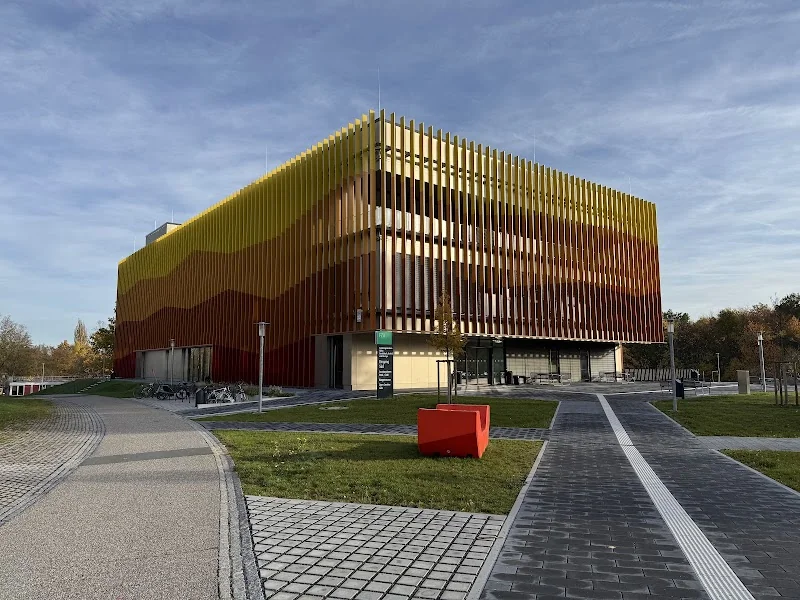
Universitätsstraße 30, Bayreuth
Universitätsstraße 30, 95447 Bayreuth, Germany
FZA University of Bayreuth | Program & Tickets
The FZA at the University of Bayreuth is much more than a single building on campus: it is the new organizational and spatial center of Bayreuth African Studies and has united important institutions since 2025, such as the Institute for African Studies, the Bayreuth International Graduate School of African Studies, the Excellence Cluster Africa Multiple, the exhibition area of the Iwalewahaus, as well as open laboratory and media spaces under one roof. Officially, the building is referred to as a research center for society, technology, and ecology in Africa; however, in daily searches and orientations, the abbreviation FZA and the connection to the University of Bayreuth are primarily used. The building is located at Universitätsstraße 30 on the campus, has been in operation since 2025, and was designed to bring research, teaching, exchange, and public formats closer together. Particularly interesting for visitors are the conference room, several seminar areas, and the open, modern architecture with workshop and media references. For inquiries regarding events, tickets, access, and parking, the FZA is therefore a hybrid place: scientifically oriented but clearly focused on public engagement and interaction. ([uni-bayreuth.de](https://www.uni-bayreuth.de/fza))
Events and Program at FZA Bayreuth
Those looking for events at FZA Bayreuth will not find a classic cultural venue with a fixed schedule, but a vibrant research and event center where academic conferences, lectures, panels, workshops, exhibitions, and public formats come together. The official opening in May 2025 already demonstrated how broad the program is conceived: after the ceremonial act, the public was invited to an open house day, where Open Creative Labs, the Media Lab, and thematic stations on migration, conflicts, religious diversity, technologies, and ecology in the African context were presented. Shortly thereafter, the international cluster conference of Africa Multiple also took place there, supplemented by artistic contributions, discussion rounds, and interactive workshops. This is typical for the FZA: it sees itself as a space where research does not take place behind closed doors but engages with art, society, and practice. Therefore, those seeking the current program should not only look for a general event calendar but also check the news and schedule pages of the cluster as well as the announcements from the University of Bayreuth. Events are announced individually there, often with date, location, format, and language. The formats at the FZA change depending on the subject area and occasion, making the search interest for program, event calendar, or today particularly meaningful. For visitors, it is important: the location is designed for flexible use and is suitable for both smaller academic groups and larger public appointments. ([uni-bayreuth.de](https://www.uni-bayreuth.de/uninotizen-48-2025-eroeffnung-fza))
Tickets, Admission, and Registration
When it comes to the keyword tickets, one should make a small adjustment in expectations for FZA Bayreuth: unlike a theater or concert hall, it often does not involve classic ticket shops, but rather invitations, free participation, registration, or accreditation. The official examples illustrate this very clearly. At the exhibition Africa in Bayreuth in the exhibition room of the FZA, admission was free and registration was not required. For the opening of the FZA, the public was explicitly invited to the open house day after the official ceremony. However, for the New Year Lecture 2026 of the Africa Multiple Clusters, an RSVP was requested. This indicates that participation in the FZA program always depends on the respective format: public exhibitions can be openly accessible, scientific events often require registration, and representative appointments may be reserved for invited guests. Therefore, the best translation for the search intent tickets in practice is usually: Is there free admission, a registration requirement, or a program item with participation information? These details are typically found in the respective announcements. So, anyone planning a visit should not assume a central ticket page but rather read the specific event details. This is particularly important because the FZA hosts both internal university events and public formats. This creates an unusual mix of open science communication and classic event organization. For visitors, this means: check early whether an appointment is open, whether registration is necessary, or whether it is a freely accessible program item. ([uni-bayreuth.de](https://www.uni-bayreuth.de/uninotizen-120-2025-ausstellung-afrika-in-bayreuth))
Access and Parking at the University Campus
Access to the FZA is easily possible via the campus of the University of Bayreuth, but currently, one should consider the construction and traffic situation. The campus is located on the southern outskirts of Bayreuth, about 900 meters from the Bayreuth-Süd exit of the A9 motorway. Those arriving by car should follow the signs towards the university; after the main entrance, they will be directed into the campus area and further towards parking lot P1. Several public transport lines are relevant: bus line 316 runs between the main train station and the campus, while lines 304, 306, and 326 also lead to the central bus stop at Mensa. On the campus itself, the stops Mensa, Geosciences, and University Administration are distributed, making access comfortable for visitors. At the same time, the university currently points out construction work that affects parking areas and pathways. P1 has been partially restricted since June 2025, and the southwestern area of P2 is closed. As alternative options, the university mentions additional parking spaces in the southern part of the campus near the TAO building and public parking areas at Kreuzsteinbad, which are freely usable. For the search interest parking, this is important information as it directly influences when one should arrive and how much time should be planned. Ideally, anyone attending an event at the FZA should leave a bit earlier, consider possible detours on campus, and prefer public transport for larger appointments. This is particularly sensible for conferences and meetings, as the pathways to the buildings can change depending on construction and time of day. Overall, however, the location is well understandable and clearly marked for guests of the University of Bayreuth. ([ub.uni-bayreuth.de](https://www.ub.uni-bayreuth.de/de/infos_zur_ub/anfahrtsbeschreibung/index.html))
Rooms, Capacity, and Equipment
The FZA is technically and spatially remarkably well equipped for events on campus. The official building page lists four seminar rooms with 14, 21, 20, and 21 seats, as well as a conference room with 249 seats. This allows the center to accommodate both smaller working groups and larger lectures and conferences. According to the university, the rooms can only be booked through the central room allocation, which is particularly important for internal or institutional organizers. Additionally, the university refers to a multimedia database for the equipment of lecture halls, seminar, and conference rooms, including network connections. Thus, the FZA is not only a place for encounters but also a functional workspace for presentations, hybrid formats, and scientific collaboration. Particularly exciting is the use of the building: under one roof, the Institute for African Studies, the Bayreuth International Graduate School of African Studies, the Excellence Cluster Africa Multiple, a gallery space for changing exhibitions of the Iwalewahaus, Open Creative Labs, and Media Labs of media studies work together. The official English-language description adds that there are also interpreter booths, a media lab, and a recording studio, and that the building is equipped with photovoltaics, LED lighting, green roofs, and charging stations for electric vehicles. For visitors and organizers, this results in a very modern, versatile space that serves not only as a lecture hall but also as a production and exhibition area. This explains why the FZA is equally suitable for conferences, public discussions, film and media formats, as well as research presentations. Therefore, those looking for seating plans, seats, or the best spots will not find a classic theater plan here, but a mix of flexibly bookable seminar rooms and a clearly defined conference room. For practical planning, the size of 249 seats is particularly decisive, as it marks the largest public space in the building. ([uni-bayreuth.de](https://www.uni-bayreuth.de/fza))
Research, History, and Profile of the FZA
The significance of the FZA only becomes truly apparent when considering the history of African Studies at the University of Bayreuth. The university itself emphasizes that African Studies have been one of its constants in teaching and research since its founding in 1975 and have developed into an outstanding profile field with around 45 professorships. The Excellence Cluster Africa Multiple, established in 2019, aims to reshape African research: in collaboration with African researchers, interdisciplinary, and globally networked. In May 2025, the cluster was again funded for seven years, further underscoring the strategic importance of this field. The FZA is the spatial response to this development. It consolidates the activities that have long been spread across multiple locations in Bayreuth into one place, creating exactly the proximity that modern research networks need. According to official statements, the new infrastructure was built in just two years, with a total volume of 39.2 million euros, financed by the federal government and the Free State of Bavaria. For visitors, this history is important because it shows that the FZA did not arise by chance but is the result of decades of institutional development. The combination of scientific depth, international networking, and spatial concentration makes the location unique. The FZA is thus both a symbol, a workplace, and a showcase of a research tradition that has made Bayreuth visible nationally and internationally. Those interested in African Studies, transdisciplinary research, or the development of university profile fields will find here a rare clear example of how a university consistently expands a topic over decades and ultimately makes it architecturally visible. ([africamultiple.uni-bayreuth.de](https://www.africamultiple.uni-bayreuth.de/en/news/2025/2025-05-14_Inaugurates-New-Research-Centre/index.html))
Exhibitions, Public Formats, and Visitor Tips
The FZA is not only a research site but also a house for public engagement and cultural mediation. A good example is the exhibition Africa in Bayreuth. The Bayreuth African Studies in the Mirror of Politics and Media, which was on display from November 25, 2025, to January 16, 2026, in the exhibition room of the Iwalewahaus at the FZA. The university describes it as a project that documents the history of Bayreuth African research while also making media, political, and scientific perspectives on this field visible. Particularly relevant for visitors: admission was free, no registration was required, and the exhibition ran on weekdays during clear opening hours. This aligns with the self-understanding of the FZA, which was also presented as a place for encounters, discussions, and insights during the opening and the open house day. In the official texts, themes such as migration, conflicts, religious diversity, technologies, ecology, art, and research are repeatedly mentioned. This shows that the content is not abstract but formulated in a socially relevant manner. For practical visits, it applies: anyone planning an event at the FZA should read the event text carefully, check the location on campus, and allow a bit more time for larger appointments. If construction work is taking place on campus, pathways and parking may vary, so it is worth checking the current university information. Particularly pleasant is that the FZA thinks many formats openly, visually, and dialogically: it is not an isolated research tower but a place where visitors can experience science directly. This creates high relevance for search queries such as events, program, tickets, free admission, exhibition, and open house day. The FZA is thus a modern example of a university that not only produces research but also consciously makes it visible. ([uni-bayreuth.de](https://www.uni-bayreuth.de/uninotizen-120-2025-ausstellung-afrika-in-bayreuth))
Sources:
Show moreShow less
FZA University of Bayreuth | Program & Tickets
The FZA at the University of Bayreuth is much more than a single building on campus: it is the new organizational and spatial center of Bayreuth African Studies and has united important institutions since 2025, such as the Institute for African Studies, the Bayreuth International Graduate School of African Studies, the Excellence Cluster Africa Multiple, the exhibition area of the Iwalewahaus, as well as open laboratory and media spaces under one roof. Officially, the building is referred to as a research center for society, technology, and ecology in Africa; however, in daily searches and orientations, the abbreviation FZA and the connection to the University of Bayreuth are primarily used. The building is located at Universitätsstraße 30 on the campus, has been in operation since 2025, and was designed to bring research, teaching, exchange, and public formats closer together. Particularly interesting for visitors are the conference room, several seminar areas, and the open, modern architecture with workshop and media references. For inquiries regarding events, tickets, access, and parking, the FZA is therefore a hybrid place: scientifically oriented but clearly focused on public engagement and interaction. ([uni-bayreuth.de](https://www.uni-bayreuth.de/fza))
Events and Program at FZA Bayreuth
Those looking for events at FZA Bayreuth will not find a classic cultural venue with a fixed schedule, but a vibrant research and event center where academic conferences, lectures, panels, workshops, exhibitions, and public formats come together. The official opening in May 2025 already demonstrated how broad the program is conceived: after the ceremonial act, the public was invited to an open house day, where Open Creative Labs, the Media Lab, and thematic stations on migration, conflicts, religious diversity, technologies, and ecology in the African context were presented. Shortly thereafter, the international cluster conference of Africa Multiple also took place there, supplemented by artistic contributions, discussion rounds, and interactive workshops. This is typical for the FZA: it sees itself as a space where research does not take place behind closed doors but engages with art, society, and practice. Therefore, those seeking the current program should not only look for a general event calendar but also check the news and schedule pages of the cluster as well as the announcements from the University of Bayreuth. Events are announced individually there, often with date, location, format, and language. The formats at the FZA change depending on the subject area and occasion, making the search interest for program, event calendar, or today particularly meaningful. For visitors, it is important: the location is designed for flexible use and is suitable for both smaller academic groups and larger public appointments. ([uni-bayreuth.de](https://www.uni-bayreuth.de/uninotizen-48-2025-eroeffnung-fza))
Tickets, Admission, and Registration
When it comes to the keyword tickets, one should make a small adjustment in expectations for FZA Bayreuth: unlike a theater or concert hall, it often does not involve classic ticket shops, but rather invitations, free participation, registration, or accreditation. The official examples illustrate this very clearly. At the exhibition Africa in Bayreuth in the exhibition room of the FZA, admission was free and registration was not required. For the opening of the FZA, the public was explicitly invited to the open house day after the official ceremony. However, for the New Year Lecture 2026 of the Africa Multiple Clusters, an RSVP was requested. This indicates that participation in the FZA program always depends on the respective format: public exhibitions can be openly accessible, scientific events often require registration, and representative appointments may be reserved for invited guests. Therefore, the best translation for the search intent tickets in practice is usually: Is there free admission, a registration requirement, or a program item with participation information? These details are typically found in the respective announcements. So, anyone planning a visit should not assume a central ticket page but rather read the specific event details. This is particularly important because the FZA hosts both internal university events and public formats. This creates an unusual mix of open science communication and classic event organization. For visitors, this means: check early whether an appointment is open, whether registration is necessary, or whether it is a freely accessible program item. ([uni-bayreuth.de](https://www.uni-bayreuth.de/uninotizen-120-2025-ausstellung-afrika-in-bayreuth))
Access and Parking at the University Campus
Access to the FZA is easily possible via the campus of the University of Bayreuth, but currently, one should consider the construction and traffic situation. The campus is located on the southern outskirts of Bayreuth, about 900 meters from the Bayreuth-Süd exit of the A9 motorway. Those arriving by car should follow the signs towards the university; after the main entrance, they will be directed into the campus area and further towards parking lot P1. Several public transport lines are relevant: bus line 316 runs between the main train station and the campus, while lines 304, 306, and 326 also lead to the central bus stop at Mensa. On the campus itself, the stops Mensa, Geosciences, and University Administration are distributed, making access comfortable for visitors. At the same time, the university currently points out construction work that affects parking areas and pathways. P1 has been partially restricted since June 2025, and the southwestern area of P2 is closed. As alternative options, the university mentions additional parking spaces in the southern part of the campus near the TAO building and public parking areas at Kreuzsteinbad, which are freely usable. For the search interest parking, this is important information as it directly influences when one should arrive and how much time should be planned. Ideally, anyone attending an event at the FZA should leave a bit earlier, consider possible detours on campus, and prefer public transport for larger appointments. This is particularly sensible for conferences and meetings, as the pathways to the buildings can change depending on construction and time of day. Overall, however, the location is well understandable and clearly marked for guests of the University of Bayreuth. ([ub.uni-bayreuth.de](https://www.ub.uni-bayreuth.de/de/infos_zur_ub/anfahrtsbeschreibung/index.html))
Rooms, Capacity, and Equipment
The FZA is technically and spatially remarkably well equipped for events on campus. The official building page lists four seminar rooms with 14, 21, 20, and 21 seats, as well as a conference room with 249 seats. This allows the center to accommodate both smaller working groups and larger lectures and conferences. According to the university, the rooms can only be booked through the central room allocation, which is particularly important for internal or institutional organizers. Additionally, the university refers to a multimedia database for the equipment of lecture halls, seminar, and conference rooms, including network connections. Thus, the FZA is not only a place for encounters but also a functional workspace for presentations, hybrid formats, and scientific collaboration. Particularly exciting is the use of the building: under one roof, the Institute for African Studies, the Bayreuth International Graduate School of African Studies, the Excellence Cluster Africa Multiple, a gallery space for changing exhibitions of the Iwalewahaus, Open Creative Labs, and Media Labs of media studies work together. The official English-language description adds that there are also interpreter booths, a media lab, and a recording studio, and that the building is equipped with photovoltaics, LED lighting, green roofs, and charging stations for electric vehicles. For visitors and organizers, this results in a very modern, versatile space that serves not only as a lecture hall but also as a production and exhibition area. This explains why the FZA is equally suitable for conferences, public discussions, film and media formats, as well as research presentations. Therefore, those looking for seating plans, seats, or the best spots will not find a classic theater plan here, but a mix of flexibly bookable seminar rooms and a clearly defined conference room. For practical planning, the size of 249 seats is particularly decisive, as it marks the largest public space in the building. ([uni-bayreuth.de](https://www.uni-bayreuth.de/fza))
Research, History, and Profile of the FZA
The significance of the FZA only becomes truly apparent when considering the history of African Studies at the University of Bayreuth. The university itself emphasizes that African Studies have been one of its constants in teaching and research since its founding in 1975 and have developed into an outstanding profile field with around 45 professorships. The Excellence Cluster Africa Multiple, established in 2019, aims to reshape African research: in collaboration with African researchers, interdisciplinary, and globally networked. In May 2025, the cluster was again funded for seven years, further underscoring the strategic importance of this field. The FZA is the spatial response to this development. It consolidates the activities that have long been spread across multiple locations in Bayreuth into one place, creating exactly the proximity that modern research networks need. According to official statements, the new infrastructure was built in just two years, with a total volume of 39.2 million euros, financed by the federal government and the Free State of Bavaria. For visitors, this history is important because it shows that the FZA did not arise by chance but is the result of decades of institutional development. The combination of scientific depth, international networking, and spatial concentration makes the location unique. The FZA is thus both a symbol, a workplace, and a showcase of a research tradition that has made Bayreuth visible nationally and internationally. Those interested in African Studies, transdisciplinary research, or the development of university profile fields will find here a rare clear example of how a university consistently expands a topic over decades and ultimately makes it architecturally visible. ([africamultiple.uni-bayreuth.de](https://www.africamultiple.uni-bayreuth.de/en/news/2025/2025-05-14_Inaugurates-New-Research-Centre/index.html))
Exhibitions, Public Formats, and Visitor Tips
The FZA is not only a research site but also a house for public engagement and cultural mediation. A good example is the exhibition Africa in Bayreuth. The Bayreuth African Studies in the Mirror of Politics and Media, which was on display from November 25, 2025, to January 16, 2026, in the exhibition room of the Iwalewahaus at the FZA. The university describes it as a project that documents the history of Bayreuth African research while also making media, political, and scientific perspectives on this field visible. Particularly relevant for visitors: admission was free, no registration was required, and the exhibition ran on weekdays during clear opening hours. This aligns with the self-understanding of the FZA, which was also presented as a place for encounters, discussions, and insights during the opening and the open house day. In the official texts, themes such as migration, conflicts, religious diversity, technologies, ecology, art, and research are repeatedly mentioned. This shows that the content is not abstract but formulated in a socially relevant manner. For practical visits, it applies: anyone planning an event at the FZA should read the event text carefully, check the location on campus, and allow a bit more time for larger appointments. If construction work is taking place on campus, pathways and parking may vary, so it is worth checking the current university information. Particularly pleasant is that the FZA thinks many formats openly, visually, and dialogically: it is not an isolated research tower but a place where visitors can experience science directly. This creates high relevance for search queries such as events, program, tickets, free admission, exhibition, and open house day. The FZA is thus a modern example of a university that not only produces research but also consciously makes it visible. ([uni-bayreuth.de](https://www.uni-bayreuth.de/uninotizen-120-2025-ausstellung-afrika-in-bayreuth))
Sources:
FZA University of Bayreuth | Program & Tickets
The FZA at the University of Bayreuth is much more than a single building on campus: it is the new organizational and spatial center of Bayreuth African Studies and has united important institutions since 2025, such as the Institute for African Studies, the Bayreuth International Graduate School of African Studies, the Excellence Cluster Africa Multiple, the exhibition area of the Iwalewahaus, as well as open laboratory and media spaces under one roof. Officially, the building is referred to as a research center for society, technology, and ecology in Africa; however, in daily searches and orientations, the abbreviation FZA and the connection to the University of Bayreuth are primarily used. The building is located at Universitätsstraße 30 on the campus, has been in operation since 2025, and was designed to bring research, teaching, exchange, and public formats closer together. Particularly interesting for visitors are the conference room, several seminar areas, and the open, modern architecture with workshop and media references. For inquiries regarding events, tickets, access, and parking, the FZA is therefore a hybrid place: scientifically oriented but clearly focused on public engagement and interaction. ([uni-bayreuth.de](https://www.uni-bayreuth.de/fza))
Events and Program at FZA Bayreuth
Those looking for events at FZA Bayreuth will not find a classic cultural venue with a fixed schedule, but a vibrant research and event center where academic conferences, lectures, panels, workshops, exhibitions, and public formats come together. The official opening in May 2025 already demonstrated how broad the program is conceived: after the ceremonial act, the public was invited to an open house day, where Open Creative Labs, the Media Lab, and thematic stations on migration, conflicts, religious diversity, technologies, and ecology in the African context were presented. Shortly thereafter, the international cluster conference of Africa Multiple also took place there, supplemented by artistic contributions, discussion rounds, and interactive workshops. This is typical for the FZA: it sees itself as a space where research does not take place behind closed doors but engages with art, society, and practice. Therefore, those seeking the current program should not only look for a general event calendar but also check the news and schedule pages of the cluster as well as the announcements from the University of Bayreuth. Events are announced individually there, often with date, location, format, and language. The formats at the FZA change depending on the subject area and occasion, making the search interest for program, event calendar, or today particularly meaningful. For visitors, it is important: the location is designed for flexible use and is suitable for both smaller academic groups and larger public appointments. ([uni-bayreuth.de](https://www.uni-bayreuth.de/uninotizen-48-2025-eroeffnung-fza))
Tickets, Admission, and Registration
When it comes to the keyword tickets, one should make a small adjustment in expectations for FZA Bayreuth: unlike a theater or concert hall, it often does not involve classic ticket shops, but rather invitations, free participation, registration, or accreditation. The official examples illustrate this very clearly. At the exhibition Africa in Bayreuth in the exhibition room of the FZA, admission was free and registration was not required. For the opening of the FZA, the public was explicitly invited to the open house day after the official ceremony. However, for the New Year Lecture 2026 of the Africa Multiple Clusters, an RSVP was requested. This indicates that participation in the FZA program always depends on the respective format: public exhibitions can be openly accessible, scientific events often require registration, and representative appointments may be reserved for invited guests. Therefore, the best translation for the search intent tickets in practice is usually: Is there free admission, a registration requirement, or a program item with participation information? These details are typically found in the respective announcements. So, anyone planning a visit should not assume a central ticket page but rather read the specific event details. This is particularly important because the FZA hosts both internal university events and public formats. This creates an unusual mix of open science communication and classic event organization. For visitors, this means: check early whether an appointment is open, whether registration is necessary, or whether it is a freely accessible program item. ([uni-bayreuth.de](https://www.uni-bayreuth.de/uninotizen-120-2025-ausstellung-afrika-in-bayreuth))
Access and Parking at the University Campus
Access to the FZA is easily possible via the campus of the University of Bayreuth, but currently, one should consider the construction and traffic situation. The campus is located on the southern outskirts of Bayreuth, about 900 meters from the Bayreuth-Süd exit of the A9 motorway. Those arriving by car should follow the signs towards the university; after the main entrance, they will be directed into the campus area and further towards parking lot P1. Several public transport lines are relevant: bus line 316 runs between the main train station and the campus, while lines 304, 306, and 326 also lead to the central bus stop at Mensa. On the campus itself, the stops Mensa, Geosciences, and University Administration are distributed, making access comfortable for visitors. At the same time, the university currently points out construction work that affects parking areas and pathways. P1 has been partially restricted since June 2025, and the southwestern area of P2 is closed. As alternative options, the university mentions additional parking spaces in the southern part of the campus near the TAO building and public parking areas at Kreuzsteinbad, which are freely usable. For the search interest parking, this is important information as it directly influences when one should arrive and how much time should be planned. Ideally, anyone attending an event at the FZA should leave a bit earlier, consider possible detours on campus, and prefer public transport for larger appointments. This is particularly sensible for conferences and meetings, as the pathways to the buildings can change depending on construction and time of day. Overall, however, the location is well understandable and clearly marked for guests of the University of Bayreuth. ([ub.uni-bayreuth.de](https://www.ub.uni-bayreuth.de/de/infos_zur_ub/anfahrtsbeschreibung/index.html))
Rooms, Capacity, and Equipment
The FZA is technically and spatially remarkably well equipped for events on campus. The official building page lists four seminar rooms with 14, 21, 20, and 21 seats, as well as a conference room with 249 seats. This allows the center to accommodate both smaller working groups and larger lectures and conferences. According to the university, the rooms can only be booked through the central room allocation, which is particularly important for internal or institutional organizers. Additionally, the university refers to a multimedia database for the equipment of lecture halls, seminar, and conference rooms, including network connections. Thus, the FZA is not only a place for encounters but also a functional workspace for presentations, hybrid formats, and scientific collaboration. Particularly exciting is the use of the building: under one roof, the Institute for African Studies, the Bayreuth International Graduate School of African Studies, the Excellence Cluster Africa Multiple, a gallery space for changing exhibitions of the Iwalewahaus, Open Creative Labs, and Media Labs of media studies work together. The official English-language description adds that there are also interpreter booths, a media lab, and a recording studio, and that the building is equipped with photovoltaics, LED lighting, green roofs, and charging stations for electric vehicles. For visitors and organizers, this results in a very modern, versatile space that serves not only as a lecture hall but also as a production and exhibition area. This explains why the FZA is equally suitable for conferences, public discussions, film and media formats, as well as research presentations. Therefore, those looking for seating plans, seats, or the best spots will not find a classic theater plan here, but a mix of flexibly bookable seminar rooms and a clearly defined conference room. For practical planning, the size of 249 seats is particularly decisive, as it marks the largest public space in the building. ([uni-bayreuth.de](https://www.uni-bayreuth.de/fza))
Research, History, and Profile of the FZA
The significance of the FZA only becomes truly apparent when considering the history of African Studies at the University of Bayreuth. The university itself emphasizes that African Studies have been one of its constants in teaching and research since its founding in 1975 and have developed into an outstanding profile field with around 45 professorships. The Excellence Cluster Africa Multiple, established in 2019, aims to reshape African research: in collaboration with African researchers, interdisciplinary, and globally networked. In May 2025, the cluster was again funded for seven years, further underscoring the strategic importance of this field. The FZA is the spatial response to this development. It consolidates the activities that have long been spread across multiple locations in Bayreuth into one place, creating exactly the proximity that modern research networks need. According to official statements, the new infrastructure was built in just two years, with a total volume of 39.2 million euros, financed by the federal government and the Free State of Bavaria. For visitors, this history is important because it shows that the FZA did not arise by chance but is the result of decades of institutional development. The combination of scientific depth, international networking, and spatial concentration makes the location unique. The FZA is thus both a symbol, a workplace, and a showcase of a research tradition that has made Bayreuth visible nationally and internationally. Those interested in African Studies, transdisciplinary research, or the development of university profile fields will find here a rare clear example of how a university consistently expands a topic over decades and ultimately makes it architecturally visible. ([africamultiple.uni-bayreuth.de](https://www.africamultiple.uni-bayreuth.de/en/news/2025/2025-05-14_Inaugurates-New-Research-Centre/index.html))
Exhibitions, Public Formats, and Visitor Tips
The FZA is not only a research site but also a house for public engagement and cultural mediation. A good example is the exhibition Africa in Bayreuth. The Bayreuth African Studies in the Mirror of Politics and Media, which was on display from November 25, 2025, to January 16, 2026, in the exhibition room of the Iwalewahaus at the FZA. The university describes it as a project that documents the history of Bayreuth African research while also making media, political, and scientific perspectives on this field visible. Particularly relevant for visitors: admission was free, no registration was required, and the exhibition ran on weekdays during clear opening hours. This aligns with the self-understanding of the FZA, which was also presented as a place for encounters, discussions, and insights during the opening and the open house day. In the official texts, themes such as migration, conflicts, religious diversity, technologies, ecology, art, and research are repeatedly mentioned. This shows that the content is not abstract but formulated in a socially relevant manner. For practical visits, it applies: anyone planning an event at the FZA should read the event text carefully, check the location on campus, and allow a bit more time for larger appointments. If construction work is taking place on campus, pathways and parking may vary, so it is worth checking the current university information. Particularly pleasant is that the FZA thinks many formats openly, visually, and dialogically: it is not an isolated research tower but a place where visitors can experience science directly. This creates high relevance for search queries such as events, program, tickets, free admission, exhibition, and open house day. The FZA is thus a modern example of a university that not only produces research but also consciously makes it visible. ([uni-bayreuth.de](https://www.uni-bayreuth.de/uninotizen-120-2025-ausstellung-afrika-in-bayreuth))
Sources:
Frequently Asked Questions
Reviews
Sefosch Sefosch
5. April 2026
Bernhard Groeneveld
13. September 2025
Mike Schwalbach
13. June 2025