
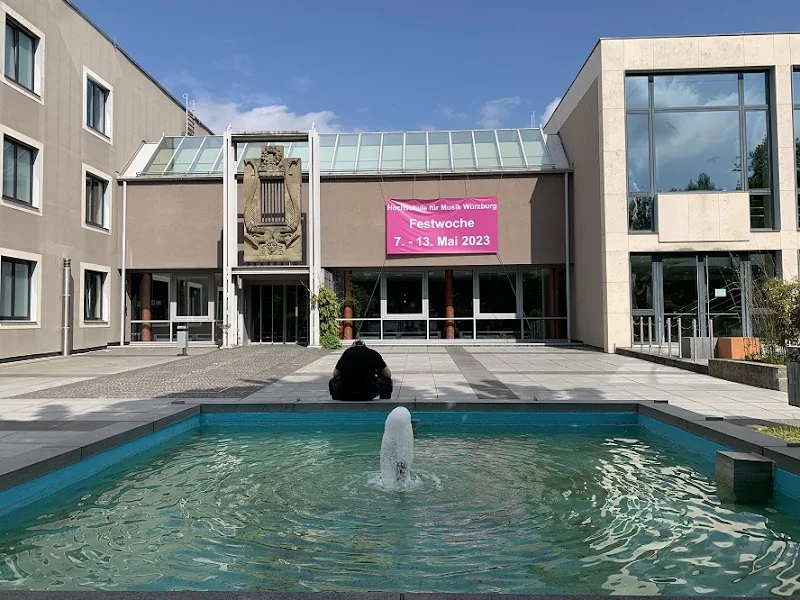
Würzburg
Hofstallstraße 6-8, 97070 Würzburg-Altstadt, Deutschland
University of Music Würzburg | Concerts & Program
The University of Music Würzburg is one of the oldest music education institutions in Germany; its roots date back to 1804. Over the decades, it has evolved from an academic music institute into an institution that today combines artistic excellence, pedagogical training, and scientific reflection. With its modern buildings in the city center of Würzburg, the university is not only a place of study but also a significant cultural venue in the city. Those searching for concerts, programs, dates, or entrance exams at the University of Music Würzburg will find an institution that consciously brings education and the public together. The university sees itself as a cultural bearer, a place of mediation, and a space where music is not only taught but also experienced, researched, and presented. This blend of tradition, present, and artistic practice makes the location equally attractive for students, teachers, and audiences. Particularly striking is the close connection between the buildings, the halls, the library, and the public event operations, which have made the institution well-known far beyond Würzburg. ([hfm-wuerzburg.de](https://hfm-wuerzburg.de/ueber-uns/geschichte))
Events, Dates, and Program at the University of Music Würzburg
The event profile of the university is exceptionally dense and diverse. According to its mission statement, the HfM Würzburg offers insights into the artistic development of its students through over 250 public events each year. This includes choir and symphony concerts, chamber music evenings, class concerts, opera projects, festivals, and lectures. The current date page shows just how broad the spectrum actually is: from the short lunchtime format Music Public to matinees and masterclass panels, to song evenings, cello evenings, jazz formats, and opera or musical galas. For visitors, the event calendar is therefore the most important point of contact when searching for the specific program of the University of Music Würzburg. The platform consolidates dates, rooms, and types of events in one place, making it clear that the university is not only a classroom but also a vibrant stage. This mix of regular operations and public presentations is particularly relevant for search queries like University of Music Würzburg dates or University of Music Würzburg program, as it makes the changing character of the institution visible. The program changes continuously, and therein lies a significant part of its appeal: sometimes the large orchestra is in focus, sometimes intimate chamber music, sometimes an experimental format or a cross-disciplinary event. Therefore, anyone wishing to attend a current event should always check the calendar before their visit. ([hfm-wuerzburg.de](https://hfm-wuerzburg.de/ueber-uns/kurzpotraet-und-leitbild))
For many visitors, it is also important to know how ticket purchasing is organized. The university explicitly states that paid events are only available in advance: at the ticket service in the Falkenhaus at the market, in the university's webshop, and at all Reservix affiliated ticket offices. There is no box office. This is helpful for planning, as one should secure their visit in advance and cannot rely on spontaneous leftover tickets on-site. At the same time, this rule shows that the institution professionally organizes its public formats and that they are in high demand. The current dates also make it clear that the university operates in various rooms and buildings: large artistic evenings take place in the Great Hall or on Bibrastraße, smaller formats in the Chamber Music Hall or in the Small Hall, and individual evenings are held in the theater or seminar rooms. This diversity is important for search behavior, as many users not only enter the name of the university but also specifically search for programs, tickets, dates, or concerts. These topics form the core of the public offering. Therefore, those visiting the University of Music Würzburg do not experience a static campus but a place with a constantly changing schedule and a clear artistic profile. ([hfm-wuerzburg.de](https://hfm-wuerzburg.de/veranstaltungen/kalender))
Great Hall, Chamber Music Hall, and Theater: Seats, Acoustics, and Organ
The Great Hall on Hofstallstraße is the acoustic heart of the university and, with 797 seats, the most sought-after concert hall in the region. The official hall information states a reverberation time of about 1.7 seconds, making the space equally suitable for solo programs, chamber music, symphony concerts, and choir concerts. Big band and pop music events also benefit from this versatility. For visitors searching for University of Music Würzburg Great Hall, these data are crucial: the hall is large enough for representative concerts but remains musically precise and transparent thanks to its acoustics. Among other events, the master concerts of the Musical Academy take place here. Particularly noteworthy is the hall organ from the company Orgelbau Klais, which has been sounding in this room since 2016. The university also describes a concert organ that is unique worldwide, realized in two construction phases in 2016 and 2023/24. This makes the Great Hall not only a concert venue but also an instrumental unique piece with international appeal. The hall complex is complemented by the Small Hall, modern teaching and rehearsal rooms, and a bright cafeteria, ensuring that the building functions excellently both artistically and in everyday life. ([hfm-wuerzburg.de](https://hfm-wuerzburg.de/veranstaltungen/raeume/h-grosser-saal?utm_source=openai))
The Chamber Music Hall in the building at Residenzplatz is the second central performance space of the university. It accommodates 151 visitors and is used for audition evenings of the vocal and instrumental classes, for events in the Music Public series, as well as for examinations and special events. An important advantage is the close connection to the recording studio, which enables professional recordings. Thus, the room is not only a concert hall but also a production site for artistic and examination-related recordings. Those searching for University of Music Würzburg Chamber Music Hall will find a smaller, very flexible room with a direct connection to teaching and public presentation. Even more tailored to music theater is the theater on Bibrastraße, the opera stage of the university. It has 234 seats, an orchestra pit, movable stage parts, and lighting and sound technology for professional scenic performances. The university particularly uses this space for productions of the vocal department but also for special formats with specific technical requirements, such as the Days of New Music or events from the jazz department. For search intents like University of Music Würzburg photos, hall, seating plan, or capacity, these three rooms are therefore the most important anchor points, as they clearly show the different usage levels of the institution: large concert hall, compact chamber music hall, and specialized opera stage. ([hfm-wuerzburg.de](https://hfm-wuerzburg.de/veranstaltungen/raeume/r-kammermusiksaal))
Entrance Exam and Application at the University of Music Würzburg
Anyone wishing to study at the University of Music Würzburg generally must pass an entrance examination. The university publishes its own admission and examination structure, which varies depending on the degree program. This is particularly important for search queries like University of Music Würzburg entrance exam, as there is no uniform examination for all subjects. The official page for the entrance examination shows that the requirements can range from artistic presentations to music theoretical tasks to group-based examination formats. In the bachelor's program, for example, instrumental and vocal examination content is queried; for the artistic teaching degree at high schools, the main subject presentation lasts between 6 to 10 minutes, depending on the subject. In some degree programs, prepared repertoires, playing from memory of works created before 1930, or ensemble tasks are required. For the certificate program, the university specifies, among other things, a 4-hour group examination in the additional subject EMP and written examinations in music theory of 75 or 120 minutes. This clearly shows: the university does not only assess pure virtuosity but also expression, presence, methodological suitability, and subject breadth. Therefore, it is crucial for applicants to read the respective degree program page carefully and not to rely on general music college rules. ([hfm-wuerzburg.de](https://hfm-wuerzburg.de/eignungspruefung?utm_source=openai))
The official admission page is also central for the application, as it consolidates the statutes and procedural guidelines. The university explicitly refers to the qualification statute and the applicable regulations. This is sensible in the context of a music university, as artistic-pedagogical, scientific, and artistic degree programs have different entry profiles. For SEO logic, the keyword University of Music Würzburg entrance exam is therefore particularly relevant, followed by terms like application, entrance examination, dates, and program-related requirements. Those preparing should therefore not only check their repertoire but also the formal guidelines: what documents are required, what deadlines apply, and what content is actually relevant in the respective subject. In practice, this means that the university makes a very subject-specific selection and shows applicants already in the admission process how high the artistic and methodological standards are. For many interested parties, this is not a hurdle but a quality feature. The university thus clearly positions itself as a training institution for musicians who not only play or sing but also want to reflect on their art, develop it professionally, and at a high level. ([hfm-wuerzburg.de](https://hfm-wuerzburg.de/ueber-uns/amt/zulassung))
Library, Practice Rooms, and Instrument Rental
The University of Music Würzburg has a library that is not just a classic book storage but a central media and information center for daily study. It is available to students and teachers as core infrastructure; external individuals can use the library on-site. This is particularly relevant for search queries like University of Music Würzburg library, as the institution has an extensive collection of scores, books, and other media and also serves as a workspace for research and preparation. Currently, the library is open in the summer semester 2026 from Monday to Thursday from 8:30 AM to 5:00 PM and Friday from 8:30 AM to 2:30 PM. The contact details locate it in the Bibrastraße building, room E 08, with mailing address at Hofstallstraße 6-8. This makes it clear that the university organizes its resources across several locations but brings them together in a common system. For students, the library is not only for borrowing but also as a place for quiet work, score study, and academic research. Especially in the daily life of a music university, this is a real added value, as artistic practice and theoretical deepening come together in close quarters. ([hfm-wuerzburg.de](https://hfm-wuerzburg.de/bibliothek?utm_source=openai))
In addition, there are practice rooms that are particularly important for daily life at the university. In Hofstallstraße, the classrooms can be used for practicing outside of class hours; reservations are made via lists on the doors, with a room being bookable for a maximum of two hours. In Bibrastraße, students have access to 25 rooms with pianos or grand pianos, which can be reserved online via mycampus.de. There are also rooms with harpsichord, fortepiano, or computers with listening software that can be used after being unlocked by the teachers. In the Residenzplatz building, there are two practice rooms that are also bookable online. This system shows how professionally the university organizes the daily life of its students: enough rooms, clear rules, and a very direct connection between teaching and independent practice. The instrument rental is also remarkably well developed. The university has a large inventory of valuable instruments that can be borrowed as needed. The rental fee is 20 euros per semester and is paid directly at the gate in Hofstallstraße; for instruments valued over 250 euros, sufficient insurance is also required. For many search queries like University of Music Würzburg lecturers, library, or photos, this infrastructure is particularly interesting as it shows how practice-oriented the university operates and what resources it provides to students for artistic development. ([hfm-wuerzburg.de](https://hfm-wuerzburg.de/studium/ueberaeume?utm_source=openai))
Address, Directions, Parking, and Accessibility
The University of Music Würzburg is very well anchored in the city center but is spread across several buildings. The official postal and contact address is Hofstallstraße 6-8, 97070 Würzburg. The Hofstallstraße building has its main entrance on Husarenstraße, the Bibrastraße building has the address Ebracher Gasse 1 with the main entrance on Bibrastraße, and the building at Residenzplatz is located at Hofstraße 13 with the main entrance on Balthasar-Neumann-Promenade. These details are crucial for search queries like University of Music Würzburg address or University of Music Würzburg Bibrastraße, as the university is not just a single building but an urban area with multiple access points. The Hofstallstraße building is located on a green belt on the edge of the Würzburg city center, adjacent to Rosenbach Park; the Bibrastraße building is towards the city center and cathedral; and the building at Residenzplatz is directly opposite the Würzburg Residence. For visitors, this results in a very central but, depending on the event, varied routing. ([hfm-wuerzburg.de](https://hfm-wuerzburg.de/kontakt?utm_source=openai))
When it comes to parking, some planning is advisable. According to signage, there are parking spaces or an underground garage at all three university buildings, but many spots are restricted or only intended for internal users. In front of the Hofstallstraße building, there is a parking lot for students; at the back, accessible via Hofstallstraße, the parking lot is reserved for employees. In Bibrastraße, the courtyard parking is reserved only for staff, and in the Residenzplatz area or building M, there is a parking garage with nine spaces, also only for staff. This leads to a practical recommendation: if attending an event, one should not count on a free parking space directly at the building but plan enough time for arrival. At the same time, the university is located in the city center, making it easily reachable on foot for many visitors if they are already in Würzburg. Particularly positive is the accessibility: the university states that all three buildings are predominantly accessible. In Hofstallstraße, there is, among other things, a wheelchair-accessible ramp at the student parking lot, an elevator, an accessible toilet, and in the Great Hall, eight wheelchair-accessible seats in row 23 with companion seats. The Small Hall and stages are also reachable with assistance. This makes the University of Music Würzburg not only organizationally but also spatially a very accessible venue. ([hfm-wuerzburg.de](https://hfm-wuerzburg.de/admin/QM/pdf/HfM_Wegweiser_fuer_Lehrende_Stand_21.08.2024.docx.pdf))
History, City Location, and Special Profiles
The history of the university is a central part of its identity. According to the official history section, the Academic Music Institute of the University was founded in 1804. Instrumental instruction was added in 1811, and from 1820, vocal instruction for future elementary school teachers was also included. In 1875, the qualification of professional musicians was established as the institution's task, in 1911 the training of school musicians was added, and in 1937 the study for instrumental and vocal educators. In 1920, after the end of the monarchy, the institution was named the Bavarian State Conservatory before it became a music university in 1973. This long development is important because it shows that the university did not emerge as a short-term project but as a grown institution with deep roots in the city and educational history of Würzburg. Today, the HfM Würzburg describes itself as a place where music and its mediation are experienced, researched, and presented together. This also explains why artistic practice, teaching, research, and public visibility support each other so closely on campus. For search queries like University of Music Würzburg photos, lecturers, or job offers, this historical depth may not always be the first point of focus, but it strongly shapes the perception of the institution. ([hfm-wuerzburg.de](https://hfm-wuerzburg.de/ueber-uns/geschichte))
In addition, there are special profiles that distinguish the university from many other educational institutions. The official short description refers to a wide range of subjects, including conducting, composition, orchestral instruments, accordion, singing, guitar, piano, organ, and saxophone, as well as focuses in elementary music education, historical instruments, jazz, chamber music, church music, and school music. The area of historical instruments is particularly noteworthy: the university is one of the few German music universities with a permanent baroque orchestra using historical instruments. This ensemble participates in the festival Days of Early Music, the annual Baroque opera, and other orchestral projects. At the same time, the university promotes chamber music with baroque instruments and singing, offers master classes and excursions, and links historical performance practice with current training. The HfM Würzburg also has a studio for experimental electronic music, a recording studio, and the renowned hyper-organ in the Great Hall. Together with the numerous annual events, collaborations with the city, and the location directly in the heart of Würzburg, this creates a profile that does not pit tradition and innovation against each other but consciously connects them. This is where the true appeal of this location lies: it is a university, concert venue, research space, and cultural showcase at the same time. ([hfm-wuerzburg.de](https://hfm-wuerzburg.de/studiengaenge/ba/hist-instrument/ueberblick))
Sources:
Mehr anzeigenWeniger anzeigen
University of Music Würzburg | Concerts & Program
The University of Music Würzburg is one of the oldest music education institutions in Germany; its roots date back to 1804. Over the decades, it has evolved from an academic music institute into an institution that today combines artistic excellence, pedagogical training, and scientific reflection. With its modern buildings in the city center of Würzburg, the university is not only a place of study but also a significant cultural venue in the city. Those searching for concerts, programs, dates, or entrance exams at the University of Music Würzburg will find an institution that consciously brings education and the public together. The university sees itself as a cultural bearer, a place of mediation, and a space where music is not only taught but also experienced, researched, and presented. This blend of tradition, present, and artistic practice makes the location equally attractive for students, teachers, and audiences. Particularly striking is the close connection between the buildings, the halls, the library, and the public event operations, which have made the institution well-known far beyond Würzburg. ([hfm-wuerzburg.de](https://hfm-wuerzburg.de/ueber-uns/geschichte))
Events, Dates, and Program at the University of Music Würzburg
The event profile of the university is exceptionally dense and diverse. According to its mission statement, the HfM Würzburg offers insights into the artistic development of its students through over 250 public events each year. This includes choir and symphony concerts, chamber music evenings, class concerts, opera projects, festivals, and lectures. The current date page shows just how broad the spectrum actually is: from the short lunchtime format Music Public to matinees and masterclass panels, to song evenings, cello evenings, jazz formats, and opera or musical galas. For visitors, the event calendar is therefore the most important point of contact when searching for the specific program of the University of Music Würzburg. The platform consolidates dates, rooms, and types of events in one place, making it clear that the university is not only a classroom but also a vibrant stage. This mix of regular operations and public presentations is particularly relevant for search queries like University of Music Würzburg dates or University of Music Würzburg program, as it makes the changing character of the institution visible. The program changes continuously, and therein lies a significant part of its appeal: sometimes the large orchestra is in focus, sometimes intimate chamber music, sometimes an experimental format or a cross-disciplinary event. Therefore, anyone wishing to attend a current event should always check the calendar before their visit. ([hfm-wuerzburg.de](https://hfm-wuerzburg.de/ueber-uns/kurzpotraet-und-leitbild))
For many visitors, it is also important to know how ticket purchasing is organized. The university explicitly states that paid events are only available in advance: at the ticket service in the Falkenhaus at the market, in the university's webshop, and at all Reservix affiliated ticket offices. There is no box office. This is helpful for planning, as one should secure their visit in advance and cannot rely on spontaneous leftover tickets on-site. At the same time, this rule shows that the institution professionally organizes its public formats and that they are in high demand. The current dates also make it clear that the university operates in various rooms and buildings: large artistic evenings take place in the Great Hall or on Bibrastraße, smaller formats in the Chamber Music Hall or in the Small Hall, and individual evenings are held in the theater or seminar rooms. This diversity is important for search behavior, as many users not only enter the name of the university but also specifically search for programs, tickets, dates, or concerts. These topics form the core of the public offering. Therefore, those visiting the University of Music Würzburg do not experience a static campus but a place with a constantly changing schedule and a clear artistic profile. ([hfm-wuerzburg.de](https://hfm-wuerzburg.de/veranstaltungen/kalender))
Great Hall, Chamber Music Hall, and Theater: Seats, Acoustics, and Organ
The Great Hall on Hofstallstraße is the acoustic heart of the university and, with 797 seats, the most sought-after concert hall in the region. The official hall information states a reverberation time of about 1.7 seconds, making the space equally suitable for solo programs, chamber music, symphony concerts, and choir concerts. Big band and pop music events also benefit from this versatility. For visitors searching for University of Music Würzburg Great Hall, these data are crucial: the hall is large enough for representative concerts but remains musically precise and transparent thanks to its acoustics. Among other events, the master concerts of the Musical Academy take place here. Particularly noteworthy is the hall organ from the company Orgelbau Klais, which has been sounding in this room since 2016. The university also describes a concert organ that is unique worldwide, realized in two construction phases in 2016 and 2023/24. This makes the Great Hall not only a concert venue but also an instrumental unique piece with international appeal. The hall complex is complemented by the Small Hall, modern teaching and rehearsal rooms, and a bright cafeteria, ensuring that the building functions excellently both artistically and in everyday life. ([hfm-wuerzburg.de](https://hfm-wuerzburg.de/veranstaltungen/raeume/h-grosser-saal?utm_source=openai))
The Chamber Music Hall in the building at Residenzplatz is the second central performance space of the university. It accommodates 151 visitors and is used for audition evenings of the vocal and instrumental classes, for events in the Music Public series, as well as for examinations and special events. An important advantage is the close connection to the recording studio, which enables professional recordings. Thus, the room is not only a concert hall but also a production site for artistic and examination-related recordings. Those searching for University of Music Würzburg Chamber Music Hall will find a smaller, very flexible room with a direct connection to teaching and public presentation. Even more tailored to music theater is the theater on Bibrastraße, the opera stage of the university. It has 234 seats, an orchestra pit, movable stage parts, and lighting and sound technology for professional scenic performances. The university particularly uses this space for productions of the vocal department but also for special formats with specific technical requirements, such as the Days of New Music or events from the jazz department. For search intents like University of Music Würzburg photos, hall, seating plan, or capacity, these three rooms are therefore the most important anchor points, as they clearly show the different usage levels of the institution: large concert hall, compact chamber music hall, and specialized opera stage. ([hfm-wuerzburg.de](https://hfm-wuerzburg.de/veranstaltungen/raeume/r-kammermusiksaal))
Entrance Exam and Application at the University of Music Würzburg
Anyone wishing to study at the University of Music Würzburg generally must pass an entrance examination. The university publishes its own admission and examination structure, which varies depending on the degree program. This is particularly important for search queries like University of Music Würzburg entrance exam, as there is no uniform examination for all subjects. The official page for the entrance examination shows that the requirements can range from artistic presentations to music theoretical tasks to group-based examination formats. In the bachelor's program, for example, instrumental and vocal examination content is queried; for the artistic teaching degree at high schools, the main subject presentation lasts between 6 to 10 minutes, depending on the subject. In some degree programs, prepared repertoires, playing from memory of works created before 1930, or ensemble tasks are required. For the certificate program, the university specifies, among other things, a 4-hour group examination in the additional subject EMP and written examinations in music theory of 75 or 120 minutes. This clearly shows: the university does not only assess pure virtuosity but also expression, presence, methodological suitability, and subject breadth. Therefore, it is crucial for applicants to read the respective degree program page carefully and not to rely on general music college rules. ([hfm-wuerzburg.de](https://hfm-wuerzburg.de/eignungspruefung?utm_source=openai))
The official admission page is also central for the application, as it consolidates the statutes and procedural guidelines. The university explicitly refers to the qualification statute and the applicable regulations. This is sensible in the context of a music university, as artistic-pedagogical, scientific, and artistic degree programs have different entry profiles. For SEO logic, the keyword University of Music Würzburg entrance exam is therefore particularly relevant, followed by terms like application, entrance examination, dates, and program-related requirements. Those preparing should therefore not only check their repertoire but also the formal guidelines: what documents are required, what deadlines apply, and what content is actually relevant in the respective subject. In practice, this means that the university makes a very subject-specific selection and shows applicants already in the admission process how high the artistic and methodological standards are. For many interested parties, this is not a hurdle but a quality feature. The university thus clearly positions itself as a training institution for musicians who not only play or sing but also want to reflect on their art, develop it professionally, and at a high level. ([hfm-wuerzburg.de](https://hfm-wuerzburg.de/ueber-uns/amt/zulassung))
Library, Practice Rooms, and Instrument Rental
The University of Music Würzburg has a library that is not just a classic book storage but a central media and information center for daily study. It is available to students and teachers as core infrastructure; external individuals can use the library on-site. This is particularly relevant for search queries like University of Music Würzburg library, as the institution has an extensive collection of scores, books, and other media and also serves as a workspace for research and preparation. Currently, the library is open in the summer semester 2026 from Monday to Thursday from 8:30 AM to 5:00 PM and Friday from 8:30 AM to 2:30 PM. The contact details locate it in the Bibrastraße building, room E 08, with mailing address at Hofstallstraße 6-8. This makes it clear that the university organizes its resources across several locations but brings them together in a common system. For students, the library is not only for borrowing but also as a place for quiet work, score study, and academic research. Especially in the daily life of a music university, this is a real added value, as artistic practice and theoretical deepening come together in close quarters. ([hfm-wuerzburg.de](https://hfm-wuerzburg.de/bibliothek?utm_source=openai))
In addition, there are practice rooms that are particularly important for daily life at the university. In Hofstallstraße, the classrooms can be used for practicing outside of class hours; reservations are made via lists on the doors, with a room being bookable for a maximum of two hours. In Bibrastraße, students have access to 25 rooms with pianos or grand pianos, which can be reserved online via mycampus.de. There are also rooms with harpsichord, fortepiano, or computers with listening software that can be used after being unlocked by the teachers. In the Residenzplatz building, there are two practice rooms that are also bookable online. This system shows how professionally the university organizes the daily life of its students: enough rooms, clear rules, and a very direct connection between teaching and independent practice. The instrument rental is also remarkably well developed. The university has a large inventory of valuable instruments that can be borrowed as needed. The rental fee is 20 euros per semester and is paid directly at the gate in Hofstallstraße; for instruments valued over 250 euros, sufficient insurance is also required. For many search queries like University of Music Würzburg lecturers, library, or photos, this infrastructure is particularly interesting as it shows how practice-oriented the university operates and what resources it provides to students for artistic development. ([hfm-wuerzburg.de](https://hfm-wuerzburg.de/studium/ueberaeume?utm_source=openai))
Address, Directions, Parking, and Accessibility
The University of Music Würzburg is very well anchored in the city center but is spread across several buildings. The official postal and contact address is Hofstallstraße 6-8, 97070 Würzburg. The Hofstallstraße building has its main entrance on Husarenstraße, the Bibrastraße building has the address Ebracher Gasse 1 with the main entrance on Bibrastraße, and the building at Residenzplatz is located at Hofstraße 13 with the main entrance on Balthasar-Neumann-Promenade. These details are crucial for search queries like University of Music Würzburg address or University of Music Würzburg Bibrastraße, as the university is not just a single building but an urban area with multiple access points. The Hofstallstraße building is located on a green belt on the edge of the Würzburg city center, adjacent to Rosenbach Park; the Bibrastraße building is towards the city center and cathedral; and the building at Residenzplatz is directly opposite the Würzburg Residence. For visitors, this results in a very central but, depending on the event, varied routing. ([hfm-wuerzburg.de](https://hfm-wuerzburg.de/kontakt?utm_source=openai))
When it comes to parking, some planning is advisable. According to signage, there are parking spaces or an underground garage at all three university buildings, but many spots are restricted or only intended for internal users. In front of the Hofstallstraße building, there is a parking lot for students; at the back, accessible via Hofstallstraße, the parking lot is reserved for employees. In Bibrastraße, the courtyard parking is reserved only for staff, and in the Residenzplatz area or building M, there is a parking garage with nine spaces, also only for staff. This leads to a practical recommendation: if attending an event, one should not count on a free parking space directly at the building but plan enough time for arrival. At the same time, the university is located in the city center, making it easily reachable on foot for many visitors if they are already in Würzburg. Particularly positive is the accessibility: the university states that all three buildings are predominantly accessible. In Hofstallstraße, there is, among other things, a wheelchair-accessible ramp at the student parking lot, an elevator, an accessible toilet, and in the Great Hall, eight wheelchair-accessible seats in row 23 with companion seats. The Small Hall and stages are also reachable with assistance. This makes the University of Music Würzburg not only organizationally but also spatially a very accessible venue. ([hfm-wuerzburg.de](https://hfm-wuerzburg.de/admin/QM/pdf/HfM_Wegweiser_fuer_Lehrende_Stand_21.08.2024.docx.pdf))
History, City Location, and Special Profiles
The history of the university is a central part of its identity. According to the official history section, the Academic Music Institute of the University was founded in 1804. Instrumental instruction was added in 1811, and from 1820, vocal instruction for future elementary school teachers was also included. In 1875, the qualification of professional musicians was established as the institution's task, in 1911 the training of school musicians was added, and in 1937 the study for instrumental and vocal educators. In 1920, after the end of the monarchy, the institution was named the Bavarian State Conservatory before it became a music university in 1973. This long development is important because it shows that the university did not emerge as a short-term project but as a grown institution with deep roots in the city and educational history of Würzburg. Today, the HfM Würzburg describes itself as a place where music and its mediation are experienced, researched, and presented together. This also explains why artistic practice, teaching, research, and public visibility support each other so closely on campus. For search queries like University of Music Würzburg photos, lecturers, or job offers, this historical depth may not always be the first point of focus, but it strongly shapes the perception of the institution. ([hfm-wuerzburg.de](https://hfm-wuerzburg.de/ueber-uns/geschichte))
In addition, there are special profiles that distinguish the university from many other educational institutions. The official short description refers to a wide range of subjects, including conducting, composition, orchestral instruments, accordion, singing, guitar, piano, organ, and saxophone, as well as focuses in elementary music education, historical instruments, jazz, chamber music, church music, and school music. The area of historical instruments is particularly noteworthy: the university is one of the few German music universities with a permanent baroque orchestra using historical instruments. This ensemble participates in the festival Days of Early Music, the annual Baroque opera, and other orchestral projects. At the same time, the university promotes chamber music with baroque instruments and singing, offers master classes and excursions, and links historical performance practice with current training. The HfM Würzburg also has a studio for experimental electronic music, a recording studio, and the renowned hyper-organ in the Great Hall. Together with the numerous annual events, collaborations with the city, and the location directly in the heart of Würzburg, this creates a profile that does not pit tradition and innovation against each other but consciously connects them. This is where the true appeal of this location lies: it is a university, concert venue, research space, and cultural showcase at the same time. ([hfm-wuerzburg.de](https://hfm-wuerzburg.de/studiengaenge/ba/hist-instrument/ueberblick))
Sources:
University of Music Würzburg | Concerts & Program
The University of Music Würzburg is one of the oldest music education institutions in Germany; its roots date back to 1804. Over the decades, it has evolved from an academic music institute into an institution that today combines artistic excellence, pedagogical training, and scientific reflection. With its modern buildings in the city center of Würzburg, the university is not only a place of study but also a significant cultural venue in the city. Those searching for concerts, programs, dates, or entrance exams at the University of Music Würzburg will find an institution that consciously brings education and the public together. The university sees itself as a cultural bearer, a place of mediation, and a space where music is not only taught but also experienced, researched, and presented. This blend of tradition, present, and artistic practice makes the location equally attractive for students, teachers, and audiences. Particularly striking is the close connection between the buildings, the halls, the library, and the public event operations, which have made the institution well-known far beyond Würzburg. ([hfm-wuerzburg.de](https://hfm-wuerzburg.de/ueber-uns/geschichte))
Events, Dates, and Program at the University of Music Würzburg
The event profile of the university is exceptionally dense and diverse. According to its mission statement, the HfM Würzburg offers insights into the artistic development of its students through over 250 public events each year. This includes choir and symphony concerts, chamber music evenings, class concerts, opera projects, festivals, and lectures. The current date page shows just how broad the spectrum actually is: from the short lunchtime format Music Public to matinees and masterclass panels, to song evenings, cello evenings, jazz formats, and opera or musical galas. For visitors, the event calendar is therefore the most important point of contact when searching for the specific program of the University of Music Würzburg. The platform consolidates dates, rooms, and types of events in one place, making it clear that the university is not only a classroom but also a vibrant stage. This mix of regular operations and public presentations is particularly relevant for search queries like University of Music Würzburg dates or University of Music Würzburg program, as it makes the changing character of the institution visible. The program changes continuously, and therein lies a significant part of its appeal: sometimes the large orchestra is in focus, sometimes intimate chamber music, sometimes an experimental format or a cross-disciplinary event. Therefore, anyone wishing to attend a current event should always check the calendar before their visit. ([hfm-wuerzburg.de](https://hfm-wuerzburg.de/ueber-uns/kurzpotraet-und-leitbild))
For many visitors, it is also important to know how ticket purchasing is organized. The university explicitly states that paid events are only available in advance: at the ticket service in the Falkenhaus at the market, in the university's webshop, and at all Reservix affiliated ticket offices. There is no box office. This is helpful for planning, as one should secure their visit in advance and cannot rely on spontaneous leftover tickets on-site. At the same time, this rule shows that the institution professionally organizes its public formats and that they are in high demand. The current dates also make it clear that the university operates in various rooms and buildings: large artistic evenings take place in the Great Hall or on Bibrastraße, smaller formats in the Chamber Music Hall or in the Small Hall, and individual evenings are held in the theater or seminar rooms. This diversity is important for search behavior, as many users not only enter the name of the university but also specifically search for programs, tickets, dates, or concerts. These topics form the core of the public offering. Therefore, those visiting the University of Music Würzburg do not experience a static campus but a place with a constantly changing schedule and a clear artistic profile. ([hfm-wuerzburg.de](https://hfm-wuerzburg.de/veranstaltungen/kalender))
Great Hall, Chamber Music Hall, and Theater: Seats, Acoustics, and Organ
The Great Hall on Hofstallstraße is the acoustic heart of the university and, with 797 seats, the most sought-after concert hall in the region. The official hall information states a reverberation time of about 1.7 seconds, making the space equally suitable for solo programs, chamber music, symphony concerts, and choir concerts. Big band and pop music events also benefit from this versatility. For visitors searching for University of Music Würzburg Great Hall, these data are crucial: the hall is large enough for representative concerts but remains musically precise and transparent thanks to its acoustics. Among other events, the master concerts of the Musical Academy take place here. Particularly noteworthy is the hall organ from the company Orgelbau Klais, which has been sounding in this room since 2016. The university also describes a concert organ that is unique worldwide, realized in two construction phases in 2016 and 2023/24. This makes the Great Hall not only a concert venue but also an instrumental unique piece with international appeal. The hall complex is complemented by the Small Hall, modern teaching and rehearsal rooms, and a bright cafeteria, ensuring that the building functions excellently both artistically and in everyday life. ([hfm-wuerzburg.de](https://hfm-wuerzburg.de/veranstaltungen/raeume/h-grosser-saal?utm_source=openai))
The Chamber Music Hall in the building at Residenzplatz is the second central performance space of the university. It accommodates 151 visitors and is used for audition evenings of the vocal and instrumental classes, for events in the Music Public series, as well as for examinations and special events. An important advantage is the close connection to the recording studio, which enables professional recordings. Thus, the room is not only a concert hall but also a production site for artistic and examination-related recordings. Those searching for University of Music Würzburg Chamber Music Hall will find a smaller, very flexible room with a direct connection to teaching and public presentation. Even more tailored to music theater is the theater on Bibrastraße, the opera stage of the university. It has 234 seats, an orchestra pit, movable stage parts, and lighting and sound technology for professional scenic performances. The university particularly uses this space for productions of the vocal department but also for special formats with specific technical requirements, such as the Days of New Music or events from the jazz department. For search intents like University of Music Würzburg photos, hall, seating plan, or capacity, these three rooms are therefore the most important anchor points, as they clearly show the different usage levels of the institution: large concert hall, compact chamber music hall, and specialized opera stage. ([hfm-wuerzburg.de](https://hfm-wuerzburg.de/veranstaltungen/raeume/r-kammermusiksaal))
Entrance Exam and Application at the University of Music Würzburg
Anyone wishing to study at the University of Music Würzburg generally must pass an entrance examination. The university publishes its own admission and examination structure, which varies depending on the degree program. This is particularly important for search queries like University of Music Würzburg entrance exam, as there is no uniform examination for all subjects. The official page for the entrance examination shows that the requirements can range from artistic presentations to music theoretical tasks to group-based examination formats. In the bachelor's program, for example, instrumental and vocal examination content is queried; for the artistic teaching degree at high schools, the main subject presentation lasts between 6 to 10 minutes, depending on the subject. In some degree programs, prepared repertoires, playing from memory of works created before 1930, or ensemble tasks are required. For the certificate program, the university specifies, among other things, a 4-hour group examination in the additional subject EMP and written examinations in music theory of 75 or 120 minutes. This clearly shows: the university does not only assess pure virtuosity but also expression, presence, methodological suitability, and subject breadth. Therefore, it is crucial for applicants to read the respective degree program page carefully and not to rely on general music college rules. ([hfm-wuerzburg.de](https://hfm-wuerzburg.de/eignungspruefung?utm_source=openai))
The official admission page is also central for the application, as it consolidates the statutes and procedural guidelines. The university explicitly refers to the qualification statute and the applicable regulations. This is sensible in the context of a music university, as artistic-pedagogical, scientific, and artistic degree programs have different entry profiles. For SEO logic, the keyword University of Music Würzburg entrance exam is therefore particularly relevant, followed by terms like application, entrance examination, dates, and program-related requirements. Those preparing should therefore not only check their repertoire but also the formal guidelines: what documents are required, what deadlines apply, and what content is actually relevant in the respective subject. In practice, this means that the university makes a very subject-specific selection and shows applicants already in the admission process how high the artistic and methodological standards are. For many interested parties, this is not a hurdle but a quality feature. The university thus clearly positions itself as a training institution for musicians who not only play or sing but also want to reflect on their art, develop it professionally, and at a high level. ([hfm-wuerzburg.de](https://hfm-wuerzburg.de/ueber-uns/amt/zulassung))
Library, Practice Rooms, and Instrument Rental
The University of Music Würzburg has a library that is not just a classic book storage but a central media and information center for daily study. It is available to students and teachers as core infrastructure; external individuals can use the library on-site. This is particularly relevant for search queries like University of Music Würzburg library, as the institution has an extensive collection of scores, books, and other media and also serves as a workspace for research and preparation. Currently, the library is open in the summer semester 2026 from Monday to Thursday from 8:30 AM to 5:00 PM and Friday from 8:30 AM to 2:30 PM. The contact details locate it in the Bibrastraße building, room E 08, with mailing address at Hofstallstraße 6-8. This makes it clear that the university organizes its resources across several locations but brings them together in a common system. For students, the library is not only for borrowing but also as a place for quiet work, score study, and academic research. Especially in the daily life of a music university, this is a real added value, as artistic practice and theoretical deepening come together in close quarters. ([hfm-wuerzburg.de](https://hfm-wuerzburg.de/bibliothek?utm_source=openai))
In addition, there are practice rooms that are particularly important for daily life at the university. In Hofstallstraße, the classrooms can be used for practicing outside of class hours; reservations are made via lists on the doors, with a room being bookable for a maximum of two hours. In Bibrastraße, students have access to 25 rooms with pianos or grand pianos, which can be reserved online via mycampus.de. There are also rooms with harpsichord, fortepiano, or computers with listening software that can be used after being unlocked by the teachers. In the Residenzplatz building, there are two practice rooms that are also bookable online. This system shows how professionally the university organizes the daily life of its students: enough rooms, clear rules, and a very direct connection between teaching and independent practice. The instrument rental is also remarkably well developed. The university has a large inventory of valuable instruments that can be borrowed as needed. The rental fee is 20 euros per semester and is paid directly at the gate in Hofstallstraße; for instruments valued over 250 euros, sufficient insurance is also required. For many search queries like University of Music Würzburg lecturers, library, or photos, this infrastructure is particularly interesting as it shows how practice-oriented the university operates and what resources it provides to students for artistic development. ([hfm-wuerzburg.de](https://hfm-wuerzburg.de/studium/ueberaeume?utm_source=openai))
Address, Directions, Parking, and Accessibility
The University of Music Würzburg is very well anchored in the city center but is spread across several buildings. The official postal and contact address is Hofstallstraße 6-8, 97070 Würzburg. The Hofstallstraße building has its main entrance on Husarenstraße, the Bibrastraße building has the address Ebracher Gasse 1 with the main entrance on Bibrastraße, and the building at Residenzplatz is located at Hofstraße 13 with the main entrance on Balthasar-Neumann-Promenade. These details are crucial for search queries like University of Music Würzburg address or University of Music Würzburg Bibrastraße, as the university is not just a single building but an urban area with multiple access points. The Hofstallstraße building is located on a green belt on the edge of the Würzburg city center, adjacent to Rosenbach Park; the Bibrastraße building is towards the city center and cathedral; and the building at Residenzplatz is directly opposite the Würzburg Residence. For visitors, this results in a very central but, depending on the event, varied routing. ([hfm-wuerzburg.de](https://hfm-wuerzburg.de/kontakt?utm_source=openai))
When it comes to parking, some planning is advisable. According to signage, there are parking spaces or an underground garage at all three university buildings, but many spots are restricted or only intended for internal users. In front of the Hofstallstraße building, there is a parking lot for students; at the back, accessible via Hofstallstraße, the parking lot is reserved for employees. In Bibrastraße, the courtyard parking is reserved only for staff, and in the Residenzplatz area or building M, there is a parking garage with nine spaces, also only for staff. This leads to a practical recommendation: if attending an event, one should not count on a free parking space directly at the building but plan enough time for arrival. At the same time, the university is located in the city center, making it easily reachable on foot for many visitors if they are already in Würzburg. Particularly positive is the accessibility: the university states that all three buildings are predominantly accessible. In Hofstallstraße, there is, among other things, a wheelchair-accessible ramp at the student parking lot, an elevator, an accessible toilet, and in the Great Hall, eight wheelchair-accessible seats in row 23 with companion seats. The Small Hall and stages are also reachable with assistance. This makes the University of Music Würzburg not only organizationally but also spatially a very accessible venue. ([hfm-wuerzburg.de](https://hfm-wuerzburg.de/admin/QM/pdf/HfM_Wegweiser_fuer_Lehrende_Stand_21.08.2024.docx.pdf))
History, City Location, and Special Profiles
The history of the university is a central part of its identity. According to the official history section, the Academic Music Institute of the University was founded in 1804. Instrumental instruction was added in 1811, and from 1820, vocal instruction for future elementary school teachers was also included. In 1875, the qualification of professional musicians was established as the institution's task, in 1911 the training of school musicians was added, and in 1937 the study for instrumental and vocal educators. In 1920, after the end of the monarchy, the institution was named the Bavarian State Conservatory before it became a music university in 1973. This long development is important because it shows that the university did not emerge as a short-term project but as a grown institution with deep roots in the city and educational history of Würzburg. Today, the HfM Würzburg describes itself as a place where music and its mediation are experienced, researched, and presented together. This also explains why artistic practice, teaching, research, and public visibility support each other so closely on campus. For search queries like University of Music Würzburg photos, lecturers, or job offers, this historical depth may not always be the first point of focus, but it strongly shapes the perception of the institution. ([hfm-wuerzburg.de](https://hfm-wuerzburg.de/ueber-uns/geschichte))
In addition, there are special profiles that distinguish the university from many other educational institutions. The official short description refers to a wide range of subjects, including conducting, composition, orchestral instruments, accordion, singing, guitar, piano, organ, and saxophone, as well as focuses in elementary music education, historical instruments, jazz, chamber music, church music, and school music. The area of historical instruments is particularly noteworthy: the university is one of the few German music universities with a permanent baroque orchestra using historical instruments. This ensemble participates in the festival Days of Early Music, the annual Baroque opera, and other orchestral projects. At the same time, the university promotes chamber music with baroque instruments and singing, offers master classes and excursions, and links historical performance practice with current training. The HfM Würzburg also has a studio for experimental electronic music, a recording studio, and the renowned hyper-organ in the Great Hall. Together with the numerous annual events, collaborations with the city, and the location directly in the heart of Würzburg, this creates a profile that does not pit tradition and innovation against each other but consciously connects them. This is where the true appeal of this location lies: it is a university, concert venue, research space, and cultural showcase at the same time. ([hfm-wuerzburg.de](https://hfm-wuerzburg.de/studiengaenge/ba/hist-instrument/ueberblick))
Sources:
Upcoming Events
Concert of the Con Brio Symphony Orchestra
Experience the Con Brio Symphony Orchestra with an engaging program in Würzburg. Works by Britten, Mahler, and Dvořák!
We will ROCK YOU: Anniversary Concert
Experience a unique concert with the Oratorio Choir Würzburg and the jazz band Urs John on July 26, 2026.
Frequently Asked Questions
Reviews
No reviews found