
Opernstraße 14, Bayreuth
Opernstraße 14, 95444 Bayreuth, Germany
Margravial Opera House | Tickets & Opening Hours
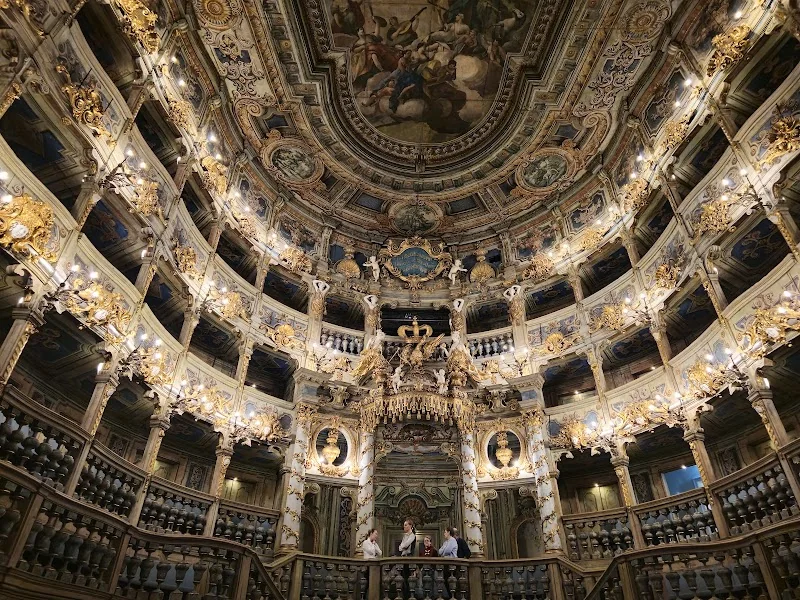
The Margravial Opera House in Bayreuth is one of those places where architecture, music history, and courtly representation merge into a single, impressive experience. Today, anyone entering the house not only immerses themselves in a baroque theater but also in the world of a culture that was conceived in the 18th century with great precision, grand staging, and a deep love for detail. The opera house is the best-preserved example of a free-standing baroque court theater and has been a UNESCO World Heritage site since 2012. At the same time, it is a vibrant destination with a museum, changing events, guided tours, and practical visitor information that make planning a visit easy. For this reason, many visitors search for topics such as tickets, opening hours, programs, directions, or the museum. This page consolidates the most important facts in a clear, search-oriented structure and shows why the Margravial Opera House is much more than just a sight: it is a baroque total work of art, a cultural anchor point in the heart of Bayreuth, and a place where history is still authentically palpable today. ([whc.unesco.org](https://whc.unesco.org/en/list/1379))
Tickets and Opening Hours at the Margravial Opera House
For many visitors, the first question is quite practical: When is the Margravial Opera House open, and where can I get tickets? The current visitor information makes planning easy. The house can be visited without a guided tour, and tickets can be purchased directly at the opera house box office or in advance at the online ticket shop. It is important to use the correct entrance: The museum visit is through the glass door labeled Museum, not through the large gray double doors. This clearly describes the way to the box office and the museum, and spontaneous visits remain possible. The opening hours are seasonally staggered: From January to March, it is open daily from 10 AM to 4 PM, from April to September daily from 9 AM to 6 PM, and from October to December daily from 10 AM to 5 PM. Since rehearsals and events also take place in the opera house, there may be restrictions or closures on certain dates; therefore, it is always worth checking the current notices before traveling. The regular admission price for the Margravial Opera House: World Heritage & Museum is 10 euros, reduced to 9 euros. Additionally, there are combination tickets and total tickets for other Wilhelmine locations in Bayreuth. For groups: A reservation may be advisable for 15 or more people, and fixed times are set for guided tours. Therefore, those looking for a manageable yet uncomplicated visit will find a combination of historical uniqueness and modern visitor logic here. ([bayreuth-tourismus.de](https://www.bayreuth-tourismus.de/sehenswertes/wilhelmine/markgraefliches-opernhaus/))
History and UNESCO World Heritage
The history of the Margravial Opera House begins with an extraordinary patron: Margravine Wilhelmine of Brandenburg-Bayreuth, who, together with her husband Margrave Friedrich III, created an opera house that was meant to make their court and festival culture visible. The building was constructed in less than four years between 1744 and 1748 and was closely linked to the 1748 wedding of their only daughter Elisabeth Friederike Sophie. The UNESCO World Heritage designation describes the opera house as a masterpiece of baroque theater architecture, built as an independent court theater in a public urban space. This location makes it particularly special: it is not integrated into a palace complex but is part of the city as a standalone building. UNESCO also states that the wooden and canvas-covered box structure, as well as the original interior, provide an authentic experience of baroque court opera culture and acoustics. The historical significance as a precursor to the large public theaters of the 19th century is also highlighted. Giuseppe Galli Bibiena, one of the leading theater architects of his time, was responsible for the design. The facade was designed by Joseph Saint Pierre. This combination of courtly representation, architectural innovation, and exceptionally well-preserved substance is the core of its World Heritage significance. Thus, visitors experience not only a beautiful old building but also a first-rate cultural historical document that remains readable as a testament to baroque festival culture, theater art, and political self-representation. ([whc.unesco.org](https://whc.unesco.org/en/list/1379))
Architecture, Box Theater, and Museum
Architecturally, the Margravial Opera House is one of the great attractions of Europe. The house follows the type of Italian box theater, where the tiers are organized as staggered boxes and the interior unfolds a nearly theatrical verticality. Notably, the interior construction consists of wood and canvas and is set within the stone shell as a fully preserved structure. This combination of materials is not only historically interesting but also explains why the opera house appears so unique: it combines the festivity of a baroque production with the precision of a carefully constructed theater space. UNESCO emphasizes the original roof structure with a span of 25 meters and the largely unaltered interior with foyer, box theater, and stage area. Today, the visit is enhanced by the museum with a World Heritage information center, which has been located in the adjacent former comedy and ballroom since April 2023. There, interactive stations, models, and originals tell the story of the Bayreuth baroque theater, the theater practice on and behind the stage, as well as the music and festival culture of the 18th century. Thus, the museum visit is not merely an accompaniment to the historical building but a substantive deepening that places the opera house in its cultural context. Therefore, when entering the house, one experiences two levels simultaneously: the magnificent real space and the museum narrative about its creation, use, and preservation. For inquiries about the museum, photos, architecture, baroque theater, or Bayreuth Germany, this connection is the strongest content anchor. ([bayreuth-tourismus.de](https://www.bayreuth-tourismus.de/sehenswertes/wilhelmine/markgraefliches-opernhaus/))
Events, Concerts, and Program Throughout the Year
Even though the Margravial Opera House does not have a permanent ensemble, it is by no means a silent monument. According to official visitor information, concerts and events of various styles and organizers take place throughout the year, usually between May and October, in the fairy-tale opera setting. This gives rise to the high relevance of search terms such as program, events, performances, and concerts. For 2026, the range is particularly visible: The event program includes productions from Bayreuth Baroque, Gluck Festival, Musica Bayreuth, the Munich Radio Orchestra, the Munich Court Orchestra, the Bayreuth Easter Festival, and other partners. The spectrum ranges from baroque opera to gala evenings to orchestral concerts and vocal programs. This diversity fits excellently with the historical space, as the opera house was itself conceived as a venue for courtly music and festival culture. Therefore, every concert here feels both historical and contemporary. For visitors, this means: Those searching for Margravial Opera House program or Margravial Opera House events will find not only individual dates but also a seasonal logic strongly shaped by festivals and specialized music events. It is also particularly relevant that tickets for many of these events are available through the theater box office or online. Thus, during the season, the opera house becomes a lively venue where the baroque backdrop is not just a backdrop but once again becomes a place of audible experience. ([bayreuth-tourismus.de](https://www.bayreuth-tourismus.de/sehenswertes/wilhelmine/markgraefliches-opernhaus/))
Directions, Parking, and Location in the City Center
The Margravial Opera House is located in the middle of Bayreuth's city center and is therefore easily accessible on foot, by bus, or by car. The official address is Opernstraße 16, 95444 Bayreuth. For traveling by car, the Bavarian Palace Administration mentions the regional connections A9 Munich-Berlin, A70 Bayreuth-Schweinfurt, as well as the federal highways B2, B22, and B85. For public transport, bus lines 302, 304, and 307 are relevant; the stop is at Luitpoldplatz, which is about a minute's walk away. This makes the house extremely central, making the visit very convenient even without a car. Those arriving by car will find a large number of parking spaces in the city center, including parking garages, underground garages, and public parking spaces, according to Bayreuth Tourism. Additionally, there are designated disabled parking spaces near the opera house on Münzgasse and Wölfelstraße. For travelers wishing to combine several sights, the location is particularly attractive, as the New Palace, the Court Garden, and other Wilhelmine sites are also located in the same urban area or are well connected. For this reason, searches related to margravial opera house bayreuth germany not only seek the sight itself but also the practical question of directions and parking. The official location in the urban area is a clear advantage: The opera house is not isolated but part of a cultural walk that can be wonderfully planned on foot. ([bayreuth-tourismus.de](https://www.bayreuth-tourismus.de/sehenswertes/wilhelmine/markgraefliches-opernhaus/))
Guided Tours, Accessibility, and Visitor Tips
Those who want to experience the Margravial Opera House more intensively should be aware of the guided tours and service offerings. Guided tours for individuals and groups are regularly offered, lasting 30 minutes and costing 3 euros per person plus admission. For groups, there is also a reservation fee, and a maximum number of 50 participants is set for group tours. Booking is tied to fixed time slots, so timely reservations are advisable. For groups of 15 or more, there is also the option to reserve a specific visit date in advance; one should be on site 30 minutes before the reserved time. The digital visitor experience is also practical: The free museum app is available in German, English, French, Italian, and Czech, and there are media guides and flyers in additional languages. This makes the visit significantly easier for international guests. The house is also particularly well-equipped regarding accessibility. The museum visit is accessible: there is a barrier-free museum entrance, areas accessible without steps or by elevator, wheelchair-accessible lockers, and a disabled toilet. For people with visual or hearing impairments, app, audio, and text offerings are also available. This service variety shows that the historical heritage is not only preserved but also made accessible. For visitors, this means: Whether buying tickets online, coming spontaneously, booking a guided tour, or needing a barrier-free solution, the Margravial Opera House is prepared for many needs and combines World Heritage with modern visitor quality. ([bayreuth-wilhelmine.de](https://www.bayreuth-wilhelmine.de/deutsch/tourist/oeffnung.htm))
Visitor Experience, Highlights, and Why the Journey is Worth It
The Margravial Opera House is a place that surprises from the very first moment. From the outside, the building appears relatively restrained and urban, but inside unfolds one of the richest baroque theater worlds in Europe. This contrast makes the visit so impressive. Those interested in photos, history, or special architecture will find a space full of depth: the finely structured boxes, the historical materiality of wood and canvas, the magnificent spatial effect, and the interplay of stage, auditorium, and museum interpretation. The official visitor information emphasizes that the house can be visited without a guided tour and that the museum with interactive stations brings baroque theater life to life. Families, culture-interested travelers, and visitors who wish to experience Bayreuth beyond the Wagner keywords receive a very differentiated access to the city’s history here. Additionally, the proximity to other Wilhelmine sites makes the visit an excellent fit for a full day in Bayreuth. Those who arrive early can combine the opera house, the New Palace, and the Court Garden, and perhaps later attend a guided tour or event, thus experiencing the transition from a museum tour to a vibrant cultural space. The house is therefore significant not only because of its UNESCO designation but also because it offers the rare opportunity to experience an authentic theater space from the 18th century in a contemporary, well-organized visiting framework. This makes it a location that remains equally relevant in search queries for reviews, photos, museum, events, and tickets. ([bayreuth-wilhelmine.de](https://www.bayreuth-wilhelmine.de/deutsch/tourist/oeffnung.htm?utm_source=openai))
Sources:
- Bayreuth Tourism - UNESCO World Heritage Margravial Opera House ([bayreuth-tourismus.de](https://www.bayreuth-tourismus.de/sehenswertes/wilhelmine/markgraefliches-opernhaus/))
- UNESCO World Heritage Centre - Margravial Opera House Bayreuth ([whc.unesco.org](https://whc.unesco.org/en/list/1379))
- Bavarian Palace Administration - Opening Hours and Visit ([bayreuth-wilhelmine.de](https://www.bayreuth-wilhelmine.de/deutsch/tourist/oeffnung.htm))
- Bavarian Palace Administration - Admission Prices and Tickets ([bayreuth-wilhelmine.de](https://www.bayreuth-wilhelmine.de/deutsch/tourist/eintritt.htm))
- Bavarian Palace Administration - Directions and Parking ([bayreuth-wilhelmine.de](https://www.bayreuth-wilhelmine.de/deutsch/tourist/anfahrt.htm?utm_source=openai))
- Bavarian Palace Administration - Accessibility Margravial Opera House ([bayreuth-wilhelmine.de](https://www.bayreuth-wilhelmine.de/deutsch/tourist/mobilitaet_opernhaus.htm))
- Bayreuth Tourism - Events at the Margravial Opera House 2026 ([bayreuth-tourismus.de](https://www.bayreuth-tourismus.de/sehenswertes/wilhelmine/markgraefliches-opernhaus/veranstaltungen-2025/))
- Bavarian Palace Administration - Exhibition and World Heritage Information Center ([bayreuth-wilhelmine.de](https://www.bayreuth-wilhelmine.de/deutsch/opernh/ausstellung.htm?utm_source=openai))
Show moreShow less
Margravial Opera House | Tickets & Opening Hours
The Margravial Opera House in Bayreuth is one of those places where architecture, music history, and courtly representation merge into a single, impressive experience. Today, anyone entering the house not only immerses themselves in a baroque theater but also in the world of a culture that was conceived in the 18th century with great precision, grand staging, and a deep love for detail. The opera house is the best-preserved example of a free-standing baroque court theater and has been a UNESCO World Heritage site since 2012. At the same time, it is a vibrant destination with a museum, changing events, guided tours, and practical visitor information that make planning a visit easy. For this reason, many visitors search for topics such as tickets, opening hours, programs, directions, or the museum. This page consolidates the most important facts in a clear, search-oriented structure and shows why the Margravial Opera House is much more than just a sight: it is a baroque total work of art, a cultural anchor point in the heart of Bayreuth, and a place where history is still authentically palpable today. ([whc.unesco.org](https://whc.unesco.org/en/list/1379))
Tickets and Opening Hours at the Margravial Opera House
For many visitors, the first question is quite practical: When is the Margravial Opera House open, and where can I get tickets? The current visitor information makes planning easy. The house can be visited without a guided tour, and tickets can be purchased directly at the opera house box office or in advance at the online ticket shop. It is important to use the correct entrance: The museum visit is through the glass door labeled Museum, not through the large gray double doors. This clearly describes the way to the box office and the museum, and spontaneous visits remain possible. The opening hours are seasonally staggered: From January to March, it is open daily from 10 AM to 4 PM, from April to September daily from 9 AM to 6 PM, and from October to December daily from 10 AM to 5 PM. Since rehearsals and events also take place in the opera house, there may be restrictions or closures on certain dates; therefore, it is always worth checking the current notices before traveling. The regular admission price for the Margravial Opera House: World Heritage & Museum is 10 euros, reduced to 9 euros. Additionally, there are combination tickets and total tickets for other Wilhelmine locations in Bayreuth. For groups: A reservation may be advisable for 15 or more people, and fixed times are set for guided tours. Therefore, those looking for a manageable yet uncomplicated visit will find a combination of historical uniqueness and modern visitor logic here. ([bayreuth-tourismus.de](https://www.bayreuth-tourismus.de/sehenswertes/wilhelmine/markgraefliches-opernhaus/))
History and UNESCO World Heritage
The history of the Margravial Opera House begins with an extraordinary patron: Margravine Wilhelmine of Brandenburg-Bayreuth, who, together with her husband Margrave Friedrich III, created an opera house that was meant to make their court and festival culture visible. The building was constructed in less than four years between 1744 and 1748 and was closely linked to the 1748 wedding of their only daughter Elisabeth Friederike Sophie. The UNESCO World Heritage designation describes the opera house as a masterpiece of baroque theater architecture, built as an independent court theater in a public urban space. This location makes it particularly special: it is not integrated into a palace complex but is part of the city as a standalone building. UNESCO also states that the wooden and canvas-covered box structure, as well as the original interior, provide an authentic experience of baroque court opera culture and acoustics. The historical significance as a precursor to the large public theaters of the 19th century is also highlighted. Giuseppe Galli Bibiena, one of the leading theater architects of his time, was responsible for the design. The facade was designed by Joseph Saint Pierre. This combination of courtly representation, architectural innovation, and exceptionally well-preserved substance is the core of its World Heritage significance. Thus, visitors experience not only a beautiful old building but also a first-rate cultural historical document that remains readable as a testament to baroque festival culture, theater art, and political self-representation. ([whc.unesco.org](https://whc.unesco.org/en/list/1379))
Architecture, Box Theater, and Museum
Architecturally, the Margravial Opera House is one of the great attractions of Europe. The house follows the type of Italian box theater, where the tiers are organized as staggered boxes and the interior unfolds a nearly theatrical verticality. Notably, the interior construction consists of wood and canvas and is set within the stone shell as a fully preserved structure. This combination of materials is not only historically interesting but also explains why the opera house appears so unique: it combines the festivity of a baroque production with the precision of a carefully constructed theater space. UNESCO emphasizes the original roof structure with a span of 25 meters and the largely unaltered interior with foyer, box theater, and stage area. Today, the visit is enhanced by the museum with a World Heritage information center, which has been located in the adjacent former comedy and ballroom since April 2023. There, interactive stations, models, and originals tell the story of the Bayreuth baroque theater, the theater practice on and behind the stage, as well as the music and festival culture of the 18th century. Thus, the museum visit is not merely an accompaniment to the historical building but a substantive deepening that places the opera house in its cultural context. Therefore, when entering the house, one experiences two levels simultaneously: the magnificent real space and the museum narrative about its creation, use, and preservation. For inquiries about the museum, photos, architecture, baroque theater, or Bayreuth Germany, this connection is the strongest content anchor. ([bayreuth-tourismus.de](https://www.bayreuth-tourismus.de/sehenswertes/wilhelmine/markgraefliches-opernhaus/))
Events, Concerts, and Program Throughout the Year
Even though the Margravial Opera House does not have a permanent ensemble, it is by no means a silent monument. According to official visitor information, concerts and events of various styles and organizers take place throughout the year, usually between May and October, in the fairy-tale opera setting. This gives rise to the high relevance of search terms such as program, events, performances, and concerts. For 2026, the range is particularly visible: The event program includes productions from Bayreuth Baroque, Gluck Festival, Musica Bayreuth, the Munich Radio Orchestra, the Munich Court Orchestra, the Bayreuth Easter Festival, and other partners. The spectrum ranges from baroque opera to gala evenings to orchestral concerts and vocal programs. This diversity fits excellently with the historical space, as the opera house was itself conceived as a venue for courtly music and festival culture. Therefore, every concert here feels both historical and contemporary. For visitors, this means: Those searching for Margravial Opera House program or Margravial Opera House events will find not only individual dates but also a seasonal logic strongly shaped by festivals and specialized music events. It is also particularly relevant that tickets for many of these events are available through the theater box office or online. Thus, during the season, the opera house becomes a lively venue where the baroque backdrop is not just a backdrop but once again becomes a place of audible experience. ([bayreuth-tourismus.de](https://www.bayreuth-tourismus.de/sehenswertes/wilhelmine/markgraefliches-opernhaus/))
Directions, Parking, and Location in the City Center
The Margravial Opera House is located in the middle of Bayreuth's city center and is therefore easily accessible on foot, by bus, or by car. The official address is Opernstraße 16, 95444 Bayreuth. For traveling by car, the Bavarian Palace Administration mentions the regional connections A9 Munich-Berlin, A70 Bayreuth-Schweinfurt, as well as the federal highways B2, B22, and B85. For public transport, bus lines 302, 304, and 307 are relevant; the stop is at Luitpoldplatz, which is about a minute's walk away. This makes the house extremely central, making the visit very convenient even without a car. Those arriving by car will find a large number of parking spaces in the city center, including parking garages, underground garages, and public parking spaces, according to Bayreuth Tourism. Additionally, there are designated disabled parking spaces near the opera house on Münzgasse and Wölfelstraße. For travelers wishing to combine several sights, the location is particularly attractive, as the New Palace, the Court Garden, and other Wilhelmine sites are also located in the same urban area or are well connected. For this reason, searches related to margravial opera house bayreuth germany not only seek the sight itself but also the practical question of directions and parking. The official location in the urban area is a clear advantage: The opera house is not isolated but part of a cultural walk that can be wonderfully planned on foot. ([bayreuth-tourismus.de](https://www.bayreuth-tourismus.de/sehenswertes/wilhelmine/markgraefliches-opernhaus/))
Guided Tours, Accessibility, and Visitor Tips
Those who want to experience the Margravial Opera House more intensively should be aware of the guided tours and service offerings. Guided tours for individuals and groups are regularly offered, lasting 30 minutes and costing 3 euros per person plus admission. For groups, there is also a reservation fee, and a maximum number of 50 participants is set for group tours. Booking is tied to fixed time slots, so timely reservations are advisable. For groups of 15 or more, there is also the option to reserve a specific visit date in advance; one should be on site 30 minutes before the reserved time. The digital visitor experience is also practical: The free museum app is available in German, English, French, Italian, and Czech, and there are media guides and flyers in additional languages. This makes the visit significantly easier for international guests. The house is also particularly well-equipped regarding accessibility. The museum visit is accessible: there is a barrier-free museum entrance, areas accessible without steps or by elevator, wheelchair-accessible lockers, and a disabled toilet. For people with visual or hearing impairments, app, audio, and text offerings are also available. This service variety shows that the historical heritage is not only preserved but also made accessible. For visitors, this means: Whether buying tickets online, coming spontaneously, booking a guided tour, or needing a barrier-free solution, the Margravial Opera House is prepared for many needs and combines World Heritage with modern visitor quality. ([bayreuth-wilhelmine.de](https://www.bayreuth-wilhelmine.de/deutsch/tourist/oeffnung.htm))
Visitor Experience, Highlights, and Why the Journey is Worth It
The Margravial Opera House is a place that surprises from the very first moment. From the outside, the building appears relatively restrained and urban, but inside unfolds one of the richest baroque theater worlds in Europe. This contrast makes the visit so impressive. Those interested in photos, history, or special architecture will find a space full of depth: the finely structured boxes, the historical materiality of wood and canvas, the magnificent spatial effect, and the interplay of stage, auditorium, and museum interpretation. The official visitor information emphasizes that the house can be visited without a guided tour and that the museum with interactive stations brings baroque theater life to life. Families, culture-interested travelers, and visitors who wish to experience Bayreuth beyond the Wagner keywords receive a very differentiated access to the city’s history here. Additionally, the proximity to other Wilhelmine sites makes the visit an excellent fit for a full day in Bayreuth. Those who arrive early can combine the opera house, the New Palace, and the Court Garden, and perhaps later attend a guided tour or event, thus experiencing the transition from a museum tour to a vibrant cultural space. The house is therefore significant not only because of its UNESCO designation but also because it offers the rare opportunity to experience an authentic theater space from the 18th century in a contemporary, well-organized visiting framework. This makes it a location that remains equally relevant in search queries for reviews, photos, museum, events, and tickets. ([bayreuth-wilhelmine.de](https://www.bayreuth-wilhelmine.de/deutsch/tourist/oeffnung.htm?utm_source=openai))
Sources:
- Bayreuth Tourism - UNESCO World Heritage Margravial Opera House ([bayreuth-tourismus.de](https://www.bayreuth-tourismus.de/sehenswertes/wilhelmine/markgraefliches-opernhaus/))
- UNESCO World Heritage Centre - Margravial Opera House Bayreuth ([whc.unesco.org](https://whc.unesco.org/en/list/1379))
- Bavarian Palace Administration - Opening Hours and Visit ([bayreuth-wilhelmine.de](https://www.bayreuth-wilhelmine.de/deutsch/tourist/oeffnung.htm))
- Bavarian Palace Administration - Admission Prices and Tickets ([bayreuth-wilhelmine.de](https://www.bayreuth-wilhelmine.de/deutsch/tourist/eintritt.htm))
- Bavarian Palace Administration - Directions and Parking ([bayreuth-wilhelmine.de](https://www.bayreuth-wilhelmine.de/deutsch/tourist/anfahrt.htm?utm_source=openai))
- Bavarian Palace Administration - Accessibility Margravial Opera House ([bayreuth-wilhelmine.de](https://www.bayreuth-wilhelmine.de/deutsch/tourist/mobilitaet_opernhaus.htm))
- Bayreuth Tourism - Events at the Margravial Opera House 2026 ([bayreuth-tourismus.de](https://www.bayreuth-tourismus.de/sehenswertes/wilhelmine/markgraefliches-opernhaus/veranstaltungen-2025/))
- Bavarian Palace Administration - Exhibition and World Heritage Information Center ([bayreuth-wilhelmine.de](https://www.bayreuth-wilhelmine.de/deutsch/opernh/ausstellung.htm?utm_source=openai))
Margravial Opera House | Tickets & Opening Hours
The Margravial Opera House in Bayreuth is one of those places where architecture, music history, and courtly representation merge into a single, impressive experience. Today, anyone entering the house not only immerses themselves in a baroque theater but also in the world of a culture that was conceived in the 18th century with great precision, grand staging, and a deep love for detail. The opera house is the best-preserved example of a free-standing baroque court theater and has been a UNESCO World Heritage site since 2012. At the same time, it is a vibrant destination with a museum, changing events, guided tours, and practical visitor information that make planning a visit easy. For this reason, many visitors search for topics such as tickets, opening hours, programs, directions, or the museum. This page consolidates the most important facts in a clear, search-oriented structure and shows why the Margravial Opera House is much more than just a sight: it is a baroque total work of art, a cultural anchor point in the heart of Bayreuth, and a place where history is still authentically palpable today. ([whc.unesco.org](https://whc.unesco.org/en/list/1379))
Tickets and Opening Hours at the Margravial Opera House
For many visitors, the first question is quite practical: When is the Margravial Opera House open, and where can I get tickets? The current visitor information makes planning easy. The house can be visited without a guided tour, and tickets can be purchased directly at the opera house box office or in advance at the online ticket shop. It is important to use the correct entrance: The museum visit is through the glass door labeled Museum, not through the large gray double doors. This clearly describes the way to the box office and the museum, and spontaneous visits remain possible. The opening hours are seasonally staggered: From January to March, it is open daily from 10 AM to 4 PM, from April to September daily from 9 AM to 6 PM, and from October to December daily from 10 AM to 5 PM. Since rehearsals and events also take place in the opera house, there may be restrictions or closures on certain dates; therefore, it is always worth checking the current notices before traveling. The regular admission price for the Margravial Opera House: World Heritage & Museum is 10 euros, reduced to 9 euros. Additionally, there are combination tickets and total tickets for other Wilhelmine locations in Bayreuth. For groups: A reservation may be advisable for 15 or more people, and fixed times are set for guided tours. Therefore, those looking for a manageable yet uncomplicated visit will find a combination of historical uniqueness and modern visitor logic here. ([bayreuth-tourismus.de](https://www.bayreuth-tourismus.de/sehenswertes/wilhelmine/markgraefliches-opernhaus/))
History and UNESCO World Heritage
The history of the Margravial Opera House begins with an extraordinary patron: Margravine Wilhelmine of Brandenburg-Bayreuth, who, together with her husband Margrave Friedrich III, created an opera house that was meant to make their court and festival culture visible. The building was constructed in less than four years between 1744 and 1748 and was closely linked to the 1748 wedding of their only daughter Elisabeth Friederike Sophie. The UNESCO World Heritage designation describes the opera house as a masterpiece of baroque theater architecture, built as an independent court theater in a public urban space. This location makes it particularly special: it is not integrated into a palace complex but is part of the city as a standalone building. UNESCO also states that the wooden and canvas-covered box structure, as well as the original interior, provide an authentic experience of baroque court opera culture and acoustics. The historical significance as a precursor to the large public theaters of the 19th century is also highlighted. Giuseppe Galli Bibiena, one of the leading theater architects of his time, was responsible for the design. The facade was designed by Joseph Saint Pierre. This combination of courtly representation, architectural innovation, and exceptionally well-preserved substance is the core of its World Heritage significance. Thus, visitors experience not only a beautiful old building but also a first-rate cultural historical document that remains readable as a testament to baroque festival culture, theater art, and political self-representation. ([whc.unesco.org](https://whc.unesco.org/en/list/1379))
Architecture, Box Theater, and Museum
Architecturally, the Margravial Opera House is one of the great attractions of Europe. The house follows the type of Italian box theater, where the tiers are organized as staggered boxes and the interior unfolds a nearly theatrical verticality. Notably, the interior construction consists of wood and canvas and is set within the stone shell as a fully preserved structure. This combination of materials is not only historically interesting but also explains why the opera house appears so unique: it combines the festivity of a baroque production with the precision of a carefully constructed theater space. UNESCO emphasizes the original roof structure with a span of 25 meters and the largely unaltered interior with foyer, box theater, and stage area. Today, the visit is enhanced by the museum with a World Heritage information center, which has been located in the adjacent former comedy and ballroom since April 2023. There, interactive stations, models, and originals tell the story of the Bayreuth baroque theater, the theater practice on and behind the stage, as well as the music and festival culture of the 18th century. Thus, the museum visit is not merely an accompaniment to the historical building but a substantive deepening that places the opera house in its cultural context. Therefore, when entering the house, one experiences two levels simultaneously: the magnificent real space and the museum narrative about its creation, use, and preservation. For inquiries about the museum, photos, architecture, baroque theater, or Bayreuth Germany, this connection is the strongest content anchor. ([bayreuth-tourismus.de](https://www.bayreuth-tourismus.de/sehenswertes/wilhelmine/markgraefliches-opernhaus/))
Events, Concerts, and Program Throughout the Year
Even though the Margravial Opera House does not have a permanent ensemble, it is by no means a silent monument. According to official visitor information, concerts and events of various styles and organizers take place throughout the year, usually between May and October, in the fairy-tale opera setting. This gives rise to the high relevance of search terms such as program, events, performances, and concerts. For 2026, the range is particularly visible: The event program includes productions from Bayreuth Baroque, Gluck Festival, Musica Bayreuth, the Munich Radio Orchestra, the Munich Court Orchestra, the Bayreuth Easter Festival, and other partners. The spectrum ranges from baroque opera to gala evenings to orchestral concerts and vocal programs. This diversity fits excellently with the historical space, as the opera house was itself conceived as a venue for courtly music and festival culture. Therefore, every concert here feels both historical and contemporary. For visitors, this means: Those searching for Margravial Opera House program or Margravial Opera House events will find not only individual dates but also a seasonal logic strongly shaped by festivals and specialized music events. It is also particularly relevant that tickets for many of these events are available through the theater box office or online. Thus, during the season, the opera house becomes a lively venue where the baroque backdrop is not just a backdrop but once again becomes a place of audible experience. ([bayreuth-tourismus.de](https://www.bayreuth-tourismus.de/sehenswertes/wilhelmine/markgraefliches-opernhaus/))
Directions, Parking, and Location in the City Center
The Margravial Opera House is located in the middle of Bayreuth's city center and is therefore easily accessible on foot, by bus, or by car. The official address is Opernstraße 16, 95444 Bayreuth. For traveling by car, the Bavarian Palace Administration mentions the regional connections A9 Munich-Berlin, A70 Bayreuth-Schweinfurt, as well as the federal highways B2, B22, and B85. For public transport, bus lines 302, 304, and 307 are relevant; the stop is at Luitpoldplatz, which is about a minute's walk away. This makes the house extremely central, making the visit very convenient even without a car. Those arriving by car will find a large number of parking spaces in the city center, including parking garages, underground garages, and public parking spaces, according to Bayreuth Tourism. Additionally, there are designated disabled parking spaces near the opera house on Münzgasse and Wölfelstraße. For travelers wishing to combine several sights, the location is particularly attractive, as the New Palace, the Court Garden, and other Wilhelmine sites are also located in the same urban area or are well connected. For this reason, searches related to margravial opera house bayreuth germany not only seek the sight itself but also the practical question of directions and parking. The official location in the urban area is a clear advantage: The opera house is not isolated but part of a cultural walk that can be wonderfully planned on foot. ([bayreuth-tourismus.de](https://www.bayreuth-tourismus.de/sehenswertes/wilhelmine/markgraefliches-opernhaus/))
Guided Tours, Accessibility, and Visitor Tips
Those who want to experience the Margravial Opera House more intensively should be aware of the guided tours and service offerings. Guided tours for individuals and groups are regularly offered, lasting 30 minutes and costing 3 euros per person plus admission. For groups, there is also a reservation fee, and a maximum number of 50 participants is set for group tours. Booking is tied to fixed time slots, so timely reservations are advisable. For groups of 15 or more, there is also the option to reserve a specific visit date in advance; one should be on site 30 minutes before the reserved time. The digital visitor experience is also practical: The free museum app is available in German, English, French, Italian, and Czech, and there are media guides and flyers in additional languages. This makes the visit significantly easier for international guests. The house is also particularly well-equipped regarding accessibility. The museum visit is accessible: there is a barrier-free museum entrance, areas accessible without steps or by elevator, wheelchair-accessible lockers, and a disabled toilet. For people with visual or hearing impairments, app, audio, and text offerings are also available. This service variety shows that the historical heritage is not only preserved but also made accessible. For visitors, this means: Whether buying tickets online, coming spontaneously, booking a guided tour, or needing a barrier-free solution, the Margravial Opera House is prepared for many needs and combines World Heritage with modern visitor quality. ([bayreuth-wilhelmine.de](https://www.bayreuth-wilhelmine.de/deutsch/tourist/oeffnung.htm))
Visitor Experience, Highlights, and Why the Journey is Worth It
The Margravial Opera House is a place that surprises from the very first moment. From the outside, the building appears relatively restrained and urban, but inside unfolds one of the richest baroque theater worlds in Europe. This contrast makes the visit so impressive. Those interested in photos, history, or special architecture will find a space full of depth: the finely structured boxes, the historical materiality of wood and canvas, the magnificent spatial effect, and the interplay of stage, auditorium, and museum interpretation. The official visitor information emphasizes that the house can be visited without a guided tour and that the museum with interactive stations brings baroque theater life to life. Families, culture-interested travelers, and visitors who wish to experience Bayreuth beyond the Wagner keywords receive a very differentiated access to the city’s history here. Additionally, the proximity to other Wilhelmine sites makes the visit an excellent fit for a full day in Bayreuth. Those who arrive early can combine the opera house, the New Palace, and the Court Garden, and perhaps later attend a guided tour or event, thus experiencing the transition from a museum tour to a vibrant cultural space. The house is therefore significant not only because of its UNESCO designation but also because it offers the rare opportunity to experience an authentic theater space from the 18th century in a contemporary, well-organized visiting framework. This makes it a location that remains equally relevant in search queries for reviews, photos, museum, events, and tickets. ([bayreuth-wilhelmine.de](https://www.bayreuth-wilhelmine.de/deutsch/tourist/oeffnung.htm?utm_source=openai))
Sources:
- Bayreuth Tourism - UNESCO World Heritage Margravial Opera House ([bayreuth-tourismus.de](https://www.bayreuth-tourismus.de/sehenswertes/wilhelmine/markgraefliches-opernhaus/))
- UNESCO World Heritage Centre - Margravial Opera House Bayreuth ([whc.unesco.org](https://whc.unesco.org/en/list/1379))
- Bavarian Palace Administration - Opening Hours and Visit ([bayreuth-wilhelmine.de](https://www.bayreuth-wilhelmine.de/deutsch/tourist/oeffnung.htm))
- Bavarian Palace Administration - Admission Prices and Tickets ([bayreuth-wilhelmine.de](https://www.bayreuth-wilhelmine.de/deutsch/tourist/eintritt.htm))
- Bavarian Palace Administration - Directions and Parking ([bayreuth-wilhelmine.de](https://www.bayreuth-wilhelmine.de/deutsch/tourist/anfahrt.htm?utm_source=openai))
- Bavarian Palace Administration - Accessibility Margravial Opera House ([bayreuth-wilhelmine.de](https://www.bayreuth-wilhelmine.de/deutsch/tourist/mobilitaet_opernhaus.htm))
- Bayreuth Tourism - Events at the Margravial Opera House 2026 ([bayreuth-tourismus.de](https://www.bayreuth-tourismus.de/sehenswertes/wilhelmine/markgraefliches-opernhaus/veranstaltungen-2025/))
- Bavarian Palace Administration - Exhibition and World Heritage Information Center ([bayreuth-wilhelmine.de](https://www.bayreuth-wilhelmine.de/deutsch/opernh/ausstellung.htm?utm_source=openai))
Frequently Asked Questions
Reviews
Krisztina Payne
4. January 2026
Exceptional place, if you love history, you enjoy hearing about the local royals, and love the small interesting facts. Ask for Jana, she was our guide and we couldn't have been more grateful to have her. She lives and breathes the history of this opera house, which was just the beginning of the beautiful culture this town has to offer. There's also an area where kids can explore how things have been done on stage and around the opera house. Worth the money!
Maciej Polakowski
20. June 2025
From the outside, you could mistake it for any other old tenement house. Inside, it's the most impressive opera I have ever seen, worthy of a UNESCO title for sure. The visit to the Opera is limited to ground floor seats and a view from one of the lounges (unless you go with the guide). After that, it's a modern museum, which is also quite interesting and has a miniature scene with which you can play. You can't bring any bags, even the smallest ones; cabinets are downstairs for 1 euro, which you get back. I wish someday to visit a play here since it has to be magical.
Evgeniia
2. November 2024
Beautiful! Beautiful and again beautiful place! Very affordable, interesting exposition about the history of the theater. Really worth visiting. There is a WC (you don't have to buy a ticket for that). Note that you can't go with your backpack and it has to be stored, so keep a 1 euro coin to lock the locker.
Monique Hempel Turini
14. August 2025
What a great visit, we had an English tour with Johan, she was so helpful, informative, and very funny with great anecdotes =) It was a wonderful visit and beautiful opera hall and historical experience to learn and experience Bayreuth =) Highly recommend the visit and tour =)
Ferdinand
16. July 2025
The entry ticket was 10€, but IT'S ALL WORTH IT! The stage was just beautiful, it's like stepping into the past and it makes you wonder how ugly art in our present day has become.