
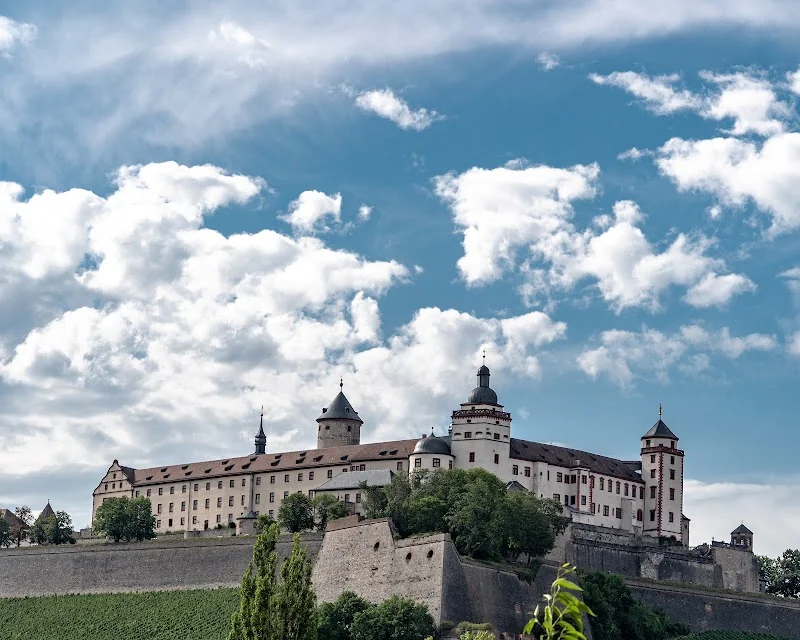
QWQC+XR, Marienberg, Würzburg-Zellerau
QWQC+XR, Marienberg, 97082 Würzburg, Germany
Marienberg Fortress | Opening Hours & Tickets
Marienberg Fortress is one of the most distinctive landmarks of Würzburg and a place where city history, views, museum visits, and current construction phases overlap directly. Those who visit the fortress today experience not a static monument view, but a vibrant complex with clearly regulated opening hours, ongoing renovation, a still-open museum, and a historical backdrop composed of many epochs. This very mix makes Marienberg Fortress relevant for queries like history, museum, opening hours, tickets, hike, map, or Prince's Garden. The complex towers above the Main, is hardly overlooked in the cityscape, and simultaneously serves as a landmark for all those who want to explore Würzburg on foot, by bus, or as a cultural-historical destination. Currently, access is not freely available everywhere, but this makes planning important: The visitor can see at a glance what is open, what is only accessible as part of a guided tour, and where the Museum of Franconia is worth visiting as an independent point. This makes the fortress a destination for travelers who are not only looking for beautiful photos but also want to understand the background, history, and practical side of a visit. ([wuerzburg.de](https://www.wuerzburg.de/tourismus/wuerzburg-entdecken/sehenswuerdigkeiten/festung-marienberg/index.html%3F_dc%3D64fd428ab2e8b))
History of Marienberg Fortress: from the Marienkirche to the Prince-Bishop's Residence
The historical depth of Marienberg Fortress is extraordinary because it cannot be explained with a single founding date. According to the Würzburg city information, the history of the mountain can be traced over three millennia; at the site of today's fortress, there was already a Celtic refuge around 1000 BC. The later castle complex developed from the Marienkirche, consecrated in 706, which is considered the earliest sacred building east of the Rhine. The castle was founded in 1201, and the keep dates from this phase. From about 1250 to 1719, Marienberg was the residence of the Prince-Bishops of Würzburg, thus not only a fortification but the political and representative center of an entire dominion. This long usage explains why the complex today shows not only military elements but also sacred, courtly, and baroque traces. After the conquest by the Swedes in 1631, Prince-Bishop Johann Philipp von Schönborn had a chain of massive bastions built, which still shape the image of the fortress today. The Bavarian Palace Administration adds to this history the note of an early fortification built in the 8th century, the Marienkapelle around the year 1000, the expansion from 1200, and the almost complete destruction in 1945. This sequence of creation, expansion, rule, and reconstruction makes the fortress a key location for all those interested in Marienberg Fortress history, Würzburg Germany, or Marienberg Fortress Germany. Understanding the complex also provides insight into the political and cultural development of the city of Würzburg itself. ([wuerzburg.de](https://www.wuerzburg.de/tourismus/wuerzburg-entdecken/sehenswuerdigkeiten/festung-marienberg/index.html%3F_dc%3D64fd428ab2e8b))
Particularly important is the transition between military architecture and representation. The main castle was converted into a Renaissance palace around 1600, followed later by the baroque expansion with bastions and the Prince's Garden. The Marienkirche, the approximately forty-meter-high keep, and the deep well house with a cistern over 100 meters deep symbolize the different functions of the fortress over the centuries. In World War II, the complex was almost completely destroyed by fire in 1945; reconstruction was only completed in 1990. This is not just a historical footnote for visitors but the reason why the fortress today appears so multifaceted: One does not see an untouched Middle Ages but a monument with breaks, losses, and reconstruction. This history also explains why the search for Marienberg Fortress WW2 or history does not only target a war event but the question of how a historical site continues to live after its destruction. For travelers, this creates an exciting contrast: above, the wide view over the Main Valley, below, centuries of religion, power, war, architecture, and monument preservation. Thus, the fortress is not only a destination but a compressed historical space that tells the story of Würzburg from the Bronze Age to the present. ([schloesser.bayern.de](https://www.schloesser.bayern.de/englisch/palace/objects/wu_fest.htm))
Marienberg Fortress inside: Museum of Franconia, Arsenal, and Prince's Building
Those searching for Marienberg Fortress inside usually want to know what is currently really visible inside the complex. The most important answer is: The Museum of Franconia is still open and is currently located in the armory at Marienberg Fortress. The museum's website describes it as the most significant museum for Franconia and as a place for dialogue about the cultural heritage of the region. The content focuses on art, culture, and regional history, precisely on those topics that provide visitors with a solid access to Würzburg and Lower Franconia. The Bavarian Palace Administration also points out that the collections of the Museum of Franconia are located in the Arsenal and the Prince's Building; this is exactly where the insights associated with the search term Marienberg Fortress and Prince's Building are created. It is important for visitors to understand that the museum should not simply be seen as a side room of the fortress but as an independent, open museum visit with its own opening hours, admission prices, and services. The museum is also only partially accessible, but offers an audio guide solution in German, English, and Easy Language, with sign language videos and a children's version. Photos for private purposes are allowed without flash or tripod, luggage can be stored or left at the ticket area, and there is a small infrastructure with lockers and vending machines in the second courtyard. This is practical for all those planning a longer stay and wanting to know how comfortable a visit currently really is. ([museum-franken.de](https://www.museum-franken.de/en/museum/unser-team))
At the same time, the theme inside is currently strongly shaped by ongoing renovations. Since 2022, the main castle has been undergoing renovation in several construction phases, and the museum's website explains that the inner fortress will be structurally reorganized and remodeled for the museum in the coming years. A current museum contribution even mentions a planned move to the main castle with a new permanent exhibition of around 4000 square meters, with the reopening scheduled for 2032. For the search intent Marienberg Fortress inside, this means: interior spaces are currently only accessible to a limited extent and not experienced in the sense of a free tour. Instead, the visit is particularly worthwhile as a combination of museum, guided format, and external reference to the historical complex. For many guests, this is interesting because they do not just see a hall or a staircase but witness the transformation process of a large fortress. The museum's website also mentions that the house is digitally evolving, expanding its educational work, and aims to promote identification with Franconia and Würzburg. Thus, Marienberg Fortress becomes not only a monument with a past but also a project with a future. So, those searching for Marienberg Fortress museum today receive not only history but also an insight into a house that is reestablishing itself while still being visitable. ([museum-franken.de](https://www.museum-franken.de/en/museum/unser-team))
Marienberg Fortress hike, map, and access: on foot, by bus, and with parking on site
The journey to Marienberg Fortress is intentionally diverse and fits the search terms hike, map, parking, and opening hours. Those wishing to come on foot have one of the most famous routes with the Tellsteige: According to the Museum of Franconia, it leads from the Old Main Bridge in about 20 minutes up to the fortress. The steps can be bypassed via Schlossgasse, but the entire route has a significant incline, making the walk more of a small ascent than a leisurely promenade. However, this is precisely the appeal for many visitors, as the path is part of the experience and already offers beautiful views of the Main, the city, and the slopes along the way. Those wishing to take the bus can use line 9 from the Residenz or Juliuspromenade to the Schönborntor stop from April to October; line 18 runs year-round from the main train station to Oberer Burgweg, from where it is about a ten-minute walk. This also supports the search intent Marienberg Fortress map, as the fortress is not isolated but clearly connected to the urban fabric. For drivers and tour groups, paid parking is available at the entrance to the fortress; designated parking spaces for people with disabilities are located within the fortress directly opposite the Museum of Franconia. Thus, the most important practical questions are relatively well resolved, even if one should inform oneself in advance about the exact access due to ongoing construction work. The administration also names the museum shop at Echtertor as a meeting point for guided tours, which is useful for day visitors and tour groups. Overall, the journey is designed so that the fortress works for both a short stop and a full-day cultural walk. ([museum-franken.de](https://www.museum-franken.de/en/besuch/besuchsinformationen))
For planning, it is also helpful that the fortress is not just a point on the map but an ensemble with several levels. Those coming from the riverside or the Old Main Bridge can already see from afar how the complex towers above the city. This is precisely why Marienberg Fortress is well-suited for guests who want to design their own route: first a walk over the bridge, then the ascent via the Tellsteige or the alternative route, followed by a museum visit and then a look at the outer courtyards and viewpoints. It is also practical that the guided tours of the fortress walk in the outdoor area last about 45 minutes and do not include the machicolation tower or the casemate. The tours are conducted in German and, during the summer on weekends and holidays, also in English; prices are 5 euros regular and 4 euros reduced, children under 18 are free. Thus, the fortress is not just a viewpoint but a well-structured cultural site with various accesses. For seekers who want to get an idea in advance, this is crucial: map, hike, tickets, and opening hours do not describe separate goals here but a cohesive visitor experience that can be adjusted according to time, condition, and interest. ([schloesser.bayern.de](https://www.schloesser.bayern.de/englisch/palace/objects/wu_fest.htm))
Prince's Garden, Views, and Photos over Würzburg
The Prince's Garden is one of the most well-known keywords surrounding Marienberg Fortress, and for good reason. The Bavarian Palace Administration describes the garden as a facility on the slope in front of the east side of the fortress, which has probably existed since the early 16th century. Its artistic terraces, balustrades, and baroque form date mainly from the time of Prince-Bishop Johann Philipp von Schönborn; the garden took on its current form around 1700 under Johann Philipp von Greiffenclau and was restored again in 1937 based on older plans. The garden is about 1300 square meters in size and usually offers wide views over Würzburg and the Main Valley to Randersacker as well as to the Nikolausberg with the Käppele. This is precisely why the search term Marienberg Fortress photos is so closely linked to the Prince's Garden: Here one finds the famous panoramic views that appear in many travel photos and city motifs. Currently, however, access is not possible because it is closed due to construction work on the fortress. For an SEO-oriented presentation, this is important as it prevents false expectations and also makes it clear that the garden is not gone but only temporarily inaccessible. Those wishing to return later will find a place where architecture, garden art, and distant views work particularly well together. ([schloesser.bayern.de](https://www.schloesser.bayern.de/englisch/garden/objects/wu_fest.htm))
Even though the Prince's Garden is currently closed, the panorama theme remains one of the strongest reasons for visiting Marienberg Fortress. The city of Würzburg already describes the fortress as a widely visible landmark with a history of more than a thousand years, and this view from above of the city is the actual highlight for many guests. In the Museum of Franconia, photographing for private purposes is allowed without flash and tripod, which further facilitates the visit if one wants to combine indoor and outdoor shots. The combination of city views, historical architecture, and the position of the fortress above the Main makes the complex an ideal destination for all those who understand photos not just as memories but as part of travel planning. Those searching for Marienberg Fortress reviews usually want to assess exactly this mix: How strenuous is the ascent, how good is the view, how much history is actually tangible, and is the detour worth it despite construction work? The answer is positive, especially because of the good viewpoints and clear structure. Even if the Prince's Garden is not open at the moment, the sightlines, courtyards, and surroundings of the fortress remain attractive. For visitors to Würzburg, this is particularly appealing because the city, vineyards, river, and fortress merge into a single landscape image. Thus, Marienberg Fortress becomes not only a historical monument but also one of the best places to visually grasp Würzburg. ([schloesser.bayern.de](https://www.schloesser.bayern.de/englisch/garden/objects/wu_fest.htm))
Renovation, Destruction 1945, and Future until 2032
A large part of today's visitor experience depends on the ongoing renovation of the fortress. The Bavarian Palace Administration explains that the main castle and the inner courtyard are closed to individual visitors due to construction work for the time being, while the second courtyard, the so-called Echterhof, and the viewpoints around the castle remain accessible. At the same time, guided tours of the entire area continue, even if the route may be adjusted at short notice. The Museum of Franconia also remains open, and this combination of limited access and active use is crucial for the current perception of the fortress. Historically, this fits with a site that was almost completely burned down in 1945 and whose reconstruction was only completed in 1990. Those searching for Marienberg Fortress WW2 do not encounter a mere war ruin but the history of a destroyed and reassembled complex. The visible construction work today is therefore not an alien element but part of a long monument history in which preservation, remodeling, and redefinition have repeatedly played a role. ([schloesser.bayern.de](https://www.schloesser.bayern.de/englisch/palace/objects/wu_fest.htm))
For the future, the perspective is also clearly described. The museum's website explains that the main castle has been undergoing several construction phases since 2022 and will be structurally redesigned for the Museum of Franconia in the coming years. A current contribution from 2026 mentions the goal of reopening the Museum of Franconia in 2032, when a restored main object will be presented again in the new exhibition rooms. At the same time, a modern, visitor-oriented permanent exhibition of around 4000 square meters is to be created in the main castle. This shows that Marienberg Fortress is not only being managed but is also being rethought in terms of content and space. For visitors, this means: Those who come today see a transitional state with very real history, active restorations, and a museum use that is already open today. Those who return later will experience a different, likely much more comprehensive tour. This is precisely why the fortress is particularly exciting for an SEO and content strategy, as it not only responds to the past but also to future questions. When all elements are brought together, a place emerges that functions simultaneously as a historical symbol, a walking destination, a museum, and a major construction site. This may seem contradictory at first glance, but it is precisely the strength of Marienberg Fortress: It remains visible, readable, and relevant, even while still under construction. ([museum-franken.de](https://www.museum-franken.de/en/museum/unser-team))
Sources:
Mehr anzeigenWeniger anzeigen
Marienberg Fortress | Opening Hours & Tickets
Marienberg Fortress is one of the most distinctive landmarks of Würzburg and a place where city history, views, museum visits, and current construction phases overlap directly. Those who visit the fortress today experience not a static monument view, but a vibrant complex with clearly regulated opening hours, ongoing renovation, a still-open museum, and a historical backdrop composed of many epochs. This very mix makes Marienberg Fortress relevant for queries like history, museum, opening hours, tickets, hike, map, or Prince's Garden. The complex towers above the Main, is hardly overlooked in the cityscape, and simultaneously serves as a landmark for all those who want to explore Würzburg on foot, by bus, or as a cultural-historical destination. Currently, access is not freely available everywhere, but this makes planning important: The visitor can see at a glance what is open, what is only accessible as part of a guided tour, and where the Museum of Franconia is worth visiting as an independent point. This makes the fortress a destination for travelers who are not only looking for beautiful photos but also want to understand the background, history, and practical side of a visit. ([wuerzburg.de](https://www.wuerzburg.de/tourismus/wuerzburg-entdecken/sehenswuerdigkeiten/festung-marienberg/index.html%3F_dc%3D64fd428ab2e8b))
History of Marienberg Fortress: from the Marienkirche to the Prince-Bishop's Residence
The historical depth of Marienberg Fortress is extraordinary because it cannot be explained with a single founding date. According to the Würzburg city information, the history of the mountain can be traced over three millennia; at the site of today's fortress, there was already a Celtic refuge around 1000 BC. The later castle complex developed from the Marienkirche, consecrated in 706, which is considered the earliest sacred building east of the Rhine. The castle was founded in 1201, and the keep dates from this phase. From about 1250 to 1719, Marienberg was the residence of the Prince-Bishops of Würzburg, thus not only a fortification but the political and representative center of an entire dominion. This long usage explains why the complex today shows not only military elements but also sacred, courtly, and baroque traces. After the conquest by the Swedes in 1631, Prince-Bishop Johann Philipp von Schönborn had a chain of massive bastions built, which still shape the image of the fortress today. The Bavarian Palace Administration adds to this history the note of an early fortification built in the 8th century, the Marienkapelle around the year 1000, the expansion from 1200, and the almost complete destruction in 1945. This sequence of creation, expansion, rule, and reconstruction makes the fortress a key location for all those interested in Marienberg Fortress history, Würzburg Germany, or Marienberg Fortress Germany. Understanding the complex also provides insight into the political and cultural development of the city of Würzburg itself. ([wuerzburg.de](https://www.wuerzburg.de/tourismus/wuerzburg-entdecken/sehenswuerdigkeiten/festung-marienberg/index.html%3F_dc%3D64fd428ab2e8b))
Particularly important is the transition between military architecture and representation. The main castle was converted into a Renaissance palace around 1600, followed later by the baroque expansion with bastions and the Prince's Garden. The Marienkirche, the approximately forty-meter-high keep, and the deep well house with a cistern over 100 meters deep symbolize the different functions of the fortress over the centuries. In World War II, the complex was almost completely destroyed by fire in 1945; reconstruction was only completed in 1990. This is not just a historical footnote for visitors but the reason why the fortress today appears so multifaceted: One does not see an untouched Middle Ages but a monument with breaks, losses, and reconstruction. This history also explains why the search for Marienberg Fortress WW2 or history does not only target a war event but the question of how a historical site continues to live after its destruction. For travelers, this creates an exciting contrast: above, the wide view over the Main Valley, below, centuries of religion, power, war, architecture, and monument preservation. Thus, the fortress is not only a destination but a compressed historical space that tells the story of Würzburg from the Bronze Age to the present. ([schloesser.bayern.de](https://www.schloesser.bayern.de/englisch/palace/objects/wu_fest.htm))
Marienberg Fortress inside: Museum of Franconia, Arsenal, and Prince's Building
Those searching for Marienberg Fortress inside usually want to know what is currently really visible inside the complex. The most important answer is: The Museum of Franconia is still open and is currently located in the armory at Marienberg Fortress. The museum's website describes it as the most significant museum for Franconia and as a place for dialogue about the cultural heritage of the region. The content focuses on art, culture, and regional history, precisely on those topics that provide visitors with a solid access to Würzburg and Lower Franconia. The Bavarian Palace Administration also points out that the collections of the Museum of Franconia are located in the Arsenal and the Prince's Building; this is exactly where the insights associated with the search term Marienberg Fortress and Prince's Building are created. It is important for visitors to understand that the museum should not simply be seen as a side room of the fortress but as an independent, open museum visit with its own opening hours, admission prices, and services. The museum is also only partially accessible, but offers an audio guide solution in German, English, and Easy Language, with sign language videos and a children's version. Photos for private purposes are allowed without flash or tripod, luggage can be stored or left at the ticket area, and there is a small infrastructure with lockers and vending machines in the second courtyard. This is practical for all those planning a longer stay and wanting to know how comfortable a visit currently really is. ([museum-franken.de](https://www.museum-franken.de/en/museum/unser-team))
At the same time, the theme inside is currently strongly shaped by ongoing renovations. Since 2022, the main castle has been undergoing renovation in several construction phases, and the museum's website explains that the inner fortress will be structurally reorganized and remodeled for the museum in the coming years. A current museum contribution even mentions a planned move to the main castle with a new permanent exhibition of around 4000 square meters, with the reopening scheduled for 2032. For the search intent Marienberg Fortress inside, this means: interior spaces are currently only accessible to a limited extent and not experienced in the sense of a free tour. Instead, the visit is particularly worthwhile as a combination of museum, guided format, and external reference to the historical complex. For many guests, this is interesting because they do not just see a hall or a staircase but witness the transformation process of a large fortress. The museum's website also mentions that the house is digitally evolving, expanding its educational work, and aims to promote identification with Franconia and Würzburg. Thus, Marienberg Fortress becomes not only a monument with a past but also a project with a future. So, those searching for Marienberg Fortress museum today receive not only history but also an insight into a house that is reestablishing itself while still being visitable. ([museum-franken.de](https://www.museum-franken.de/en/museum/unser-team))
Marienberg Fortress hike, map, and access: on foot, by bus, and with parking on site
The journey to Marienberg Fortress is intentionally diverse and fits the search terms hike, map, parking, and opening hours. Those wishing to come on foot have one of the most famous routes with the Tellsteige: According to the Museum of Franconia, it leads from the Old Main Bridge in about 20 minutes up to the fortress. The steps can be bypassed via Schlossgasse, but the entire route has a significant incline, making the walk more of a small ascent than a leisurely promenade. However, this is precisely the appeal for many visitors, as the path is part of the experience and already offers beautiful views of the Main, the city, and the slopes along the way. Those wishing to take the bus can use line 9 from the Residenz or Juliuspromenade to the Schönborntor stop from April to October; line 18 runs year-round from the main train station to Oberer Burgweg, from where it is about a ten-minute walk. This also supports the search intent Marienberg Fortress map, as the fortress is not isolated but clearly connected to the urban fabric. For drivers and tour groups, paid parking is available at the entrance to the fortress; designated parking spaces for people with disabilities are located within the fortress directly opposite the Museum of Franconia. Thus, the most important practical questions are relatively well resolved, even if one should inform oneself in advance about the exact access due to ongoing construction work. The administration also names the museum shop at Echtertor as a meeting point for guided tours, which is useful for day visitors and tour groups. Overall, the journey is designed so that the fortress works for both a short stop and a full-day cultural walk. ([museum-franken.de](https://www.museum-franken.de/en/besuch/besuchsinformationen))
For planning, it is also helpful that the fortress is not just a point on the map but an ensemble with several levels. Those coming from the riverside or the Old Main Bridge can already see from afar how the complex towers above the city. This is precisely why Marienberg Fortress is well-suited for guests who want to design their own route: first a walk over the bridge, then the ascent via the Tellsteige or the alternative route, followed by a museum visit and then a look at the outer courtyards and viewpoints. It is also practical that the guided tours of the fortress walk in the outdoor area last about 45 minutes and do not include the machicolation tower or the casemate. The tours are conducted in German and, during the summer on weekends and holidays, also in English; prices are 5 euros regular and 4 euros reduced, children under 18 are free. Thus, the fortress is not just a viewpoint but a well-structured cultural site with various accesses. For seekers who want to get an idea in advance, this is crucial: map, hike, tickets, and opening hours do not describe separate goals here but a cohesive visitor experience that can be adjusted according to time, condition, and interest. ([schloesser.bayern.de](https://www.schloesser.bayern.de/englisch/palace/objects/wu_fest.htm))
Prince's Garden, Views, and Photos over Würzburg
The Prince's Garden is one of the most well-known keywords surrounding Marienberg Fortress, and for good reason. The Bavarian Palace Administration describes the garden as a facility on the slope in front of the east side of the fortress, which has probably existed since the early 16th century. Its artistic terraces, balustrades, and baroque form date mainly from the time of Prince-Bishop Johann Philipp von Schönborn; the garden took on its current form around 1700 under Johann Philipp von Greiffenclau and was restored again in 1937 based on older plans. The garden is about 1300 square meters in size and usually offers wide views over Würzburg and the Main Valley to Randersacker as well as to the Nikolausberg with the Käppele. This is precisely why the search term Marienberg Fortress photos is so closely linked to the Prince's Garden: Here one finds the famous panoramic views that appear in many travel photos and city motifs. Currently, however, access is not possible because it is closed due to construction work on the fortress. For an SEO-oriented presentation, this is important as it prevents false expectations and also makes it clear that the garden is not gone but only temporarily inaccessible. Those wishing to return later will find a place where architecture, garden art, and distant views work particularly well together. ([schloesser.bayern.de](https://www.schloesser.bayern.de/englisch/garden/objects/wu_fest.htm))
Even though the Prince's Garden is currently closed, the panorama theme remains one of the strongest reasons for visiting Marienberg Fortress. The city of Würzburg already describes the fortress as a widely visible landmark with a history of more than a thousand years, and this view from above of the city is the actual highlight for many guests. In the Museum of Franconia, photographing for private purposes is allowed without flash and tripod, which further facilitates the visit if one wants to combine indoor and outdoor shots. The combination of city views, historical architecture, and the position of the fortress above the Main makes the complex an ideal destination for all those who understand photos not just as memories but as part of travel planning. Those searching for Marienberg Fortress reviews usually want to assess exactly this mix: How strenuous is the ascent, how good is the view, how much history is actually tangible, and is the detour worth it despite construction work? The answer is positive, especially because of the good viewpoints and clear structure. Even if the Prince's Garden is not open at the moment, the sightlines, courtyards, and surroundings of the fortress remain attractive. For visitors to Würzburg, this is particularly appealing because the city, vineyards, river, and fortress merge into a single landscape image. Thus, Marienberg Fortress becomes not only a historical monument but also one of the best places to visually grasp Würzburg. ([schloesser.bayern.de](https://www.schloesser.bayern.de/englisch/garden/objects/wu_fest.htm))
Renovation, Destruction 1945, and Future until 2032
A large part of today's visitor experience depends on the ongoing renovation of the fortress. The Bavarian Palace Administration explains that the main castle and the inner courtyard are closed to individual visitors due to construction work for the time being, while the second courtyard, the so-called Echterhof, and the viewpoints around the castle remain accessible. At the same time, guided tours of the entire area continue, even if the route may be adjusted at short notice. The Museum of Franconia also remains open, and this combination of limited access and active use is crucial for the current perception of the fortress. Historically, this fits with a site that was almost completely burned down in 1945 and whose reconstruction was only completed in 1990. Those searching for Marienberg Fortress WW2 do not encounter a mere war ruin but the history of a destroyed and reassembled complex. The visible construction work today is therefore not an alien element but part of a long monument history in which preservation, remodeling, and redefinition have repeatedly played a role. ([schloesser.bayern.de](https://www.schloesser.bayern.de/englisch/palace/objects/wu_fest.htm))
For the future, the perspective is also clearly described. The museum's website explains that the main castle has been undergoing several construction phases since 2022 and will be structurally redesigned for the Museum of Franconia in the coming years. A current contribution from 2026 mentions the goal of reopening the Museum of Franconia in 2032, when a restored main object will be presented again in the new exhibition rooms. At the same time, a modern, visitor-oriented permanent exhibition of around 4000 square meters is to be created in the main castle. This shows that Marienberg Fortress is not only being managed but is also being rethought in terms of content and space. For visitors, this means: Those who come today see a transitional state with very real history, active restorations, and a museum use that is already open today. Those who return later will experience a different, likely much more comprehensive tour. This is precisely why the fortress is particularly exciting for an SEO and content strategy, as it not only responds to the past but also to future questions. When all elements are brought together, a place emerges that functions simultaneously as a historical symbol, a walking destination, a museum, and a major construction site. This may seem contradictory at first glance, but it is precisely the strength of Marienberg Fortress: It remains visible, readable, and relevant, even while still under construction. ([museum-franken.de](https://www.museum-franken.de/en/museum/unser-team))
Sources:
Marienberg Fortress | Opening Hours & Tickets
Marienberg Fortress is one of the most distinctive landmarks of Würzburg and a place where city history, views, museum visits, and current construction phases overlap directly. Those who visit the fortress today experience not a static monument view, but a vibrant complex with clearly regulated opening hours, ongoing renovation, a still-open museum, and a historical backdrop composed of many epochs. This very mix makes Marienberg Fortress relevant for queries like history, museum, opening hours, tickets, hike, map, or Prince's Garden. The complex towers above the Main, is hardly overlooked in the cityscape, and simultaneously serves as a landmark for all those who want to explore Würzburg on foot, by bus, or as a cultural-historical destination. Currently, access is not freely available everywhere, but this makes planning important: The visitor can see at a glance what is open, what is only accessible as part of a guided tour, and where the Museum of Franconia is worth visiting as an independent point. This makes the fortress a destination for travelers who are not only looking for beautiful photos but also want to understand the background, history, and practical side of a visit. ([wuerzburg.de](https://www.wuerzburg.de/tourismus/wuerzburg-entdecken/sehenswuerdigkeiten/festung-marienberg/index.html%3F_dc%3D64fd428ab2e8b))
History of Marienberg Fortress: from the Marienkirche to the Prince-Bishop's Residence
The historical depth of Marienberg Fortress is extraordinary because it cannot be explained with a single founding date. According to the Würzburg city information, the history of the mountain can be traced over three millennia; at the site of today's fortress, there was already a Celtic refuge around 1000 BC. The later castle complex developed from the Marienkirche, consecrated in 706, which is considered the earliest sacred building east of the Rhine. The castle was founded in 1201, and the keep dates from this phase. From about 1250 to 1719, Marienberg was the residence of the Prince-Bishops of Würzburg, thus not only a fortification but the political and representative center of an entire dominion. This long usage explains why the complex today shows not only military elements but also sacred, courtly, and baroque traces. After the conquest by the Swedes in 1631, Prince-Bishop Johann Philipp von Schönborn had a chain of massive bastions built, which still shape the image of the fortress today. The Bavarian Palace Administration adds to this history the note of an early fortification built in the 8th century, the Marienkapelle around the year 1000, the expansion from 1200, and the almost complete destruction in 1945. This sequence of creation, expansion, rule, and reconstruction makes the fortress a key location for all those interested in Marienberg Fortress history, Würzburg Germany, or Marienberg Fortress Germany. Understanding the complex also provides insight into the political and cultural development of the city of Würzburg itself. ([wuerzburg.de](https://www.wuerzburg.de/tourismus/wuerzburg-entdecken/sehenswuerdigkeiten/festung-marienberg/index.html%3F_dc%3D64fd428ab2e8b))
Particularly important is the transition between military architecture and representation. The main castle was converted into a Renaissance palace around 1600, followed later by the baroque expansion with bastions and the Prince's Garden. The Marienkirche, the approximately forty-meter-high keep, and the deep well house with a cistern over 100 meters deep symbolize the different functions of the fortress over the centuries. In World War II, the complex was almost completely destroyed by fire in 1945; reconstruction was only completed in 1990. This is not just a historical footnote for visitors but the reason why the fortress today appears so multifaceted: One does not see an untouched Middle Ages but a monument with breaks, losses, and reconstruction. This history also explains why the search for Marienberg Fortress WW2 or history does not only target a war event but the question of how a historical site continues to live after its destruction. For travelers, this creates an exciting contrast: above, the wide view over the Main Valley, below, centuries of religion, power, war, architecture, and monument preservation. Thus, the fortress is not only a destination but a compressed historical space that tells the story of Würzburg from the Bronze Age to the present. ([schloesser.bayern.de](https://www.schloesser.bayern.de/englisch/palace/objects/wu_fest.htm))
Marienberg Fortress inside: Museum of Franconia, Arsenal, and Prince's Building
Those searching for Marienberg Fortress inside usually want to know what is currently really visible inside the complex. The most important answer is: The Museum of Franconia is still open and is currently located in the armory at Marienberg Fortress. The museum's website describes it as the most significant museum for Franconia and as a place for dialogue about the cultural heritage of the region. The content focuses on art, culture, and regional history, precisely on those topics that provide visitors with a solid access to Würzburg and Lower Franconia. The Bavarian Palace Administration also points out that the collections of the Museum of Franconia are located in the Arsenal and the Prince's Building; this is exactly where the insights associated with the search term Marienberg Fortress and Prince's Building are created. It is important for visitors to understand that the museum should not simply be seen as a side room of the fortress but as an independent, open museum visit with its own opening hours, admission prices, and services. The museum is also only partially accessible, but offers an audio guide solution in German, English, and Easy Language, with sign language videos and a children's version. Photos for private purposes are allowed without flash or tripod, luggage can be stored or left at the ticket area, and there is a small infrastructure with lockers and vending machines in the second courtyard. This is practical for all those planning a longer stay and wanting to know how comfortable a visit currently really is. ([museum-franken.de](https://www.museum-franken.de/en/museum/unser-team))
At the same time, the theme inside is currently strongly shaped by ongoing renovations. Since 2022, the main castle has been undergoing renovation in several construction phases, and the museum's website explains that the inner fortress will be structurally reorganized and remodeled for the museum in the coming years. A current museum contribution even mentions a planned move to the main castle with a new permanent exhibition of around 4000 square meters, with the reopening scheduled for 2032. For the search intent Marienberg Fortress inside, this means: interior spaces are currently only accessible to a limited extent and not experienced in the sense of a free tour. Instead, the visit is particularly worthwhile as a combination of museum, guided format, and external reference to the historical complex. For many guests, this is interesting because they do not just see a hall or a staircase but witness the transformation process of a large fortress. The museum's website also mentions that the house is digitally evolving, expanding its educational work, and aims to promote identification with Franconia and Würzburg. Thus, Marienberg Fortress becomes not only a monument with a past but also a project with a future. So, those searching for Marienberg Fortress museum today receive not only history but also an insight into a house that is reestablishing itself while still being visitable. ([museum-franken.de](https://www.museum-franken.de/en/museum/unser-team))
Marienberg Fortress hike, map, and access: on foot, by bus, and with parking on site
The journey to Marienberg Fortress is intentionally diverse and fits the search terms hike, map, parking, and opening hours. Those wishing to come on foot have one of the most famous routes with the Tellsteige: According to the Museum of Franconia, it leads from the Old Main Bridge in about 20 minutes up to the fortress. The steps can be bypassed via Schlossgasse, but the entire route has a significant incline, making the walk more of a small ascent than a leisurely promenade. However, this is precisely the appeal for many visitors, as the path is part of the experience and already offers beautiful views of the Main, the city, and the slopes along the way. Those wishing to take the bus can use line 9 from the Residenz or Juliuspromenade to the Schönborntor stop from April to October; line 18 runs year-round from the main train station to Oberer Burgweg, from where it is about a ten-minute walk. This also supports the search intent Marienberg Fortress map, as the fortress is not isolated but clearly connected to the urban fabric. For drivers and tour groups, paid parking is available at the entrance to the fortress; designated parking spaces for people with disabilities are located within the fortress directly opposite the Museum of Franconia. Thus, the most important practical questions are relatively well resolved, even if one should inform oneself in advance about the exact access due to ongoing construction work. The administration also names the museum shop at Echtertor as a meeting point for guided tours, which is useful for day visitors and tour groups. Overall, the journey is designed so that the fortress works for both a short stop and a full-day cultural walk. ([museum-franken.de](https://www.museum-franken.de/en/besuch/besuchsinformationen))
For planning, it is also helpful that the fortress is not just a point on the map but an ensemble with several levels. Those coming from the riverside or the Old Main Bridge can already see from afar how the complex towers above the city. This is precisely why Marienberg Fortress is well-suited for guests who want to design their own route: first a walk over the bridge, then the ascent via the Tellsteige or the alternative route, followed by a museum visit and then a look at the outer courtyards and viewpoints. It is also practical that the guided tours of the fortress walk in the outdoor area last about 45 minutes and do not include the machicolation tower or the casemate. The tours are conducted in German and, during the summer on weekends and holidays, also in English; prices are 5 euros regular and 4 euros reduced, children under 18 are free. Thus, the fortress is not just a viewpoint but a well-structured cultural site with various accesses. For seekers who want to get an idea in advance, this is crucial: map, hike, tickets, and opening hours do not describe separate goals here but a cohesive visitor experience that can be adjusted according to time, condition, and interest. ([schloesser.bayern.de](https://www.schloesser.bayern.de/englisch/palace/objects/wu_fest.htm))
Prince's Garden, Views, and Photos over Würzburg
The Prince's Garden is one of the most well-known keywords surrounding Marienberg Fortress, and for good reason. The Bavarian Palace Administration describes the garden as a facility on the slope in front of the east side of the fortress, which has probably existed since the early 16th century. Its artistic terraces, balustrades, and baroque form date mainly from the time of Prince-Bishop Johann Philipp von Schönborn; the garden took on its current form around 1700 under Johann Philipp von Greiffenclau and was restored again in 1937 based on older plans. The garden is about 1300 square meters in size and usually offers wide views over Würzburg and the Main Valley to Randersacker as well as to the Nikolausberg with the Käppele. This is precisely why the search term Marienberg Fortress photos is so closely linked to the Prince's Garden: Here one finds the famous panoramic views that appear in many travel photos and city motifs. Currently, however, access is not possible because it is closed due to construction work on the fortress. For an SEO-oriented presentation, this is important as it prevents false expectations and also makes it clear that the garden is not gone but only temporarily inaccessible. Those wishing to return later will find a place where architecture, garden art, and distant views work particularly well together. ([schloesser.bayern.de](https://www.schloesser.bayern.de/englisch/garden/objects/wu_fest.htm))
Even though the Prince's Garden is currently closed, the panorama theme remains one of the strongest reasons for visiting Marienberg Fortress. The city of Würzburg already describes the fortress as a widely visible landmark with a history of more than a thousand years, and this view from above of the city is the actual highlight for many guests. In the Museum of Franconia, photographing for private purposes is allowed without flash and tripod, which further facilitates the visit if one wants to combine indoor and outdoor shots. The combination of city views, historical architecture, and the position of the fortress above the Main makes the complex an ideal destination for all those who understand photos not just as memories but as part of travel planning. Those searching for Marienberg Fortress reviews usually want to assess exactly this mix: How strenuous is the ascent, how good is the view, how much history is actually tangible, and is the detour worth it despite construction work? The answer is positive, especially because of the good viewpoints and clear structure. Even if the Prince's Garden is not open at the moment, the sightlines, courtyards, and surroundings of the fortress remain attractive. For visitors to Würzburg, this is particularly appealing because the city, vineyards, river, and fortress merge into a single landscape image. Thus, Marienberg Fortress becomes not only a historical monument but also one of the best places to visually grasp Würzburg. ([schloesser.bayern.de](https://www.schloesser.bayern.de/englisch/garden/objects/wu_fest.htm))
Renovation, Destruction 1945, and Future until 2032
A large part of today's visitor experience depends on the ongoing renovation of the fortress. The Bavarian Palace Administration explains that the main castle and the inner courtyard are closed to individual visitors due to construction work for the time being, while the second courtyard, the so-called Echterhof, and the viewpoints around the castle remain accessible. At the same time, guided tours of the entire area continue, even if the route may be adjusted at short notice. The Museum of Franconia also remains open, and this combination of limited access and active use is crucial for the current perception of the fortress. Historically, this fits with a site that was almost completely burned down in 1945 and whose reconstruction was only completed in 1990. Those searching for Marienberg Fortress WW2 do not encounter a mere war ruin but the history of a destroyed and reassembled complex. The visible construction work today is therefore not an alien element but part of a long monument history in which preservation, remodeling, and redefinition have repeatedly played a role. ([schloesser.bayern.de](https://www.schloesser.bayern.de/englisch/palace/objects/wu_fest.htm))
For the future, the perspective is also clearly described. The museum's website explains that the main castle has been undergoing several construction phases since 2022 and will be structurally redesigned for the Museum of Franconia in the coming years. A current contribution from 2026 mentions the goal of reopening the Museum of Franconia in 2032, when a restored main object will be presented again in the new exhibition rooms. At the same time, a modern, visitor-oriented permanent exhibition of around 4000 square meters is to be created in the main castle. This shows that Marienberg Fortress is not only being managed but is also being rethought in terms of content and space. For visitors, this means: Those who come today see a transitional state with very real history, active restorations, and a museum use that is already open today. Those who return later will experience a different, likely much more comprehensive tour. This is precisely why the fortress is particularly exciting for an SEO and content strategy, as it not only responds to the past but also to future questions. When all elements are brought together, a place emerges that functions simultaneously as a historical symbol, a walking destination, a museum, and a major construction site. This may seem contradictory at first glance, but it is precisely the strength of Marienberg Fortress: It remains visible, readable, and relevant, even while still under construction. ([museum-franken.de](https://www.museum-franken.de/en/museum/unser-team))
Sources:
Upcoming Events
No events found
Frequently Asked Questions
Reviews
Nanita
30. January 2026
The Marienberg Fortress with origins from the 7th / 8th century is a Würzburg icon. Perched high on a hill overlooking the Main river, this fortress is well worth visiting. There are gardens open to the public and you can even walk along a path through a vineyard to access the fortress. The fortress is open to the public; however I did not enter. I still managed to spend a couple hours walking there from across the river and exploring the surroundings.
Tony B
7. October 2025
One of the best strolls in the area: crossing the bridge and leisurely walking up to the fortress in the midst of vineyards. Strongly recommended the castle tour and enjoying the view from the top gardens.
John Sutherland
2. November 2025
We have just enjoyed a very pleasant and interesting visit to the fortress. The steady climb up from the river provided nice views. Although the fortress is undergoing major renovations until 2032, the museum in the former arsenal was worth a visit, especially for the exhibition on the peasants war for which this year is the 500th anniversary. Being a Sunday admission was only 1 euro each! During the renovations, tours of the main part of the fortress are by guide only, tickets from the visitor centre in the new courtyard. At this time of year (November until Spring) tours are in German only. However, as we were the only two people signed up for the 14:00 tour, the guide was able to do it in English. This was very informative and personal. Our thanks to the lovely guide for this. During the refurbishment, the cafe etc is closed, but there is a kiosk selling cold drinks and hot snacks, plus machines for hot drinks. Overall, well worth a visit!
Mike Z
9. November 2025
I’ve hiked to the fortress crossing Alte Mainbrücke bridge and going gradually on Zeller Strabe and via chain of town gardens culminating in ascent to back entrance of Marienberg Fortress (with benefit of sightseeing much more than the forest). Given limited amount of time, I have not chosen interior tour, but full loop around the fortress afforded beautiful town and nature views. Returning back to the town via main entrance to the forest was quick and easy descent.
Pete
11. December 2025
Pretty cool to walk around and a fun walk to get up there. HOWEVER, the interior of the fortress is closed for renovations and will be for YEARS according to the person I talked to while accidentally trespassing. Still with the trip - the outside and the vineyards are great, but just know that you won't be getting inside.