
Würzburg
Matthias-Lexer-Weg 25, 97074 Würzburg-Frauenland, Deutschland
MIND-Center Würzburg | Touch Science & Opening Hours
The MIND-Center at the University of Würzburg is not a traditional event venue, but a university and learning center that brings together research, teaching, and school practice. It is located on the Hubland Nord campus in building 25 at Matthias-Lexer-Weg 25 and is organized under the name M!ND-Centre as an interdisciplinary network of the subject didactics of biology, chemistry, geography, computer science, mathematics, and physics. For this reason, many people search for MIND-Center Würzburg, photos, opening hours, or directions: Those who come here want to not only understand science but also experience it. At the center is the interactive exhibition Touch Science, complemented by teaching-learning laboratories and a student research center. For the SEO logic of this page, this is important because the search intentions of visitors are usually very practical: What does it look like on-site, when can I enter, how do I get there, and what can children or school classes expect? The MIND-Center answers all these questions with a clear, science-oriented offer and is thus a place of learning, research, and a point of orientation for everyone looking for something concrete on the Hubland Nord campus. ([wueaddress.uni-wuerzburg.de](https://wueaddress.uni-wuerzburg.de/oeh/19010000?utm_source=openai))
MIND-Center Würzburg Photos and Impressions: Touch Science to Touch
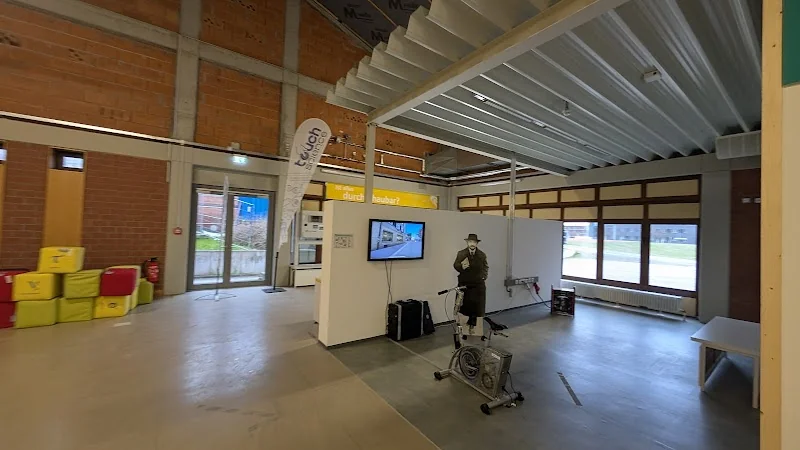
Those searching for MIND-Center photos usually want to get an idea of whether a visit feels more like a museum, laboratory, or hands-on exhibition. In fact, Touch Science is exactly this mix: On about 350 square meters, there are interactive stations where visitors can look inside objects using computer tomography, view their infrared image, control the energy supply of a small town, or experiment with the nearly light-speed Einstein wheel. The exhibition is designed so that scientific phenomena do not remain abstract but become tangible. Visually, it appears as a modern learning space with a clear hands-on orientation, where observing, trying out, and understanding intertwine. Therefore, those taking photos of the location or searching for them online will primarily find dynamic stations and no classic hall architecture. This is exactly what makes it appealing: It is not about a representative backdrop, but about visible science in everyday life, experimenting with hands and mind, and an atmosphere that immediately activates curiosity. ([uni-wuerzburg.de](https://www.uni-wuerzburg.de/einrichtungen/mind/bildungspfade/entdecken/?utm_source=openai))
The exhibition categorizes its content into four major thematic areas that address questions of transparency, internal forces, relativity, and body perception. This is particularly relevant for the user intention around mind center for kids, as children and adolescents can quickly find access through illustrative experiments and clear questions. Adults also benefit from the fact that the stations are not only observed but actively engaged with. The MIND-Center understands this approach as part of its educational work: Science should not be conveyed in an explanatory manner from above, but should arise through curiosity, movement, and personal action. Especially in a city like Würzburg, where the university is strongly present in public life, this concept fits well. It combines the spatial proximity to the campus with an exhibition that is consciously aimed at laypeople, school groups, and education enthusiasts. Thus, Touch Science is not just a single offer, but the most visible symbol of the entire institution and its idea of shaping science as a space for experience. ([uni-wuerzburg.de](https://www.uni-wuerzburg.de/einrichtungen/mind/bildungspfade/entdecken/?utm_source=openai))
Touch Science: Opening Hours, Admission, and Visit Planning
The most important visitor information is clear and straightforward: Touch Science is open on Saturdays and Sundays from 2 PM to 6 PM, closed on public holidays. Those planning with family or friends should definitely keep an eye on the weekend hours, as the MIND-Center does not have daily foot traffic like a shopping center, but a consciously curated learning offer with fixed opening hours. For school classes and groups of ten or more, visits are also possible at any time upon request. This is particularly attractive for teachers, project groups, or associations looking for an appointment outside of the weekend. The admission prices are also transparent: Adults pay 5 euros, children and adolescents aged 6 to 17 pay 3 euros. This keeps the visit well-planned even for smaller budgets, and it is clear that the offer is deliberately designed to be low-threshold. Those preparing the trip can therefore already estimate how much time and budget should be planned. ([uni-wuerzburg.de](https://www.uni-wuerzburg.de/einrichtungen/mind/bildungspfade/entdecken/?utm_source=openai))
From an SEO perspective, this page thus serves multiple search motives simultaneously: opening hours, admission, group inquiries, and family-friendliness. For visitors, this is helpful because it becomes clear in advance that the place is not designed for quick visits but for active time. Those coming should therefore not only expect a short stop but a genuine participatory visit. The advantage lies in the structure of the exhibition: The stations invite visitors to read, test, compare, and return once more. Especially with an interactive offer, it makes sense to bring enough time. The official page does not specify a rigid time value, but the character of the exhibition speaks for a calm, curious tour rather than a hectic appointment. For many users, this mix of clear prices and an open, experimental format is a strong decision criterion because it offers both planning security and experiential value. ([uni-wuerzburg.de](https://www.uni-wuerzburg.de/einrichtungen/mind/bildungspfade/entdecken/?utm_source=openai))
Directions to the MIND-Center at Campus Hubland Nord
The directions to the MIND-Center are easily manageable due to its location on the Hubland Nord campus if one pays attention to the university signage. The bus line 10 is particularly important as it goes directly over the campus and serves the Sprachenzentrum stop, which is in immediate proximity to the MIND-Center. Additionally, the stops Campus Hubland Nord and Hubland TGZ on the campus network are relevant, depending on the direction of travel and entry point. Those coming from the main train station or from the city center can also travel with lines 14, 114, and 214 and then plan a walking distance of about five to ten minutes. The university describes the orientation on campus as well signposted and refers to site maps at the entrance of the grounds. This is important for first-time visitors because the North Campus is extensive and several facilities are located around building 25. Those who familiarize themselves with the location in advance save time on-site and avoid unnecessary searching, which can make a big difference, especially on a first visit with children or a group. ([informatik.uni-wuerzburg.de](https://www.informatik.uni-wuerzburg.de/en/didaktik/fortbildung/ki/?utm_source=openai))
Those searching for MIND-Center directions or Mind Center Würzburg on their smartphone will often ask for the most direct route. Therefore, the combination of bus line and short walk is practical. The connection via bus line 10 is particularly sensible if coming from the city center or Sanderring, as it offers several stops directly on campus. This reduces uncertainty on-site and saves detours. This is also relevant for group trips or family outings, as not every member necessarily has to arrive by car. Those planning to use public transport can arrive relaxed and have no parking pressure. This good public transport connection fits very well with the profile of a scientific institution that welcomes school classes, students, and visitors. It makes the place easily accessible and supports the idea of an open educational space rather than a closed research island. For many visitors, this is a significant advantage because the visit begins with an uncomplicated arrival. ([informatik.uni-wuerzburg.de](https://www.informatik.uni-wuerzburg.de/en/didaktik/fortbildung/ki/?utm_source=openai))
Parking at Matthias-Lexer-Weg 25
When it comes to parking, the location is somewhat more sensitive than arriving by bus. Directly at Matthias-Lexer-Weg 25, parking spaces are limited, which is why the official information recommends parking on Gerda-Laufer-Straße on the north side of the building. There are usually sufficient parking spaces available there. It is also important to have the correct access: Building 25 can be reached via the Hubland Nord campus, specifically via Emil-Fischer-Straße and Klara-Oppenheimer-Weg. The Magdalene-Schoch-Straße should not be approached as it ends at a barrier. For search queries like MIND Center parking or directions Würzburg, this information is particularly valuable as it clears up the most common uncertainties in advance. Instead of driving around in circles, one can align the route directly with the campus structure and thus arrive relaxed at the visit location. Those traveling with several people can also plan carpooling and drop-off points sensibly in advance. ([informatik.uni-wuerzburg.de](https://www.informatik.uni-wuerzburg.de/en/didaktik/fortbildung/ki/?utm_source=openai))
The practical orientation on-site also benefits from the campus layout: The Hubland Nord campus is structured as a university area with several buildings, and the signage is said to be good according to the university. This is especially important if one is not only going to the MIND-Center but may also be looking for other facilities in the same building complex. For visitors, this means a clear, factual wayfinding instead of complicated detours. However, those arriving with children or in a group should still plan a little buffer, as the parking situation can change, especially on weekends or during events. Since the official recommendation provides enough alternatives, the location remains generally well accessible. For SEO and user satisfaction, this mix of direct parking information and campus guidance is ideal: It answers the most important question before the visit and reduces frustration in advance. Thus, parking search does not become an obstacle but just a short step on the way to the exhibition. ([informatik.uni-wuerzburg.de](https://www.informatik.uni-wuerzburg.de/en/didaktik/fortbildung/ki/?utm_source=openai))
Children, School Classes, and Learning Offers at the M!ND-Center
The MIND-Center is particularly interesting for children, school classes, and youth groups because it connects several learning levels. The university speaks of educational paths that range from playful discovery in Touch Science to experimenting in the teaching-learning laboratory to researching in the student research center. For young visitors, this is a strong signal: It is not just about observing but about participating and thinking for oneself. The Touch Science exhibition is suitable for children aged six and older, and groups of ten or more can organize visits upon request. This makes the facility attractive for teachers, parents, and caregivers alike. Unlike a pure exhibition, learning content can be experienced here in different depths, making the place valuable for heterogeneous groups. Therefore, those coming with a class or as a family will not find a pure leisure place but a pedagogically thought-out space that relies on active participation while simultaneously presenting scientific content clearly. ([uni-wuerzburg.de](https://www.uni-wuerzburg.de/einrichtungen/mind/?utm_source=openai))
Particularly, the combination of exhibition, laboratory, and research center is a unique selling point because it does not stop at knowledge transfer. In the teaching-learning laboratory, students and children or adolescents work together at subject-related stations, embedding scientific topics into a real learning process. In the student research center, specific questions can be pursued independently or with guidance. For search queries like mind center for kids or mind center student laboratory, this is particularly relevant as the institution indeed provides an environment where children are introduced to science in an age-appropriate manner. The educational value lies in the fact that curiosity is not only awakened in the short term but deepened through repeated experimentation. This creates a place that one does not just visit once but can also revisit with a class or later in their studies. This fits well with a modern understanding of education, where enthusiasm, structure, and practice belong together. ([uni-wuerzburg.de](https://www.uni-wuerzburg.de/einrichtungen/mind/?utm_source=openai))
History and Concept of the MIND-Center
Historically, the MIND-Center was established in 2009 as a central scientific institution of the University of Würzburg. Since then, it has connected the subject didactics of biology, chemistry, geography, computer science, mathematics, and physics and aims to strengthen the quality of teacher training in the STEM field through joint teaching concepts and subject-didactic research. This is important not only for students but also for schools in the region, as scientific expertise and teaching practice are closely combined here. The claim is not just to collect knowledge but to improve teaching. This connection between research and teaching distinguishes the MIND-Center from many other learning locations. It is not a museum with static objects but a subject network with a clear didactic mission that systematically connects theory and practice, thereby making a direct contribution to teacher education. ([uni-wuerzburg.de](https://www.uni-wuerzburg.de/einrichtungen/mind/konzept/?utm_source=openai))
The official description also emphasizes the interface between research, teaching, and school, as well as the attractiveness of the extracurricular learning location. This explains why the MIND-Center is also recognized beyond Würzburg: It bundles interdisciplinary work, practical relevance, and science communication at one location. Since moving to the Hubland Nord campus, the institution has become spatially part of a larger university environment used for courses, laboratories, and language offerings. This creates a campus location where various educational functions intertwine. For the location page, this means a clear message: The MIND-Center is not just a name on the building but an active hub for STEM education, school cooperation, and research. Therefore, those searching for MIND-Center Würzburg, photos, or opening hours discover a much broader profile than just an exhibition address. It is about a place where curiosity, education, and science are deliberately brought together. ([uni-wuerzburg.de](https://www.uni-wuerzburg.de/einrichtungen/mind/konzept/?utm_source=openai))
For visitors, the result is simple: The MIND-Center offers a well-accessible campus location, clear weekend opening hours, fair admission prices, and a program that appeals to many target groups from curious children to school groups. Those who like to touch science rather than just read about it will find one of the most exciting learning places in Würzburg here. The combination of exhibition, laboratory, research environment, and university embedding makes the location an unusually versatile destination that works for both a family outing and a school excursion. This is precisely why it is worthwhile to clarify the most important questions before the visit and to keep an eye on directions, parking options, and opening hours. ([uni-wuerzburg.de](https://www.uni-wuerzburg.de/einrichtungen/mind/bildungspfade/entdecken/?utm_source=openai))
Sources:
Mehr anzeigenWeniger anzeigen
MIND-Center Würzburg | Touch Science & Opening Hours
The MIND-Center at the University of Würzburg is not a traditional event venue, but a university and learning center that brings together research, teaching, and school practice. It is located on the Hubland Nord campus in building 25 at Matthias-Lexer-Weg 25 and is organized under the name M!ND-Centre as an interdisciplinary network of the subject didactics of biology, chemistry, geography, computer science, mathematics, and physics. For this reason, many people search for MIND-Center Würzburg, photos, opening hours, or directions: Those who come here want to not only understand science but also experience it. At the center is the interactive exhibition Touch Science, complemented by teaching-learning laboratories and a student research center. For the SEO logic of this page, this is important because the search intentions of visitors are usually very practical: What does it look like on-site, when can I enter, how do I get there, and what can children or school classes expect? The MIND-Center answers all these questions with a clear, science-oriented offer and is thus a place of learning, research, and a point of orientation for everyone looking for something concrete on the Hubland Nord campus. ([wueaddress.uni-wuerzburg.de](https://wueaddress.uni-wuerzburg.de/oeh/19010000?utm_source=openai))
MIND-Center Würzburg Photos and Impressions: Touch Science to Touch
Those searching for MIND-Center photos usually want to get an idea of whether a visit feels more like a museum, laboratory, or hands-on exhibition. In fact, Touch Science is exactly this mix: On about 350 square meters, there are interactive stations where visitors can look inside objects using computer tomography, view their infrared image, control the energy supply of a small town, or experiment with the nearly light-speed Einstein wheel. The exhibition is designed so that scientific phenomena do not remain abstract but become tangible. Visually, it appears as a modern learning space with a clear hands-on orientation, where observing, trying out, and understanding intertwine. Therefore, those taking photos of the location or searching for them online will primarily find dynamic stations and no classic hall architecture. This is exactly what makes it appealing: It is not about a representative backdrop, but about visible science in everyday life, experimenting with hands and mind, and an atmosphere that immediately activates curiosity. ([uni-wuerzburg.de](https://www.uni-wuerzburg.de/einrichtungen/mind/bildungspfade/entdecken/?utm_source=openai))
The exhibition categorizes its content into four major thematic areas that address questions of transparency, internal forces, relativity, and body perception. This is particularly relevant for the user intention around mind center for kids, as children and adolescents can quickly find access through illustrative experiments and clear questions. Adults also benefit from the fact that the stations are not only observed but actively engaged with. The MIND-Center understands this approach as part of its educational work: Science should not be conveyed in an explanatory manner from above, but should arise through curiosity, movement, and personal action. Especially in a city like Würzburg, where the university is strongly present in public life, this concept fits well. It combines the spatial proximity to the campus with an exhibition that is consciously aimed at laypeople, school groups, and education enthusiasts. Thus, Touch Science is not just a single offer, but the most visible symbol of the entire institution and its idea of shaping science as a space for experience. ([uni-wuerzburg.de](https://www.uni-wuerzburg.de/einrichtungen/mind/bildungspfade/entdecken/?utm_source=openai))
Touch Science: Opening Hours, Admission, and Visit Planning
The most important visitor information is clear and straightforward: Touch Science is open on Saturdays and Sundays from 2 PM to 6 PM, closed on public holidays. Those planning with family or friends should definitely keep an eye on the weekend hours, as the MIND-Center does not have daily foot traffic like a shopping center, but a consciously curated learning offer with fixed opening hours. For school classes and groups of ten or more, visits are also possible at any time upon request. This is particularly attractive for teachers, project groups, or associations looking for an appointment outside of the weekend. The admission prices are also transparent: Adults pay 5 euros, children and adolescents aged 6 to 17 pay 3 euros. This keeps the visit well-planned even for smaller budgets, and it is clear that the offer is deliberately designed to be low-threshold. Those preparing the trip can therefore already estimate how much time and budget should be planned. ([uni-wuerzburg.de](https://www.uni-wuerzburg.de/einrichtungen/mind/bildungspfade/entdecken/?utm_source=openai))
From an SEO perspective, this page thus serves multiple search motives simultaneously: opening hours, admission, group inquiries, and family-friendliness. For visitors, this is helpful because it becomes clear in advance that the place is not designed for quick visits but for active time. Those coming should therefore not only expect a short stop but a genuine participatory visit. The advantage lies in the structure of the exhibition: The stations invite visitors to read, test, compare, and return once more. Especially with an interactive offer, it makes sense to bring enough time. The official page does not specify a rigid time value, but the character of the exhibition speaks for a calm, curious tour rather than a hectic appointment. For many users, this mix of clear prices and an open, experimental format is a strong decision criterion because it offers both planning security and experiential value. ([uni-wuerzburg.de](https://www.uni-wuerzburg.de/einrichtungen/mind/bildungspfade/entdecken/?utm_source=openai))
Directions to the MIND-Center at Campus Hubland Nord
The directions to the MIND-Center are easily manageable due to its location on the Hubland Nord campus if one pays attention to the university signage. The bus line 10 is particularly important as it goes directly over the campus and serves the Sprachenzentrum stop, which is in immediate proximity to the MIND-Center. Additionally, the stops Campus Hubland Nord and Hubland TGZ on the campus network are relevant, depending on the direction of travel and entry point. Those coming from the main train station or from the city center can also travel with lines 14, 114, and 214 and then plan a walking distance of about five to ten minutes. The university describes the orientation on campus as well signposted and refers to site maps at the entrance of the grounds. This is important for first-time visitors because the North Campus is extensive and several facilities are located around building 25. Those who familiarize themselves with the location in advance save time on-site and avoid unnecessary searching, which can make a big difference, especially on a first visit with children or a group. ([informatik.uni-wuerzburg.de](https://www.informatik.uni-wuerzburg.de/en/didaktik/fortbildung/ki/?utm_source=openai))
Those searching for MIND-Center directions or Mind Center Würzburg on their smartphone will often ask for the most direct route. Therefore, the combination of bus line and short walk is practical. The connection via bus line 10 is particularly sensible if coming from the city center or Sanderring, as it offers several stops directly on campus. This reduces uncertainty on-site and saves detours. This is also relevant for group trips or family outings, as not every member necessarily has to arrive by car. Those planning to use public transport can arrive relaxed and have no parking pressure. This good public transport connection fits very well with the profile of a scientific institution that welcomes school classes, students, and visitors. It makes the place easily accessible and supports the idea of an open educational space rather than a closed research island. For many visitors, this is a significant advantage because the visit begins with an uncomplicated arrival. ([informatik.uni-wuerzburg.de](https://www.informatik.uni-wuerzburg.de/en/didaktik/fortbildung/ki/?utm_source=openai))
Parking at Matthias-Lexer-Weg 25
When it comes to parking, the location is somewhat more sensitive than arriving by bus. Directly at Matthias-Lexer-Weg 25, parking spaces are limited, which is why the official information recommends parking on Gerda-Laufer-Straße on the north side of the building. There are usually sufficient parking spaces available there. It is also important to have the correct access: Building 25 can be reached via the Hubland Nord campus, specifically via Emil-Fischer-Straße and Klara-Oppenheimer-Weg. The Magdalene-Schoch-Straße should not be approached as it ends at a barrier. For search queries like MIND Center parking or directions Würzburg, this information is particularly valuable as it clears up the most common uncertainties in advance. Instead of driving around in circles, one can align the route directly with the campus structure and thus arrive relaxed at the visit location. Those traveling with several people can also plan carpooling and drop-off points sensibly in advance. ([informatik.uni-wuerzburg.de](https://www.informatik.uni-wuerzburg.de/en/didaktik/fortbildung/ki/?utm_source=openai))
The practical orientation on-site also benefits from the campus layout: The Hubland Nord campus is structured as a university area with several buildings, and the signage is said to be good according to the university. This is especially important if one is not only going to the MIND-Center but may also be looking for other facilities in the same building complex. For visitors, this means a clear, factual wayfinding instead of complicated detours. However, those arriving with children or in a group should still plan a little buffer, as the parking situation can change, especially on weekends or during events. Since the official recommendation provides enough alternatives, the location remains generally well accessible. For SEO and user satisfaction, this mix of direct parking information and campus guidance is ideal: It answers the most important question before the visit and reduces frustration in advance. Thus, parking search does not become an obstacle but just a short step on the way to the exhibition. ([informatik.uni-wuerzburg.de](https://www.informatik.uni-wuerzburg.de/en/didaktik/fortbildung/ki/?utm_source=openai))
Children, School Classes, and Learning Offers at the M!ND-Center
The MIND-Center is particularly interesting for children, school classes, and youth groups because it connects several learning levels. The university speaks of educational paths that range from playful discovery in Touch Science to experimenting in the teaching-learning laboratory to researching in the student research center. For young visitors, this is a strong signal: It is not just about observing but about participating and thinking for oneself. The Touch Science exhibition is suitable for children aged six and older, and groups of ten or more can organize visits upon request. This makes the facility attractive for teachers, parents, and caregivers alike. Unlike a pure exhibition, learning content can be experienced here in different depths, making the place valuable for heterogeneous groups. Therefore, those coming with a class or as a family will not find a pure leisure place but a pedagogically thought-out space that relies on active participation while simultaneously presenting scientific content clearly. ([uni-wuerzburg.de](https://www.uni-wuerzburg.de/einrichtungen/mind/?utm_source=openai))
Particularly, the combination of exhibition, laboratory, and research center is a unique selling point because it does not stop at knowledge transfer. In the teaching-learning laboratory, students and children or adolescents work together at subject-related stations, embedding scientific topics into a real learning process. In the student research center, specific questions can be pursued independently or with guidance. For search queries like mind center for kids or mind center student laboratory, this is particularly relevant as the institution indeed provides an environment where children are introduced to science in an age-appropriate manner. The educational value lies in the fact that curiosity is not only awakened in the short term but deepened through repeated experimentation. This creates a place that one does not just visit once but can also revisit with a class or later in their studies. This fits well with a modern understanding of education, where enthusiasm, structure, and practice belong together. ([uni-wuerzburg.de](https://www.uni-wuerzburg.de/einrichtungen/mind/?utm_source=openai))
History and Concept of the MIND-Center
Historically, the MIND-Center was established in 2009 as a central scientific institution of the University of Würzburg. Since then, it has connected the subject didactics of biology, chemistry, geography, computer science, mathematics, and physics and aims to strengthen the quality of teacher training in the STEM field through joint teaching concepts and subject-didactic research. This is important not only for students but also for schools in the region, as scientific expertise and teaching practice are closely combined here. The claim is not just to collect knowledge but to improve teaching. This connection between research and teaching distinguishes the MIND-Center from many other learning locations. It is not a museum with static objects but a subject network with a clear didactic mission that systematically connects theory and practice, thereby making a direct contribution to teacher education. ([uni-wuerzburg.de](https://www.uni-wuerzburg.de/einrichtungen/mind/konzept/?utm_source=openai))
The official description also emphasizes the interface between research, teaching, and school, as well as the attractiveness of the extracurricular learning location. This explains why the MIND-Center is also recognized beyond Würzburg: It bundles interdisciplinary work, practical relevance, and science communication at one location. Since moving to the Hubland Nord campus, the institution has become spatially part of a larger university environment used for courses, laboratories, and language offerings. This creates a campus location where various educational functions intertwine. For the location page, this means a clear message: The MIND-Center is not just a name on the building but an active hub for STEM education, school cooperation, and research. Therefore, those searching for MIND-Center Würzburg, photos, or opening hours discover a much broader profile than just an exhibition address. It is about a place where curiosity, education, and science are deliberately brought together. ([uni-wuerzburg.de](https://www.uni-wuerzburg.de/einrichtungen/mind/konzept/?utm_source=openai))
For visitors, the result is simple: The MIND-Center offers a well-accessible campus location, clear weekend opening hours, fair admission prices, and a program that appeals to many target groups from curious children to school groups. Those who like to touch science rather than just read about it will find one of the most exciting learning places in Würzburg here. The combination of exhibition, laboratory, research environment, and university embedding makes the location an unusually versatile destination that works for both a family outing and a school excursion. This is precisely why it is worthwhile to clarify the most important questions before the visit and to keep an eye on directions, parking options, and opening hours. ([uni-wuerzburg.de](https://www.uni-wuerzburg.de/einrichtungen/mind/bildungspfade/entdecken/?utm_source=openai))
Sources:
MIND-Center Würzburg | Touch Science & Opening Hours
The MIND-Center at the University of Würzburg is not a traditional event venue, but a university and learning center that brings together research, teaching, and school practice. It is located on the Hubland Nord campus in building 25 at Matthias-Lexer-Weg 25 and is organized under the name M!ND-Centre as an interdisciplinary network of the subject didactics of biology, chemistry, geography, computer science, mathematics, and physics. For this reason, many people search for MIND-Center Würzburg, photos, opening hours, or directions: Those who come here want to not only understand science but also experience it. At the center is the interactive exhibition Touch Science, complemented by teaching-learning laboratories and a student research center. For the SEO logic of this page, this is important because the search intentions of visitors are usually very practical: What does it look like on-site, when can I enter, how do I get there, and what can children or school classes expect? The MIND-Center answers all these questions with a clear, science-oriented offer and is thus a place of learning, research, and a point of orientation for everyone looking for something concrete on the Hubland Nord campus. ([wueaddress.uni-wuerzburg.de](https://wueaddress.uni-wuerzburg.de/oeh/19010000?utm_source=openai))
MIND-Center Würzburg Photos and Impressions: Touch Science to Touch
Those searching for MIND-Center photos usually want to get an idea of whether a visit feels more like a museum, laboratory, or hands-on exhibition. In fact, Touch Science is exactly this mix: On about 350 square meters, there are interactive stations where visitors can look inside objects using computer tomography, view their infrared image, control the energy supply of a small town, or experiment with the nearly light-speed Einstein wheel. The exhibition is designed so that scientific phenomena do not remain abstract but become tangible. Visually, it appears as a modern learning space with a clear hands-on orientation, where observing, trying out, and understanding intertwine. Therefore, those taking photos of the location or searching for them online will primarily find dynamic stations and no classic hall architecture. This is exactly what makes it appealing: It is not about a representative backdrop, but about visible science in everyday life, experimenting with hands and mind, and an atmosphere that immediately activates curiosity. ([uni-wuerzburg.de](https://www.uni-wuerzburg.de/einrichtungen/mind/bildungspfade/entdecken/?utm_source=openai))
The exhibition categorizes its content into four major thematic areas that address questions of transparency, internal forces, relativity, and body perception. This is particularly relevant for the user intention around mind center for kids, as children and adolescents can quickly find access through illustrative experiments and clear questions. Adults also benefit from the fact that the stations are not only observed but actively engaged with. The MIND-Center understands this approach as part of its educational work: Science should not be conveyed in an explanatory manner from above, but should arise through curiosity, movement, and personal action. Especially in a city like Würzburg, where the university is strongly present in public life, this concept fits well. It combines the spatial proximity to the campus with an exhibition that is consciously aimed at laypeople, school groups, and education enthusiasts. Thus, Touch Science is not just a single offer, but the most visible symbol of the entire institution and its idea of shaping science as a space for experience. ([uni-wuerzburg.de](https://www.uni-wuerzburg.de/einrichtungen/mind/bildungspfade/entdecken/?utm_source=openai))
Touch Science: Opening Hours, Admission, and Visit Planning
The most important visitor information is clear and straightforward: Touch Science is open on Saturdays and Sundays from 2 PM to 6 PM, closed on public holidays. Those planning with family or friends should definitely keep an eye on the weekend hours, as the MIND-Center does not have daily foot traffic like a shopping center, but a consciously curated learning offer with fixed opening hours. For school classes and groups of ten or more, visits are also possible at any time upon request. This is particularly attractive for teachers, project groups, or associations looking for an appointment outside of the weekend. The admission prices are also transparent: Adults pay 5 euros, children and adolescents aged 6 to 17 pay 3 euros. This keeps the visit well-planned even for smaller budgets, and it is clear that the offer is deliberately designed to be low-threshold. Those preparing the trip can therefore already estimate how much time and budget should be planned. ([uni-wuerzburg.de](https://www.uni-wuerzburg.de/einrichtungen/mind/bildungspfade/entdecken/?utm_source=openai))
From an SEO perspective, this page thus serves multiple search motives simultaneously: opening hours, admission, group inquiries, and family-friendliness. For visitors, this is helpful because it becomes clear in advance that the place is not designed for quick visits but for active time. Those coming should therefore not only expect a short stop but a genuine participatory visit. The advantage lies in the structure of the exhibition: The stations invite visitors to read, test, compare, and return once more. Especially with an interactive offer, it makes sense to bring enough time. The official page does not specify a rigid time value, but the character of the exhibition speaks for a calm, curious tour rather than a hectic appointment. For many users, this mix of clear prices and an open, experimental format is a strong decision criterion because it offers both planning security and experiential value. ([uni-wuerzburg.de](https://www.uni-wuerzburg.de/einrichtungen/mind/bildungspfade/entdecken/?utm_source=openai))
Directions to the MIND-Center at Campus Hubland Nord
The directions to the MIND-Center are easily manageable due to its location on the Hubland Nord campus if one pays attention to the university signage. The bus line 10 is particularly important as it goes directly over the campus and serves the Sprachenzentrum stop, which is in immediate proximity to the MIND-Center. Additionally, the stops Campus Hubland Nord and Hubland TGZ on the campus network are relevant, depending on the direction of travel and entry point. Those coming from the main train station or from the city center can also travel with lines 14, 114, and 214 and then plan a walking distance of about five to ten minutes. The university describes the orientation on campus as well signposted and refers to site maps at the entrance of the grounds. This is important for first-time visitors because the North Campus is extensive and several facilities are located around building 25. Those who familiarize themselves with the location in advance save time on-site and avoid unnecessary searching, which can make a big difference, especially on a first visit with children or a group. ([informatik.uni-wuerzburg.de](https://www.informatik.uni-wuerzburg.de/en/didaktik/fortbildung/ki/?utm_source=openai))
Those searching for MIND-Center directions or Mind Center Würzburg on their smartphone will often ask for the most direct route. Therefore, the combination of bus line and short walk is practical. The connection via bus line 10 is particularly sensible if coming from the city center or Sanderring, as it offers several stops directly on campus. This reduces uncertainty on-site and saves detours. This is also relevant for group trips or family outings, as not every member necessarily has to arrive by car. Those planning to use public transport can arrive relaxed and have no parking pressure. This good public transport connection fits very well with the profile of a scientific institution that welcomes school classes, students, and visitors. It makes the place easily accessible and supports the idea of an open educational space rather than a closed research island. For many visitors, this is a significant advantage because the visit begins with an uncomplicated arrival. ([informatik.uni-wuerzburg.de](https://www.informatik.uni-wuerzburg.de/en/didaktik/fortbildung/ki/?utm_source=openai))
Parking at Matthias-Lexer-Weg 25
When it comes to parking, the location is somewhat more sensitive than arriving by bus. Directly at Matthias-Lexer-Weg 25, parking spaces are limited, which is why the official information recommends parking on Gerda-Laufer-Straße on the north side of the building. There are usually sufficient parking spaces available there. It is also important to have the correct access: Building 25 can be reached via the Hubland Nord campus, specifically via Emil-Fischer-Straße and Klara-Oppenheimer-Weg. The Magdalene-Schoch-Straße should not be approached as it ends at a barrier. For search queries like MIND Center parking or directions Würzburg, this information is particularly valuable as it clears up the most common uncertainties in advance. Instead of driving around in circles, one can align the route directly with the campus structure and thus arrive relaxed at the visit location. Those traveling with several people can also plan carpooling and drop-off points sensibly in advance. ([informatik.uni-wuerzburg.de](https://www.informatik.uni-wuerzburg.de/en/didaktik/fortbildung/ki/?utm_source=openai))
The practical orientation on-site also benefits from the campus layout: The Hubland Nord campus is structured as a university area with several buildings, and the signage is said to be good according to the university. This is especially important if one is not only going to the MIND-Center but may also be looking for other facilities in the same building complex. For visitors, this means a clear, factual wayfinding instead of complicated detours. However, those arriving with children or in a group should still plan a little buffer, as the parking situation can change, especially on weekends or during events. Since the official recommendation provides enough alternatives, the location remains generally well accessible. For SEO and user satisfaction, this mix of direct parking information and campus guidance is ideal: It answers the most important question before the visit and reduces frustration in advance. Thus, parking search does not become an obstacle but just a short step on the way to the exhibition. ([informatik.uni-wuerzburg.de](https://www.informatik.uni-wuerzburg.de/en/didaktik/fortbildung/ki/?utm_source=openai))
Children, School Classes, and Learning Offers at the M!ND-Center
The MIND-Center is particularly interesting for children, school classes, and youth groups because it connects several learning levels. The university speaks of educational paths that range from playful discovery in Touch Science to experimenting in the teaching-learning laboratory to researching in the student research center. For young visitors, this is a strong signal: It is not just about observing but about participating and thinking for oneself. The Touch Science exhibition is suitable for children aged six and older, and groups of ten or more can organize visits upon request. This makes the facility attractive for teachers, parents, and caregivers alike. Unlike a pure exhibition, learning content can be experienced here in different depths, making the place valuable for heterogeneous groups. Therefore, those coming with a class or as a family will not find a pure leisure place but a pedagogically thought-out space that relies on active participation while simultaneously presenting scientific content clearly. ([uni-wuerzburg.de](https://www.uni-wuerzburg.de/einrichtungen/mind/?utm_source=openai))
Particularly, the combination of exhibition, laboratory, and research center is a unique selling point because it does not stop at knowledge transfer. In the teaching-learning laboratory, students and children or adolescents work together at subject-related stations, embedding scientific topics into a real learning process. In the student research center, specific questions can be pursued independently or with guidance. For search queries like mind center for kids or mind center student laboratory, this is particularly relevant as the institution indeed provides an environment where children are introduced to science in an age-appropriate manner. The educational value lies in the fact that curiosity is not only awakened in the short term but deepened through repeated experimentation. This creates a place that one does not just visit once but can also revisit with a class or later in their studies. This fits well with a modern understanding of education, where enthusiasm, structure, and practice belong together. ([uni-wuerzburg.de](https://www.uni-wuerzburg.de/einrichtungen/mind/?utm_source=openai))
History and Concept of the MIND-Center
Historically, the MIND-Center was established in 2009 as a central scientific institution of the University of Würzburg. Since then, it has connected the subject didactics of biology, chemistry, geography, computer science, mathematics, and physics and aims to strengthen the quality of teacher training in the STEM field through joint teaching concepts and subject-didactic research. This is important not only for students but also for schools in the region, as scientific expertise and teaching practice are closely combined here. The claim is not just to collect knowledge but to improve teaching. This connection between research and teaching distinguishes the MIND-Center from many other learning locations. It is not a museum with static objects but a subject network with a clear didactic mission that systematically connects theory and practice, thereby making a direct contribution to teacher education. ([uni-wuerzburg.de](https://www.uni-wuerzburg.de/einrichtungen/mind/konzept/?utm_source=openai))
The official description also emphasizes the interface between research, teaching, and school, as well as the attractiveness of the extracurricular learning location. This explains why the MIND-Center is also recognized beyond Würzburg: It bundles interdisciplinary work, practical relevance, and science communication at one location. Since moving to the Hubland Nord campus, the institution has become spatially part of a larger university environment used for courses, laboratories, and language offerings. This creates a campus location where various educational functions intertwine. For the location page, this means a clear message: The MIND-Center is not just a name on the building but an active hub for STEM education, school cooperation, and research. Therefore, those searching for MIND-Center Würzburg, photos, or opening hours discover a much broader profile than just an exhibition address. It is about a place where curiosity, education, and science are deliberately brought together. ([uni-wuerzburg.de](https://www.uni-wuerzburg.de/einrichtungen/mind/konzept/?utm_source=openai))
For visitors, the result is simple: The MIND-Center offers a well-accessible campus location, clear weekend opening hours, fair admission prices, and a program that appeals to many target groups from curious children to school groups. Those who like to touch science rather than just read about it will find one of the most exciting learning places in Würzburg here. The combination of exhibition, laboratory, research environment, and university embedding makes the location an unusually versatile destination that works for both a family outing and a school excursion. This is precisely why it is worthwhile to clarify the most important questions before the visit and to keep an eye on directions, parking options, and opening hours. ([uni-wuerzburg.de](https://www.uni-wuerzburg.de/einrichtungen/mind/bildungspfade/entdecken/?utm_source=openai))
Sources:
Frequently Asked Questions
Reviews
No reviews found