
Würzburg
Domerschulstraße 16, 97070 Würzburg, Deutschland
Neubaukirche | Events & Organ
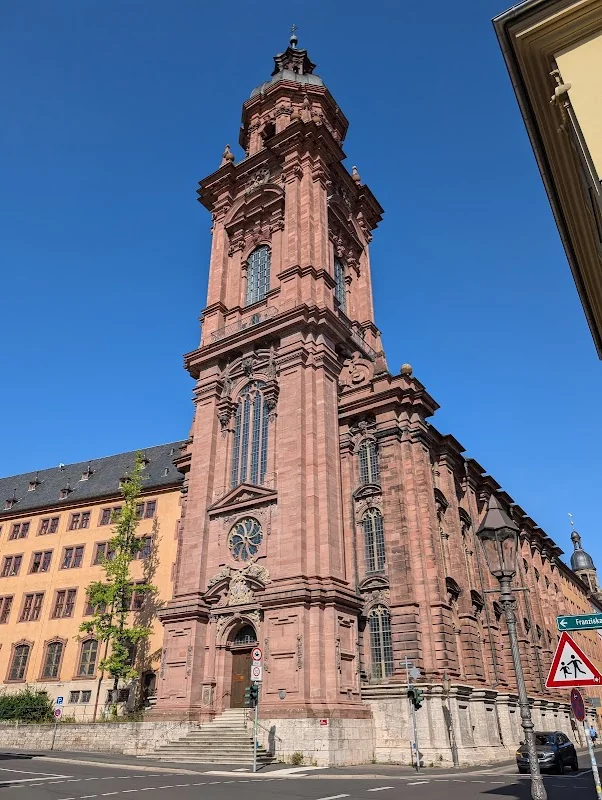
The Neubaukirche is much more than just a historical building in Würzburg: It is a place of identity between Renaissance, university history, and vibrant present. Those looking for Neubaukirche Würzburg events, concerts, organ, or entrance are actually referring to a space where academic celebration culture, musical tradition, and urban attraction connect in an extraordinary way. The church is part of the ensemble of the Old University, located in the heart of the old town, and is currently used as a festive hall, auditorium, and event venue for the university. It is precisely this blend of history and function that makes the Neubaukirche so special: it is not a museum object, but a place that is still used today for ceremonial acts, concerts, conferences, and cultural formats. At the same time, it impresses with a carefully restored interior, a distinctive organ, a carillon in the tower, and an atmosphere that is rarely found in modern event locations. Visitors to the Neubaukirche experience Würzburg not just as a city, but as a stage of lived tradition. ([uni-wuerzburg.de](https://www.uni-wuerzburg.de/uniarchiv/die-geschichte-unserer-universitaet/schauplaetze/neubaukirche/))
Events, Concerts, and Program in the Neubaukirche
The Neubaukirche has been explicitly designated as a concert hall, festive hall, auditorium, and space for exhibitions and academic celebrations since its reopening in 1985. This is precisely where its current strength in the event sector arises: it is not limited to a single type of use but is employed for various formats organized by the University of Würzburg and its departments. These include festive events such as the annual foundation celebration, musical semester programs, Christmas and Advent concerts, as well as conferences and ceremonial academic occasions. For visitors, this means: those searching for Neubaukirche Würzburg today or Neubaukirche Würzburg events will not find a rigid schedule like in a classical theater, but a lively, seasonally changing program that is directly fed by university life. This proximity to the university makes the location particularly authentic, as events here are not arbitrary but related to education, music, and public life. The Neubaukirche thus functions as a representative stage for Würzburg's science and cultural world. ([uni-wuerzburg.de](https://www.uni-wuerzburg.de/uniarchiv/die-geschichte-unserer-universitaet/schauplaetze/neubaukirche/))
Even in 2026, this usage is clearly recognizable: the university has utilized the Neubaukirche for its foundation celebration, the chair for music education has announced a concert there, and the law faculty continues its series with Advent and Christmas concerts. Such examples demonstrate why search queries around Neubaukirche Würzburg concerts, Neubaukirche concert, and Neubaukirche Würzburg today strongly refer to a culturally active house. The Neubaukirche is not a place that is only opened for rare anniversaries, but a fixed part of the university's event calendar. Particularly attractive is the combination of a ceremonial setting and good acoustics, which benefits both organizers and audiences. Those seeking a historical location with academic character, musical profile, and central location will find one of the most distinctive addresses in the city here. This also explains why the Neubaukirche has such a high recognition value among regional guests, culture enthusiasts, and university visitors. ([uni-wuerzburg.de](https://www.uni-wuerzburg.de/en/news-and-events/einblick/single/news/foundation-festival-2026/?utm_source=openai))
Organ, Carillon, and Special Sound Moments
A central search topic around the Neubaukirche is the organ, and not without reason. The church was equipped with a Schuke organ shortly after its reopening in 1986. According to the university archive, it is the second largest organ in the city of Würzburg after the organ in the cathedral. Thus, the Neubaukirche possesses not only an visually impressive but also a musically significant centerpiece. For concerts, academic celebrations, and liturgically influenced music evenings, this is a strong unique selling point, as the space gains a depth and richness of sound that is often missed in modern multipurpose halls. Therefore, those searching for Neubaukirche Würzburg organ will encounter an instrument that is closely linked to the musical identity of the house and directly shapes its use as a concert and festive hall. ([uni-wuerzburg.de](https://www.uni-wuerzburg.de/uniarchiv/die-geschichte-unserer-universitaet/schauplaetze/neubaukirche/))
Additionally, there is the tower with its carillon, which was installed in 2005 and makes the Neubaukirche a musical place even outside of hall operations. The city of Würzburg describes the tower as a characteristic part of the ensemble; the carillon is a special sound feature found in only a few European universities. Furthermore, the tower has been illuminated since 2003 after dark, allowing the Neubaukirche to remain present in the cityscape even at night. For visitors looking for photos, interior views, or special moments, this interplay of architecture, organ, and tower sound is particularly exciting. The location thus appears not only festive but almost staged: historically and representatively during the day, atmospheric and striking in the evening. This is precisely why terms like Neubaukirche Würzburg interior, Neubaukirche Würzburg photos, or even Neubaukirche candlelight concert are so relevant when users search for a special sound experience. The real strength of the place lies in this rare connection of space, instrument, and history. ([uni-wuerzburg.de](https://www.uni-wuerzburg.de/uniarchiv/die-geschichte-unserer-universitaet/schauplaetze/neubaukirche/))
Entrance, Access, and Parking at the Neubaukirche
For practical access, the Neubaukirche is very clearly located: the entrance is via the courtyard of the Old University at Domerschulstraße 16. The KIS of the university points out that Domerschulstraße is centrally located in the old town and is not directly reachable by public transport; however, the tram stop Neubaustraße with lines 1 to 5 is about a ten-minute walk away. Another event page of the university additionally mentions lines 4 and 5 from the main train station Würzburg via the stop Neubaustraße. Therefore, those searching for Neubaukirche Würzburg entrance or Neubaukirche Würzburg maps receive a clear orientation: old town, courtyard, historic university ensemble. This is important because the entrance is not perceived as a classic street access but as part of an architectural courtyard system. Therefore, it is worthwhile for first-time visitors to plan a little time for the walk through the ensemble. ([uni-wuerzburg.de](https://www.uni-wuerzburg.de/chancengleichheit/kis/barrierefreiheit-von-gebaeuden/sortierung-nach-alphabet/alte-universitaet-domerschulstrasse-juristische-fakultaet/))
The topic of parking is also clearly regulated, although not comfortably like in a large event arena. The university mentions the paid parking lot at the Residenz and the paid parking garage Neubaustraße for events. An older but still helpful access description points out that parking spaces in Würzburg's city center are scarce and usually chargeable, so arriving by public transport is worthwhile. For visitors with mobility impairments, it is important to note: the main entrance is accessible via a ramp, there is a lift, and a disabled parking space is located right next to the metal ramp. Additionally, the building has four entrances; the lecture halls are barrier-free accessible, and access to the backyard is also possible. This information is particularly valuable for search queries like Neubaukirche Würzburg parking or Neubaukirche Würzburg opening hours, as it shows: the place is primarily organized for events and is less intended as a freely accessible museum. Therefore, anyone attending a specific event should always check the event notice and plan a few minutes of buffer time for arrival. ([jura.uni-wuerzburg.de](https://www.jura.uni-wuerzburg.de/fakultaet/forschungsprojekte/zentrum-fuer-europaeisches-und-internationales-recht-und-rechtssprachen/wuerzburger-europarechtstage/31-wuerzburger-europarechtstage-2026/))
Seating, Capacity, and Room Feel in the Festsaal
According to the university, the Neubaukirche has 750 chairs that are regularly rotated to ensure even wear. This already shows how intensively the space is used and how much it is designed for recurring events. The seating was specially designed for the Neubaukirche, giving the interior a uniform and very distinctive effect. Therefore, when entering the space, one does not experience arbitrary hall architecture but a consciously designed interplay of historical shell and seating tailored to the place. In search queries like Neubaukirche Würzburg interior or Neubaukirche seating plan, there is always also the question of the special room feel: what is it like to sit in a hall that goes back to a former church building and simultaneously functions as a university festive hall? The answer lies in the mix of representation, overview, and proximity to the stage. Academic celebrations and concerts particularly benefit from the fact that the space neither appears oversized nor anonymous. ([uni-wuerzburg.de](https://www.uni-wuerzburg.de/en/alumni/support/successfully-completed-projects/polster-projekt-in-der-neubaukirche/))
Since its reopening in 1985, the interior has formed the framework and the center of social life at the University of Würzburg. The official description emphasizes that the Neubaukirche has been carefully restored in accordance with its original design. This results in a festive hall that does not appear like a modern new building but relies on historical dignity in materiality and atmosphere. For visitors, this is particularly attractive because the space conveys a strong sense of occasion and significance. One does not simply come to an appointment but enters a building with history, symbolic power, and academic tradition. This also explains why the Neubaukirche is suitable for both festive honors and musical formats. The combination of 750 seats, restored interior, and high frequency of use makes it one of the most important event locations at the university. Therefore, those searching for Neubaukirche Würzburg interior, Neubaukirche Würzburg today, or Neubaukirche concert often refer to this special room feel that connects historical significance with practical usability. ([uni-wuerzburg.de](https://www.uni-wuerzburg.de/en/alumni/support/successfully-completed-projects/polster-projekt-in-der-neubaukirche/))
History of the Neubaukirche: From University Church to Festsaal
The history of the Neubaukirche begins closely with the re-establishment of the University of Würzburg in 1582. Already in 1583, Prince-Bishop Julius Echter von Mespelbrunn commissioned the Mainz court architect Georg Robin to build the church; work began in 1586 after the east, north, and west wings of the Echter University had already been constructed. On September 8, 1591, the university church was solemnly consecrated, and the entire complex was completed the following year. Thus, a building field stood in Würzburg that was intended from the beginning as a representative center of a revived university. The name Neubaukirche also refers to this claim: the new university complex was considered the new building in Würzburg par excellence in the 16th century. However, it became apparent early on that the building experienced not only splendor but also instability. In 1626, the church vault had to be removed, in 1631, restoration work was halted due to the invasion of the Swedes, and the church remained without a roof and vault for almost 70 years. It was not until 1696 that it received a new vault, a new roof, and the form of the present tower by Antonio Petrini. ([uni-wuerzburg.de](https://www.uni-wuerzburg.de/uniarchiv/die-geschichte-unserer-universitaet/schauplaetze/neubaukirche/))
In the 19th and 20th centuries, the use changed multiple times. During the secularization, the church was profaned and used as a depot for files and books; later, an organ was added, and services resumed in 1867. During the bombing of Würzburg on March 16, 1945, the Neubaukirche was severely damaged, along with large parts of the Old University and the university library. The debris removal lasted until the end of 1946, and it was not until decades later that reconstruction began. In 1970, the senate decided to use the church as a concert hall, festive hall, auditorium, and exhibition space after renovation; in 1977, the topping-out ceremony of the tower followed, in 1982, the heart of Julius Echter was buried in a memorial, and on November 7, 1985, the Neubaukirche was reopened. Shortly thereafter, in 1986, it received the Schuke organ, in 2003, the tower was illuminated, and in 2005, the carillon was added. The development impressively shows why the Neubaukirche is perceived today as a historically grown event venue: it is neither purely sacred nor purely academic but the result of a long, repeatedly interrupted history of use that has remained visible and audible to this day. ([uni-wuerzburg.de](https://www.uni-wuerzburg.de/uniarchiv/die-geschichte-unserer-universitaet/schauplaetze/neubaukirche/))
Old University and the Location in the Würzburg Old Town
The Neubaukirche is inseparably linked to the Old University. The city of Würzburg describes the entire complex as a Renaissance building of outstanding significance, of which the southern tract forms the Neubaukirche. The building is located on Domerschulstraße and is framed by Neubaustraße, Schönthalstraße, and Domerschulstraße. Today, only the law faculty remains there, while the former university church serves as the festive hall of the university. For visitors searching for Neubaukirche Würzburg maps or Neubaukirche Domerschulstraße 16 Würzburg, this location is particularly important as it simplifies orientation: one does not move in a freestanding event center but within a historic courtyard and faculty ensemble. The city also names the Neubaukirche as one of the most significant churches of the German Renaissance; the carillon is installed in the tower from 1696. This gives the place a strong presence in the urban space, as it is not isolated but part of a culturally and architecturally dense old town area. ([wuerzburg.de](https://www.wuerzburg.de/tourismus/wuerzburg-entdecken/sehenswuerdigkeiten/weitere-attraktionen/alte-universitaet/15014.Alte-Universitaet.html))
The surroundings are also important for the visit. Access is through the courtyard of the Old University, and directly next to it are other historical and university buildings, including the priest seminary and the Michaelskirche. This makes the way to the event a small city walk through Würzburg's educational and architectural history. Those wanting to take photos will find strong perspectives here: Renaissance facade, courtyard, tower, and the clear separation between old town and sacred-academic space. At the same time, this location explains why visitors often ask about opening hours, entrance, and parking. The Neubaukirche is embedded in its surroundings and therefore functions differently than a freestanding hall. It requires a little orientation but rewards with a special atmosphere that works in the daily life of the city as well as during festive occasions. Therefore, those visiting the Neubaukirche experience not just an event venue but one of the most distinctive historical sites in Würzburg, where university, city, and music remain closely connected to this day. ([uni-wuerzburg.de](https://www.uni-wuerzburg.de/chancengleichheit/kis/barrierefreiheit-von-gebaeuden/sortierung-nach-alphabet/alte-universitaet-domerschulstrasse-juristische-fakultaet/))
Sources:
Mehr anzeigenWeniger anzeigen
Neubaukirche | Events & Organ
The Neubaukirche is much more than just a historical building in Würzburg: It is a place of identity between Renaissance, university history, and vibrant present. Those looking for Neubaukirche Würzburg events, concerts, organ, or entrance are actually referring to a space where academic celebration culture, musical tradition, and urban attraction connect in an extraordinary way. The church is part of the ensemble of the Old University, located in the heart of the old town, and is currently used as a festive hall, auditorium, and event venue for the university. It is precisely this blend of history and function that makes the Neubaukirche so special: it is not a museum object, but a place that is still used today for ceremonial acts, concerts, conferences, and cultural formats. At the same time, it impresses with a carefully restored interior, a distinctive organ, a carillon in the tower, and an atmosphere that is rarely found in modern event locations. Visitors to the Neubaukirche experience Würzburg not just as a city, but as a stage of lived tradition. ([uni-wuerzburg.de](https://www.uni-wuerzburg.de/uniarchiv/die-geschichte-unserer-universitaet/schauplaetze/neubaukirche/))
Events, Concerts, and Program in the Neubaukirche
The Neubaukirche has been explicitly designated as a concert hall, festive hall, auditorium, and space for exhibitions and academic celebrations since its reopening in 1985. This is precisely where its current strength in the event sector arises: it is not limited to a single type of use but is employed for various formats organized by the University of Würzburg and its departments. These include festive events such as the annual foundation celebration, musical semester programs, Christmas and Advent concerts, as well as conferences and ceremonial academic occasions. For visitors, this means: those searching for Neubaukirche Würzburg today or Neubaukirche Würzburg events will not find a rigid schedule like in a classical theater, but a lively, seasonally changing program that is directly fed by university life. This proximity to the university makes the location particularly authentic, as events here are not arbitrary but related to education, music, and public life. The Neubaukirche thus functions as a representative stage for Würzburg's science and cultural world. ([uni-wuerzburg.de](https://www.uni-wuerzburg.de/uniarchiv/die-geschichte-unserer-universitaet/schauplaetze/neubaukirche/))
Even in 2026, this usage is clearly recognizable: the university has utilized the Neubaukirche for its foundation celebration, the chair for music education has announced a concert there, and the law faculty continues its series with Advent and Christmas concerts. Such examples demonstrate why search queries around Neubaukirche Würzburg concerts, Neubaukirche concert, and Neubaukirche Würzburg today strongly refer to a culturally active house. The Neubaukirche is not a place that is only opened for rare anniversaries, but a fixed part of the university's event calendar. Particularly attractive is the combination of a ceremonial setting and good acoustics, which benefits both organizers and audiences. Those seeking a historical location with academic character, musical profile, and central location will find one of the most distinctive addresses in the city here. This also explains why the Neubaukirche has such a high recognition value among regional guests, culture enthusiasts, and university visitors. ([uni-wuerzburg.de](https://www.uni-wuerzburg.de/en/news-and-events/einblick/single/news/foundation-festival-2026/?utm_source=openai))
Organ, Carillon, and Special Sound Moments
A central search topic around the Neubaukirche is the organ, and not without reason. The church was equipped with a Schuke organ shortly after its reopening in 1986. According to the university archive, it is the second largest organ in the city of Würzburg after the organ in the cathedral. Thus, the Neubaukirche possesses not only an visually impressive but also a musically significant centerpiece. For concerts, academic celebrations, and liturgically influenced music evenings, this is a strong unique selling point, as the space gains a depth and richness of sound that is often missed in modern multipurpose halls. Therefore, those searching for Neubaukirche Würzburg organ will encounter an instrument that is closely linked to the musical identity of the house and directly shapes its use as a concert and festive hall. ([uni-wuerzburg.de](https://www.uni-wuerzburg.de/uniarchiv/die-geschichte-unserer-universitaet/schauplaetze/neubaukirche/))
Additionally, there is the tower with its carillon, which was installed in 2005 and makes the Neubaukirche a musical place even outside of hall operations. The city of Würzburg describes the tower as a characteristic part of the ensemble; the carillon is a special sound feature found in only a few European universities. Furthermore, the tower has been illuminated since 2003 after dark, allowing the Neubaukirche to remain present in the cityscape even at night. For visitors looking for photos, interior views, or special moments, this interplay of architecture, organ, and tower sound is particularly exciting. The location thus appears not only festive but almost staged: historically and representatively during the day, atmospheric and striking in the evening. This is precisely why terms like Neubaukirche Würzburg interior, Neubaukirche Würzburg photos, or even Neubaukirche candlelight concert are so relevant when users search for a special sound experience. The real strength of the place lies in this rare connection of space, instrument, and history. ([uni-wuerzburg.de](https://www.uni-wuerzburg.de/uniarchiv/die-geschichte-unserer-universitaet/schauplaetze/neubaukirche/))
Entrance, Access, and Parking at the Neubaukirche
For practical access, the Neubaukirche is very clearly located: the entrance is via the courtyard of the Old University at Domerschulstraße 16. The KIS of the university points out that Domerschulstraße is centrally located in the old town and is not directly reachable by public transport; however, the tram stop Neubaustraße with lines 1 to 5 is about a ten-minute walk away. Another event page of the university additionally mentions lines 4 and 5 from the main train station Würzburg via the stop Neubaustraße. Therefore, those searching for Neubaukirche Würzburg entrance or Neubaukirche Würzburg maps receive a clear orientation: old town, courtyard, historic university ensemble. This is important because the entrance is not perceived as a classic street access but as part of an architectural courtyard system. Therefore, it is worthwhile for first-time visitors to plan a little time for the walk through the ensemble. ([uni-wuerzburg.de](https://www.uni-wuerzburg.de/chancengleichheit/kis/barrierefreiheit-von-gebaeuden/sortierung-nach-alphabet/alte-universitaet-domerschulstrasse-juristische-fakultaet/))
The topic of parking is also clearly regulated, although not comfortably like in a large event arena. The university mentions the paid parking lot at the Residenz and the paid parking garage Neubaustraße for events. An older but still helpful access description points out that parking spaces in Würzburg's city center are scarce and usually chargeable, so arriving by public transport is worthwhile. For visitors with mobility impairments, it is important to note: the main entrance is accessible via a ramp, there is a lift, and a disabled parking space is located right next to the metal ramp. Additionally, the building has four entrances; the lecture halls are barrier-free accessible, and access to the backyard is also possible. This information is particularly valuable for search queries like Neubaukirche Würzburg parking or Neubaukirche Würzburg opening hours, as it shows: the place is primarily organized for events and is less intended as a freely accessible museum. Therefore, anyone attending a specific event should always check the event notice and plan a few minutes of buffer time for arrival. ([jura.uni-wuerzburg.de](https://www.jura.uni-wuerzburg.de/fakultaet/forschungsprojekte/zentrum-fuer-europaeisches-und-internationales-recht-und-rechtssprachen/wuerzburger-europarechtstage/31-wuerzburger-europarechtstage-2026/))
Seating, Capacity, and Room Feel in the Festsaal
According to the university, the Neubaukirche has 750 chairs that are regularly rotated to ensure even wear. This already shows how intensively the space is used and how much it is designed for recurring events. The seating was specially designed for the Neubaukirche, giving the interior a uniform and very distinctive effect. Therefore, when entering the space, one does not experience arbitrary hall architecture but a consciously designed interplay of historical shell and seating tailored to the place. In search queries like Neubaukirche Würzburg interior or Neubaukirche seating plan, there is always also the question of the special room feel: what is it like to sit in a hall that goes back to a former church building and simultaneously functions as a university festive hall? The answer lies in the mix of representation, overview, and proximity to the stage. Academic celebrations and concerts particularly benefit from the fact that the space neither appears oversized nor anonymous. ([uni-wuerzburg.de](https://www.uni-wuerzburg.de/en/alumni/support/successfully-completed-projects/polster-projekt-in-der-neubaukirche/))
Since its reopening in 1985, the interior has formed the framework and the center of social life at the University of Würzburg. The official description emphasizes that the Neubaukirche has been carefully restored in accordance with its original design. This results in a festive hall that does not appear like a modern new building but relies on historical dignity in materiality and atmosphere. For visitors, this is particularly attractive because the space conveys a strong sense of occasion and significance. One does not simply come to an appointment but enters a building with history, symbolic power, and academic tradition. This also explains why the Neubaukirche is suitable for both festive honors and musical formats. The combination of 750 seats, restored interior, and high frequency of use makes it one of the most important event locations at the university. Therefore, those searching for Neubaukirche Würzburg interior, Neubaukirche Würzburg today, or Neubaukirche concert often refer to this special room feel that connects historical significance with practical usability. ([uni-wuerzburg.de](https://www.uni-wuerzburg.de/en/alumni/support/successfully-completed-projects/polster-projekt-in-der-neubaukirche/))
History of the Neubaukirche: From University Church to Festsaal
The history of the Neubaukirche begins closely with the re-establishment of the University of Würzburg in 1582. Already in 1583, Prince-Bishop Julius Echter von Mespelbrunn commissioned the Mainz court architect Georg Robin to build the church; work began in 1586 after the east, north, and west wings of the Echter University had already been constructed. On September 8, 1591, the university church was solemnly consecrated, and the entire complex was completed the following year. Thus, a building field stood in Würzburg that was intended from the beginning as a representative center of a revived university. The name Neubaukirche also refers to this claim: the new university complex was considered the new building in Würzburg par excellence in the 16th century. However, it became apparent early on that the building experienced not only splendor but also instability. In 1626, the church vault had to be removed, in 1631, restoration work was halted due to the invasion of the Swedes, and the church remained without a roof and vault for almost 70 years. It was not until 1696 that it received a new vault, a new roof, and the form of the present tower by Antonio Petrini. ([uni-wuerzburg.de](https://www.uni-wuerzburg.de/uniarchiv/die-geschichte-unserer-universitaet/schauplaetze/neubaukirche/))
In the 19th and 20th centuries, the use changed multiple times. During the secularization, the church was profaned and used as a depot for files and books; later, an organ was added, and services resumed in 1867. During the bombing of Würzburg on March 16, 1945, the Neubaukirche was severely damaged, along with large parts of the Old University and the university library. The debris removal lasted until the end of 1946, and it was not until decades later that reconstruction began. In 1970, the senate decided to use the church as a concert hall, festive hall, auditorium, and exhibition space after renovation; in 1977, the topping-out ceremony of the tower followed, in 1982, the heart of Julius Echter was buried in a memorial, and on November 7, 1985, the Neubaukirche was reopened. Shortly thereafter, in 1986, it received the Schuke organ, in 2003, the tower was illuminated, and in 2005, the carillon was added. The development impressively shows why the Neubaukirche is perceived today as a historically grown event venue: it is neither purely sacred nor purely academic but the result of a long, repeatedly interrupted history of use that has remained visible and audible to this day. ([uni-wuerzburg.de](https://www.uni-wuerzburg.de/uniarchiv/die-geschichte-unserer-universitaet/schauplaetze/neubaukirche/))
Old University and the Location in the Würzburg Old Town
The Neubaukirche is inseparably linked to the Old University. The city of Würzburg describes the entire complex as a Renaissance building of outstanding significance, of which the southern tract forms the Neubaukirche. The building is located on Domerschulstraße and is framed by Neubaustraße, Schönthalstraße, and Domerschulstraße. Today, only the law faculty remains there, while the former university church serves as the festive hall of the university. For visitors searching for Neubaukirche Würzburg maps or Neubaukirche Domerschulstraße 16 Würzburg, this location is particularly important as it simplifies orientation: one does not move in a freestanding event center but within a historic courtyard and faculty ensemble. The city also names the Neubaukirche as one of the most significant churches of the German Renaissance; the carillon is installed in the tower from 1696. This gives the place a strong presence in the urban space, as it is not isolated but part of a culturally and architecturally dense old town area. ([wuerzburg.de](https://www.wuerzburg.de/tourismus/wuerzburg-entdecken/sehenswuerdigkeiten/weitere-attraktionen/alte-universitaet/15014.Alte-Universitaet.html))
The surroundings are also important for the visit. Access is through the courtyard of the Old University, and directly next to it are other historical and university buildings, including the priest seminary and the Michaelskirche. This makes the way to the event a small city walk through Würzburg's educational and architectural history. Those wanting to take photos will find strong perspectives here: Renaissance facade, courtyard, tower, and the clear separation between old town and sacred-academic space. At the same time, this location explains why visitors often ask about opening hours, entrance, and parking. The Neubaukirche is embedded in its surroundings and therefore functions differently than a freestanding hall. It requires a little orientation but rewards with a special atmosphere that works in the daily life of the city as well as during festive occasions. Therefore, those visiting the Neubaukirche experience not just an event venue but one of the most distinctive historical sites in Würzburg, where university, city, and music remain closely connected to this day. ([uni-wuerzburg.de](https://www.uni-wuerzburg.de/chancengleichheit/kis/barrierefreiheit-von-gebaeuden/sortierung-nach-alphabet/alte-universitaet-domerschulstrasse-juristische-fakultaet/))
Sources:
Neubaukirche | Events & Organ
The Neubaukirche is much more than just a historical building in Würzburg: It is a place of identity between Renaissance, university history, and vibrant present. Those looking for Neubaukirche Würzburg events, concerts, organ, or entrance are actually referring to a space where academic celebration culture, musical tradition, and urban attraction connect in an extraordinary way. The church is part of the ensemble of the Old University, located in the heart of the old town, and is currently used as a festive hall, auditorium, and event venue for the university. It is precisely this blend of history and function that makes the Neubaukirche so special: it is not a museum object, but a place that is still used today for ceremonial acts, concerts, conferences, and cultural formats. At the same time, it impresses with a carefully restored interior, a distinctive organ, a carillon in the tower, and an atmosphere that is rarely found in modern event locations. Visitors to the Neubaukirche experience Würzburg not just as a city, but as a stage of lived tradition. ([uni-wuerzburg.de](https://www.uni-wuerzburg.de/uniarchiv/die-geschichte-unserer-universitaet/schauplaetze/neubaukirche/))
Events, Concerts, and Program in the Neubaukirche
The Neubaukirche has been explicitly designated as a concert hall, festive hall, auditorium, and space for exhibitions and academic celebrations since its reopening in 1985. This is precisely where its current strength in the event sector arises: it is not limited to a single type of use but is employed for various formats organized by the University of Würzburg and its departments. These include festive events such as the annual foundation celebration, musical semester programs, Christmas and Advent concerts, as well as conferences and ceremonial academic occasions. For visitors, this means: those searching for Neubaukirche Würzburg today or Neubaukirche Würzburg events will not find a rigid schedule like in a classical theater, but a lively, seasonally changing program that is directly fed by university life. This proximity to the university makes the location particularly authentic, as events here are not arbitrary but related to education, music, and public life. The Neubaukirche thus functions as a representative stage for Würzburg's science and cultural world. ([uni-wuerzburg.de](https://www.uni-wuerzburg.de/uniarchiv/die-geschichte-unserer-universitaet/schauplaetze/neubaukirche/))
Even in 2026, this usage is clearly recognizable: the university has utilized the Neubaukirche for its foundation celebration, the chair for music education has announced a concert there, and the law faculty continues its series with Advent and Christmas concerts. Such examples demonstrate why search queries around Neubaukirche Würzburg concerts, Neubaukirche concert, and Neubaukirche Würzburg today strongly refer to a culturally active house. The Neubaukirche is not a place that is only opened for rare anniversaries, but a fixed part of the university's event calendar. Particularly attractive is the combination of a ceremonial setting and good acoustics, which benefits both organizers and audiences. Those seeking a historical location with academic character, musical profile, and central location will find one of the most distinctive addresses in the city here. This also explains why the Neubaukirche has such a high recognition value among regional guests, culture enthusiasts, and university visitors. ([uni-wuerzburg.de](https://www.uni-wuerzburg.de/en/news-and-events/einblick/single/news/foundation-festival-2026/?utm_source=openai))
Organ, Carillon, and Special Sound Moments
A central search topic around the Neubaukirche is the organ, and not without reason. The church was equipped with a Schuke organ shortly after its reopening in 1986. According to the university archive, it is the second largest organ in the city of Würzburg after the organ in the cathedral. Thus, the Neubaukirche possesses not only an visually impressive but also a musically significant centerpiece. For concerts, academic celebrations, and liturgically influenced music evenings, this is a strong unique selling point, as the space gains a depth and richness of sound that is often missed in modern multipurpose halls. Therefore, those searching for Neubaukirche Würzburg organ will encounter an instrument that is closely linked to the musical identity of the house and directly shapes its use as a concert and festive hall. ([uni-wuerzburg.de](https://www.uni-wuerzburg.de/uniarchiv/die-geschichte-unserer-universitaet/schauplaetze/neubaukirche/))
Additionally, there is the tower with its carillon, which was installed in 2005 and makes the Neubaukirche a musical place even outside of hall operations. The city of Würzburg describes the tower as a characteristic part of the ensemble; the carillon is a special sound feature found in only a few European universities. Furthermore, the tower has been illuminated since 2003 after dark, allowing the Neubaukirche to remain present in the cityscape even at night. For visitors looking for photos, interior views, or special moments, this interplay of architecture, organ, and tower sound is particularly exciting. The location thus appears not only festive but almost staged: historically and representatively during the day, atmospheric and striking in the evening. This is precisely why terms like Neubaukirche Würzburg interior, Neubaukirche Würzburg photos, or even Neubaukirche candlelight concert are so relevant when users search for a special sound experience. The real strength of the place lies in this rare connection of space, instrument, and history. ([uni-wuerzburg.de](https://www.uni-wuerzburg.de/uniarchiv/die-geschichte-unserer-universitaet/schauplaetze/neubaukirche/))
Entrance, Access, and Parking at the Neubaukirche
For practical access, the Neubaukirche is very clearly located: the entrance is via the courtyard of the Old University at Domerschulstraße 16. The KIS of the university points out that Domerschulstraße is centrally located in the old town and is not directly reachable by public transport; however, the tram stop Neubaustraße with lines 1 to 5 is about a ten-minute walk away. Another event page of the university additionally mentions lines 4 and 5 from the main train station Würzburg via the stop Neubaustraße. Therefore, those searching for Neubaukirche Würzburg entrance or Neubaukirche Würzburg maps receive a clear orientation: old town, courtyard, historic university ensemble. This is important because the entrance is not perceived as a classic street access but as part of an architectural courtyard system. Therefore, it is worthwhile for first-time visitors to plan a little time for the walk through the ensemble. ([uni-wuerzburg.de](https://www.uni-wuerzburg.de/chancengleichheit/kis/barrierefreiheit-von-gebaeuden/sortierung-nach-alphabet/alte-universitaet-domerschulstrasse-juristische-fakultaet/))
The topic of parking is also clearly regulated, although not comfortably like in a large event arena. The university mentions the paid parking lot at the Residenz and the paid parking garage Neubaustraße for events. An older but still helpful access description points out that parking spaces in Würzburg's city center are scarce and usually chargeable, so arriving by public transport is worthwhile. For visitors with mobility impairments, it is important to note: the main entrance is accessible via a ramp, there is a lift, and a disabled parking space is located right next to the metal ramp. Additionally, the building has four entrances; the lecture halls are barrier-free accessible, and access to the backyard is also possible. This information is particularly valuable for search queries like Neubaukirche Würzburg parking or Neubaukirche Würzburg opening hours, as it shows: the place is primarily organized for events and is less intended as a freely accessible museum. Therefore, anyone attending a specific event should always check the event notice and plan a few minutes of buffer time for arrival. ([jura.uni-wuerzburg.de](https://www.jura.uni-wuerzburg.de/fakultaet/forschungsprojekte/zentrum-fuer-europaeisches-und-internationales-recht-und-rechtssprachen/wuerzburger-europarechtstage/31-wuerzburger-europarechtstage-2026/))
Seating, Capacity, and Room Feel in the Festsaal
According to the university, the Neubaukirche has 750 chairs that are regularly rotated to ensure even wear. This already shows how intensively the space is used and how much it is designed for recurring events. The seating was specially designed for the Neubaukirche, giving the interior a uniform and very distinctive effect. Therefore, when entering the space, one does not experience arbitrary hall architecture but a consciously designed interplay of historical shell and seating tailored to the place. In search queries like Neubaukirche Würzburg interior or Neubaukirche seating plan, there is always also the question of the special room feel: what is it like to sit in a hall that goes back to a former church building and simultaneously functions as a university festive hall? The answer lies in the mix of representation, overview, and proximity to the stage. Academic celebrations and concerts particularly benefit from the fact that the space neither appears oversized nor anonymous. ([uni-wuerzburg.de](https://www.uni-wuerzburg.de/en/alumni/support/successfully-completed-projects/polster-projekt-in-der-neubaukirche/))
Since its reopening in 1985, the interior has formed the framework and the center of social life at the University of Würzburg. The official description emphasizes that the Neubaukirche has been carefully restored in accordance with its original design. This results in a festive hall that does not appear like a modern new building but relies on historical dignity in materiality and atmosphere. For visitors, this is particularly attractive because the space conveys a strong sense of occasion and significance. One does not simply come to an appointment but enters a building with history, symbolic power, and academic tradition. This also explains why the Neubaukirche is suitable for both festive honors and musical formats. The combination of 750 seats, restored interior, and high frequency of use makes it one of the most important event locations at the university. Therefore, those searching for Neubaukirche Würzburg interior, Neubaukirche Würzburg today, or Neubaukirche concert often refer to this special room feel that connects historical significance with practical usability. ([uni-wuerzburg.de](https://www.uni-wuerzburg.de/en/alumni/support/successfully-completed-projects/polster-projekt-in-der-neubaukirche/))
History of the Neubaukirche: From University Church to Festsaal
The history of the Neubaukirche begins closely with the re-establishment of the University of Würzburg in 1582. Already in 1583, Prince-Bishop Julius Echter von Mespelbrunn commissioned the Mainz court architect Georg Robin to build the church; work began in 1586 after the east, north, and west wings of the Echter University had already been constructed. On September 8, 1591, the university church was solemnly consecrated, and the entire complex was completed the following year. Thus, a building field stood in Würzburg that was intended from the beginning as a representative center of a revived university. The name Neubaukirche also refers to this claim: the new university complex was considered the new building in Würzburg par excellence in the 16th century. However, it became apparent early on that the building experienced not only splendor but also instability. In 1626, the church vault had to be removed, in 1631, restoration work was halted due to the invasion of the Swedes, and the church remained without a roof and vault for almost 70 years. It was not until 1696 that it received a new vault, a new roof, and the form of the present tower by Antonio Petrini. ([uni-wuerzburg.de](https://www.uni-wuerzburg.de/uniarchiv/die-geschichte-unserer-universitaet/schauplaetze/neubaukirche/))
In the 19th and 20th centuries, the use changed multiple times. During the secularization, the church was profaned and used as a depot for files and books; later, an organ was added, and services resumed in 1867. During the bombing of Würzburg on March 16, 1945, the Neubaukirche was severely damaged, along with large parts of the Old University and the university library. The debris removal lasted until the end of 1946, and it was not until decades later that reconstruction began. In 1970, the senate decided to use the church as a concert hall, festive hall, auditorium, and exhibition space after renovation; in 1977, the topping-out ceremony of the tower followed, in 1982, the heart of Julius Echter was buried in a memorial, and on November 7, 1985, the Neubaukirche was reopened. Shortly thereafter, in 1986, it received the Schuke organ, in 2003, the tower was illuminated, and in 2005, the carillon was added. The development impressively shows why the Neubaukirche is perceived today as a historically grown event venue: it is neither purely sacred nor purely academic but the result of a long, repeatedly interrupted history of use that has remained visible and audible to this day. ([uni-wuerzburg.de](https://www.uni-wuerzburg.de/uniarchiv/die-geschichte-unserer-universitaet/schauplaetze/neubaukirche/))
Old University and the Location in the Würzburg Old Town
The Neubaukirche is inseparably linked to the Old University. The city of Würzburg describes the entire complex as a Renaissance building of outstanding significance, of which the southern tract forms the Neubaukirche. The building is located on Domerschulstraße and is framed by Neubaustraße, Schönthalstraße, and Domerschulstraße. Today, only the law faculty remains there, while the former university church serves as the festive hall of the university. For visitors searching for Neubaukirche Würzburg maps or Neubaukirche Domerschulstraße 16 Würzburg, this location is particularly important as it simplifies orientation: one does not move in a freestanding event center but within a historic courtyard and faculty ensemble. The city also names the Neubaukirche as one of the most significant churches of the German Renaissance; the carillon is installed in the tower from 1696. This gives the place a strong presence in the urban space, as it is not isolated but part of a culturally and architecturally dense old town area. ([wuerzburg.de](https://www.wuerzburg.de/tourismus/wuerzburg-entdecken/sehenswuerdigkeiten/weitere-attraktionen/alte-universitaet/15014.Alte-Universitaet.html))
The surroundings are also important for the visit. Access is through the courtyard of the Old University, and directly next to it are other historical and university buildings, including the priest seminary and the Michaelskirche. This makes the way to the event a small city walk through Würzburg's educational and architectural history. Those wanting to take photos will find strong perspectives here: Renaissance facade, courtyard, tower, and the clear separation between old town and sacred-academic space. At the same time, this location explains why visitors often ask about opening hours, entrance, and parking. The Neubaukirche is embedded in its surroundings and therefore functions differently than a freestanding hall. It requires a little orientation but rewards with a special atmosphere that works in the daily life of the city as well as during festive occasions. Therefore, those visiting the Neubaukirche experience not just an event venue but one of the most distinctive historical sites in Würzburg, where university, city, and music remain closely connected to this day. ([uni-wuerzburg.de](https://www.uni-wuerzburg.de/chancengleichheit/kis/barrierefreiheit-von-gebaeuden/sortierung-nach-alphabet/alte-universitaet-domerschulstrasse-juristische-fakultaet/))
Sources:
Frequently Asked Questions
Reviews
No reviews found