
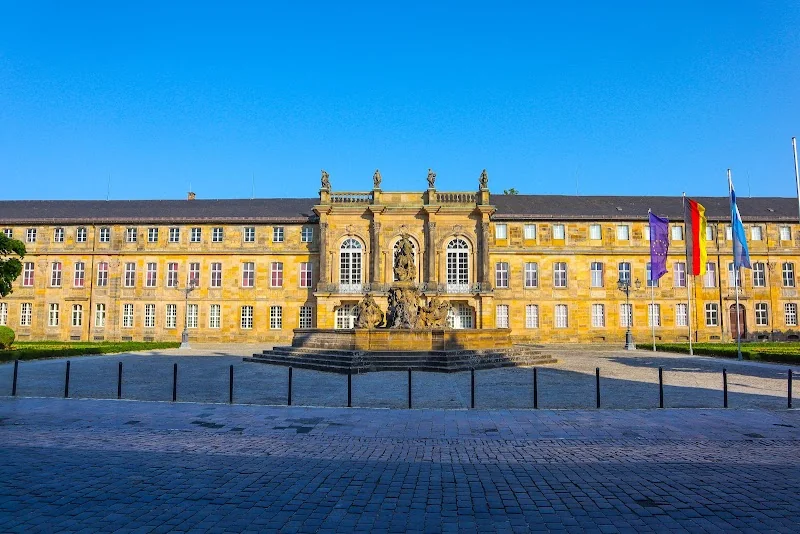
Ludwigstraße 21, Bayreuth
Ludwigstraße 21, 95444 Bayreuth, Germany
New Palace Bayreuth | Opening Hours & Tickets
The New Palace Bayreuth is much more than a beautiful facade in the center of the city. Upon arrival, visitors enter one of the most important residences of Bayreuth Rococo, which still impresses today with its historical splendor, museum collections, and the directly adjacent court garden. The palace is located at Ludwigstraße 21 in Bayreuth and is closely linked to the history of Margravine Wilhelmine, whose taste and ideas significantly shaped the sequences of rooms, decorations, and courtly ambiance. Particularly appealing is the mix of freely accessible state rooms, the Italian Palace which can only be visited with a guided tour, and the collections on the ground and upper floors. Those looking for opening hours, admission prices, tickets, parking, guided tours, or children's offerings will find here a compact yet atmospheric orientation for their visit. The court garden is also always accessible and makes the ensemble a worthwhile destination even if one is only seeking a short break in the green. ([bayreuth-wilhelmine.de](https://www.bayreuth-wilhelmine.de/deutsch/tourist/oeffnung.htm))
Opening Hours, Admission & Tickets for the New Palace Bayreuth
The current opening hours are clearly defined: From April to September, the New Palace is open daily from 9 AM to 6 PM, and from October to March daily from 10 AM to 4 PM. The palace is closed on Mondays, although there are exceptions for certain holidays. Additionally, the palace is closed on January 1, Shrove Tuesday, and December 24, 25, and 31. Those planning their visit should especially consider the shorter hours during the winter months. The court garden itself has different rules: it is accessible at any time and can therefore be used as a walking destination even outside museum hours. This is particularly practical for those who can only experience Bayreuth partially on a travel day or wish to combine their palace visit with a stroll through the city center. ([bayreuth-wilhelmine.de](https://www.bayreuth-wilhelmine.de/deutsch/tourist/oeffnung.htm))
For admission, the New Palace offers a good price-performance ratio for a historic residence ensemble in 2026. The regular admission fee is 7 euros, reduced 6 euros. Those who wish to combine their visit to the New Palace with the Margravial Opera House can use a combination ticket for 15 euros regular or 13 euros reduced. For all who want to explore Bayreuth more intensively, there is also a comprehensive ticket for the world of Wilhelmine, covering all Bayreuth objects, for 21 euros regular or 19 euros reduced. Children under 18 years have free admission. This makes the palace attractive not only for cultural travelers but also for families planning a high-quality day trip on a manageable budget. The official pages also recommend checking for current changes or details regarding rates and special openings before visiting. ([schloesser.bayern.de](https://www.schloesser.bayern.de/englisch/palace/objects/bay_ns.htm))
The structure for guided tours is also transparent. The state rooms can generally be visited without a guide, making the visit very flexible. However, regular guided tours are offered that deepen the experience of the rooms and make the art-historical details more understandable. According to current visitor information, tours for individual guests and groups take place from Friday to Sunday at 11 AM, last about 60 minutes, and cost 3 euros plus admission. The number of participants is limited, so registration is recommended. In addition, private group tours can be booked. Especially for visitors who want not just to see the palace but truly understand it, this is an important point: The New Palace is not a passive photo stop, but a place where design, court culture, and representation become very tangible. ([bayreuth-wilhelmine.de](https://www.bayreuth-wilhelmine.de/deutsch/tourist/oeffnung.htm))
Interior Rooms in the New Palace Bayreuth: Palm Room, Mirror Shard Cabinet, and Italian Palace
The interior rooms are among the strongest arguments for a visit. The New Palace is famous for rooms that are not simply decorated but tell a whole courtly world. Noteworthy are the Mirror Shard Cabinet with its unusual mirror effect, the salon with a gold ceiling, Wilhelmine's Japanese Room with exotic garden and trellis design, the Old Music Room with pastel portraits of singers, actors, and dancers, as well as the Palm Room in the southern wing. The Palm Room is considered one of the most significant spatial artworks of Bayreuth Rococo. Its walnut paneling and gilded palms create an impressive, almost theatrical atmosphere that immediately transports the visitor into the aesthetics of the 18th century. At the same time, the room has a special cultural depth, as it served, among other things, as a meeting place for a Masonic lodge founded by Margrave Friedrich in Bayreuth. This makes the room not only beautiful but also historically extraordinary. ([bayreuth-wilhelmine.de](https://www.bayreuth-wilhelmine.de/deutsch/n_schloss/spiegel.htm?utm_source=openai))
The private rooms of the Margravine also appear remarkably personal. The Mirror Shard Cabinet was not intended for courtly representation but for the private area of the Margravine. The unusually placed mirror shards and stucco forms do not make the wall appear larger but rather perforated, almost like an art object with mysterious depth. Such solutions exist in this form only in Bayreuth Rococo. The Japanese Room, in turn, shows how strongly the courtly architecture of the 18th century was inspired by Far Eastern motifs and garden images. Additional rooms include the Prussian Family Room, the Festsaal, and the salons of the Margravine, making the visit a journey through very different moods. On the ground floor, Bayreuth faience from the Rummel collection, the painting gallery with late Baroque paintings, and the permanent exhibition of Gallant Miniatures complement the palace program. The latter showcases around 100 miniature paintings, mainly by French painters of the 18th century, in three newly designed rooms and is considered a unique collection worldwide. Those interested in interior design, crafts, and court culture will find an exceptionally dense mix here. ([bayreuth-wilhelmine.de](https://www.bayreuth-wilhelmine.de/deutsch/n_schloss/spiegel.htm?utm_source=openai))
History of the New Palace Bayreuth and Margravine Wilhelmine
The history of the New Palace begins with a fire. After the Old Palace burned down in January 1753, it was decided in the same year to rebuild the residence. The French architect Joseph Saint-Pierre constructed the new complex on behalf of Margrave Friedrich of Brandenburg-Bayreuth. The role of Margravine Wilhelmine was crucial: she significantly influenced the design of the rooms and brought her cultural interests, artistic education, and sense of staging into the project. The New Palace thus became not only a replacement building but a conscious statement for a new courtly representation. It symbolically represents Bayreuth's development in the 18th century when the city, under Friedrich and Wilhelmine, became a European residence with remarkable cultural density. The fact that so many sequences of rooms, decorations, and artworks are still preserved today makes the place a very vivid testimony of that era. ([schloesser.bayern.de](https://www.schloesser.bayern.de/englisch/palace/objects/bay_ns.htm))
After the completion of the main palace, the Margrave had the initially freestanding Italian Palace built in 1759 for his second wife Sophie Caroline of Brunswick-Wolfenbüttel, which was later connected to the southern wing. This historical construction context is important because it shows how the palace grew over the years and was not exhausted in a single construction phase. The court garden also developed further: by the end of the 18th century, it was transformed into an English-style landscape park with winding paths and natural groups of trees, while the geometric basic structure, the canal, and the three main axes remained intact. In 1990, the parterre in front of the southern wing was reconstructed. Thus, the ensemble today shows several layers of time simultaneously: Baroque planning, Rococo spatial art, later garden development, and modern restoration. This is where a large part of its fascination lies. The New Palace is not just a monument but a historically readable landscape of architecture, garden art, and court culture. ([schloesser.bayern.de](https://www.schloesser.bayern.de/englisch/palace/objects/bay_ns.htm))
Access and Parking at the New Palace Bayreuth
The location in the city center makes the visit generally easy, even when arriving by car. Officially, access via Bayreuth and arrival by bus to Sternplatz is recommended. For parking, the Bavarian Palace Administration refers to the parking options in the Bayreuth city center. The Tourist Information adds that there are parking garages, underground garages, and more than 6,000 public and private parking spaces available in the city center. So if one does not park directly at the palace, there are usually several alternatives within walking distance. This is particularly relevant for day visitors, as the New Palace is centrally located and can be easily combined with the old town, opera house, and city center stroll. For those unfamiliar with the area, it is advisable not to rely on a single parking space but to understand the city center as parking space and then plan the short walk. ([schloesser.bayern.de](https://www.schloesser.bayern.de/englisch/palace/objects/bay_ns.htm))
For people with limited mobility, several details are particularly helpful. Opposite the main entrance on Ludwigstraße at Residenzplatz, there is a disabled parking space, another is located in Glasenappweg, that is, to the left of the palace. Two level, barrier-free paths lead from the palace square to the entrance. Inside, there is a separate step-free access to the ticket area and shop, and the main areas are accessible by elevator. Seating is also available. Additionally, the court garden is largely well accessible, although some areas, such as the bridge to the Great Island, have steps. For visitors who value a relaxed route, this is good news: The New Palace is not a difficult destination but is comparatively well developed despite its historical character. Those arriving by public transport also benefit from the fact that the palace location is in the middle of the urban area and can be well combined with other sights. ([bayreuth-wilhelmine.de](https://www.bayreuth-wilhelmine.de/deutsch/tourist/mobilitaet_neues-schloss.htm))
Guided Tours, Children's Offers, and Current Events at the New Palace Bayreuth
When it comes to guided tours, the New Palace is surprisingly versatile. The state rooms can be visited freely, but for those interested in backgrounds, additional guided tour dates are regularly offered. Currently, tours for individual guests and groups are offered from Friday to Sunday at 11 AM. The Italian Palace is generally only accessible with a guided tour, making the visit there more curated and focused. For international guests, the Palace Administration also provides guided texts and handouts in several languages, including English, French, Italian, Polish, Russian, Spanish, and Czech. This mix of free visiting, regulated tours, and multilingual support is very pleasant for a historic house, as it allows for both spontaneous and prepared visits. Those who want to delve deeper can also book private group tours. ([bayreuth-wilhelmine.de](https://www.bayreuth-wilhelmine.de/deutsch/tourist/oeffnung.htm))
The New Palace is also well equipped for families. On the children's and youth pages of the Bayreuth Palaces, a special museum educational program is offered for families, kindergarten groups, school classes, after-school care groups, holiday clubs, youth groups, and children's birthdays. The offerings are playful, experimental, and interactive. For the New Palace, there is, for example, a museum bag suitable for children aged 6 to 12 years, which can be borrowed free of charge at the museum ticket office. With the help of Wilhelmine's favorite dog Folichon, children and parents solve tasks, listen to stories, and learn about the world of the Margravine. Additionally, there are regularly special family tours, such as being guests of the prince and princess in the baroque palace or discovering Wilhelmine's world. Such formats make the palace tangible for younger visitors, as they not only explain the rooms but turn them into small adventures. ([bayreuth-wilhelmine.de](https://www.bayreuth-wilhelmine.de/deutsch/kinder/mitmachen/mitmachen.htm))
For current events, it is also worthwhile to take a look at the official Bayreuth-Wilhelmine homepage. There, ongoing theme tours, activities for families, and events at Bayreuth's attractions, including the New Palace, are bundled. This is important because the program points can change throughout the year and because some theme tours only take place on specific dates. Therefore, those planning a cultural trip should not reduce their visit to the standard opening hours but also check the event situation. Especially during residence days, family formats, or special tours, the New Palace can be experienced even more intensively. Thus, a classic palace visit becomes a lively cultural program that connects architecture, history, and mediation. ([bayreuth-wilhelmine.de](https://www.bayreuth-wilhelmine.de/))
Court Garden, Museum, and Photo Opportunities around the New Palace
The court garden is a central part of the experience and not just a beautiful backdrop. It is always accessible and forms the green extension of the palace into the city. Historically, it was redesigned into an English-style park with winding paths and natural groups of trees by the end of the 18th century, without completely abandoning the older geometric structure. The canal and the three main axes are still preserved today as historical order elements. This creates a park that appears both strict and light, exactly the kind of contrast one expects from a court garden. Those looking for a quiet walk will find open paths, seating, and a good transition between the palace, city center, and other Bayreuth cultural sites. For photos, this mix of architecture and landscape is appealing, as it allows for both classic facade shots and atmospheric perspectives into the garden. ([schloesser.bayern.de](https://www.schloesser.bayern.de/englisch/palace/objects/bay_ns.htm))
The museum side is also remarkably versatile. On the ground floor, the palace showcases Bayreuth faience, late Baroque painting, and a view of courtly usage culture. The museum The Bayreuth of Margravine Wilhelmine conveys everyday life, art, and representation at the court of the 18th century. The gallery of late Baroque painting complements the ensemble with an art-historical line, while the Gallant Miniatures open a small but extraordinary world in three newly designed museum rooms. Together with the state rooms, the Italian Palace, and the court garden, a tour is created that works both art-historically and emotionally. Those coming with a camera will find motifs in the interplay of Rococo detail, garden axis, palace facade, and interior light. Therefore, the New Palace Bayreuth is not a place for a quick obligatory stop but a house that reveals new layers with every glance and is particularly worthwhile for quiet, attentive visits. ([bayreuth-wilhelmine.de](https://www.bayreuth-wilhelmine.de/deutsch/n_schloss/index.htm?utm_source=openai))
Sources:
- Bavarian Palace Administration – New Palace Bayreuth ([schloesser.bayern.de](https://www.schloesser.bayern.de/deutsch/schloss/objekte/bay_ns.htm))
- Bayreuth Tourism – New Palace with Court Garden ([bayreuth-tourismus.de](https://www.bayreuth-tourismus.de/sehenswertes/wilhelmine/neues-schloss-mit-hofgarten/))
- Bayreuth Tourism – Parking in Bayreuth ([bayreuth-tourismus.de](https://www.bayreuth-tourismus.de/parken/))
- Bavarian Palace Administration – Visitor Information / Opening Hours ([bayreuth-wilhelmine.de](https://www.bayreuth-wilhelmine.de/deutsch/tourist/oeffnung.htm))
- Bavarian Palace Administration – Children's and Youth Pages / To (Participate) ([bayreuth-wilhelmine.de](https://www.bayreuth-wilhelmine.de/deutsch/kinder/mitmachen/mitmachen.htm))
- Bavarian Palace Administration – The Bayreuth of Margravine Wilhelmine ([bayreuth-wilhelmine.de](https://www.bayreuth-wilhelmine.de/))
Show moreShow less
New Palace Bayreuth | Opening Hours & Tickets
The New Palace Bayreuth is much more than a beautiful facade in the center of the city. Upon arrival, visitors enter one of the most important residences of Bayreuth Rococo, which still impresses today with its historical splendor, museum collections, and the directly adjacent court garden. The palace is located at Ludwigstraße 21 in Bayreuth and is closely linked to the history of Margravine Wilhelmine, whose taste and ideas significantly shaped the sequences of rooms, decorations, and courtly ambiance. Particularly appealing is the mix of freely accessible state rooms, the Italian Palace which can only be visited with a guided tour, and the collections on the ground and upper floors. Those looking for opening hours, admission prices, tickets, parking, guided tours, or children's offerings will find here a compact yet atmospheric orientation for their visit. The court garden is also always accessible and makes the ensemble a worthwhile destination even if one is only seeking a short break in the green. ([bayreuth-wilhelmine.de](https://www.bayreuth-wilhelmine.de/deutsch/tourist/oeffnung.htm))
Opening Hours, Admission & Tickets for the New Palace Bayreuth
The current opening hours are clearly defined: From April to September, the New Palace is open daily from 9 AM to 6 PM, and from October to March daily from 10 AM to 4 PM. The palace is closed on Mondays, although there are exceptions for certain holidays. Additionally, the palace is closed on January 1, Shrove Tuesday, and December 24, 25, and 31. Those planning their visit should especially consider the shorter hours during the winter months. The court garden itself has different rules: it is accessible at any time and can therefore be used as a walking destination even outside museum hours. This is particularly practical for those who can only experience Bayreuth partially on a travel day or wish to combine their palace visit with a stroll through the city center. ([bayreuth-wilhelmine.de](https://www.bayreuth-wilhelmine.de/deutsch/tourist/oeffnung.htm))
For admission, the New Palace offers a good price-performance ratio for a historic residence ensemble in 2026. The regular admission fee is 7 euros, reduced 6 euros. Those who wish to combine their visit to the New Palace with the Margravial Opera House can use a combination ticket for 15 euros regular or 13 euros reduced. For all who want to explore Bayreuth more intensively, there is also a comprehensive ticket for the world of Wilhelmine, covering all Bayreuth objects, for 21 euros regular or 19 euros reduced. Children under 18 years have free admission. This makes the palace attractive not only for cultural travelers but also for families planning a high-quality day trip on a manageable budget. The official pages also recommend checking for current changes or details regarding rates and special openings before visiting. ([schloesser.bayern.de](https://www.schloesser.bayern.de/englisch/palace/objects/bay_ns.htm))
The structure for guided tours is also transparent. The state rooms can generally be visited without a guide, making the visit very flexible. However, regular guided tours are offered that deepen the experience of the rooms and make the art-historical details more understandable. According to current visitor information, tours for individual guests and groups take place from Friday to Sunday at 11 AM, last about 60 minutes, and cost 3 euros plus admission. The number of participants is limited, so registration is recommended. In addition, private group tours can be booked. Especially for visitors who want not just to see the palace but truly understand it, this is an important point: The New Palace is not a passive photo stop, but a place where design, court culture, and representation become very tangible. ([bayreuth-wilhelmine.de](https://www.bayreuth-wilhelmine.de/deutsch/tourist/oeffnung.htm))
Interior Rooms in the New Palace Bayreuth: Palm Room, Mirror Shard Cabinet, and Italian Palace
The interior rooms are among the strongest arguments for a visit. The New Palace is famous for rooms that are not simply decorated but tell a whole courtly world. Noteworthy are the Mirror Shard Cabinet with its unusual mirror effect, the salon with a gold ceiling, Wilhelmine's Japanese Room with exotic garden and trellis design, the Old Music Room with pastel portraits of singers, actors, and dancers, as well as the Palm Room in the southern wing. The Palm Room is considered one of the most significant spatial artworks of Bayreuth Rococo. Its walnut paneling and gilded palms create an impressive, almost theatrical atmosphere that immediately transports the visitor into the aesthetics of the 18th century. At the same time, the room has a special cultural depth, as it served, among other things, as a meeting place for a Masonic lodge founded by Margrave Friedrich in Bayreuth. This makes the room not only beautiful but also historically extraordinary. ([bayreuth-wilhelmine.de](https://www.bayreuth-wilhelmine.de/deutsch/n_schloss/spiegel.htm?utm_source=openai))
The private rooms of the Margravine also appear remarkably personal. The Mirror Shard Cabinet was not intended for courtly representation but for the private area of the Margravine. The unusually placed mirror shards and stucco forms do not make the wall appear larger but rather perforated, almost like an art object with mysterious depth. Such solutions exist in this form only in Bayreuth Rococo. The Japanese Room, in turn, shows how strongly the courtly architecture of the 18th century was inspired by Far Eastern motifs and garden images. Additional rooms include the Prussian Family Room, the Festsaal, and the salons of the Margravine, making the visit a journey through very different moods. On the ground floor, Bayreuth faience from the Rummel collection, the painting gallery with late Baroque paintings, and the permanent exhibition of Gallant Miniatures complement the palace program. The latter showcases around 100 miniature paintings, mainly by French painters of the 18th century, in three newly designed rooms and is considered a unique collection worldwide. Those interested in interior design, crafts, and court culture will find an exceptionally dense mix here. ([bayreuth-wilhelmine.de](https://www.bayreuth-wilhelmine.de/deutsch/n_schloss/spiegel.htm?utm_source=openai))
History of the New Palace Bayreuth and Margravine Wilhelmine
The history of the New Palace begins with a fire. After the Old Palace burned down in January 1753, it was decided in the same year to rebuild the residence. The French architect Joseph Saint-Pierre constructed the new complex on behalf of Margrave Friedrich of Brandenburg-Bayreuth. The role of Margravine Wilhelmine was crucial: she significantly influenced the design of the rooms and brought her cultural interests, artistic education, and sense of staging into the project. The New Palace thus became not only a replacement building but a conscious statement for a new courtly representation. It symbolically represents Bayreuth's development in the 18th century when the city, under Friedrich and Wilhelmine, became a European residence with remarkable cultural density. The fact that so many sequences of rooms, decorations, and artworks are still preserved today makes the place a very vivid testimony of that era. ([schloesser.bayern.de](https://www.schloesser.bayern.de/englisch/palace/objects/bay_ns.htm))
After the completion of the main palace, the Margrave had the initially freestanding Italian Palace built in 1759 for his second wife Sophie Caroline of Brunswick-Wolfenbüttel, which was later connected to the southern wing. This historical construction context is important because it shows how the palace grew over the years and was not exhausted in a single construction phase. The court garden also developed further: by the end of the 18th century, it was transformed into an English-style landscape park with winding paths and natural groups of trees, while the geometric basic structure, the canal, and the three main axes remained intact. In 1990, the parterre in front of the southern wing was reconstructed. Thus, the ensemble today shows several layers of time simultaneously: Baroque planning, Rococo spatial art, later garden development, and modern restoration. This is where a large part of its fascination lies. The New Palace is not just a monument but a historically readable landscape of architecture, garden art, and court culture. ([schloesser.bayern.de](https://www.schloesser.bayern.de/englisch/palace/objects/bay_ns.htm))
Access and Parking at the New Palace Bayreuth
The location in the city center makes the visit generally easy, even when arriving by car. Officially, access via Bayreuth and arrival by bus to Sternplatz is recommended. For parking, the Bavarian Palace Administration refers to the parking options in the Bayreuth city center. The Tourist Information adds that there are parking garages, underground garages, and more than 6,000 public and private parking spaces available in the city center. So if one does not park directly at the palace, there are usually several alternatives within walking distance. This is particularly relevant for day visitors, as the New Palace is centrally located and can be easily combined with the old town, opera house, and city center stroll. For those unfamiliar with the area, it is advisable not to rely on a single parking space but to understand the city center as parking space and then plan the short walk. ([schloesser.bayern.de](https://www.schloesser.bayern.de/englisch/palace/objects/bay_ns.htm))
For people with limited mobility, several details are particularly helpful. Opposite the main entrance on Ludwigstraße at Residenzplatz, there is a disabled parking space, another is located in Glasenappweg, that is, to the left of the palace. Two level, barrier-free paths lead from the palace square to the entrance. Inside, there is a separate step-free access to the ticket area and shop, and the main areas are accessible by elevator. Seating is also available. Additionally, the court garden is largely well accessible, although some areas, such as the bridge to the Great Island, have steps. For visitors who value a relaxed route, this is good news: The New Palace is not a difficult destination but is comparatively well developed despite its historical character. Those arriving by public transport also benefit from the fact that the palace location is in the middle of the urban area and can be well combined with other sights. ([bayreuth-wilhelmine.de](https://www.bayreuth-wilhelmine.de/deutsch/tourist/mobilitaet_neues-schloss.htm))
Guided Tours, Children's Offers, and Current Events at the New Palace Bayreuth
When it comes to guided tours, the New Palace is surprisingly versatile. The state rooms can be visited freely, but for those interested in backgrounds, additional guided tour dates are regularly offered. Currently, tours for individual guests and groups are offered from Friday to Sunday at 11 AM. The Italian Palace is generally only accessible with a guided tour, making the visit there more curated and focused. For international guests, the Palace Administration also provides guided texts and handouts in several languages, including English, French, Italian, Polish, Russian, Spanish, and Czech. This mix of free visiting, regulated tours, and multilingual support is very pleasant for a historic house, as it allows for both spontaneous and prepared visits. Those who want to delve deeper can also book private group tours. ([bayreuth-wilhelmine.de](https://www.bayreuth-wilhelmine.de/deutsch/tourist/oeffnung.htm))
The New Palace is also well equipped for families. On the children's and youth pages of the Bayreuth Palaces, a special museum educational program is offered for families, kindergarten groups, school classes, after-school care groups, holiday clubs, youth groups, and children's birthdays. The offerings are playful, experimental, and interactive. For the New Palace, there is, for example, a museum bag suitable for children aged 6 to 12 years, which can be borrowed free of charge at the museum ticket office. With the help of Wilhelmine's favorite dog Folichon, children and parents solve tasks, listen to stories, and learn about the world of the Margravine. Additionally, there are regularly special family tours, such as being guests of the prince and princess in the baroque palace or discovering Wilhelmine's world. Such formats make the palace tangible for younger visitors, as they not only explain the rooms but turn them into small adventures. ([bayreuth-wilhelmine.de](https://www.bayreuth-wilhelmine.de/deutsch/kinder/mitmachen/mitmachen.htm))
For current events, it is also worthwhile to take a look at the official Bayreuth-Wilhelmine homepage. There, ongoing theme tours, activities for families, and events at Bayreuth's attractions, including the New Palace, are bundled. This is important because the program points can change throughout the year and because some theme tours only take place on specific dates. Therefore, those planning a cultural trip should not reduce their visit to the standard opening hours but also check the event situation. Especially during residence days, family formats, or special tours, the New Palace can be experienced even more intensively. Thus, a classic palace visit becomes a lively cultural program that connects architecture, history, and mediation. ([bayreuth-wilhelmine.de](https://www.bayreuth-wilhelmine.de/))
Court Garden, Museum, and Photo Opportunities around the New Palace
The court garden is a central part of the experience and not just a beautiful backdrop. It is always accessible and forms the green extension of the palace into the city. Historically, it was redesigned into an English-style park with winding paths and natural groups of trees by the end of the 18th century, without completely abandoning the older geometric structure. The canal and the three main axes are still preserved today as historical order elements. This creates a park that appears both strict and light, exactly the kind of contrast one expects from a court garden. Those looking for a quiet walk will find open paths, seating, and a good transition between the palace, city center, and other Bayreuth cultural sites. For photos, this mix of architecture and landscape is appealing, as it allows for both classic facade shots and atmospheric perspectives into the garden. ([schloesser.bayern.de](https://www.schloesser.bayern.de/englisch/palace/objects/bay_ns.htm))
The museum side is also remarkably versatile. On the ground floor, the palace showcases Bayreuth faience, late Baroque painting, and a view of courtly usage culture. The museum The Bayreuth of Margravine Wilhelmine conveys everyday life, art, and representation at the court of the 18th century. The gallery of late Baroque painting complements the ensemble with an art-historical line, while the Gallant Miniatures open a small but extraordinary world in three newly designed museum rooms. Together with the state rooms, the Italian Palace, and the court garden, a tour is created that works both art-historically and emotionally. Those coming with a camera will find motifs in the interplay of Rococo detail, garden axis, palace facade, and interior light. Therefore, the New Palace Bayreuth is not a place for a quick obligatory stop but a house that reveals new layers with every glance and is particularly worthwhile for quiet, attentive visits. ([bayreuth-wilhelmine.de](https://www.bayreuth-wilhelmine.de/deutsch/n_schloss/index.htm?utm_source=openai))
Sources:
- Bavarian Palace Administration – New Palace Bayreuth ([schloesser.bayern.de](https://www.schloesser.bayern.de/deutsch/schloss/objekte/bay_ns.htm))
- Bayreuth Tourism – New Palace with Court Garden ([bayreuth-tourismus.de](https://www.bayreuth-tourismus.de/sehenswertes/wilhelmine/neues-schloss-mit-hofgarten/))
- Bayreuth Tourism – Parking in Bayreuth ([bayreuth-tourismus.de](https://www.bayreuth-tourismus.de/parken/))
- Bavarian Palace Administration – Visitor Information / Opening Hours ([bayreuth-wilhelmine.de](https://www.bayreuth-wilhelmine.de/deutsch/tourist/oeffnung.htm))
- Bavarian Palace Administration – Children's and Youth Pages / To (Participate) ([bayreuth-wilhelmine.de](https://www.bayreuth-wilhelmine.de/deutsch/kinder/mitmachen/mitmachen.htm))
- Bavarian Palace Administration – The Bayreuth of Margravine Wilhelmine ([bayreuth-wilhelmine.de](https://www.bayreuth-wilhelmine.de/))
New Palace Bayreuth | Opening Hours & Tickets
The New Palace Bayreuth is much more than a beautiful facade in the center of the city. Upon arrival, visitors enter one of the most important residences of Bayreuth Rococo, which still impresses today with its historical splendor, museum collections, and the directly adjacent court garden. The palace is located at Ludwigstraße 21 in Bayreuth and is closely linked to the history of Margravine Wilhelmine, whose taste and ideas significantly shaped the sequences of rooms, decorations, and courtly ambiance. Particularly appealing is the mix of freely accessible state rooms, the Italian Palace which can only be visited with a guided tour, and the collections on the ground and upper floors. Those looking for opening hours, admission prices, tickets, parking, guided tours, or children's offerings will find here a compact yet atmospheric orientation for their visit. The court garden is also always accessible and makes the ensemble a worthwhile destination even if one is only seeking a short break in the green. ([bayreuth-wilhelmine.de](https://www.bayreuth-wilhelmine.de/deutsch/tourist/oeffnung.htm))
Opening Hours, Admission & Tickets for the New Palace Bayreuth
The current opening hours are clearly defined: From April to September, the New Palace is open daily from 9 AM to 6 PM, and from October to March daily from 10 AM to 4 PM. The palace is closed on Mondays, although there are exceptions for certain holidays. Additionally, the palace is closed on January 1, Shrove Tuesday, and December 24, 25, and 31. Those planning their visit should especially consider the shorter hours during the winter months. The court garden itself has different rules: it is accessible at any time and can therefore be used as a walking destination even outside museum hours. This is particularly practical for those who can only experience Bayreuth partially on a travel day or wish to combine their palace visit with a stroll through the city center. ([bayreuth-wilhelmine.de](https://www.bayreuth-wilhelmine.de/deutsch/tourist/oeffnung.htm))
For admission, the New Palace offers a good price-performance ratio for a historic residence ensemble in 2026. The regular admission fee is 7 euros, reduced 6 euros. Those who wish to combine their visit to the New Palace with the Margravial Opera House can use a combination ticket for 15 euros regular or 13 euros reduced. For all who want to explore Bayreuth more intensively, there is also a comprehensive ticket for the world of Wilhelmine, covering all Bayreuth objects, for 21 euros regular or 19 euros reduced. Children under 18 years have free admission. This makes the palace attractive not only for cultural travelers but also for families planning a high-quality day trip on a manageable budget. The official pages also recommend checking for current changes or details regarding rates and special openings before visiting. ([schloesser.bayern.de](https://www.schloesser.bayern.de/englisch/palace/objects/bay_ns.htm))
The structure for guided tours is also transparent. The state rooms can generally be visited without a guide, making the visit very flexible. However, regular guided tours are offered that deepen the experience of the rooms and make the art-historical details more understandable. According to current visitor information, tours for individual guests and groups take place from Friday to Sunday at 11 AM, last about 60 minutes, and cost 3 euros plus admission. The number of participants is limited, so registration is recommended. In addition, private group tours can be booked. Especially for visitors who want not just to see the palace but truly understand it, this is an important point: The New Palace is not a passive photo stop, but a place where design, court culture, and representation become very tangible. ([bayreuth-wilhelmine.de](https://www.bayreuth-wilhelmine.de/deutsch/tourist/oeffnung.htm))
Interior Rooms in the New Palace Bayreuth: Palm Room, Mirror Shard Cabinet, and Italian Palace
The interior rooms are among the strongest arguments for a visit. The New Palace is famous for rooms that are not simply decorated but tell a whole courtly world. Noteworthy are the Mirror Shard Cabinet with its unusual mirror effect, the salon with a gold ceiling, Wilhelmine's Japanese Room with exotic garden and trellis design, the Old Music Room with pastel portraits of singers, actors, and dancers, as well as the Palm Room in the southern wing. The Palm Room is considered one of the most significant spatial artworks of Bayreuth Rococo. Its walnut paneling and gilded palms create an impressive, almost theatrical atmosphere that immediately transports the visitor into the aesthetics of the 18th century. At the same time, the room has a special cultural depth, as it served, among other things, as a meeting place for a Masonic lodge founded by Margrave Friedrich in Bayreuth. This makes the room not only beautiful but also historically extraordinary. ([bayreuth-wilhelmine.de](https://www.bayreuth-wilhelmine.de/deutsch/n_schloss/spiegel.htm?utm_source=openai))
The private rooms of the Margravine also appear remarkably personal. The Mirror Shard Cabinet was not intended for courtly representation but for the private area of the Margravine. The unusually placed mirror shards and stucco forms do not make the wall appear larger but rather perforated, almost like an art object with mysterious depth. Such solutions exist in this form only in Bayreuth Rococo. The Japanese Room, in turn, shows how strongly the courtly architecture of the 18th century was inspired by Far Eastern motifs and garden images. Additional rooms include the Prussian Family Room, the Festsaal, and the salons of the Margravine, making the visit a journey through very different moods. On the ground floor, Bayreuth faience from the Rummel collection, the painting gallery with late Baroque paintings, and the permanent exhibition of Gallant Miniatures complement the palace program. The latter showcases around 100 miniature paintings, mainly by French painters of the 18th century, in three newly designed rooms and is considered a unique collection worldwide. Those interested in interior design, crafts, and court culture will find an exceptionally dense mix here. ([bayreuth-wilhelmine.de](https://www.bayreuth-wilhelmine.de/deutsch/n_schloss/spiegel.htm?utm_source=openai))
History of the New Palace Bayreuth and Margravine Wilhelmine
The history of the New Palace begins with a fire. After the Old Palace burned down in January 1753, it was decided in the same year to rebuild the residence. The French architect Joseph Saint-Pierre constructed the new complex on behalf of Margrave Friedrich of Brandenburg-Bayreuth. The role of Margravine Wilhelmine was crucial: she significantly influenced the design of the rooms and brought her cultural interests, artistic education, and sense of staging into the project. The New Palace thus became not only a replacement building but a conscious statement for a new courtly representation. It symbolically represents Bayreuth's development in the 18th century when the city, under Friedrich and Wilhelmine, became a European residence with remarkable cultural density. The fact that so many sequences of rooms, decorations, and artworks are still preserved today makes the place a very vivid testimony of that era. ([schloesser.bayern.de](https://www.schloesser.bayern.de/englisch/palace/objects/bay_ns.htm))
After the completion of the main palace, the Margrave had the initially freestanding Italian Palace built in 1759 for his second wife Sophie Caroline of Brunswick-Wolfenbüttel, which was later connected to the southern wing. This historical construction context is important because it shows how the palace grew over the years and was not exhausted in a single construction phase. The court garden also developed further: by the end of the 18th century, it was transformed into an English-style landscape park with winding paths and natural groups of trees, while the geometric basic structure, the canal, and the three main axes remained intact. In 1990, the parterre in front of the southern wing was reconstructed. Thus, the ensemble today shows several layers of time simultaneously: Baroque planning, Rococo spatial art, later garden development, and modern restoration. This is where a large part of its fascination lies. The New Palace is not just a monument but a historically readable landscape of architecture, garden art, and court culture. ([schloesser.bayern.de](https://www.schloesser.bayern.de/englisch/palace/objects/bay_ns.htm))
Access and Parking at the New Palace Bayreuth
The location in the city center makes the visit generally easy, even when arriving by car. Officially, access via Bayreuth and arrival by bus to Sternplatz is recommended. For parking, the Bavarian Palace Administration refers to the parking options in the Bayreuth city center. The Tourist Information adds that there are parking garages, underground garages, and more than 6,000 public and private parking spaces available in the city center. So if one does not park directly at the palace, there are usually several alternatives within walking distance. This is particularly relevant for day visitors, as the New Palace is centrally located and can be easily combined with the old town, opera house, and city center stroll. For those unfamiliar with the area, it is advisable not to rely on a single parking space but to understand the city center as parking space and then plan the short walk. ([schloesser.bayern.de](https://www.schloesser.bayern.de/englisch/palace/objects/bay_ns.htm))
For people with limited mobility, several details are particularly helpful. Opposite the main entrance on Ludwigstraße at Residenzplatz, there is a disabled parking space, another is located in Glasenappweg, that is, to the left of the palace. Two level, barrier-free paths lead from the palace square to the entrance. Inside, there is a separate step-free access to the ticket area and shop, and the main areas are accessible by elevator. Seating is also available. Additionally, the court garden is largely well accessible, although some areas, such as the bridge to the Great Island, have steps. For visitors who value a relaxed route, this is good news: The New Palace is not a difficult destination but is comparatively well developed despite its historical character. Those arriving by public transport also benefit from the fact that the palace location is in the middle of the urban area and can be well combined with other sights. ([bayreuth-wilhelmine.de](https://www.bayreuth-wilhelmine.de/deutsch/tourist/mobilitaet_neues-schloss.htm))
Guided Tours, Children's Offers, and Current Events at the New Palace Bayreuth
When it comes to guided tours, the New Palace is surprisingly versatile. The state rooms can be visited freely, but for those interested in backgrounds, additional guided tour dates are regularly offered. Currently, tours for individual guests and groups are offered from Friday to Sunday at 11 AM. The Italian Palace is generally only accessible with a guided tour, making the visit there more curated and focused. For international guests, the Palace Administration also provides guided texts and handouts in several languages, including English, French, Italian, Polish, Russian, Spanish, and Czech. This mix of free visiting, regulated tours, and multilingual support is very pleasant for a historic house, as it allows for both spontaneous and prepared visits. Those who want to delve deeper can also book private group tours. ([bayreuth-wilhelmine.de](https://www.bayreuth-wilhelmine.de/deutsch/tourist/oeffnung.htm))
The New Palace is also well equipped for families. On the children's and youth pages of the Bayreuth Palaces, a special museum educational program is offered for families, kindergarten groups, school classes, after-school care groups, holiday clubs, youth groups, and children's birthdays. The offerings are playful, experimental, and interactive. For the New Palace, there is, for example, a museum bag suitable for children aged 6 to 12 years, which can be borrowed free of charge at the museum ticket office. With the help of Wilhelmine's favorite dog Folichon, children and parents solve tasks, listen to stories, and learn about the world of the Margravine. Additionally, there are regularly special family tours, such as being guests of the prince and princess in the baroque palace or discovering Wilhelmine's world. Such formats make the palace tangible for younger visitors, as they not only explain the rooms but turn them into small adventures. ([bayreuth-wilhelmine.de](https://www.bayreuth-wilhelmine.de/deutsch/kinder/mitmachen/mitmachen.htm))
For current events, it is also worthwhile to take a look at the official Bayreuth-Wilhelmine homepage. There, ongoing theme tours, activities for families, and events at Bayreuth's attractions, including the New Palace, are bundled. This is important because the program points can change throughout the year and because some theme tours only take place on specific dates. Therefore, those planning a cultural trip should not reduce their visit to the standard opening hours but also check the event situation. Especially during residence days, family formats, or special tours, the New Palace can be experienced even more intensively. Thus, a classic palace visit becomes a lively cultural program that connects architecture, history, and mediation. ([bayreuth-wilhelmine.de](https://www.bayreuth-wilhelmine.de/))
Court Garden, Museum, and Photo Opportunities around the New Palace
The court garden is a central part of the experience and not just a beautiful backdrop. It is always accessible and forms the green extension of the palace into the city. Historically, it was redesigned into an English-style park with winding paths and natural groups of trees by the end of the 18th century, without completely abandoning the older geometric structure. The canal and the three main axes are still preserved today as historical order elements. This creates a park that appears both strict and light, exactly the kind of contrast one expects from a court garden. Those looking for a quiet walk will find open paths, seating, and a good transition between the palace, city center, and other Bayreuth cultural sites. For photos, this mix of architecture and landscape is appealing, as it allows for both classic facade shots and atmospheric perspectives into the garden. ([schloesser.bayern.de](https://www.schloesser.bayern.de/englisch/palace/objects/bay_ns.htm))
The museum side is also remarkably versatile. On the ground floor, the palace showcases Bayreuth faience, late Baroque painting, and a view of courtly usage culture. The museum The Bayreuth of Margravine Wilhelmine conveys everyday life, art, and representation at the court of the 18th century. The gallery of late Baroque painting complements the ensemble with an art-historical line, while the Gallant Miniatures open a small but extraordinary world in three newly designed museum rooms. Together with the state rooms, the Italian Palace, and the court garden, a tour is created that works both art-historically and emotionally. Those coming with a camera will find motifs in the interplay of Rococo detail, garden axis, palace facade, and interior light. Therefore, the New Palace Bayreuth is not a place for a quick obligatory stop but a house that reveals new layers with every glance and is particularly worthwhile for quiet, attentive visits. ([bayreuth-wilhelmine.de](https://www.bayreuth-wilhelmine.de/deutsch/n_schloss/index.htm?utm_source=openai))
Sources:
- Bavarian Palace Administration – New Palace Bayreuth ([schloesser.bayern.de](https://www.schloesser.bayern.de/deutsch/schloss/objekte/bay_ns.htm))
- Bayreuth Tourism – New Palace with Court Garden ([bayreuth-tourismus.de](https://www.bayreuth-tourismus.de/sehenswertes/wilhelmine/neues-schloss-mit-hofgarten/))
- Bayreuth Tourism – Parking in Bayreuth ([bayreuth-tourismus.de](https://www.bayreuth-tourismus.de/parken/))
- Bavarian Palace Administration – Visitor Information / Opening Hours ([bayreuth-wilhelmine.de](https://www.bayreuth-wilhelmine.de/deutsch/tourist/oeffnung.htm))
- Bavarian Palace Administration – Children's and Youth Pages / To (Participate) ([bayreuth-wilhelmine.de](https://www.bayreuth-wilhelmine.de/deutsch/kinder/mitmachen/mitmachen.htm))
- Bavarian Palace Administration – The Bayreuth of Margravine Wilhelmine ([bayreuth-wilhelmine.de](https://www.bayreuth-wilhelmine.de/))
Upcoming Events
No events found
Frequently Asked Questions
Reviews
Krisztina Payne
4. January 2026
What a pretty place! We were greeted by Péter as we grabbed our tickets and our guide Jana showed us how the royals lived and their history, marriage and deaths and remarried life, how interesting, I could not get enough of the intertwined lives of the European royal houses that even touched on Bayreuth. The gardens are beautiful, relaxing shades under the old trees while you look onto the pond and flowers and people who strolled past.
Maryam Klidsar
6. January 2026
It is a stunning gem of history and art. The Italian palace section, with its refined yet vivid design and soft color palette, is absolutely breathtaking. The knowledgeable guide brought its history and artistic details to life with engaging storytelling, making the visit even more memorable. A must-see for anyone visiting Bayreuth!
Li Shen
16. May 2025
I really felt hospitality here at the Schloss today. I came by today because I liked my walk at sunset out at the Schlosspark last visit. Wasn’t expecting anything as I walked in and the gentleman at the Kasse was too warm and happy not to talk to. I got the ticket and was informed of a guided tour at the gallery. But the good vibe at the Kasse was only the beginning. We ran into a friendly staff who accompanied us to the restroom, and the guided tour lady was full of passion on the topic of the Schloss history. You see joy and spark in her eyes and she tells the stories. I had such an entertaining walk with all the details she gave. Luckily we were there in the early morning. So we ended up having an exclusive guided tour! I can probably also keep telling the story I learned today for quite a while among my friends. Recommend, you will have fun interacting with the people here and if time permits, visit the opera house too. To summarize, come early, no need to buy beforehand, interact, have a walk at the park at sunset. Park your car behind the opera house. In May this place is not crowded.
Lesly Huxley
3. April 2024
We visited on a cold, wet afternoon so didn't spend much time in the extensive gardens and grounds, but the interior was well worth the entrance fee. The rooms are beautifully decorated, it is easy to get around on both upper and lower floors, although there are some parts you can only visit on one of the regular guided tours. There is a small shop and museum, and a gallery of pictures on the ground floor.
p b
25. June 2023
A beautifully decorated building, the tour was in German but there was an information guide in English that gave a good overview of what was on display. The gardens and the adjacent park are good to visit too.