
Würzburg
Valentin-Becker-Straße 11, 97072 Würzburg-Altstadt, Deutschland
Shalom Europa Würzburg | Photos & Reviews
Shalom Europa in Würzburg is much more than a single building. At Valentin-Becker-Straße 11, there is a Jewish community and cultural center that connects religious life, history, education, and encounters. For visitors, the area is particularly interesting because it houses an active Jewish community, a synagogue, a museum, and facilities for documenting Jewish history in Lower Franconia. Those searching for Shalom Europa Würzburg photos, reviews, admission prices, or suitable directions will find an unusually dense connection of present and past at this location.
The Shalom Europa Museum presents Jewish religion, tradition, and history. The medieval tombstones from Würzburg, dated between 1147 and 1346, hold a special significance and were integrated into the new center after their rediscovery in the 1980s. At the same time, Shalom Europa remains a place of vibrant community. The spaces are used for worship services, education, encounters, seminars, and communal activities. This creates an atmosphere that is not only focused on historical remembrance but also makes Jewish life visible in the present.
The regular museum hours are Monday to Thursday from 10 AM to 4 PM and Sunday from 11 AM to 4 PM. The museum is closed on Friday and Saturday due to the Sabbath. Visitors should also note that during holiday periods and state and Jewish holidays, different closures may apply. Therefore, prior information on the official museum website is advisable.
Shalom Europa Würzburg Photos, Reviews, and First Impressions
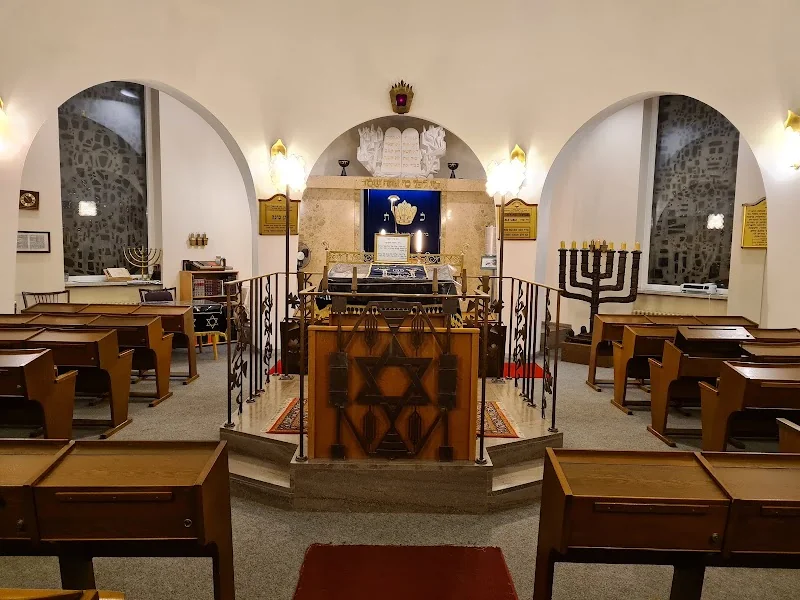
Those searching online for Shalom Europa Würzburg photos often initially expect images of a classic event venue. In fact, the center shows a different, more complex face. The architecture and use of the area are closely linked to the history of the Jewish community in Würzburg. On the premises stands the synagogue, inaugurated in 1970, which was later expanded as part of the new community and cultural center. The result is a modern complex whose function is not limited to a single exhibition or a single hall.
Photographic impressions can therefore show various perspectives: exterior views of the community center, interiors of the museum, exhibits, references to Jewish traditions, and the special area where the medieval tombstone finds are kept. It is precisely this connection between modern architecture and historical testimonies that makes Shalom Europa particularly interesting for culture enthusiasts. However, the photos should always be viewed in the context of the house rules. Since it is a Jewish community center and not solely a public museum, special security and visitation regulations may apply to certain areas, events, or tours.
Reviews of Shalom Europa Würzburg can also be meaningfully categorized when considering the different expectations. Some visitors come to the museum because of the Jewish history of Würzburg, others are interested in the synagogue, the medieval tombstones, or the educational work. Still, others participate in a guided tour, a lecture, or an encounter. The quality of the visit often depends on whether sufficient time is allocated for the historical contexts. Those expecting only a short museum visit will experience the place differently than someone who engages more deeply with Jewish history, religion, and memory culture.
The visitor information of the museum points to child-friendly and school educational offerings. The museum can thus also be interesting for groups, school classes, and families, provided the visit is appropriately prepared. Historical objects, religious content, and the history of the Würzburg community are not only conveyed abstractly but made tangible through concrete objects, spaces, and testimonies. Photos provide a first impression; however, the actual significance of the place is primarily revealed through the content of the exhibition and through a guided tour.
For a successful visit, it is advisable to check the opening hours in advance, note the address at Valentin-Becker-Straße 11, and contact early for groups or tour requests. Those wishing to take pictures for personal memories should observe the applicable photo and security rules on-site. This way, the visit remains respectful towards the community and informative for the guests.
Museum Shalom Europa Opening Hours, Admission, and Tickets
The Shalom Europa Museum is the publicly accessible part of the center that directly familiarizes visitors with Jewish history and present in Würzburg. The regular opening hours are Monday to Thursday from 10 AM to 4 PM and Sunday from 11 AM to 4 PM. The museum is closed on Fridays and Saturdays because the Sabbath holds special significance in the Jewish weekly rhythm. Additionally, holiday periods, state holidays, and Jewish holidays may lead to different opening hours. Therefore, the visit should not rely solely on older entries in travel guides or review portals.
The admission prices are comparatively low. Adults pay a regular fee of 3 euros. A reduced fee of 2 euros applies to students, retirees, and other eligible individuals with proof, as well as groups of ten or more. Students and trainees up to the age of 18 pay 1 euro. Children between 0 and 10 years have free admission. This pricing structure facilitates access to the exhibition for families, school classes, and culture-interested individual guests. A separate fee is charged for guided tours. According to visitor information, a museum guide during opening hours costs 30 euros; admission is added.
The search query tickets for Shalom Europa Israelite Community Würzburg can lead to misunderstandings. Shalom Europa is not an ordinary concert or theater venue with a permanent ticket shop. Admission prices apply on-site for the museum visit, while tours are organized upon registration. Events, lectures, or special programs may have their own registration rules and prices. Therefore, it is sensible to distinguish between museum admission, guided tour, and event ticket. A general ticket for all areas of the community center is not automatically available.
The exhibition focuses on Jewish life, religious foundations, and the history of Jews in Würzburg and Lower Franconia. A central theme is the medieval tombstones from the former Jewish cemetery. These objects connect local city history with a Jewish scholarly and community history of European significance. Würzburg was an important place of Jewish education and religious scholarship in the Middle Ages. The exhibition helps to understand this past not only through dates but through concrete testimonies.
For groups and school classes, prior registration is particularly worthwhile. Guided tours can better explain the historical and religious content and address questions. Even visitors without prior knowledge benefit from this, as many topics are placed in their historical context. Those coming alone should plan at least an hour; for a more in-depth consideration, combining with a guided tour, or engaging with the historical backgrounds, more time is recommended.
Shalom Europa Synagogue and Jewish Community Center
At the center of Shalom Europa is not only the museum but also the synagogue and the Jewish community. The center was developed by the Israelite Community of Würzburg and Lower Franconia together with an initiative group as a new Jewish community and cultural center. The planning responded to the growing community and the desire to connect religious life, education, social tasks, and cultural mediation in one place. This concept distinguishes Shalom Europa from a pure exhibition house.
The synagogue on the premises was inaugurated in 1970. As part of the new center, the existing religious site was integrated into a more comprehensive ensemble. The official description emphasizes that the synagogue remains at the center and that the other facilities are arranged around it. This statement is important for understanding the house: museum, community hall, educational spaces, and documentation are not isolated from each other but are part of a vibrant Jewish infrastructure.
According to the community and center's information, the building complex includes a museum, the storage facility for the medieval tombstone finds, a community hall with space for up to 400 people and an adjacent foyer, a dining hall with kosher kitchen, office spaces, and rooms for conferences and seminars. There are also areas for classrooms, a youth meeting place, a senior club, and the documentation center for Jewish history and culture in Lower Franconia. These different uses explain why Shalom Europa is significant for both community members and educational groups, guests, and professionals.
The synagogue itself is not a freely accessible event space in the usual sense. Visits may be tied to tours or special visiting offers. Those wishing to get to know the religious area should therefore inform themselves in advance and respect the house's guidelines. Different expectations apply to religious spaces than to a concert foyer or a tourist attraction. Consideration for worship services, holidays, security regulations, and religious processes is part of an appropriate visit.
The community center also fulfills a social function. Jewish life here encompasses not only worship and exhibition but also learning, communal meals, youth work, encounters, and support for various age groups. This combination makes Shalom Europa an important place for the Jewish community in Würzburg and Lower Franconia. Visitors gain insights into a present that consists not only of memory but also of everyday community work, education, and communal engagement.
Jewish History of Würzburg and the Medieval Tombstones
The history of the Jewish community of Würzburg dates back to the Middle Ages. Official historical accounts mention the year 1147 as an early written reference in connection with a pogrom. Between 1147 and 1298, Würzburg developed into a significant center of Jewish religion, culture, and scholarship. Jewish people came to the city from various regions of Europe. Rabbis and Talmud scholars were connected with communities in Germany and France. This European networking is one of the most important historical backgrounds that the museum conveys.
The medieval flourishing period ended in persecutions and destructions. During the Rintfleisch pogrom of 1298, numerous Jewish residents were murdered in Würzburg. Further persecutions followed in the 14th century. In 1349, the Jewish community in Würzburg was almost completely wiped out. The tombstones from this time are therefore of particular significance. They document names, life dates, religious formulas, and the existence of a community whose traces in the city's history were long only partially visible.
In 1987, 1485 tombstones and tombstone fragments were discovered in the Würzburg district of Pleich. The finds come from the medieval Jewish cemetery and are considered an extraordinary testimony to Jewish history. In the center's information, the find is described as the largest of its kind in the world. Other visitor information refers to 1455 Würzburg Jewish stones; the different figures may refer to various counts of tombstones and fragments. What is crucial is the extraordinary dimension of the collection and its scientific as well as memorial cultural value.
Since 2006, the tombstones have had their permanent place in the new community and cultural center Shalom Europa. They are kept in a special room under the courtyard of the center and are integrated into the museum. This creates a direct connection between today's Jewish community life and the historical testimonies of the medieval community. Visitors see not only a general representation of Jewish history but also gain access to concrete objects from Würzburg.
The exhibition also makes it clear that Jewish history does not begin with the time of National Socialism. It reaches back many centuries in Würzburg and includes phases of religious scholarship, economic activity, social integration, exclusion, persecution, re-establishment, and new beginnings. This temporal depth is particularly valuable pedagogically. It prevents a shortened view of Jewish history and shows that Jewish life was and is an integral part of European and Franconian city history.
The history after 1945 is also part of the center. The Jewish community of Würzburg was rebuilt after World War II. Since the 1990s, numerous Jewish immigrants from the former Soviet Union have come to the region. The community grew significantly and needed new spaces. The construction of the Shalom Europa project began in 2001, the first rooms were occupied in 2003, and on October 23, 2006, the new Jewish cultural and community center was officially inaugurated.
Shalom Europa Events, Tours, and Educational Offerings
Shalom Europa is a place for various forms of events. These include religious appointments of the community, educational offerings, lectures, seminars, encounters, exhibitions, and programs on Jewish history and culture. The specific event planning may change throughout the year. Those looking for Shalom Europa Würzburg events should therefore pay attention to current announcements from the Israelite community, the museum, and the institutions associated with the center.
An important component is guided tours through the museum and the synagogue. The visitor information explicitly addresses school classes as well. Tours can explain Jewish traditions, religious foundations, the history of the Würzburg community, and the significance of the medieval tombstone finds. For children and young people, direct access through objects, spaces, and stories is particularly helpful. The exhibition allows for learning about Jewish life not as a distant or abstract topic but as part of regional history and present.
The center has rooms for conferences and seminars. According to the official website, the community hall can accommodate up to 400 people and is also usable for synagogue purposes. Thus, the area is generally suitable for larger community gatherings and educational formats. The adjacent area and foyer support the use for encounters and exchanges. However, a public event in the hall does not automatically mean that the space can be freely visited or spontaneously booked at any time. For inquiries, the responsible departments of the community or organizers are decisive.
The educational work of the museum connects local history with overarching themes. These include religious customs, Jewish holidays, community organization, historical persecutions, the development of Jewish life in Lower Franconia, and the significance of remembrance. The documentation center expands this approach by collecting and conveying Jewish history and culture in the region. Together, a learning place is created that is suitable for both school education and interested adults.
For attending an event, guests should consider the special framework conditions. The center is a protected Jewish place. Security checks, entry rules, or registration may be required depending on the event. For religious events, the respective rules of the community also apply. Questions about admission, accessibility, photo permission, seating, or meeting points should be clarified in advance, especially if it is a guided tour or a visit with a larger group.
The search for programs and tickets should therefore always distinguish between general museum opening hours and individual events. The museum can be visited without a classic online ticket, while registration may be advisable or necessary for guided tours or special dates. Those planning a current event should check the date, the language of the tour, the duration, and possible restrictions directly with the respective provider. This way, it can be avoided that a visit cannot take place due to changed times or a closed facility.
Shalom Europa Directions, Parking, and Visit at Valentin-Becker-Straße
The address of Shalom Europa is Valentin-Becker-Straße 11, 97072 Würzburg. For arrival by public transport, the official visitor information names the Würzburg Süd train station as a possible train exit. Additionally, the Valentin-Becker-Straße stop is located near the center. From Würzburg main station, bus 114 goes towards the university and sports center. From Juliuspromenade or the theater, bus 6 towards Gartenstadt and Keesburg or bus 114 can also be used.
The connection with bus and train is particularly convenient as it allows visitors to avoid searching for parking in the city. For guests arriving by public transport, it is still advisable to check current timetable information, as line routes, departure times, and stop information may change. Also, for events with many participants, it is worthwhile to plan some extra time for the walk from the stop to the entrance.
Regarding Shalom Europa parking, the official museum information does not provide detailed information about a dedicated visitor parking lot. Therefore, it should not be assumed that there are regularly sufficient parking spaces available on the premises. Those arriving by car should check local parking options and signage in the area, observe parking bans, and allow time to search for a legal parking space. For tours, group visits, or events, it may be sensible to inquire in advance with the organizer.
The location in Würzburg allows visitors to combine their visit with other cultural destinations in the city. Nevertheless, guests should consider that Shalom Europa is not a completely freely accessible area like a public park. The visit focuses on the museum, tours, and announced events. Some rooms serve community life and are not publicly open at all times. This is especially true for religious or internal areas.
Before arrival, a short checklist is advisable. First, the museum's opening hours on the desired day should be checked. Second, it should be verified whether a tour or event requires registration. Third, visitors should plan their arrival by train or bus or check the current parking situation. Fourth, attention should be paid to possible holidays and closure days. Fifth, guests should plan respectful clothing and appropriate behavior in the religious and communally used spaces.
The security situation may also require special measures at Jewish institutions. Visitors should heed staff instructions and only enter the areas that are open for the respective appointment. Larger bags, photo equipment, or items not permitted at events may complicate entry. Current regulations may change and should be inquired directly at the center for special dates.
What Makes Shalom Europa Special in Würzburg
The uniqueness of Shalom Europa lies in the combination of various functions. The center serves as a synagogue, community house, museum, educational place, and meeting venue at the same time. Many cultural places deal with the past, while religious communities are primarily committed to the present. Shalom Europa connects both. Here, historical testimonies are preserved, and spaces for today's Jewish life are created.
Another special aspect is the connection of regional and European history. The medieval community of Würzburg was not isolated but part of a far-reaching network of Jewish scholarship. The tombstone finds make this past concrete. Names, inscriptions, and dates refer to people, families, and religious traditions that existed in the city for centuries. The visit thus shows that Jewish history in Würzburg should not be understood as a marginal topic.
The architectural development of the center also has its own significance. The synagogue from 1970 was integrated into the complex and supplemented by new facilities. The construction of the new center began in 2001, the first rooms were occupied in 2003, and the official inauguration took place in 2006. This development reflects the needs of a growing community. It also stands for the establishment of Jewish infrastructure in Germany after the Shoah and for the conscious decision to make Jewish life publicly visible and sustainable.
The center also offers access to Jewish religion that is not reduced to individual customs. Visitors can engage with community, prayer, holidays, dietary laws, education, and memory culture. The kosher kitchen, community hall, youth rooms, spaces for older people, and seminar areas show that religion and community have many everyday dimensions. This holistic view can help correct simplified notions of Jewish life.
For Würzburg, Shalom Europa is an important place of learning and remembrance. The institution makes the history of the Jewish community visible and supports dialogue between the Jewish community and the city society. At the same time, it remains a protected space for the community itself. This balance between public mediation and internal community use shapes the character of the place.
Those visiting Shalom Europa should therefore not only ask about the most spectacular exhibit. The value of the center lies in the interplay of elements: the synagogue as a religious center, the museum as a place of mediation, the tombstones as historical testimonies, the community as a living present, and the educational spaces as an invitation to exchange. It is precisely this connection that makes Shalom Europa a special destination for culture enthusiasts, school classes, Würzburg guests, and people who wish to engage with Jewish history in Germany.
Sources:
- Museum Shalom Europa – Your Visit, Opening Hours, Admission, and Directions
- Shalom Europa – New Jewish Community and Cultural Center
- Israelite Community Würzburg and Lower Franconia – History
- Shalom Europa – Museum and Medieval Jewish Tombstones
- Israelite Community Würzburg and Lower Franconia – Community Information
- Jewish Bavaria – Israelite Community Würzburg
- City of Würzburg – Art and Culture, Museum Shalom Europa
Mehr anzeigenWeniger anzeigen
Shalom Europa Würzburg | Photos & Reviews
Shalom Europa in Würzburg is much more than a single building. At Valentin-Becker-Straße 11, there is a Jewish community and cultural center that connects religious life, history, education, and encounters. For visitors, the area is particularly interesting because it houses an active Jewish community, a synagogue, a museum, and facilities for documenting Jewish history in Lower Franconia. Those searching for Shalom Europa Würzburg photos, reviews, admission prices, or suitable directions will find an unusually dense connection of present and past at this location.
The Shalom Europa Museum presents Jewish religion, tradition, and history. The medieval tombstones from Würzburg, dated between 1147 and 1346, hold a special significance and were integrated into the new center after their rediscovery in the 1980s. At the same time, Shalom Europa remains a place of vibrant community. The spaces are used for worship services, education, encounters, seminars, and communal activities. This creates an atmosphere that is not only focused on historical remembrance but also makes Jewish life visible in the present.
The regular museum hours are Monday to Thursday from 10 AM to 4 PM and Sunday from 11 AM to 4 PM. The museum is closed on Friday and Saturday due to the Sabbath. Visitors should also note that during holiday periods and state and Jewish holidays, different closures may apply. Therefore, prior information on the official museum website is advisable.
Shalom Europa Würzburg Photos, Reviews, and First Impressions
Those searching online for Shalom Europa Würzburg photos often initially expect images of a classic event venue. In fact, the center shows a different, more complex face. The architecture and use of the area are closely linked to the history of the Jewish community in Würzburg. On the premises stands the synagogue, inaugurated in 1970, which was later expanded as part of the new community and cultural center. The result is a modern complex whose function is not limited to a single exhibition or a single hall.
Photographic impressions can therefore show various perspectives: exterior views of the community center, interiors of the museum, exhibits, references to Jewish traditions, and the special area where the medieval tombstone finds are kept. It is precisely this connection between modern architecture and historical testimonies that makes Shalom Europa particularly interesting for culture enthusiasts. However, the photos should always be viewed in the context of the house rules. Since it is a Jewish community center and not solely a public museum, special security and visitation regulations may apply to certain areas, events, or tours.
Reviews of Shalom Europa Würzburg can also be meaningfully categorized when considering the different expectations. Some visitors come to the museum because of the Jewish history of Würzburg, others are interested in the synagogue, the medieval tombstones, or the educational work. Still, others participate in a guided tour, a lecture, or an encounter. The quality of the visit often depends on whether sufficient time is allocated for the historical contexts. Those expecting only a short museum visit will experience the place differently than someone who engages more deeply with Jewish history, religion, and memory culture.
The visitor information of the museum points to child-friendly and school educational offerings. The museum can thus also be interesting for groups, school classes, and families, provided the visit is appropriately prepared. Historical objects, religious content, and the history of the Würzburg community are not only conveyed abstractly but made tangible through concrete objects, spaces, and testimonies. Photos provide a first impression; however, the actual significance of the place is primarily revealed through the content of the exhibition and through a guided tour.
For a successful visit, it is advisable to check the opening hours in advance, note the address at Valentin-Becker-Straße 11, and contact early for groups or tour requests. Those wishing to take pictures for personal memories should observe the applicable photo and security rules on-site. This way, the visit remains respectful towards the community and informative for the guests.
Museum Shalom Europa Opening Hours, Admission, and Tickets
The Shalom Europa Museum is the publicly accessible part of the center that directly familiarizes visitors with Jewish history and present in Würzburg. The regular opening hours are Monday to Thursday from 10 AM to 4 PM and Sunday from 11 AM to 4 PM. The museum is closed on Fridays and Saturdays because the Sabbath holds special significance in the Jewish weekly rhythm. Additionally, holiday periods, state holidays, and Jewish holidays may lead to different opening hours. Therefore, the visit should not rely solely on older entries in travel guides or review portals.
The admission prices are comparatively low. Adults pay a regular fee of 3 euros. A reduced fee of 2 euros applies to students, retirees, and other eligible individuals with proof, as well as groups of ten or more. Students and trainees up to the age of 18 pay 1 euro. Children between 0 and 10 years have free admission. This pricing structure facilitates access to the exhibition for families, school classes, and culture-interested individual guests. A separate fee is charged for guided tours. According to visitor information, a museum guide during opening hours costs 30 euros; admission is added.
The search query tickets for Shalom Europa Israelite Community Würzburg can lead to misunderstandings. Shalom Europa is not an ordinary concert or theater venue with a permanent ticket shop. Admission prices apply on-site for the museum visit, while tours are organized upon registration. Events, lectures, or special programs may have their own registration rules and prices. Therefore, it is sensible to distinguish between museum admission, guided tour, and event ticket. A general ticket for all areas of the community center is not automatically available.
The exhibition focuses on Jewish life, religious foundations, and the history of Jews in Würzburg and Lower Franconia. A central theme is the medieval tombstones from the former Jewish cemetery. These objects connect local city history with a Jewish scholarly and community history of European significance. Würzburg was an important place of Jewish education and religious scholarship in the Middle Ages. The exhibition helps to understand this past not only through dates but through concrete testimonies.
For groups and school classes, prior registration is particularly worthwhile. Guided tours can better explain the historical and religious content and address questions. Even visitors without prior knowledge benefit from this, as many topics are placed in their historical context. Those coming alone should plan at least an hour; for a more in-depth consideration, combining with a guided tour, or engaging with the historical backgrounds, more time is recommended.
Shalom Europa Synagogue and Jewish Community Center
At the center of Shalom Europa is not only the museum but also the synagogue and the Jewish community. The center was developed by the Israelite Community of Würzburg and Lower Franconia together with an initiative group as a new Jewish community and cultural center. The planning responded to the growing community and the desire to connect religious life, education, social tasks, and cultural mediation in one place. This concept distinguishes Shalom Europa from a pure exhibition house.
The synagogue on the premises was inaugurated in 1970. As part of the new center, the existing religious site was integrated into a more comprehensive ensemble. The official description emphasizes that the synagogue remains at the center and that the other facilities are arranged around it. This statement is important for understanding the house: museum, community hall, educational spaces, and documentation are not isolated from each other but are part of a vibrant Jewish infrastructure.
According to the community and center's information, the building complex includes a museum, the storage facility for the medieval tombstone finds, a community hall with space for up to 400 people and an adjacent foyer, a dining hall with kosher kitchen, office spaces, and rooms for conferences and seminars. There are also areas for classrooms, a youth meeting place, a senior club, and the documentation center for Jewish history and culture in Lower Franconia. These different uses explain why Shalom Europa is significant for both community members and educational groups, guests, and professionals.
The synagogue itself is not a freely accessible event space in the usual sense. Visits may be tied to tours or special visiting offers. Those wishing to get to know the religious area should therefore inform themselves in advance and respect the house's guidelines. Different expectations apply to religious spaces than to a concert foyer or a tourist attraction. Consideration for worship services, holidays, security regulations, and religious processes is part of an appropriate visit.
The community center also fulfills a social function. Jewish life here encompasses not only worship and exhibition but also learning, communal meals, youth work, encounters, and support for various age groups. This combination makes Shalom Europa an important place for the Jewish community in Würzburg and Lower Franconia. Visitors gain insights into a present that consists not only of memory but also of everyday community work, education, and communal engagement.
Jewish History of Würzburg and the Medieval Tombstones
The history of the Jewish community of Würzburg dates back to the Middle Ages. Official historical accounts mention the year 1147 as an early written reference in connection with a pogrom. Between 1147 and 1298, Würzburg developed into a significant center of Jewish religion, culture, and scholarship. Jewish people came to the city from various regions of Europe. Rabbis and Talmud scholars were connected with communities in Germany and France. This European networking is one of the most important historical backgrounds that the museum conveys.
The medieval flourishing period ended in persecutions and destructions. During the Rintfleisch pogrom of 1298, numerous Jewish residents were murdered in Würzburg. Further persecutions followed in the 14th century. In 1349, the Jewish community in Würzburg was almost completely wiped out. The tombstones from this time are therefore of particular significance. They document names, life dates, religious formulas, and the existence of a community whose traces in the city's history were long only partially visible.
In 1987, 1485 tombstones and tombstone fragments were discovered in the Würzburg district of Pleich. The finds come from the medieval Jewish cemetery and are considered an extraordinary testimony to Jewish history. In the center's information, the find is described as the largest of its kind in the world. Other visitor information refers to 1455 Würzburg Jewish stones; the different figures may refer to various counts of tombstones and fragments. What is crucial is the extraordinary dimension of the collection and its scientific as well as memorial cultural value.
Since 2006, the tombstones have had their permanent place in the new community and cultural center Shalom Europa. They are kept in a special room under the courtyard of the center and are integrated into the museum. This creates a direct connection between today's Jewish community life and the historical testimonies of the medieval community. Visitors see not only a general representation of Jewish history but also gain access to concrete objects from Würzburg.
The exhibition also makes it clear that Jewish history does not begin with the time of National Socialism. It reaches back many centuries in Würzburg and includes phases of religious scholarship, economic activity, social integration, exclusion, persecution, re-establishment, and new beginnings. This temporal depth is particularly valuable pedagogically. It prevents a shortened view of Jewish history and shows that Jewish life was and is an integral part of European and Franconian city history.
The history after 1945 is also part of the center. The Jewish community of Würzburg was rebuilt after World War II. Since the 1990s, numerous Jewish immigrants from the former Soviet Union have come to the region. The community grew significantly and needed new spaces. The construction of the Shalom Europa project began in 2001, the first rooms were occupied in 2003, and on October 23, 2006, the new Jewish cultural and community center was officially inaugurated.
Shalom Europa Events, Tours, and Educational Offerings
Shalom Europa is a place for various forms of events. These include religious appointments of the community, educational offerings, lectures, seminars, encounters, exhibitions, and programs on Jewish history and culture. The specific event planning may change throughout the year. Those looking for Shalom Europa Würzburg events should therefore pay attention to current announcements from the Israelite community, the museum, and the institutions associated with the center.
An important component is guided tours through the museum and the synagogue. The visitor information explicitly addresses school classes as well. Tours can explain Jewish traditions, religious foundations, the history of the Würzburg community, and the significance of the medieval tombstone finds. For children and young people, direct access through objects, spaces, and stories is particularly helpful. The exhibition allows for learning about Jewish life not as a distant or abstract topic but as part of regional history and present.
The center has rooms for conferences and seminars. According to the official website, the community hall can accommodate up to 400 people and is also usable for synagogue purposes. Thus, the area is generally suitable for larger community gatherings and educational formats. The adjacent area and foyer support the use for encounters and exchanges. However, a public event in the hall does not automatically mean that the space can be freely visited or spontaneously booked at any time. For inquiries, the responsible departments of the community or organizers are decisive.
The educational work of the museum connects local history with overarching themes. These include religious customs, Jewish holidays, community organization, historical persecutions, the development of Jewish life in Lower Franconia, and the significance of remembrance. The documentation center expands this approach by collecting and conveying Jewish history and culture in the region. Together, a learning place is created that is suitable for both school education and interested adults.
For attending an event, guests should consider the special framework conditions. The center is a protected Jewish place. Security checks, entry rules, or registration may be required depending on the event. For religious events, the respective rules of the community also apply. Questions about admission, accessibility, photo permission, seating, or meeting points should be clarified in advance, especially if it is a guided tour or a visit with a larger group.
The search for programs and tickets should therefore always distinguish between general museum opening hours and individual events. The museum can be visited without a classic online ticket, while registration may be advisable or necessary for guided tours or special dates. Those planning a current event should check the date, the language of the tour, the duration, and possible restrictions directly with the respective provider. This way, it can be avoided that a visit cannot take place due to changed times or a closed facility.
Shalom Europa Directions, Parking, and Visit at Valentin-Becker-Straße
The address of Shalom Europa is Valentin-Becker-Straße 11, 97072 Würzburg. For arrival by public transport, the official visitor information names the Würzburg Süd train station as a possible train exit. Additionally, the Valentin-Becker-Straße stop is located near the center. From Würzburg main station, bus 114 goes towards the university and sports center. From Juliuspromenade or the theater, bus 6 towards Gartenstadt and Keesburg or bus 114 can also be used.
The connection with bus and train is particularly convenient as it allows visitors to avoid searching for parking in the city. For guests arriving by public transport, it is still advisable to check current timetable information, as line routes, departure times, and stop information may change. Also, for events with many participants, it is worthwhile to plan some extra time for the walk from the stop to the entrance.
Regarding Shalom Europa parking, the official museum information does not provide detailed information about a dedicated visitor parking lot. Therefore, it should not be assumed that there are regularly sufficient parking spaces available on the premises. Those arriving by car should check local parking options and signage in the area, observe parking bans, and allow time to search for a legal parking space. For tours, group visits, or events, it may be sensible to inquire in advance with the organizer.
The location in Würzburg allows visitors to combine their visit with other cultural destinations in the city. Nevertheless, guests should consider that Shalom Europa is not a completely freely accessible area like a public park. The visit focuses on the museum, tours, and announced events. Some rooms serve community life and are not publicly open at all times. This is especially true for religious or internal areas.
Before arrival, a short checklist is advisable. First, the museum's opening hours on the desired day should be checked. Second, it should be verified whether a tour or event requires registration. Third, visitors should plan their arrival by train or bus or check the current parking situation. Fourth, attention should be paid to possible holidays and closure days. Fifth, guests should plan respectful clothing and appropriate behavior in the religious and communally used spaces.
The security situation may also require special measures at Jewish institutions. Visitors should heed staff instructions and only enter the areas that are open for the respective appointment. Larger bags, photo equipment, or items not permitted at events may complicate entry. Current regulations may change and should be inquired directly at the center for special dates.
What Makes Shalom Europa Special in Würzburg
The uniqueness of Shalom Europa lies in the combination of various functions. The center serves as a synagogue, community house, museum, educational place, and meeting venue at the same time. Many cultural places deal with the past, while religious communities are primarily committed to the present. Shalom Europa connects both. Here, historical testimonies are preserved, and spaces for today's Jewish life are created.
Another special aspect is the connection of regional and European history. The medieval community of Würzburg was not isolated but part of a far-reaching network of Jewish scholarship. The tombstone finds make this past concrete. Names, inscriptions, and dates refer to people, families, and religious traditions that existed in the city for centuries. The visit thus shows that Jewish history in Würzburg should not be understood as a marginal topic.
The architectural development of the center also has its own significance. The synagogue from 1970 was integrated into the complex and supplemented by new facilities. The construction of the new center began in 2001, the first rooms were occupied in 2003, and the official inauguration took place in 2006. This development reflects the needs of a growing community. It also stands for the establishment of Jewish infrastructure in Germany after the Shoah and for the conscious decision to make Jewish life publicly visible and sustainable.
The center also offers access to Jewish religion that is not reduced to individual customs. Visitors can engage with community, prayer, holidays, dietary laws, education, and memory culture. The kosher kitchen, community hall, youth rooms, spaces for older people, and seminar areas show that religion and community have many everyday dimensions. This holistic view can help correct simplified notions of Jewish life.
For Würzburg, Shalom Europa is an important place of learning and remembrance. The institution makes the history of the Jewish community visible and supports dialogue between the Jewish community and the city society. At the same time, it remains a protected space for the community itself. This balance between public mediation and internal community use shapes the character of the place.
Those visiting Shalom Europa should therefore not only ask about the most spectacular exhibit. The value of the center lies in the interplay of elements: the synagogue as a religious center, the museum as a place of mediation, the tombstones as historical testimonies, the community as a living present, and the educational spaces as an invitation to exchange. It is precisely this connection that makes Shalom Europa a special destination for culture enthusiasts, school classes, Würzburg guests, and people who wish to engage with Jewish history in Germany.
Sources:
- Museum Shalom Europa – Your Visit, Opening Hours, Admission, and Directions
- Shalom Europa – New Jewish Community and Cultural Center
- Israelite Community Würzburg and Lower Franconia – History
- Shalom Europa – Museum and Medieval Jewish Tombstones
- Israelite Community Würzburg and Lower Franconia – Community Information
- Jewish Bavaria – Israelite Community Würzburg
- City of Würzburg – Art and Culture, Museum Shalom Europa
Frequently Asked Questions
Reviews
No reviews found