
Marktpl. 2497070, Würzburg
Marktpl. 2497070, 97070 Würzburg, Germany
Lower Market Würzburg | Green Market & Christmas Market
The Lower Market is one of the most prominent places in Würzburg's old town. The square serves as a market area, meeting point, and stage all year round: The Green Market takes place here, the stage of the Christmas Market is located here, and the Kilian Fair, with its long tradition, begins here. Its location in the immediate vicinity of Falkenhaus, Marienkapelle, and other attractions makes the square one of the densest urban spaces in Würzburg. Visitors to the Lower Market experience not only trade but also city history, gastronomy, daily routines of locals, and the special old town atmosphere at the center. ([wuerzburg.de](https://www.wuerzburg.de/events-termine/volksfeste/403224.Gruener-Markt-und-Spezialitaetenmarkt.html))
Green Market and Specialty Market at the Lower Market
The Green Market and the Specialty Market take place year-round at the Lower Market square. This is an important fixed point for the city center of Würzburg, as the square is not only known for tourism but also has a clear function in everyday life: it is a shopping place, a supply place, and a meeting point in one. The city designates fixed market days on Tuesday, Wednesday, and Friday from 7:00 AM to 6:00 PM, and on Saturday from 7:00 AM to 4:00 PM. These times indicate that the Lower Market has its highest frequency mainly in the morning and early afternoon when fresh goods, short distances, and a lively environment come together. During the Würzburg Wine Village and the Christmas Market, the Green Market is moved to Eichhornstraße to provide enough space for the large events while still allowing market operations to continue. ([wuerzburg.de](https://www.wuerzburg.de/events-termine/volksfeste/403224.Gruener-Markt-und-Spezialitaetenmarkt.html))
Particularly defining is the market-adjacent urban landscape: The Lower Market does not appear as a loosely defined leftover area but as a consciously utilized urban space where daily shopping and urban atmosphere are closely intertwined. Since the year 2000, the square has also been characterized by two parallel rows of market stalls with glass roofs. The city describes 13 fixed market stalls, whose offerings range from flowers to fruits and vegetables to food stalls, such as bratwurst, fish variations, cakes, and fruit juices. This very mix explains why the Lower Market works for both residents and guests: it combines supply with quality of stay. The glass roof solution gives the place a clear visual order and makes it more weather-independent without losing the open character of a historical marketplace. ([wuerzburg.de](https://www.wuerzburg.de/media/www.wuerzburg.de/org/med_517248/585173_expose_marktstand_nr._4.pdf))
Christmas Market, Stage, and Light Splendor at the Lower Market
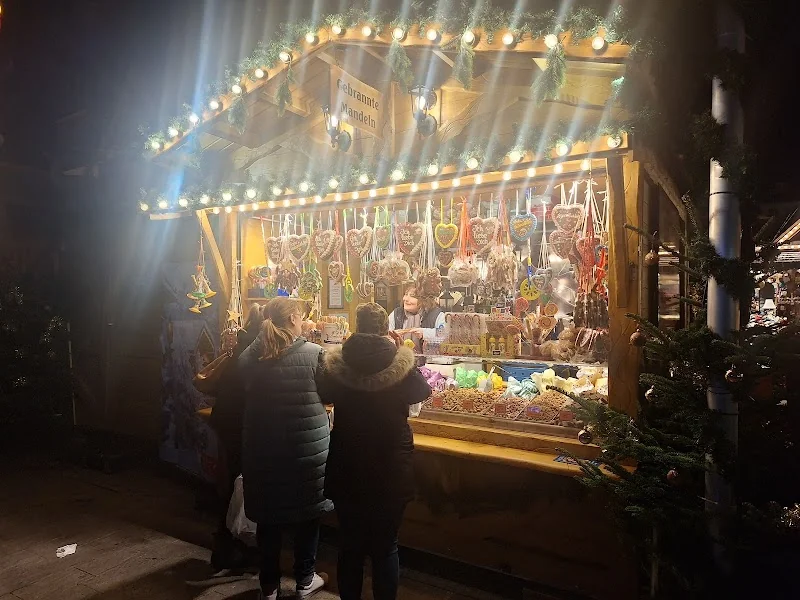
During Advent, the Lower Market becomes one of the most important venues of the Würzburg Christmas Market. The city informs that the Christmas Market takes place from November 28 to December 23, 2025, and extends over the Upper and Lower Market squares, Eichhornstraße, and Grafeneckart. The official opening takes place on the stage at the Lower Market, exactly where the square transforms into a festive backdrop. The program is also strongly tailored to this location: A colorful entertainment program is offered on the atmospherically decorated stage at the Lower Market square, accompanied by artists, music, and choir groups from Würzburg and the region. With more than 100 stalls, and according to the city's information, around 120 including the artist Christmas market, the Christmas Market is a defining year-end event for the city center. ([wuerzburg.de](https://www.wuerzburg.de/tourismus/service/presse-tourismus/aktuelle-meldungen/548059.Wuerzburger-Weihnachtsmarkt.html))
The special effect of the Lower Market during this time lies in the combination of historical architecture, light ambiance, and high visitor frequency. The city describes the market as a place where splendor and atmosphere come together during the Würzburg events at the end of the year. For visitors, this means: The Lower Market is not just a place to pass through but a space to linger, listen, watch, and shop. The backdrop of Falkenhaus and the Gothic Marienkapelle further enhances this effect, as they provide the market with a distinctive framework. For this reason, the Christmas Market here is not just a seasonal event but an example of how Würzburg stages its old town in winter without losing the functional character of the square. The result is a market image that appears atmospheric, dense, and at the same time very urban. ([wuerzburg.de](https://www.wuerzburg.de/tourismus/service/presse-tourismus/aktuelle-meldungen/548059.Wuerzburger-Weihnachtsmarkt.html))
Kilian Fair: Sales Fair with over 975 Years of Tradition
The Kilian Fair is one of the most traditional events at the Lower Market. According to the city, the annual Kilian Fair begins with the folk festival at the marketplace. For 17 days, visitors can purchase a wide range of everyday goods at the Upper and Lower Markets. These include herbs, spices, household and gift items, clothing, and ceramics. This mix shows that the Kilian Fair cannot be reduced to a single theme but is intended as a classic sales fair where diversity and advice are at the forefront. The opening hours are clearly regulated: Monday to Saturday from 9:30 AM to 6:30 PM and Sunday from 11:00 AM to 6:00 PM. This makes the fair easily accessible for families, working people, and city center visitors. ([wuerzburg.de](https://www.wuerzburg.de/events-termine/kilianivolksfest/kilianimesse))
Also exciting is the historical depth that the city explicitly emphasizes. The Kilian Fair has a tradition of over 975 years in Würzburg. The marketplace once again becomes a trading place in the heart of the city, where conversation and customer advice are the focus. This description is important because it shows that the Lower Market is not just a tourist photo spot but a vibrant part of the city's trading history. Anyone interested in the square quickly realizes: Here, modernity and tradition are not opposites. The sales fair has remained youthful, offers something for every age, and still fits into a historic city center that has been shaped by markets for centuries. For this reason, the Kilian Fair is one of the strongest themes when one wants to describe the Lower Market content-wise and in terms of SEO. ([wuerzburg.de](https://www.wuerzburg.de/events-termine/kilianivolksfest/kilianimesse))
Market Bear Fountain, Drinking Fountain, and Summer Freshness
The Market Bear Fountain is a special anchor point at the Lower Market. The city of Würzburg names it as one of six drinking fountains in the city center. For visitors, this is more than a practical detail: In a densely built city center with much foot traffic and often strong summer tourism, a freely accessible drinking fountain is a real asset. The city refers in its climate adaptation and drinking fountain information to the fact that such fountains are part of a broader strategy for health protection and quality of stay. The Lower Market also benefits from this, as the fountain not only functionally complements the square but also allows for a short break during the city tour. So, those walking through the market find not only market stalls and events here but also an offer that makes the stay more pleasant. ([wuerzburg.de](https://www.wuerzburg.de/rathaus/presse/aktuelle-pressemitteilungen/546934.Trinkbrunnenspaziergang.html))
Additionally, the connection with city tours is particularly useful. During a drinking fountain walk through the city center, the Lower Market is the meeting point at the obelisk, and the path is described as barrier-free. This makes the square easily accessible for groups, older people, and anyone seeking a relaxed city discovery. The city connects history, health, and urban development in a very practical way. The Market Bear Fountain is not isolated but part of a network of six city center drinking fountains that buffer the urban microclimate and create quality of stay. In connection with the character of the Lower Market, a special mix emerges: market, meeting point, refreshment place, and starting point for city walks. This interplay is particularly important in communication because it shows the Lower Market not only as an event space but as a practical, friendly urban space with real benefits for locals and guests. ([wuerzburg.de](https://www.wuerzburg.de/rathaus/presse/aktuelle-pressemitteilungen/546934.Trinkbrunnenspaziergang.html))
Access, Parking, and Public Transport around the Lower Market
The location of the Lower Market in the city center is an advantage for access, as the square is located right in the middle of Würzburg's center. The city mentions several parking options in its city center information, including the market garage, the parking lot at the Residenz, the parking garage at the theater, and the parking garage at the train station. Additionally, there are managed, time-limited street parking spaces in various areas of the city. For visitors, this means: Those arriving by car should not expect a direct parking space right at the square but should plan for the available parking garages in the center. This is typical for a historic old town where space is limited and public space is heavily utilized. The Lower Market benefits from the fact that the paths from the parking garage are usually short, and one can experience the city center well on foot. ([wuerzburg.de](https://www.wuerzburg.de/media/www.wuerzburg.de/org/med_14239/21237_einzelhandels-und_zentrenkonzept_stadt_wuerzburg_2021.pdf))
Public transport is also an important plus point for the Lower Market. The city describes Würzburg as well-connected and refers to its timetable information and the WVV customer center. In a city event info about the Lower Market, the tram lines 1, 3, 4, and 5 are also mentioned, along with the market garage as a reference for access. For everyday life and events, this is a clear indication: The old town can be reached not only by car but also very well by bus and tram. Those using the square as a starting point for a city visit can meaningfully combine arrival and walking. This is especially important for markets, Christmas events, and city tours because the Lower Market is located in a heavily frequented area. For many guests, this combination of public transport, short distances, and central location is the reason why the square works so well. ([wuerzburg.de](https://www.wuerzburg.de/tourismus/service/tourist-information/content-elemente-ti/548731.FAQ-Touristische-Fragen.html))
Old Town Location, Falkenhaus, Marienkapelle, and Market Architecture
The Lower Market is not just an address but a key location in the urban fabric of Würzburg. In urban planning documents, the central marketplace is described as an urban planning focal point, with Falkenhaus and Marienkapelle as defining neighbors. At the same time, the city emphasizes the high importance of the marketplace for local supply, tourism, and frequency in the city center. For the Lower Market, this means: It is part of a densely networked old town space where shopping, strolling, culture, and urban life directly intertwine. The tourist description of the square starts exactly here and invites strolling, seeing, and observing. This makes the Lower Market a place where the city of Würzburg condenses a lot of its identity in a short distance. ([wuerzburg.de](https://www.wuerzburg.de/media/www.wuerzburg.de/org/med_14239/21237_einzelhandels-und_zentrenkonzept_stadt_wuerzburg_2021.pdf))
This identity also includes the special market architecture. The previously mentioned rows of market stalls with glass roofs give the Lower Market a modern, orderly appearance within a historical framework. This is complemented by the weather station Lower Market in the city's open data portal, which was established as part of the Climate Experience Würzburg project and has been providing hourly published data since November 2024. This adds another contemporary layer to the square: it is not only a trading and event space but also a place where urban climate and public data become visible. Anyone wanting to understand the Lower Market should therefore see it as a multifaceted urban space: traditional in market activities, strong in the event calendar, touristically attractive due to its neighborhood, and simultaneously modernly integrated into urban development and climate adaptation. This very mix makes the square so interesting and so sought after by visitors with clear informational intentions. ([wuerzburg.de](https://www.wuerzburg.de/media/www.wuerzburg.de/org/med_517248/585173_expose_marktstand_nr._4.pdf))
Sources:
- City of Würzburg - Green Market and Specialty Market
- City of Würzburg - Kilian Fair
- City of Würzburg - Würzburg Christmas Market 2025
- City of Würzburg - Drinking Fountain Walk at the Lower Market
- City of Würzburg - Rental Market Stall No. 4 at the Lower Market
- Open Data Portal Würzburg - Weather Station Lower Market
Mehr anzeigenWeniger anzeigen
Lower Market Würzburg | Green Market & Christmas Market
The Lower Market is one of the most prominent places in Würzburg's old town. The square serves as a market area, meeting point, and stage all year round: The Green Market takes place here, the stage of the Christmas Market is located here, and the Kilian Fair, with its long tradition, begins here. Its location in the immediate vicinity of Falkenhaus, Marienkapelle, and other attractions makes the square one of the densest urban spaces in Würzburg. Visitors to the Lower Market experience not only trade but also city history, gastronomy, daily routines of locals, and the special old town atmosphere at the center. ([wuerzburg.de](https://www.wuerzburg.de/events-termine/volksfeste/403224.Gruener-Markt-und-Spezialitaetenmarkt.html))
Green Market and Specialty Market at the Lower Market
The Green Market and the Specialty Market take place year-round at the Lower Market square. This is an important fixed point for the city center of Würzburg, as the square is not only known for tourism but also has a clear function in everyday life: it is a shopping place, a supply place, and a meeting point in one. The city designates fixed market days on Tuesday, Wednesday, and Friday from 7:00 AM to 6:00 PM, and on Saturday from 7:00 AM to 4:00 PM. These times indicate that the Lower Market has its highest frequency mainly in the morning and early afternoon when fresh goods, short distances, and a lively environment come together. During the Würzburg Wine Village and the Christmas Market, the Green Market is moved to Eichhornstraße to provide enough space for the large events while still allowing market operations to continue. ([wuerzburg.de](https://www.wuerzburg.de/events-termine/volksfeste/403224.Gruener-Markt-und-Spezialitaetenmarkt.html))
Particularly defining is the market-adjacent urban landscape: The Lower Market does not appear as a loosely defined leftover area but as a consciously utilized urban space where daily shopping and urban atmosphere are closely intertwined. Since the year 2000, the square has also been characterized by two parallel rows of market stalls with glass roofs. The city describes 13 fixed market stalls, whose offerings range from flowers to fruits and vegetables to food stalls, such as bratwurst, fish variations, cakes, and fruit juices. This very mix explains why the Lower Market works for both residents and guests: it combines supply with quality of stay. The glass roof solution gives the place a clear visual order and makes it more weather-independent without losing the open character of a historical marketplace. ([wuerzburg.de](https://www.wuerzburg.de/media/www.wuerzburg.de/org/med_517248/585173_expose_marktstand_nr._4.pdf))
Christmas Market, Stage, and Light Splendor at the Lower Market
During Advent, the Lower Market becomes one of the most important venues of the Würzburg Christmas Market. The city informs that the Christmas Market takes place from November 28 to December 23, 2025, and extends over the Upper and Lower Market squares, Eichhornstraße, and Grafeneckart. The official opening takes place on the stage at the Lower Market, exactly where the square transforms into a festive backdrop. The program is also strongly tailored to this location: A colorful entertainment program is offered on the atmospherically decorated stage at the Lower Market square, accompanied by artists, music, and choir groups from Würzburg and the region. With more than 100 stalls, and according to the city's information, around 120 including the artist Christmas market, the Christmas Market is a defining year-end event for the city center. ([wuerzburg.de](https://www.wuerzburg.de/tourismus/service/presse-tourismus/aktuelle-meldungen/548059.Wuerzburger-Weihnachtsmarkt.html))
The special effect of the Lower Market during this time lies in the combination of historical architecture, light ambiance, and high visitor frequency. The city describes the market as a place where splendor and atmosphere come together during the Würzburg events at the end of the year. For visitors, this means: The Lower Market is not just a place to pass through but a space to linger, listen, watch, and shop. The backdrop of Falkenhaus and the Gothic Marienkapelle further enhances this effect, as they provide the market with a distinctive framework. For this reason, the Christmas Market here is not just a seasonal event but an example of how Würzburg stages its old town in winter without losing the functional character of the square. The result is a market image that appears atmospheric, dense, and at the same time very urban. ([wuerzburg.de](https://www.wuerzburg.de/tourismus/service/presse-tourismus/aktuelle-meldungen/548059.Wuerzburger-Weihnachtsmarkt.html))
Kilian Fair: Sales Fair with over 975 Years of Tradition
The Kilian Fair is one of the most traditional events at the Lower Market. According to the city, the annual Kilian Fair begins with the folk festival at the marketplace. For 17 days, visitors can purchase a wide range of everyday goods at the Upper and Lower Markets. These include herbs, spices, household and gift items, clothing, and ceramics. This mix shows that the Kilian Fair cannot be reduced to a single theme but is intended as a classic sales fair where diversity and advice are at the forefront. The opening hours are clearly regulated: Monday to Saturday from 9:30 AM to 6:30 PM and Sunday from 11:00 AM to 6:00 PM. This makes the fair easily accessible for families, working people, and city center visitors. ([wuerzburg.de](https://www.wuerzburg.de/events-termine/kilianivolksfest/kilianimesse))
Also exciting is the historical depth that the city explicitly emphasizes. The Kilian Fair has a tradition of over 975 years in Würzburg. The marketplace once again becomes a trading place in the heart of the city, where conversation and customer advice are the focus. This description is important because it shows that the Lower Market is not just a tourist photo spot but a vibrant part of the city's trading history. Anyone interested in the square quickly realizes: Here, modernity and tradition are not opposites. The sales fair has remained youthful, offers something for every age, and still fits into a historic city center that has been shaped by markets for centuries. For this reason, the Kilian Fair is one of the strongest themes when one wants to describe the Lower Market content-wise and in terms of SEO. ([wuerzburg.de](https://www.wuerzburg.de/events-termine/kilianivolksfest/kilianimesse))
Market Bear Fountain, Drinking Fountain, and Summer Freshness
The Market Bear Fountain is a special anchor point at the Lower Market. The city of Würzburg names it as one of six drinking fountains in the city center. For visitors, this is more than a practical detail: In a densely built city center with much foot traffic and often strong summer tourism, a freely accessible drinking fountain is a real asset. The city refers in its climate adaptation and drinking fountain information to the fact that such fountains are part of a broader strategy for health protection and quality of stay. The Lower Market also benefits from this, as the fountain not only functionally complements the square but also allows for a short break during the city tour. So, those walking through the market find not only market stalls and events here but also an offer that makes the stay more pleasant. ([wuerzburg.de](https://www.wuerzburg.de/rathaus/presse/aktuelle-pressemitteilungen/546934.Trinkbrunnenspaziergang.html))
Additionally, the connection with city tours is particularly useful. During a drinking fountain walk through the city center, the Lower Market is the meeting point at the obelisk, and the path is described as barrier-free. This makes the square easily accessible for groups, older people, and anyone seeking a relaxed city discovery. The city connects history, health, and urban development in a very practical way. The Market Bear Fountain is not isolated but part of a network of six city center drinking fountains that buffer the urban microclimate and create quality of stay. In connection with the character of the Lower Market, a special mix emerges: market, meeting point, refreshment place, and starting point for city walks. This interplay is particularly important in communication because it shows the Lower Market not only as an event space but as a practical, friendly urban space with real benefits for locals and guests. ([wuerzburg.de](https://www.wuerzburg.de/rathaus/presse/aktuelle-pressemitteilungen/546934.Trinkbrunnenspaziergang.html))
Access, Parking, and Public Transport around the Lower Market
The location of the Lower Market in the city center is an advantage for access, as the square is located right in the middle of Würzburg's center. The city mentions several parking options in its city center information, including the market garage, the parking lot at the Residenz, the parking garage at the theater, and the parking garage at the train station. Additionally, there are managed, time-limited street parking spaces in various areas of the city. For visitors, this means: Those arriving by car should not expect a direct parking space right at the square but should plan for the available parking garages in the center. This is typical for a historic old town where space is limited and public space is heavily utilized. The Lower Market benefits from the fact that the paths from the parking garage are usually short, and one can experience the city center well on foot. ([wuerzburg.de](https://www.wuerzburg.de/media/www.wuerzburg.de/org/med_14239/21237_einzelhandels-und_zentrenkonzept_stadt_wuerzburg_2021.pdf))
Public transport is also an important plus point for the Lower Market. The city describes Würzburg as well-connected and refers to its timetable information and the WVV customer center. In a city event info about the Lower Market, the tram lines 1, 3, 4, and 5 are also mentioned, along with the market garage as a reference for access. For everyday life and events, this is a clear indication: The old town can be reached not only by car but also very well by bus and tram. Those using the square as a starting point for a city visit can meaningfully combine arrival and walking. This is especially important for markets, Christmas events, and city tours because the Lower Market is located in a heavily frequented area. For many guests, this combination of public transport, short distances, and central location is the reason why the square works so well. ([wuerzburg.de](https://www.wuerzburg.de/tourismus/service/tourist-information/content-elemente-ti/548731.FAQ-Touristische-Fragen.html))
Old Town Location, Falkenhaus, Marienkapelle, and Market Architecture
The Lower Market is not just an address but a key location in the urban fabric of Würzburg. In urban planning documents, the central marketplace is described as an urban planning focal point, with Falkenhaus and Marienkapelle as defining neighbors. At the same time, the city emphasizes the high importance of the marketplace for local supply, tourism, and frequency in the city center. For the Lower Market, this means: It is part of a densely networked old town space where shopping, strolling, culture, and urban life directly intertwine. The tourist description of the square starts exactly here and invites strolling, seeing, and observing. This makes the Lower Market a place where the city of Würzburg condenses a lot of its identity in a short distance. ([wuerzburg.de](https://www.wuerzburg.de/media/www.wuerzburg.de/org/med_14239/21237_einzelhandels-und_zentrenkonzept_stadt_wuerzburg_2021.pdf))
This identity also includes the special market architecture. The previously mentioned rows of market stalls with glass roofs give the Lower Market a modern, orderly appearance within a historical framework. This is complemented by the weather station Lower Market in the city's open data portal, which was established as part of the Climate Experience Würzburg project and has been providing hourly published data since November 2024. This adds another contemporary layer to the square: it is not only a trading and event space but also a place where urban climate and public data become visible. Anyone wanting to understand the Lower Market should therefore see it as a multifaceted urban space: traditional in market activities, strong in the event calendar, touristically attractive due to its neighborhood, and simultaneously modernly integrated into urban development and climate adaptation. This very mix makes the square so interesting and so sought after by visitors with clear informational intentions. ([wuerzburg.de](https://www.wuerzburg.de/media/www.wuerzburg.de/org/med_517248/585173_expose_marktstand_nr._4.pdf))
Sources:
- City of Würzburg - Green Market and Specialty Market
- City of Würzburg - Kilian Fair
- City of Würzburg - Würzburg Christmas Market 2025
- City of Würzburg - Drinking Fountain Walk at the Lower Market
- City of Würzburg - Rental Market Stall No. 4 at the Lower Market
- Open Data Portal Würzburg - Weather Station Lower Market
Lower Market Würzburg | Green Market & Christmas Market
The Lower Market is one of the most prominent places in Würzburg's old town. The square serves as a market area, meeting point, and stage all year round: The Green Market takes place here, the stage of the Christmas Market is located here, and the Kilian Fair, with its long tradition, begins here. Its location in the immediate vicinity of Falkenhaus, Marienkapelle, and other attractions makes the square one of the densest urban spaces in Würzburg. Visitors to the Lower Market experience not only trade but also city history, gastronomy, daily routines of locals, and the special old town atmosphere at the center. ([wuerzburg.de](https://www.wuerzburg.de/events-termine/volksfeste/403224.Gruener-Markt-und-Spezialitaetenmarkt.html))
Green Market and Specialty Market at the Lower Market
The Green Market and the Specialty Market take place year-round at the Lower Market square. This is an important fixed point for the city center of Würzburg, as the square is not only known for tourism but also has a clear function in everyday life: it is a shopping place, a supply place, and a meeting point in one. The city designates fixed market days on Tuesday, Wednesday, and Friday from 7:00 AM to 6:00 PM, and on Saturday from 7:00 AM to 4:00 PM. These times indicate that the Lower Market has its highest frequency mainly in the morning and early afternoon when fresh goods, short distances, and a lively environment come together. During the Würzburg Wine Village and the Christmas Market, the Green Market is moved to Eichhornstraße to provide enough space for the large events while still allowing market operations to continue. ([wuerzburg.de](https://www.wuerzburg.de/events-termine/volksfeste/403224.Gruener-Markt-und-Spezialitaetenmarkt.html))
Particularly defining is the market-adjacent urban landscape: The Lower Market does not appear as a loosely defined leftover area but as a consciously utilized urban space where daily shopping and urban atmosphere are closely intertwined. Since the year 2000, the square has also been characterized by two parallel rows of market stalls with glass roofs. The city describes 13 fixed market stalls, whose offerings range from flowers to fruits and vegetables to food stalls, such as bratwurst, fish variations, cakes, and fruit juices. This very mix explains why the Lower Market works for both residents and guests: it combines supply with quality of stay. The glass roof solution gives the place a clear visual order and makes it more weather-independent without losing the open character of a historical marketplace. ([wuerzburg.de](https://www.wuerzburg.de/media/www.wuerzburg.de/org/med_517248/585173_expose_marktstand_nr._4.pdf))
Christmas Market, Stage, and Light Splendor at the Lower Market
During Advent, the Lower Market becomes one of the most important venues of the Würzburg Christmas Market. The city informs that the Christmas Market takes place from November 28 to December 23, 2025, and extends over the Upper and Lower Market squares, Eichhornstraße, and Grafeneckart. The official opening takes place on the stage at the Lower Market, exactly where the square transforms into a festive backdrop. The program is also strongly tailored to this location: A colorful entertainment program is offered on the atmospherically decorated stage at the Lower Market square, accompanied by artists, music, and choir groups from Würzburg and the region. With more than 100 stalls, and according to the city's information, around 120 including the artist Christmas market, the Christmas Market is a defining year-end event for the city center. ([wuerzburg.de](https://www.wuerzburg.de/tourismus/service/presse-tourismus/aktuelle-meldungen/548059.Wuerzburger-Weihnachtsmarkt.html))
The special effect of the Lower Market during this time lies in the combination of historical architecture, light ambiance, and high visitor frequency. The city describes the market as a place where splendor and atmosphere come together during the Würzburg events at the end of the year. For visitors, this means: The Lower Market is not just a place to pass through but a space to linger, listen, watch, and shop. The backdrop of Falkenhaus and the Gothic Marienkapelle further enhances this effect, as they provide the market with a distinctive framework. For this reason, the Christmas Market here is not just a seasonal event but an example of how Würzburg stages its old town in winter without losing the functional character of the square. The result is a market image that appears atmospheric, dense, and at the same time very urban. ([wuerzburg.de](https://www.wuerzburg.de/tourismus/service/presse-tourismus/aktuelle-meldungen/548059.Wuerzburger-Weihnachtsmarkt.html))
Kilian Fair: Sales Fair with over 975 Years of Tradition
The Kilian Fair is one of the most traditional events at the Lower Market. According to the city, the annual Kilian Fair begins with the folk festival at the marketplace. For 17 days, visitors can purchase a wide range of everyday goods at the Upper and Lower Markets. These include herbs, spices, household and gift items, clothing, and ceramics. This mix shows that the Kilian Fair cannot be reduced to a single theme but is intended as a classic sales fair where diversity and advice are at the forefront. The opening hours are clearly regulated: Monday to Saturday from 9:30 AM to 6:30 PM and Sunday from 11:00 AM to 6:00 PM. This makes the fair easily accessible for families, working people, and city center visitors. ([wuerzburg.de](https://www.wuerzburg.de/events-termine/kilianivolksfest/kilianimesse))
Also exciting is the historical depth that the city explicitly emphasizes. The Kilian Fair has a tradition of over 975 years in Würzburg. The marketplace once again becomes a trading place in the heart of the city, where conversation and customer advice are the focus. This description is important because it shows that the Lower Market is not just a tourist photo spot but a vibrant part of the city's trading history. Anyone interested in the square quickly realizes: Here, modernity and tradition are not opposites. The sales fair has remained youthful, offers something for every age, and still fits into a historic city center that has been shaped by markets for centuries. For this reason, the Kilian Fair is one of the strongest themes when one wants to describe the Lower Market content-wise and in terms of SEO. ([wuerzburg.de](https://www.wuerzburg.de/events-termine/kilianivolksfest/kilianimesse))
Market Bear Fountain, Drinking Fountain, and Summer Freshness
The Market Bear Fountain is a special anchor point at the Lower Market. The city of Würzburg names it as one of six drinking fountains in the city center. For visitors, this is more than a practical detail: In a densely built city center with much foot traffic and often strong summer tourism, a freely accessible drinking fountain is a real asset. The city refers in its climate adaptation and drinking fountain information to the fact that such fountains are part of a broader strategy for health protection and quality of stay. The Lower Market also benefits from this, as the fountain not only functionally complements the square but also allows for a short break during the city tour. So, those walking through the market find not only market stalls and events here but also an offer that makes the stay more pleasant. ([wuerzburg.de](https://www.wuerzburg.de/rathaus/presse/aktuelle-pressemitteilungen/546934.Trinkbrunnenspaziergang.html))
Additionally, the connection with city tours is particularly useful. During a drinking fountain walk through the city center, the Lower Market is the meeting point at the obelisk, and the path is described as barrier-free. This makes the square easily accessible for groups, older people, and anyone seeking a relaxed city discovery. The city connects history, health, and urban development in a very practical way. The Market Bear Fountain is not isolated but part of a network of six city center drinking fountains that buffer the urban microclimate and create quality of stay. In connection with the character of the Lower Market, a special mix emerges: market, meeting point, refreshment place, and starting point for city walks. This interplay is particularly important in communication because it shows the Lower Market not only as an event space but as a practical, friendly urban space with real benefits for locals and guests. ([wuerzburg.de](https://www.wuerzburg.de/rathaus/presse/aktuelle-pressemitteilungen/546934.Trinkbrunnenspaziergang.html))
Access, Parking, and Public Transport around the Lower Market
The location of the Lower Market in the city center is an advantage for access, as the square is located right in the middle of Würzburg's center. The city mentions several parking options in its city center information, including the market garage, the parking lot at the Residenz, the parking garage at the theater, and the parking garage at the train station. Additionally, there are managed, time-limited street parking spaces in various areas of the city. For visitors, this means: Those arriving by car should not expect a direct parking space right at the square but should plan for the available parking garages in the center. This is typical for a historic old town where space is limited and public space is heavily utilized. The Lower Market benefits from the fact that the paths from the parking garage are usually short, and one can experience the city center well on foot. ([wuerzburg.de](https://www.wuerzburg.de/media/www.wuerzburg.de/org/med_14239/21237_einzelhandels-und_zentrenkonzept_stadt_wuerzburg_2021.pdf))
Public transport is also an important plus point for the Lower Market. The city describes Würzburg as well-connected and refers to its timetable information and the WVV customer center. In a city event info about the Lower Market, the tram lines 1, 3, 4, and 5 are also mentioned, along with the market garage as a reference for access. For everyday life and events, this is a clear indication: The old town can be reached not only by car but also very well by bus and tram. Those using the square as a starting point for a city visit can meaningfully combine arrival and walking. This is especially important for markets, Christmas events, and city tours because the Lower Market is located in a heavily frequented area. For many guests, this combination of public transport, short distances, and central location is the reason why the square works so well. ([wuerzburg.de](https://www.wuerzburg.de/tourismus/service/tourist-information/content-elemente-ti/548731.FAQ-Touristische-Fragen.html))
Old Town Location, Falkenhaus, Marienkapelle, and Market Architecture
The Lower Market is not just an address but a key location in the urban fabric of Würzburg. In urban planning documents, the central marketplace is described as an urban planning focal point, with Falkenhaus and Marienkapelle as defining neighbors. At the same time, the city emphasizes the high importance of the marketplace for local supply, tourism, and frequency in the city center. For the Lower Market, this means: It is part of a densely networked old town space where shopping, strolling, culture, and urban life directly intertwine. The tourist description of the square starts exactly here and invites strolling, seeing, and observing. This makes the Lower Market a place where the city of Würzburg condenses a lot of its identity in a short distance. ([wuerzburg.de](https://www.wuerzburg.de/media/www.wuerzburg.de/org/med_14239/21237_einzelhandels-und_zentrenkonzept_stadt_wuerzburg_2021.pdf))
This identity also includes the special market architecture. The previously mentioned rows of market stalls with glass roofs give the Lower Market a modern, orderly appearance within a historical framework. This is complemented by the weather station Lower Market in the city's open data portal, which was established as part of the Climate Experience Würzburg project and has been providing hourly published data since November 2024. This adds another contemporary layer to the square: it is not only a trading and event space but also a place where urban climate and public data become visible. Anyone wanting to understand the Lower Market should therefore see it as a multifaceted urban space: traditional in market activities, strong in the event calendar, touristically attractive due to its neighborhood, and simultaneously modernly integrated into urban development and climate adaptation. This very mix makes the square so interesting and so sought after by visitors with clear informational intentions. ([wuerzburg.de](https://www.wuerzburg.de/media/www.wuerzburg.de/org/med_517248/585173_expose_marktstand_nr._4.pdf))
Sources:
- City of Würzburg - Green Market and Specialty Market
- City of Würzburg - Kilian Fair
- City of Würzburg - Würzburg Christmas Market 2025
- City of Würzburg - Drinking Fountain Walk at the Lower Market
- City of Würzburg - Rental Market Stall No. 4 at the Lower Market
- Open Data Portal Würzburg - Weather Station Lower Market
Upcoming Events
No events found
Frequently Asked Questions
Reviews
Gerhard Ramminger
18. December 2023
Beautiful Christmas market.
Sascha Knescht
11. February 2025
istván szabo
20. December 2024
DK G
22. August 2024