
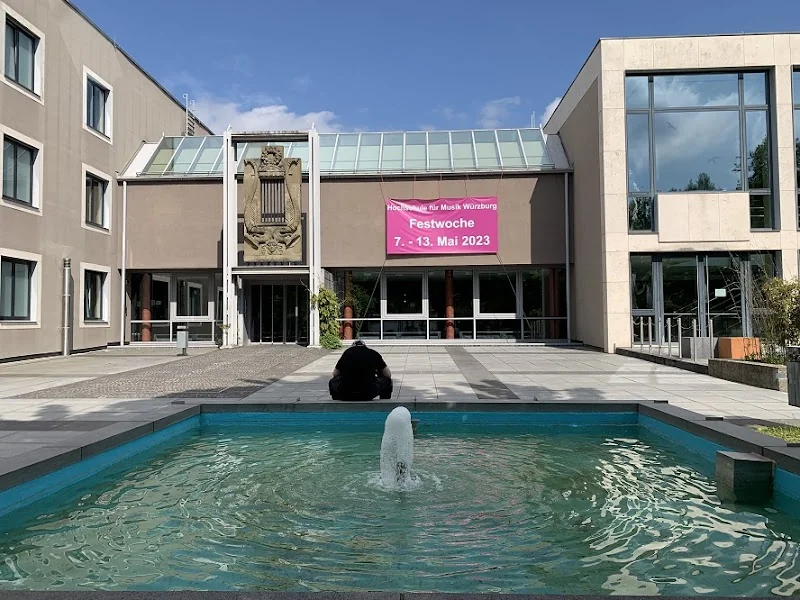
Hofstallstraße 6-8, Würzburg-Altstadt
Hofstallstraße 6-8, 97070 Würzburg, Germany
Würzburg University of Music | Concert Hall & Music Studies
The Würzburg University of Music is more than just a training institution for aspiring musicians. It combines a rich history with a modern event venue, a compact campus in a central location, and a study environment that closely intertwines artistic practice, pedagogy, and theory. Those searching for hochschule für musik würzburg, würzburg musikhochschule, or university of music würzburg germany will therefore not only find an address but a place where concert operations, teaching, and student life visibly interact. Hofstallstraße 6-8, with the main entrance on Husarenstraße, is the heart of the location. ([hfm-wuerzburg.de](https://hfm-wuerzburg.de/standorte/hofstallstrasse))
Study Programs, Entrance Examination, and Music Studies in Würzburg
Search queries related to würzburg musik studium, würzburg uni musik, and würzburg musikwissenschaft quickly lead to a core that shapes the university: a broad range of study programs with artistic, artistically-pedagogical, and teaching-oriented paths. Officially, the university refers to a diverse range of study offerings, ensembles as an important part of musical training, master classes, and recurring workshops and conferences with soloists, music educators, and scholars. For prospective students, it is also important that many degree programs require an entrance examination, and admission to the university is linked to an artistic or pedagogical profile. Thus, the location is aimed at people who want to not only listen to music but systematically study and create it at a high level. ([hfm-wuerzburg.de](https://hfm-wuerzburg.de/studium/angebot?utm_source=openai))
This breadth is particularly evident in the subject pages on Music Theory and Elementary Music Education. Music Theory is offered in Würzburg as a major in both the Bachelor's and Master's programs; additionally, there are music education certificate programs with the profiles of composition and ear training. Elementary Music Education is anchored as a Bachelor's program with the profiles of jazz and classical, placing a strong focus on practical relevance, artistic expression, and pedagogical application fields. This is precisely why search terms like würzburg musik studium, würzburg musikwissenschaft, or musikhochschule würzburg fit well together in content: The university does not cover a single niche but an environment where theory, mediation, instrumental and vocal training, and ensemble practice intertwine. For applicants, this is helpful as they can quickly determine whether they are looking for a pedagogical, theoretical, or artistic career. ([musiktheorie.hfm-wuerzburg.de](https://musiktheorie.hfm-wuerzburg.de/?utm_source=openai))
Main Hall on Hofstallstraße: Seating, Acoustics, and Concert Life
A central theme of search queries is the Main Hall of the Würzburg University of Music. According to the official site, the hall is equipped with 797 seats and is considered the most sought-after concert hall in the region. Its acoustics are suitable for solo evenings as well as chamber music, symphony and choir concerts, as well as big band and pop music events. The university states a reverberation time of about 1.7 seconds, which is considered particularly balanced for many ensembles. For visitors, this means: Those searching for sitzplätze großer saal würzburg or akustik großer saal würzburg are ultimately looking for a space that is not only large but also musically very precise. This combination makes the venue equally attractive for audiences, ensembles, and teaching operations. ([hfm-wuerzburg.de](https://hfm-wuerzburg.de/veranstaltungen/raeume/h-grosser-saal?utm_source=openai))
Additionally, there is a feature that distinguishes the hall from many other concert venues: a modern concert organ with over 90 registers, which since 2016, or in its later expansion phase, provides additional sound possibilities. The university also describes that the Main Hall works excellently with various sound bodies, from string quartets to symphony orchestras. This is complemented by a recording studio that enables professional recordings, for example, for competitions or master class applications. Thus, a location is created where concerts not only take place but are also prepared, documented, and productively used in academic everyday life. This is important for the external perception of the university because the Main Hall is the most visible link between education and the public. ([hfm-wuerzburg.de](https://hfm-wuerzburg.de/standorte/hofstallstrasse))
Access, Location, and Parking at Hofstallstraße 6-8
The location of the university is one of its greatest advantages. The Hofstallstraße building is situated with one side directly adjacent to the green belt that surrounds the city of Würzburg and with another side next to the Rosenbach Park in proximity to the State Wine Cellar. Across the street stands the Protestant main church St. Johannis, with which the university cooperates, among other things, during the Würzburg Bach Days. For all those searching for anfahrt hochschule für musik würzburg, this location information is important because it not only names the address but also explains the urban context: The university is located in the midst of urban life and simultaneously in an environment characterized by greenery, culture, and historical architecture. The main entrance is located on Husarenstraße, which is also helpful for orientation on site. ([hfm-wuerzburg.de](https://hfm-wuerzburg.de/standorte/hofstallstrasse))
Regarding parking hochschule für musik würzburg, the most important real information is: In front of the Hofstallstraße building, there is a student parking lot with 29 parking spaces. According to university documents, this parking lot is intended for students and staff, thus not designed as a large public parking area. This is why the capacity in everyday life is a relevant detail for applicants, concert visitors, and members of ensembles. Additionally, the university points out barrier-free access in the area of the student parking lot, such as a wheelchair-accessible ramp in front of the main entrance on Husarenstraße. Therefore, those visiting the location benefit from a central, easily recognizable location but should keep the limited parking options in mind. Especially during evening events, this information is crucial because the location is more designed for compact, city-center use rather than large parking reserves. ([hfm-wuerzburg.de](https://hfm-wuerzburg.de/service/Leitfaden/Compass_for_Students_Status_03.04.2025.pdf))
History of the Würzburg University of Music since 1804
The Würzburg University of Music is one of the oldest institutions in Germany dedicated to musical education. Its history began in 1804 with the founding of the so-called Academic Music Institute of the University of Würzburg. Initially, this institution served to enable the performance of symphonic works by the student Collegium musicum. As early as 1811, instrumental instruction was added, and from 1820, vocal instruction for future elementary school teachers. This shows that the institution was from the beginning oriented not only towards concert practice but also towards the connection of education, mediation, and academic environment. Those searching for geschichte hochschule für musik würzburg will therefore encounter a development that links early musical practice with a long-term educational mission. ([hfm-wuerzburg.de](https://hfm-wuerzburg.de/ueber-uns/geschichte?utm_source=openai))
In the further course, the profile was gradually sharpened: In 1875, the qualification of professional musicians was established as a task, in 1911 the training of school musicians was added, and in 1937 the study for instrumental and vocal educators. In 1920, after the abolition of the monarchy, the institution was renamed Bavarian State Conservatory before it was transformed into a music university in 1973. Since then, the educational profile has further differentiated, among other things, through the integration of the municipal Hermann-Zilcher-Conservatory and through offerings such as jazz and elementary music education. This development explains why the university is perceived today as both traditional and modern. It carries its history not only in its name but also in the connection of artistic excellence, pedagogy, and urban music culture. ([hfm-wuerzburg.de](https://hfm-wuerzburg.de/ueber-uns/geschichte?utm_source=openai))
Rooms, Practice Rooms, Recording Studio, and Accessibility
The Hofstallstraße building is architecturally and functionally designed for music operations. One wing contains the Small and Large Halls, and there are modern, soundproofed classrooms and practice rooms on four floors. The rooms are each equipped with one or two grand pianos, which facilitates daily instruction, rehearsals, and accompaniment at a professional level. A spacious, light-flooded cafeteria with comfortable seating and computer workstations provides for breaks, exchanges, and informal working phases. For search queries like hochschule für musik würzburg university of music or würzburg musikhochschule, this part is particularly relevant because it presents the university not only as a building but as a functional musical workspace. Here it becomes clear that education at HfM Würzburg does not take place in an abstract seminar room but in real, acoustically thought-out spaces. ([hfm-wuerzburg.de](https://hfm-wuerzburg.de/standorte/hofstallstrasse))
Accessibility is also specifically described. The university states that all three buildings are predominantly accessible. For the Hofstallstraße building, it mentions a wheelchair-accessible ramp at the student parking lot, an elevator from the basement to the second floor, a disabled toilet on the ground floor, barrier-free access to the classrooms and practice rooms, as well as eight wheelchair-accessible spectator seats in row 23 of the Main Hall, each with a space for an accompanying person. The Small Hall is accessible via elevator and connecting corridor or through the rear entrance. These details are important not only for visitors with mobility needs but also represent a strong quality feature of the institution. They show that the location is not only musically but also organizationally oriented towards different needs. ([hfm-wuerzburg.de](https://hfm-wuerzburg.de/barrierefreiheit))
Why the Würzburg University of Music is Relevant for the City, Audience, and Applicants
The significance of the Würzburg University of Music extends far beyond the campus. The university links teaching, performances, and public perception in such a way that a place of study becomes a cultural center. Regular formats take place in the Main Hall that are relevant for the city and the region, and the Hofstallstraße building, with its location between green space, city center, and church and cultural environment, is a visible part of Würzburg. For this reason, search queries like würzburg uni musik, großer saal würzburg, or würzburg musik studium are not only academic inquiries but also indications that people are looking for a place where music is present in everyday life. Those visiting the university experience it as a connection between education, concert life, and public culture. ([hfm-wuerzburg.de](https://hfm-wuerzburg.de/standorte/hofstallstrasse))
For applicants, the university is particularly attractive because it offers clear profiles and concrete practical relevance. This ranges from music theory and EMP to teacher training programs, master classes, ensembles, and projects that connect studies with real stage experience. For the audience and event visitors, the location is interesting because the Main Hall, with its excellent acoustics and good facilities, provides a high-quality concert environment. Thus, a place is created where the search for information about the university almost inevitably leads in three directions: towards study choice, towards event experience, and towards historical significance. It is precisely in this triple role that the strength of the Würzburg University of Music lies. It is a place of learning, a concert venue, and a point of identification for an entire music city. ([hfm-wuerzburg.de](https://hfm-wuerzburg.de/studium/angebot?utm_source=openai))
Sources:
Show moreShow less
Würzburg University of Music | Concert Hall & Music Studies
The Würzburg University of Music is more than just a training institution for aspiring musicians. It combines a rich history with a modern event venue, a compact campus in a central location, and a study environment that closely intertwines artistic practice, pedagogy, and theory. Those searching for hochschule für musik würzburg, würzburg musikhochschule, or university of music würzburg germany will therefore not only find an address but a place where concert operations, teaching, and student life visibly interact. Hofstallstraße 6-8, with the main entrance on Husarenstraße, is the heart of the location. ([hfm-wuerzburg.de](https://hfm-wuerzburg.de/standorte/hofstallstrasse))
Study Programs, Entrance Examination, and Music Studies in Würzburg
Search queries related to würzburg musik studium, würzburg uni musik, and würzburg musikwissenschaft quickly lead to a core that shapes the university: a broad range of study programs with artistic, artistically-pedagogical, and teaching-oriented paths. Officially, the university refers to a diverse range of study offerings, ensembles as an important part of musical training, master classes, and recurring workshops and conferences with soloists, music educators, and scholars. For prospective students, it is also important that many degree programs require an entrance examination, and admission to the university is linked to an artistic or pedagogical profile. Thus, the location is aimed at people who want to not only listen to music but systematically study and create it at a high level. ([hfm-wuerzburg.de](https://hfm-wuerzburg.de/studium/angebot?utm_source=openai))
This breadth is particularly evident in the subject pages on Music Theory and Elementary Music Education. Music Theory is offered in Würzburg as a major in both the Bachelor's and Master's programs; additionally, there are music education certificate programs with the profiles of composition and ear training. Elementary Music Education is anchored as a Bachelor's program with the profiles of jazz and classical, placing a strong focus on practical relevance, artistic expression, and pedagogical application fields. This is precisely why search terms like würzburg musik studium, würzburg musikwissenschaft, or musikhochschule würzburg fit well together in content: The university does not cover a single niche but an environment where theory, mediation, instrumental and vocal training, and ensemble practice intertwine. For applicants, this is helpful as they can quickly determine whether they are looking for a pedagogical, theoretical, or artistic career. ([musiktheorie.hfm-wuerzburg.de](https://musiktheorie.hfm-wuerzburg.de/?utm_source=openai))
Main Hall on Hofstallstraße: Seating, Acoustics, and Concert Life
A central theme of search queries is the Main Hall of the Würzburg University of Music. According to the official site, the hall is equipped with 797 seats and is considered the most sought-after concert hall in the region. Its acoustics are suitable for solo evenings as well as chamber music, symphony and choir concerts, as well as big band and pop music events. The university states a reverberation time of about 1.7 seconds, which is considered particularly balanced for many ensembles. For visitors, this means: Those searching for sitzplätze großer saal würzburg or akustik großer saal würzburg are ultimately looking for a space that is not only large but also musically very precise. This combination makes the venue equally attractive for audiences, ensembles, and teaching operations. ([hfm-wuerzburg.de](https://hfm-wuerzburg.de/veranstaltungen/raeume/h-grosser-saal?utm_source=openai))
Additionally, there is a feature that distinguishes the hall from many other concert venues: a modern concert organ with over 90 registers, which since 2016, or in its later expansion phase, provides additional sound possibilities. The university also describes that the Main Hall works excellently with various sound bodies, from string quartets to symphony orchestras. This is complemented by a recording studio that enables professional recordings, for example, for competitions or master class applications. Thus, a location is created where concerts not only take place but are also prepared, documented, and productively used in academic everyday life. This is important for the external perception of the university because the Main Hall is the most visible link between education and the public. ([hfm-wuerzburg.de](https://hfm-wuerzburg.de/standorte/hofstallstrasse))
Access, Location, and Parking at Hofstallstraße 6-8
The location of the university is one of its greatest advantages. The Hofstallstraße building is situated with one side directly adjacent to the green belt that surrounds the city of Würzburg and with another side next to the Rosenbach Park in proximity to the State Wine Cellar. Across the street stands the Protestant main church St. Johannis, with which the university cooperates, among other things, during the Würzburg Bach Days. For all those searching for anfahrt hochschule für musik würzburg, this location information is important because it not only names the address but also explains the urban context: The university is located in the midst of urban life and simultaneously in an environment characterized by greenery, culture, and historical architecture. The main entrance is located on Husarenstraße, which is also helpful for orientation on site. ([hfm-wuerzburg.de](https://hfm-wuerzburg.de/standorte/hofstallstrasse))
Regarding parking hochschule für musik würzburg, the most important real information is: In front of the Hofstallstraße building, there is a student parking lot with 29 parking spaces. According to university documents, this parking lot is intended for students and staff, thus not designed as a large public parking area. This is why the capacity in everyday life is a relevant detail for applicants, concert visitors, and members of ensembles. Additionally, the university points out barrier-free access in the area of the student parking lot, such as a wheelchair-accessible ramp in front of the main entrance on Husarenstraße. Therefore, those visiting the location benefit from a central, easily recognizable location but should keep the limited parking options in mind. Especially during evening events, this information is crucial because the location is more designed for compact, city-center use rather than large parking reserves. ([hfm-wuerzburg.de](https://hfm-wuerzburg.de/service/Leitfaden/Compass_for_Students_Status_03.04.2025.pdf))
History of the Würzburg University of Music since 1804
The Würzburg University of Music is one of the oldest institutions in Germany dedicated to musical education. Its history began in 1804 with the founding of the so-called Academic Music Institute of the University of Würzburg. Initially, this institution served to enable the performance of symphonic works by the student Collegium musicum. As early as 1811, instrumental instruction was added, and from 1820, vocal instruction for future elementary school teachers. This shows that the institution was from the beginning oriented not only towards concert practice but also towards the connection of education, mediation, and academic environment. Those searching for geschichte hochschule für musik würzburg will therefore encounter a development that links early musical practice with a long-term educational mission. ([hfm-wuerzburg.de](https://hfm-wuerzburg.de/ueber-uns/geschichte?utm_source=openai))
In the further course, the profile was gradually sharpened: In 1875, the qualification of professional musicians was established as a task, in 1911 the training of school musicians was added, and in 1937 the study for instrumental and vocal educators. In 1920, after the abolition of the monarchy, the institution was renamed Bavarian State Conservatory before it was transformed into a music university in 1973. Since then, the educational profile has further differentiated, among other things, through the integration of the municipal Hermann-Zilcher-Conservatory and through offerings such as jazz and elementary music education. This development explains why the university is perceived today as both traditional and modern. It carries its history not only in its name but also in the connection of artistic excellence, pedagogy, and urban music culture. ([hfm-wuerzburg.de](https://hfm-wuerzburg.de/ueber-uns/geschichte?utm_source=openai))
Rooms, Practice Rooms, Recording Studio, and Accessibility
The Hofstallstraße building is architecturally and functionally designed for music operations. One wing contains the Small and Large Halls, and there are modern, soundproofed classrooms and practice rooms on four floors. The rooms are each equipped with one or two grand pianos, which facilitates daily instruction, rehearsals, and accompaniment at a professional level. A spacious, light-flooded cafeteria with comfortable seating and computer workstations provides for breaks, exchanges, and informal working phases. For search queries like hochschule für musik würzburg university of music or würzburg musikhochschule, this part is particularly relevant because it presents the university not only as a building but as a functional musical workspace. Here it becomes clear that education at HfM Würzburg does not take place in an abstract seminar room but in real, acoustically thought-out spaces. ([hfm-wuerzburg.de](https://hfm-wuerzburg.de/standorte/hofstallstrasse))
Accessibility is also specifically described. The university states that all three buildings are predominantly accessible. For the Hofstallstraße building, it mentions a wheelchair-accessible ramp at the student parking lot, an elevator from the basement to the second floor, a disabled toilet on the ground floor, barrier-free access to the classrooms and practice rooms, as well as eight wheelchair-accessible spectator seats in row 23 of the Main Hall, each with a space for an accompanying person. The Small Hall is accessible via elevator and connecting corridor or through the rear entrance. These details are important not only for visitors with mobility needs but also represent a strong quality feature of the institution. They show that the location is not only musically but also organizationally oriented towards different needs. ([hfm-wuerzburg.de](https://hfm-wuerzburg.de/barrierefreiheit))
Why the Würzburg University of Music is Relevant for the City, Audience, and Applicants
The significance of the Würzburg University of Music extends far beyond the campus. The university links teaching, performances, and public perception in such a way that a place of study becomes a cultural center. Regular formats take place in the Main Hall that are relevant for the city and the region, and the Hofstallstraße building, with its location between green space, city center, and church and cultural environment, is a visible part of Würzburg. For this reason, search queries like würzburg uni musik, großer saal würzburg, or würzburg musik studium are not only academic inquiries but also indications that people are looking for a place where music is present in everyday life. Those visiting the university experience it as a connection between education, concert life, and public culture. ([hfm-wuerzburg.de](https://hfm-wuerzburg.de/standorte/hofstallstrasse))
For applicants, the university is particularly attractive because it offers clear profiles and concrete practical relevance. This ranges from music theory and EMP to teacher training programs, master classes, ensembles, and projects that connect studies with real stage experience. For the audience and event visitors, the location is interesting because the Main Hall, with its excellent acoustics and good facilities, provides a high-quality concert environment. Thus, a place is created where the search for information about the university almost inevitably leads in three directions: towards study choice, towards event experience, and towards historical significance. It is precisely in this triple role that the strength of the Würzburg University of Music lies. It is a place of learning, a concert venue, and a point of identification for an entire music city. ([hfm-wuerzburg.de](https://hfm-wuerzburg.de/studium/angebot?utm_source=openai))
Sources:
Würzburg University of Music | Concert Hall & Music Studies
The Würzburg University of Music is more than just a training institution for aspiring musicians. It combines a rich history with a modern event venue, a compact campus in a central location, and a study environment that closely intertwines artistic practice, pedagogy, and theory. Those searching for hochschule für musik würzburg, würzburg musikhochschule, or university of music würzburg germany will therefore not only find an address but a place where concert operations, teaching, and student life visibly interact. Hofstallstraße 6-8, with the main entrance on Husarenstraße, is the heart of the location. ([hfm-wuerzburg.de](https://hfm-wuerzburg.de/standorte/hofstallstrasse))
Study Programs, Entrance Examination, and Music Studies in Würzburg
Search queries related to würzburg musik studium, würzburg uni musik, and würzburg musikwissenschaft quickly lead to a core that shapes the university: a broad range of study programs with artistic, artistically-pedagogical, and teaching-oriented paths. Officially, the university refers to a diverse range of study offerings, ensembles as an important part of musical training, master classes, and recurring workshops and conferences with soloists, music educators, and scholars. For prospective students, it is also important that many degree programs require an entrance examination, and admission to the university is linked to an artistic or pedagogical profile. Thus, the location is aimed at people who want to not only listen to music but systematically study and create it at a high level. ([hfm-wuerzburg.de](https://hfm-wuerzburg.de/studium/angebot?utm_source=openai))
This breadth is particularly evident in the subject pages on Music Theory and Elementary Music Education. Music Theory is offered in Würzburg as a major in both the Bachelor's and Master's programs; additionally, there are music education certificate programs with the profiles of composition and ear training. Elementary Music Education is anchored as a Bachelor's program with the profiles of jazz and classical, placing a strong focus on practical relevance, artistic expression, and pedagogical application fields. This is precisely why search terms like würzburg musik studium, würzburg musikwissenschaft, or musikhochschule würzburg fit well together in content: The university does not cover a single niche but an environment where theory, mediation, instrumental and vocal training, and ensemble practice intertwine. For applicants, this is helpful as they can quickly determine whether they are looking for a pedagogical, theoretical, or artistic career. ([musiktheorie.hfm-wuerzburg.de](https://musiktheorie.hfm-wuerzburg.de/?utm_source=openai))
Main Hall on Hofstallstraße: Seating, Acoustics, and Concert Life
A central theme of search queries is the Main Hall of the Würzburg University of Music. According to the official site, the hall is equipped with 797 seats and is considered the most sought-after concert hall in the region. Its acoustics are suitable for solo evenings as well as chamber music, symphony and choir concerts, as well as big band and pop music events. The university states a reverberation time of about 1.7 seconds, which is considered particularly balanced for many ensembles. For visitors, this means: Those searching for sitzplätze großer saal würzburg or akustik großer saal würzburg are ultimately looking for a space that is not only large but also musically very precise. This combination makes the venue equally attractive for audiences, ensembles, and teaching operations. ([hfm-wuerzburg.de](https://hfm-wuerzburg.de/veranstaltungen/raeume/h-grosser-saal?utm_source=openai))
Additionally, there is a feature that distinguishes the hall from many other concert venues: a modern concert organ with over 90 registers, which since 2016, or in its later expansion phase, provides additional sound possibilities. The university also describes that the Main Hall works excellently with various sound bodies, from string quartets to symphony orchestras. This is complemented by a recording studio that enables professional recordings, for example, for competitions or master class applications. Thus, a location is created where concerts not only take place but are also prepared, documented, and productively used in academic everyday life. This is important for the external perception of the university because the Main Hall is the most visible link between education and the public. ([hfm-wuerzburg.de](https://hfm-wuerzburg.de/standorte/hofstallstrasse))
Access, Location, and Parking at Hofstallstraße 6-8
The location of the university is one of its greatest advantages. The Hofstallstraße building is situated with one side directly adjacent to the green belt that surrounds the city of Würzburg and with another side next to the Rosenbach Park in proximity to the State Wine Cellar. Across the street stands the Protestant main church St. Johannis, with which the university cooperates, among other things, during the Würzburg Bach Days. For all those searching for anfahrt hochschule für musik würzburg, this location information is important because it not only names the address but also explains the urban context: The university is located in the midst of urban life and simultaneously in an environment characterized by greenery, culture, and historical architecture. The main entrance is located on Husarenstraße, which is also helpful for orientation on site. ([hfm-wuerzburg.de](https://hfm-wuerzburg.de/standorte/hofstallstrasse))
Regarding parking hochschule für musik würzburg, the most important real information is: In front of the Hofstallstraße building, there is a student parking lot with 29 parking spaces. According to university documents, this parking lot is intended for students and staff, thus not designed as a large public parking area. This is why the capacity in everyday life is a relevant detail for applicants, concert visitors, and members of ensembles. Additionally, the university points out barrier-free access in the area of the student parking lot, such as a wheelchair-accessible ramp in front of the main entrance on Husarenstraße. Therefore, those visiting the location benefit from a central, easily recognizable location but should keep the limited parking options in mind. Especially during evening events, this information is crucial because the location is more designed for compact, city-center use rather than large parking reserves. ([hfm-wuerzburg.de](https://hfm-wuerzburg.de/service/Leitfaden/Compass_for_Students_Status_03.04.2025.pdf))
History of the Würzburg University of Music since 1804
The Würzburg University of Music is one of the oldest institutions in Germany dedicated to musical education. Its history began in 1804 with the founding of the so-called Academic Music Institute of the University of Würzburg. Initially, this institution served to enable the performance of symphonic works by the student Collegium musicum. As early as 1811, instrumental instruction was added, and from 1820, vocal instruction for future elementary school teachers. This shows that the institution was from the beginning oriented not only towards concert practice but also towards the connection of education, mediation, and academic environment. Those searching for geschichte hochschule für musik würzburg will therefore encounter a development that links early musical practice with a long-term educational mission. ([hfm-wuerzburg.de](https://hfm-wuerzburg.de/ueber-uns/geschichte?utm_source=openai))
In the further course, the profile was gradually sharpened: In 1875, the qualification of professional musicians was established as a task, in 1911 the training of school musicians was added, and in 1937 the study for instrumental and vocal educators. In 1920, after the abolition of the monarchy, the institution was renamed Bavarian State Conservatory before it was transformed into a music university in 1973. Since then, the educational profile has further differentiated, among other things, through the integration of the municipal Hermann-Zilcher-Conservatory and through offerings such as jazz and elementary music education. This development explains why the university is perceived today as both traditional and modern. It carries its history not only in its name but also in the connection of artistic excellence, pedagogy, and urban music culture. ([hfm-wuerzburg.de](https://hfm-wuerzburg.de/ueber-uns/geschichte?utm_source=openai))
Rooms, Practice Rooms, Recording Studio, and Accessibility
The Hofstallstraße building is architecturally and functionally designed for music operations. One wing contains the Small and Large Halls, and there are modern, soundproofed classrooms and practice rooms on four floors. The rooms are each equipped with one or two grand pianos, which facilitates daily instruction, rehearsals, and accompaniment at a professional level. A spacious, light-flooded cafeteria with comfortable seating and computer workstations provides for breaks, exchanges, and informal working phases. For search queries like hochschule für musik würzburg university of music or würzburg musikhochschule, this part is particularly relevant because it presents the university not only as a building but as a functional musical workspace. Here it becomes clear that education at HfM Würzburg does not take place in an abstract seminar room but in real, acoustically thought-out spaces. ([hfm-wuerzburg.de](https://hfm-wuerzburg.de/standorte/hofstallstrasse))
Accessibility is also specifically described. The university states that all three buildings are predominantly accessible. For the Hofstallstraße building, it mentions a wheelchair-accessible ramp at the student parking lot, an elevator from the basement to the second floor, a disabled toilet on the ground floor, barrier-free access to the classrooms and practice rooms, as well as eight wheelchair-accessible spectator seats in row 23 of the Main Hall, each with a space for an accompanying person. The Small Hall is accessible via elevator and connecting corridor or through the rear entrance. These details are important not only for visitors with mobility needs but also represent a strong quality feature of the institution. They show that the location is not only musically but also organizationally oriented towards different needs. ([hfm-wuerzburg.de](https://hfm-wuerzburg.de/barrierefreiheit))
Why the Würzburg University of Music is Relevant for the City, Audience, and Applicants
The significance of the Würzburg University of Music extends far beyond the campus. The university links teaching, performances, and public perception in such a way that a place of study becomes a cultural center. Regular formats take place in the Main Hall that are relevant for the city and the region, and the Hofstallstraße building, with its location between green space, city center, and church and cultural environment, is a visible part of Würzburg. For this reason, search queries like würzburg uni musik, großer saal würzburg, or würzburg musik studium are not only academic inquiries but also indications that people are looking for a place where music is present in everyday life. Those visiting the university experience it as a connection between education, concert life, and public culture. ([hfm-wuerzburg.de](https://hfm-wuerzburg.de/standorte/hofstallstrasse))
For applicants, the university is particularly attractive because it offers clear profiles and concrete practical relevance. This ranges from music theory and EMP to teacher training programs, master classes, ensembles, and projects that connect studies with real stage experience. For the audience and event visitors, the location is interesting because the Main Hall, with its excellent acoustics and good facilities, provides a high-quality concert environment. Thus, a place is created where the search for information about the university almost inevitably leads in three directions: towards study choice, towards event experience, and towards historical significance. It is precisely in this triple role that the strength of the Würzburg University of Music lies. It is a place of learning, a concert venue, and a point of identification for an entire music city. ([hfm-wuerzburg.de](https://hfm-wuerzburg.de/studium/angebot?utm_source=openai))
Sources:
Upcoming Events
No events found
Frequently Asked Questions
Reviews
Oliver Füller
20. September 2022
Top.....😄
Ste Wine
22. October 2025
I would give it 5 stars for the ambience, flair, feel, acoustics, and comfortable seating. I only gave it 3 stars because of the really bad air quality during the concert. It was so uncomfortably warm. It felt like there was absolutely no air circulation. With 800 people in a hall without ventilation/air conditioning, it wasn't a pleasant experience; it was rather oppressive.
Dagmar Wirth
2. December 2025
It was a wonderful concert. The new General Music Director made his introduction so engaging that every minute was enjoyable. Thankfully, he also addressed the issue of the limited space available for the introduction; not everyone could attend.
C. Ani-Mani B2K48
12. October 2025
We experienced an extraordinary evening with Dennis Alexander Volk, with incredibly touching, emotionally charged moments. His interplay between "piano and life" is unique! Everyone should experience it.
SENICHI MINAMI
18. October 2018
From the outside, it looks like a relatively new university. It's conveniently located near the residence. I went to listen to a student presentation, and the venue was compact but well-equipped. It's also within walking distance from the station.