
Business Meets Science in Würzburg
How Research Becomes Successful Companies: Mainfranken Relies on Start-up and Transfer Power
If university research is to have an economic impact, scientific excellence alone is not enough. What matters is the path from the idea, through the prototype, to a product that succeeds in the market – including the team, financing, intellectual property rights, and first customers. This is precisely the interface targeted by the cooperative event "Business Meets Science" 2026, to which the Faculty of Business and Economics at Julius-Maximilians-University Würzburg (JMU) and the IHK Würzburg-Schweinfurt invite on April 23, 2026.
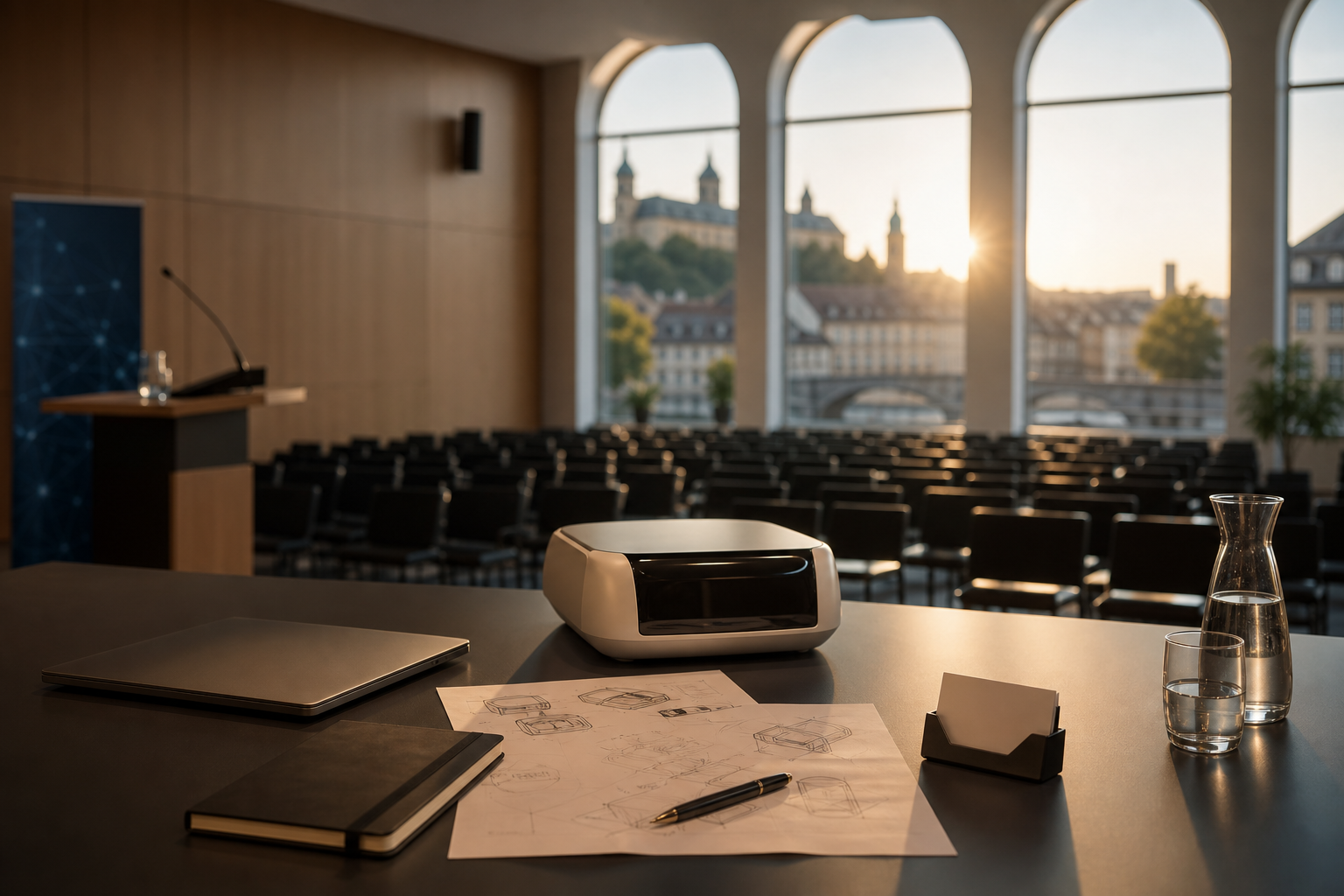
Under the title "Innovation and Future in Mainfranken: Entrepreneurial Spirit and Start-up Power," the evening focuses on start-ups, technology transfer, and the exchange between universities, start-ups, and the regional economy. The event will take place in the Audimax of the New University at Sanderring 2 in Würzburg. It begins at 6:00 p.m., and the program runs until 9:30 p.m.
The evening is clearly designed as a bridge: research should not end in the lecture hall but should lead to marketable applications, new companies, and regional value creation. For Mainfranken, this is more than a signal of innovation – it is a question of location. Regions benefit economically above all when research repeatedly leads to start-ups that retain skilled workers, build supply chains, and enter into partnerships with established companies.
Focus on Technology Transfer: From Insight to Market
The event will begin at 6:00 p.m. with greetings and an introduction by Prof. Dr. Anja Schlömerkemper (University of Würzburg) and Dr.-Ing. Stefan Möhringer (IHK Würzburg-Schweinfurt). At 6:15 p.m., the program point "When Research Founds: How Innovations Reach the Market" will follow with Prof. Dr. Jana-Kristin Prigge and Prof. Dr. Axel Winkelmann.
The dramaturgy alone makes it clear what the organizers are concerned with: not research for its own sake, but the mechanics of implementation. In practice, success often depends on details that lie outside the laboratory – for example, whether a team talks to users early on, whether a business model is robust, whether funding mechanisms are understood, and whether access to pilot customers is achieved. For a region that relies on medium-sized strength and specialized industries, such transfer processes are particularly relevant because they can bring research results more quickly into productive value chains.
Start-up Pitches: Young Teams in the Spotlight
From 6:30 p.m., the transfer idea becomes concrete: start-up pitches are planned – by Nico Elbert and Magnus Maichle for SOLISTIQ GmbH i.G. as well as by Anna Manger and Johannes Störlein for mindocu GmbH.
The fact that start-up projects ("i.G.") and already established companies appear together shows a typical reality in the innovation process: between a research idea and a scalable company, there are often several development stages in which teams refine their technology, test market segments, and prepare financing steps.
For the audience from business, science, and the start-up scene, the added value of such pitches is not just getting to know individual projects. What matters is the potential for connection: Where are there application fields in regional companies? What pilot projects would be conceivable? And what cooperations – from data access to manufacturing to sales – could arise from an initial contact?
Deep-Tech Perspective: Scaling, Capital Market, and Feedback
At 7:00 p.m., Dr. Joachim Kuhn will present the program point "From the Lecture Hall to the Stock Exchange (and Back) – Perspectives for Deep Tech Start-ups Using the Example of va-Q-tec." Deep-tech start-ups are usually capital- and time-intensive: development cycles are longer, approvals or industrial standards may play a role, and partnerships with industry, research, and investors are often necessary before a product reaches the market on a larger scale.
The inclusion of such an example broadens the perspective beyond the early phase. It sets a counterpoint to the widespread notion that a start-up is primarily a matter of rapid scaling. In many technology-driven fields, the opposite is true: those who want to survive in the long term must orchestrate technical maturity, production readiness, intellectual property rights, and financing so that growth does not fail due to the realities of development and industrialization.
Exchange as the Core: Q&A Session and Networking
At 7:30 p.m., a Q&A session is planned, followed by a standing reception in the atrium of the New University from 8:00 p.m. This makes visible what often has the greatest effect in transfer formats: the conversation between different milieus. When researchers, founding teams, investors, chamber structures, and companies are in the same room, the chances increase that an idea becomes a pilot project – or a pilot project becomes a robust business model.
Why This Matters for Mainfranken
The fact that the university and IHK are jointly organizing the event brings together two roles that complement each other in transfer processes: the university provides research, methodological expertise, and talent; the chamber represents the breadth of the regional business landscape and practical relevance in questions of founding and business development. The IHK Würzburg-Schweinfurt describes itself as the representative of the interests of around 73,000 member companies in the region (IHK Würzburg-Schweinfurt, "About Us").
For Mainfranken, this interplay is strategic: successful start-ups rarely emerge alone. They need access to markets, feedback from application, network partners, and often a region that not only welcomes innovation but also supports it structurally – for example, through mentoring, cooperation, and visibility.
Organizational Details: Location, Time, Registration, Accessibility
The event will take place on April 23, 2026, from 6:00 p.m. to 9:30 p.m. in the Audimax of the New University (Sanderring 2). Registration is possible via the form on the IHK Würzburg-Schweinfurt website up to 24 hours before the event begins. Access is barrier-free via the elevator in the New University.
In summary, "Business Meets Science" 2026 is less of an academic obligation and more of a location format: it shows what questions the region is asking when research is to become more than just insight – namely, business start-ups, jobs, and economic future viability in Mainfranken.