
Christian Schmiedbauer
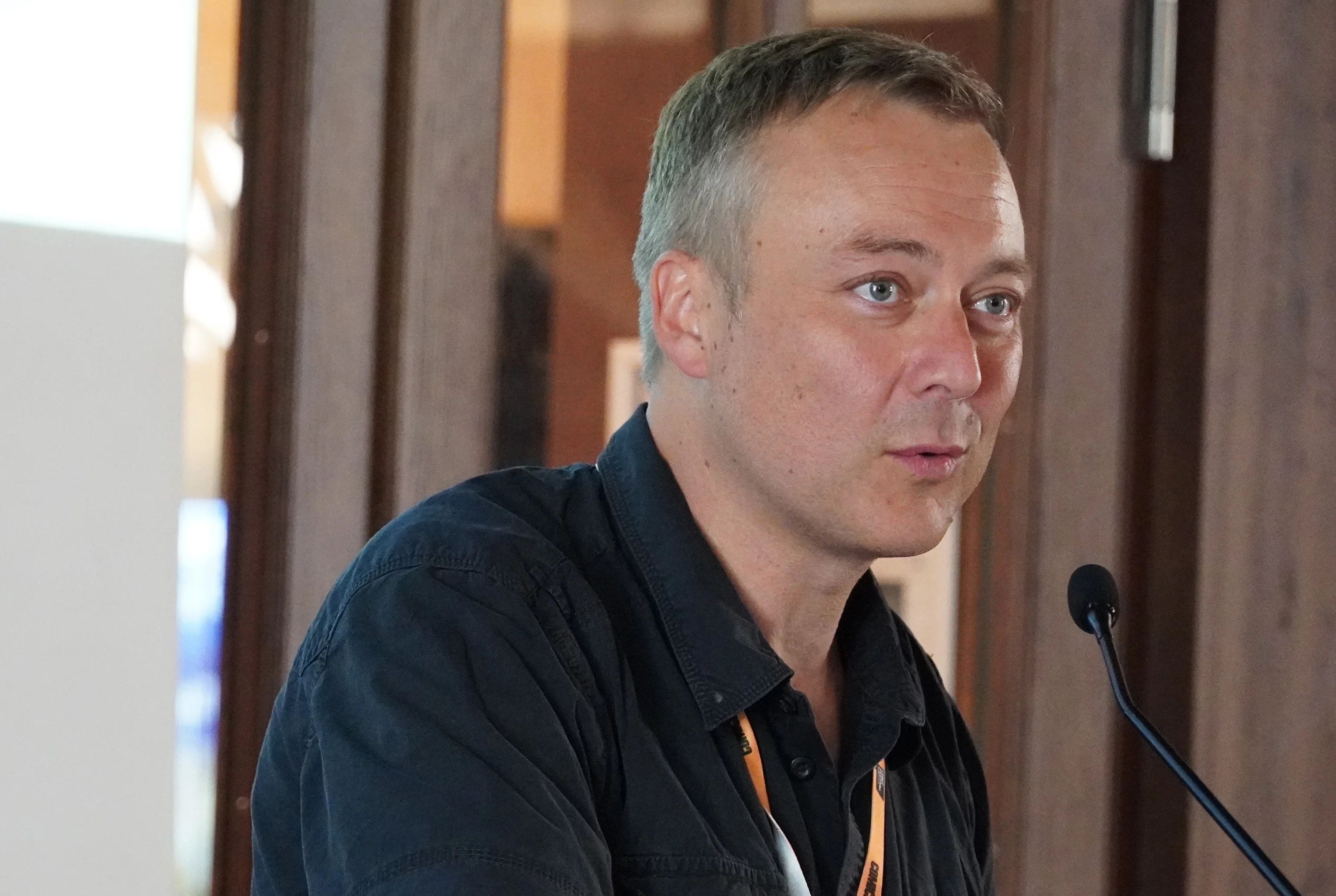
Image from Wikipedia
Image from Wikipedia
Christian Schmiedbauer – Comic artist, designer, and storyteller from Augsburg
Between Pen and Screen Printing: The Powerful Visual Language of “Kauboi & Kaktus”
Christian Schmiedbauer, born in 1976 in Straubing and known to many until 2011 under the pseudonym “Landrömer,” is one of the distinctive voices in the German independent comic scene. Rooted in Augsburg, where he lives and works, the comic artist and designer combines narrative precision with a unique visual vocabulary. His muse constellation “Kauboi & Kaktus” has evolved into a signature universe where minimalism, humor, and existential nuances harmoniously converge. At the same time, Schmiedbauer is committed as a designer and educational mentor in cultural education, among other things in the award-winning children's participation project LOGI-FOX – a dual artistic development that mutually enriches work and impact.
His professional career includes work in design agencies, founding his own Mondfähre design office, and teaching and workshop activities at the State Technical College of Augsburg. In exhibitions, books, and newspaper strips, this experience crystallizes into a distinctive handwriting: clear contours, reduced coloring, economical panel dramaturgy. Schmiedbauer uses the comic medium as a stage for contemplation and contrast, for comedy and edge – a stage presence on paper.
Biography and Artistic Development
Growing up in Straßkirchen, Christian Schmiedbauer studied graphic design in Augsburg and at the ISIA Urbino. After stints in the advertising industry, he established himself as a freelance illustrator and designer. His artistic development is marked by double expertise: a secure command of composition, typography, and corporate design on one hand, and the narrative fine mechanics of serial comics on the other. This intersection of design and narrative defines his artistic career – the development of a visual language that translates rhythm, timing, and dynamics onto pages and strips.
In Augsburg, Schmiedbauer connects with the local cultural scene, curating visual identities such as the logo for SchwabIllu and working as a workshop trainer in the design department. His artistic practice remains dialogical: workshops, comic camps, and school projects open the creation process to the audience, who become not only recipients but co-producers of aesthetic experience.
“Kauboi & Kaktus”: Character Psychology Between Laconicism and Hunger for Life
Schmiedbauer's most famous series “Kauboi & Kaktus” tells the story of the unequal friendship between a laconic skeleton and a stoic cactus. The psychology and poetry of the characters unfold in a reduced line style and precise punchline: the Kauboi as a death allegory with humor, the cactus as a spiky heart with dry wit. From this constellation emerges a serially composed dramaturgy in which every panel sits like a beat. The minimalist style creates space for meaning – what is not drawn resonates in the minds of the readers.
The series has appeared in newspapers and magazines, evolved into book publications, and has been recognized by media as one of the strong webcomic formats of the 2010s. In exhibitions, covers are shown as risographs and large-format prints that emphasize the graphic clarity of the series and transition the text-image composition from the flow of reading into the light of the museum.
Work Directory and Bibliographical Highlights
The bibliography documents Schmiedbauer's continuous work on cycles, variations, and expansions of his own cosmos. Key publications include early volumes such as “Kauboi und Kaktus 1: Verreckte Hund’” and “Kauboi und Kaktus 2: Schnorcheln ohne Badehose,” followed by “Zum Teufel!” and later “Süßwasserpiraten” published by Jaja Verlag. Besides the series, the adaptation “Peterchens Mondfahrt – Der Comic” transforms a classic of children's and youth literature into a contemporary visual language. Recent works like “Kauboi und Kaktus 4: Hell is’ im Wunderland” illustrate how Schmiedbauer continually re-arranges thematic cores, while the travel diary “Menschen am Fluss – Tagebuch meiner Donaureise” intertwines introspective non-fiction with visual essayism.
This discography of comics – a discursive series of volumes, editions, and artistic stages – points to the independence of graphic storytelling: composition, arrangement, and “production” as an editorial and printing process with a clear authorial signature. The balance of strips, volumes, and exhibitions creates reach in various audience spaces.
Exhibitions, Resonance, and Cultural Context
The exhibition practice frames the work in curatorial contexts. Risographic covers, screen prints, and sequences step out from the book page and demonstrate the transferability of panel logic into space. Media reports and features emphasize the “punk rock” energy of the line: unembellished, direct, with a sovereign sense of timing. This resonance is grounded in formal rigor and thematic openness – Schmiedbauer's works appear light yet carry weight as they stage friendship, finitude, and departure.
As part of the Bavarian comic landscape, Schmiedbauer is situated within a network of illustrators, designers, and authors that connects regional scenes with national radiance. In this tradition, comics are not only read as entertainment but as a designed narrative form with literary, graphic, and sociocultural relevance.
Logi-Fox and Artistic Education: Design as Participation
With the children's participation project LOGI-FOX – Augsburg Children's Newspaper – Schmiedbauer has been supporting young creatives for years. The project, awarded among others by the German Children's Fund, allows children editorial practice: researching, writing, drawing, and laying out. Schmiedbauer's role as a graphic designer, workshop leader, and mentor strengthens the artistic development of the young editorial teams and anchors design as a democratic competence.
Comic camps and tutorials convey the fundamentals of character development, story ideas, and image comprehensibility. This didactic expertise enhances the credibility of his artistic practice: those who teach sharpen their own craft. Thus, synergies arise between studio, classroom, and public, making the cultural value of the medium visible in urban spaces.
Form, Technique, and Style: Minimalism with Maximum Statement
Schmiedbauer's style thrives on reduction and rhythm. Linework and negative space structure the composition, while economical color usage keeps the focus on gesture, gaze, and beat of the panels. In “Kauboi & Kaktus,” wordplay and visual dramaturgy function like hook and bridge: precisely timed pauses, unexpected cuts, visual refrains. This clarity also appears in print graphics and corporate design – from logo to poster, a design that perceives readability as an aesthetic principle.
The narrative production follows a clear dramaturgy: build-up, variation, condensation. This keeps the characters identity-forming, while the setting remains flexible – desert, water, wonderland. This modular narrative architecture facilitates the transfer into exhibition concepts and serial newspaper formats.
Current Projects and Public Presence
In recent years, Schmiedbauer has intensified the connection between travel, research, and drawing. The Danube travel diary shows him as an observer with a personal voice – a graphic reportage that brings landscape, memory, and present into a flowing narrative. Simultaneously, new prints and exhibitions are being created that make the visual language of “Kauboi & Kaktus” tangible in space.
Recent program points – from urban presentations to thematic series – illustrate his continuous activity. Here, the tension between free artistic work, applied design in the Mondfähre design office, and cultural educational formats remains central. This versatility is not just coexistence but an integrated professional profile.
Reception and Influences: Between Independent Aesthetics and Media Presence
The media classification underscores Schmiedbauer's authority in the German-speaking comic landscape. Newspaper articles appreciate the energy of the line and the internal logic of his figures. Industry platforms, festival appearances, and catalogue entries document visibility and consistency. The references reflect a scene that understands graphic storytelling as part of the cultural journalistic discourse – with critiques, workshop reports, and exhibition reviews.
Influences range from classic children's literature – as seen in the adaptation “Peterchens Mondfahrt” – to contemporary indie comic aesthetics. In design, there is a sensitivity for collaborative processes and brand identities that unite artistic handwriting and functional objectives.
Conclusion: Why Read, See, and Experience Christian Schmiedbauer Today?
Because his comics show how much intensity lies in reduction. Because “Kauboi & Kaktus” uses humor as an instrument of insight. Because the integration of free art, applied design, and cultural education rarely succeeds so coherently. Schmiedbauer's artistic development exemplifies a scene that takes the medium of comics seriously – as literature, as graphics, as a societal conversation.
Anyone who has the chance to visit an exhibition, workshop, or reading with Christian Schmiedbauer should seize it. Live, prints, original drawings, and working notes reveal an intimacy that no screen can replace. The appeal: Go there, look, take a copy home – and continue to think about the characters.
Official Channels of Christian Schmiedbauer:
- Instagram: No official profile found
- Facebook: No official profile found
- YouTube: No official profile found
- Spotify: No official profile found
- TikTok: No official profile found
Sources:
- Wikipedia – Christian Schmiedbauer
- International Comic Salon Erlangen – Artist Profile Christian Schmiedbauer
- City of Augsburg – LOGI-FOX Augsburg Children's Post (Future Prize Project)
- City of Augsburg – Press Release: New Children's Newspaper LOGI-FOX Published
- Comics in Bavaria – Gallery: Christian Schmiedbauer
- State FOSBOS Augsburg – Contact Person: Christian Schmiedbauer
- Augsburger Allgemeine – “Punk Rock on Paper” (Portrait/Article)
- Mondfähre Design Office – Work Scholarship from the Free State of Bavaria (Excerpt from Laudation)
- Lesen.Bayern – “Peterchens Mondfahrt. The Comic”
- City of Ulm – Exhibition: “Kauboi & Kaktus – Expression” (Dates March 2026)
- Wikipedia: Image and text source
Upcoming Events
Christian Schmiedbauer: Cowboy & Cactus – Mode of Expression
Visually striking comic art in the Griesbad Gallery Ulm: Risographs, screen prints, and humor from Cowboy & Cactus. March 27, 2026, 14–18 hours, admission: information to follow. Immerse yourself and be amazed. #Ulm
Free Comic Day at the Augsburg City Library
Free comics, live drawing, and creative energy in Augsburg: The Free Comic Day brings reading fun and color to the City Library on May 9, 2026. #Augsburg #ComicDay