
Erich Fried
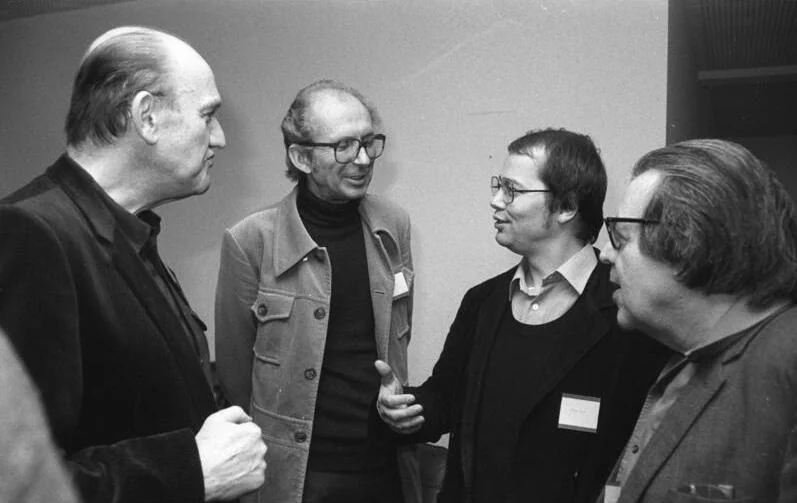
Image from Wikipedia
Image from Wikipedia
Erich Fried – Poet Between Love and Contradiction
A poet who ignites language: Erich Fried's path from Vienna to exile in London
Erich Fried, born on May 6, 1921, in Vienna and died on November 22, 1988, in Baden-Baden, influenced whole generations of readers with political poetry, love poems, and masterful translations. Although he did not pursue a career in music in the traditional sense, his poems became the voices of an era, recited on stages, set to music by composers, and celebrated by a broad public. Growing up in a Jewish household, Fried fled to London after the "Anschluss" in 1938, where he developed his literary life in exile. Balancing political intervention, poetic tenderness, and a new, vibrant language of Shakespeare, Fried crafted an artistic evolution that resonates today in literature, theater, and song interpretations.
As a leading representative of political poetry in post-war Germany, Fried combined social analysis with a clear, musically influenced diction. He became a noteworthy translator of T. S. Eliot, Dylan Thomas, Sylvia Plath, Graham Greene, and – in particular – William Shakespeare, establishing himself as an authority in German literature. In 1987, he was awarded the Georg-Büchner-Preis for his complete works – an accolade that affirmed his status as a poetic voice and an esteemed translator.
Biographical Beginnings: Vienna, Childhood, Early Stage
Fried's closeness to language began early in Vienna. He performed on stage as a child, wrote political essays and poems as a teenager, and sought the public space as a site of expression. The murder of his father by the Gestapo marked a turning point: In 1938, he left Austria, found refuge in London, and simultaneously discovered a resonant space for his writing. In 1949, he took on British citizenship – without denying his Austrian origins, which continued to shape his tone, themes, and moral vigilance.
The experience of exile heightened his sensitivity to language politics, propaganda, and the vulnerable dignity of the individual. Fried distrusted pathos, seeking instead a language that names what is – uncompromising yet without relinquishing nuance. This attitude became an aesthetic principle: accuracy in imagery, conciseness in verses, tension between outrage and empathy.
Political Poetry: Engagement, Artistic Intent, and the Vietnam Cycle
In the 1960s, Fried established himself as a distinctive voice of committed poetry. The collection "und Vietnam und" (1966) gathered elegies, sayings, and protest poems against the war – a documentary-lyrical project that sparked controversies at the time and is considered a watershed moment in literary history. Fried expanded the repertoire of political poetry by radically personalizing the speaking position while simultaneously paralleling a chronicle of facts with the condensation of feelings. This artistic choice intertwined composition, arrangement, and attitude: The verse became a witness account, and the rhythm a persuasive argument.
Fried's political poems operate – even outside historical contexts – as studies of the language that wields power. Their analytical coolness meets moral urgency: The poem becomes a form of compassion that is not sentimental, but concrete. This poetic-political musicality, with its clear line and precisely timed pauses and repetitions, created a tone that continues to make Fried's texts accessible today for theater, readings, and musical adaptations.
Love Poems: Tenderness with Barbs – From Bestseller to Classic
With the "Love Poems" (1979), Fried reached a mass audience. The reduction of means – unembellished, precise words, rhythmic clarity – unfolds a profound emotional resonance in these texts. Many poems are privately addressed yet remain exemplary: They celebrate intimacy, grapple with loss, and test love for its feasibility in reality. The later collection "Es ist was es ist" (1983) consolidates love, fear, and anger poems and features the iconic "Was es ist," whose tautological refrain became the poetic formula of an entire era.
That a political poet penned some of the most sensitive love poems of contemporary German literature is one of Fried's most productive contradictions. His love poetry is never mere private reading: It nullifies the language of power by taking the language of affection seriously. In reading books, on stages, and in numerous musical adaptations, this poetry remains present – as singable, speakable, and memorable poetry.
Translator of Shakespeare: A Lively Stage in German
As a translator, Fried opened up a new tonal realm of Shakespeare for German-speaking readers. His translations – including "Romeo und Julia," "Hamlet," and "Othello" – emphasize stage presence, dialogue tempo, and idiomatic freshness. Musically conceived, they follow the pulse of the drama: Cadences, cues, and contrasts are arranged so that character speech and conflict energy become immediately audible in German. This work had a stylistic impact and set standards in theater and educational editions.
Fried's Shakespearean German is less museum-like and more performative. It examines sound shades and semantic stretches, without tipping into arbitrariness. Thus, the translator expands the German theater tradition with a modern, agile Shakespearean language. That critics honored him as an "ideal translator" underscores the significance of this philological and artistic achievement.
Awards, Recognition, and Cultural Political Presence
In 1987, Fried received the Georg-Büchner-Preis. The official recognition highlighted his ability to "lead the German language out of obscurity" – a formula that precisely captures his work. The laudation also emphasized the enlightening power of his poetry: Fried's texts do not seek comfortable applause but open debates in which language and action form a unity. This recognition crowns a life's work that connects poetic rigor with public responsibility.
Beyond Fried's death, his name continues to resonate in contemporary literature: The Erich Fried Prize, awarded annually by the International Erich Fried Society since 1990 and funded by the Austrian government, ranks among the significant literary awards in the country. Recent laureates demonstrate how productively Fried's legacy influences today's poetic debates – a historical award with contemporary impulse.
Bibliography and Central Editions: From Protest to Poetry
Among Fried's most important volumes are the political poems of the 1960s and 1970s and the love and anger poems from his later phase. "und Vietnam und" (1966) marks his breakthrough as a political poet; "Liebesgedichte" (1979) opens up to a broad readership; "Es ist was es ist" (1983) consolidates his iconic texts. These core volumes are complemented by essays, a novel, and short prose, as well as a multi-volume collected works that document Fried's range. His translations – particularly Shakespeare – are continuously reissued in theater and educational editions.
Editorial care by renowned publishers ensures availability in various formats – as hardcover, paperback, e-book, and stage edition. A decisive quality for reception remains the performative aspect: Fried's poems continue to live on in readings, radio broadcasts, theater performances, and musical adaptations. The discography in the strict sense may not apply to a poet; yet his texts form a catalog of voices – spoken, sung, staged.
Style and Poetics: Clarity of Form, Rhythm, Counter-speech
Fried's texts are characterized by formal economy: short lines, controlled rhythm, precise semantic hinges. This economy is not minimalism but a matter of evidence. The composition of his poems is based on recurring motifs, serial increments, and pointed concluding cadences. In political poetry, repetition becomes an argumentative figure; in love poetry, it serves to invoke, countering the contradictions of the outer world.
Musically, Fried's influence can be placed within the tradition of spoken texts with musical accompaniment – from song adaptations to contemporary musical interpretations. His language is melody-capable, its rhythm fuels recitation. This musical disposition explains why Fried's texts found resonance across various genres – from radio plays to chansons. In all, the central thought remains: language should not obscure but reveal.
Cultural Influence: Exile, Public Sphere, and Continuation in Awards and Education
Fried belongs to the London circle of German-speaking exile authors, for whom writing was simultaneously memory, critique, and ethical positioning. His work touches on debates about war, memory politics, Israel/Palestine, anti-fascism, and democracy – always with an awareness of the ambiguities and risks of speaking. The popularity of his love poems reminds us that political writing and intimate discourse for Fried are not opposites but two means of truth testing.
The academic and university canon secures Fried's presence in education; theatrical and reading stages keep his texts audible. The Erich Fried Prize acts as an institutionalized continuation of this presence: Annual juries select voices that challenge contemporary language – very much in the spirit of the critical humanism embodied in Fried's work.
Reception and Critique: Between Canon and Controversy
Fried's work has been both celebrated and contested. Particularly his political poetry provoked debates about "committed poetry," regarding the tone of accusation and the danger of moralization. However, Fried's best texts evade the suspicion of mere ideological phoneme because they do not erase ambiguity. In love poetry, he demonstrated how profoundly poetic simplicity can resonate when it combines intellectual honesty with emotional precision. Critiques from the literary press recognized this dual character – the "tender realism" of love poems and the language-critical sharpness of political pieces.
Legacy: A Language that Confronts Reality
Erich Fried's artistic development led from the experience of exile to a poetics of responsibility. His work remains current because it recognizes the manipulability of language while steadfastly holding to it: as a medium of enlightenment, comfort, and counter-speech. The fact that his poems are still present in schoolbooks, on stages, and in musical contexts attests to the enduring brilliance of this oeuvre. Fried created a language that both sings and thinks – and that holds contradiction in its clarity.
Conclusion: Why Erich Fried Should Be Read, Heard, and Experienced on Stage Today
Erich Fried encourages the use of language. His poems connect the precision of argument with the warmth of attention. Those who read his texts or hear them in readings experience stage presence in the best sense: words that resonate. In times when the public sphere is flooded with buzzwords, Fried reminds us that the precise line can be the loudest one. His work invites us to sharpen our perception – and it is worthwhile to experience this voice live: in recitations, staged readings, or new musical interpretations.
Official Channels of Erich Fried:
- Instagram: No official profile found
- Facebook: No official profile found
- YouTube: No official profile found
- Spotify: No official profile found
- TikTok: No official profile found
Sources:
- Wikipedia – Erich Fried
- Klaus Wagenbach Verlag – Author Page Erich Fried
- Klaus Wagenbach Verlag – "und Vietnam und"
- Klaus Wagenbach Verlag – "Es ist was es ist"
- Suhrkamp Verlag – Shakespeare: Romeo und Julia (Translation by Erich Fried)
- German Academy for Language and Poetry – Georg-Büchner-Preis 1987, Erich Fried
- German Academy – Laudation by Herbert Heckmann (1987)
- German Academy – Acceptance Speech by Erich Fried (1987)
- Büchnerpreis.de – Story: "Erich Fried: Poet of Protest"
- International Erich Fried Society – Erich Fried Prize 2025
- Literaturhaus Wien – Erich Fried Prize 2024
- Wikipedia (EN) – Erich Fried
- Wikipedia: Image and Text Source
Upcoming Events
The Poet's Suitcase – Erich Fried: Dramatic Reading with Coffee and Cake
Poetic Sunday afternoon in the Suitcase Factory: Erich Fried texts as a dramatic reading, coffee & cake. 04.01.2026, 4 PM, 5 €. Intense listening experience – secure your place now. #LiteratureLive
Friendly Fire – Finding Erich Fried
An intense documentary film evening in Bielefeld: Friendly Fire tells the story of Erich Fried between exile, family, and politics. 12.05.2026, 7 PM. #Bielefeld #DocumentaryFilm