
Georg Philipp Wörlen
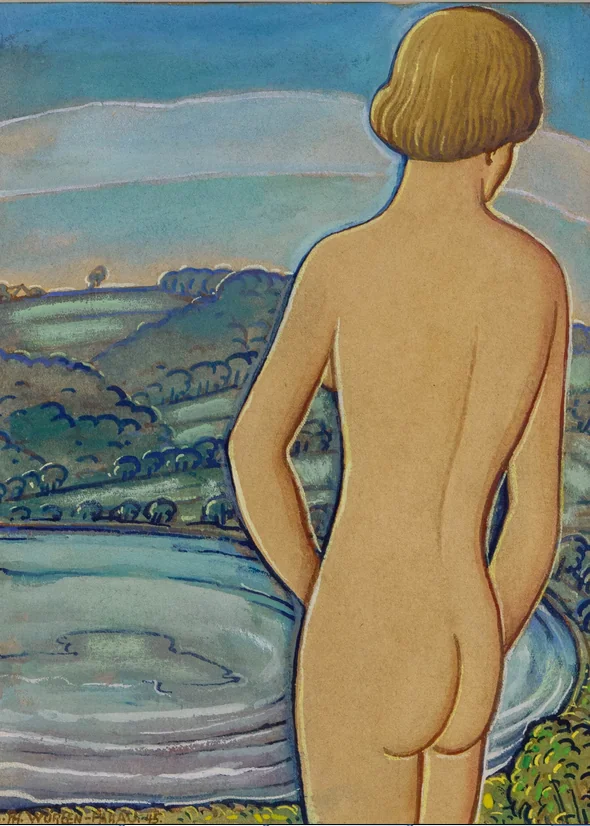
Image from Wikipedia
Image from Wikipedia
Georg Philipp Wörlen – Painter, Graphic Artist and Influential Voice of Classical Modernism in Southern Germany
An Artist's Life Between Expressionism, New Objectivity, and Passau – The Fascinating World of Georg Philipp Wörlen
Georg Philipp Wörlen (1886–1954) is one of the prominent voices of German Modernism. His path led him from the Swabian city of Dillingen on the Danube through the experiences of World War I to Passau, where he developed an independent visual language as a painter, graphic artist, and art educator. His oeuvre comprises vibrant wax casein paintings, rigorously composed watercolors, woodcuts, and lithographs – works that pulse between expressive density and objective clarity. Wörlen was a co-founder of the artist collective "Der Fels," later a member of the Vienna Hagenbund, and after 1945 a founding member of the Donau-Wald Group. His artistic estate today forms the core collection of the Museum of Modern Art Wörlen in Passau.
Background and Early Years: Craftsmanship, Restoration, and Educational Practice
Born on May 5, 1886, in Dillingen on the Danube, Wörlen completed his education at the School of Applied Arts in Nuremberg after finishing high school. His early practice as a restorer and his work in a studio in Regensburg shaped his precise eye for material, surface, and color effects. Before the war, he worked as a teacher at a technical school – an educational aspect that, along with keen observation and the discipline of craftsmanship, remained important constants in his artistic career in a broader sense: work on the subject, on the arrangement of forms, on the "score" of line, plane, and color.
War Years and Artistic Turning Point: From Experience to Form
The First World War left deep traces in both Wörlen's work and biography. Injuries, burial, and ultimately captivity in England became a biographical turning point – and led to a change in artistic direction. In a camp near Ripon (Yorkshire), Wörlen met artists Fritz Fuhrken and Franz Bronstert; through exchanges about art, sketches, and graphic experiments, he transitioned from impressionistic beginnings to a distinctly modern visual language influenced by Expressionism and Cubism. The reduction to crystalline forms, rhythmic brushwork, and a clear, "resonant" color palette became hallmarks of his artistic development.
Passau as the Center of Life and Work: "Der Fels" and the Breakthrough of the 1920s
In 1920, Wörlen moved to Passau with his family and taught as an art educator at the Leopoldinum Gymnasium. There, he solidified his network, fostered exchanges with colleagues, and opened himself to the exhibition scene in the southern German-Austrian region. Together with Fuhrken and Bronstert, he founded the artist collective "Der Fels" in 1920/21, which soon welcomed Carry Hauser and Reinhard Hilker. This group exhibited over 30 times in Germany and Austria until 1927, promoting an uncompromisingly contemporary visual language and processing war experiences, urban motifs, and existential questions in an expressive-cubist idiom. For Passau, Wörlen became a seminal figure – his city views condensing topography and atmosphere into a compositional unity, in which architectural motifs like the Schaiblingsturm become iconic forms.
Style and Work: Composition, Material and the Radiance of Color
Wörlen’s discography in terms of his oeuvre reads like a consistent search for balance between structure and emotion. He preferred wax casein colors: a medium that allows for matte yet intense color spaces and supports the spatial architecture of his paintings. In the "composition" of his works, clearly structured volumes, faceted contours, and a sensitive relationship between figure and ground meet. His graphic work – woodcuts, lithographs, and etchings – translates this clarity into linear scores that make the rhythm of light and shadow audible. Wörlen's "arrangement" of color triads, diagonal tensions, and tectonic axes demonstrates a conscious, almost musical discipline of form that defines his stage presence in the exhibition space.
New Objectivity and Religious Imagery: Clarity after Ecstasy
At the beginning of the 1920s, Wörlen's expression shifted towards New Objectivity. Religious themes – crucifixions, Madonnas, holy figures – acquire a cool, transparent concentration. The bodies are clearly contoured, and the pictorial space organizes itself according to constructive principles. However, the work never loses the inner rhythm of earlier Expressionism. Rather, an independent synthesis emerges: A "production" of controlled pathos, calm in the division of surfaces, and refined colors. This phase attests to Wörlen's ability to stylistically shift without opportunism – he develops a distinctive grammar of forms that remains relevant in later years.
Between Associations and Positions: Group of Six, Hagenbund, Donau-Wald Group
Wörlen was only briefly a member of the "Group of Six" (1923/24) but found an important exhibition platform within the Vienna Hagenbund (1927–1938). After the war, he co-founded the Donau-Wald Group in 1947 – a coalition of artists from Eastern Bavaria that cultivated diversity over doctrine and made contemporary art from the region visible through numerous exhibitions. These stages demonstrate Wörlen's authority in the exhibition landscape of the time: He moved between regional anchorage and supra-regional networks, building bridges to Vienna and the Bavarian-Bohemian cultural area.
Biographical Breaks and Historical Responsibility
To the historical truth of Wörlen's life journey belongs his proximity to National Socialism in the 1930s, evidenced by memberships and contemporary statements. After 1945, he underwent de-Nazification. A serious assessment of his work takes these facts into account without negating his artistic achievements: The ethical reflection on the biography sharpens the view for the ambiguities of Modernism and the conditions under which art is produced. For contemporary reception, this means: thinking about work and context together, studying sources, and critically examining influences and continuities.
After 1945: Return to Density and the Path to Abstraction
In his later work, Wörlen returned to expressive-cubic densities and developed an abstracting visual language. Geometric structures and atmospheric color areas intertwine; cityscapes become symbols of stairs, gables, and towers. At the same time, works arise that translate religious motifs into a modern vocabulary. These years mark a mastery of genres and techniques: paintings, watercolors, gouaches, and an impressive collection of drawings and print graphics document the breadth of his oeuvre.
Reception, Legacy, and Institutions: The Museum of Modern Art Wörlen in Passau
A particular feature of the Wörlen reception is the institutional visibility of his work in Passau. The architect Hanns Egon Wörlen, the artist's son, founded the Wörlen Foundation in 1988 and the Museum of Modern Art Wörlen in 1990. Its core collection consists of more than 1,500 works by Georg Philipp Wörlen, supplemented by works from his friends in "Der Fels" and the Donau-Wald Group, as well as correspondences documenting the artistic exchange. Since its opening, the museum has hosted hundreds of exhibitions and significantly contributes to the authority of the artist in the cultural-historical memory of the region.
Catalog and Research: Foundations for Further Evaluation
With the publication of the catalog of paintings in 2020, there is now a solid basis for research and collection work. The volume consolidates biography, artistic development, and high-quality images, reflecting the range from the expressionist early phase through New Objectivity to the abstracting late work. For collectors, curators, and the interested public, this "Catalogue Raisonné" serves as a reliable reference: Provenance, techniques, dating, and the embedding in the context of Classical Modernism become comprehensible.
Exhibitions and Current Visibility: Retrospectives and Collection Presentations
To celebrate the 30th anniversary of the museum, Passau showcased the largest Wörlen exhibition to date in 2020 – a comprehensive retrospective that presented the works chronologically and made key groups of works experienceable in their internal logic. Since 2022, a long-term collection exhibition has displayed highlights from the estate, accompanied by works from friends such as Alfred Kubin. Such presentations demonstrate Wörlen's enduring relevance: He serves as a nexus of a network of regional modernism, Austrian connections, and an open, cross-border art landscape.
Art Historical Classification: Between Regional Identity and European Modernism
Wörlen embodies European Modernism from the perspective of a Danube city. His pictorial spaces act like architectural scores, overlaying medieval city profiles, baroque silhouettes, and modern compositional techniques. He ties the expressive energy of the 1910s/20s to the constructive clarity of New Objectivity without relinquishing the sensuality of color. Compared to contemporaries of the avant-garde, Wörlen stands out for the consistency of his formal means: no spectacular breaks, but a patient, steady refinement of rhythm, light, and surface. This consistent "arrangement" gives his work a quiet, long-tested authority.
Motifs and Visual Language: City, Landscape, Transcendence
Passau as a motif serves as a guiding thread – alleys, towers, bridges, banks. But Wörlen is no topographer: he composes atmospheres. In his religious works, he spans the arc from iconic single images to dense narratives. His graphic works show how strongly he thinks in series: variations of a motif, shifts in light-dark balance, changes in the "arrangement" of surfaces. This methodical work – almost like producing various takes in music – makes the inner creative process visible.
Teaching, Influence, and Aftermath
As an art educator, Wörlen influenced generations of young people. His influence extends into regional art circles, exhibition cultures, and the collective visual memory of the city of Passau. The Donau-Wald Group, whose founding he initiated, connected various artistic voices after 1945 – a testament to diversity as a prerequisite for artistic quality. The ongoing museum presence of his work, recent research, and curatorial projects secure his position within the southern German art history of the first half of the 20th century.
Conclusion: Why Georg Philipp Wörlen Inspires Today
Wörlen's art impresses with inner calm and formal clarity – a modern visual music of planes, lines, and colors. His career illustrates how an independent style emerges from biographical experience, communal work in artist groups, and continuous reflection. Those who experience his works in person sense the balance of emotion and order, the vibrancy of color planes, and the precision of structure. Recommendation: The presentations in Passau provide profound insights into a work that connects regional identity, European modernity, and timeless visual poetry – a compelling reason to see this art live.
Official Channels of Georg Philipp Wörlen:
- Instagram: No official profile found
- Facebook: No official profile found
- YouTube: No official profile found
- Spotify: No official profile found
- TikTok: No official profile found
Sources:
- Wikipedia (DE) – Georg Philipp Wörlen
- Wikipedia (EN) – Georg Philipp Wörlen
- Museum Moderner Kunst Wörlen Passau – Retrospective 2020
- Museum Moderner Kunst Wörlen Passau – Collection/Wörlen Foundation
- Museum Moderner Kunst Wörlen Passau – 100 Years of "Der Fels"
- Passau Tourism – Museum of Modern Art Wörlen
- Museums in Bavaria – Museum of Modern Art Wörlen (DE)
- Museums in Bavaria – Museum of Modern Art Wörlen (EN)
- Wienand Verlag – Georg Philipp Wörlen. Catalog of Paintings (2020)
- Giese & Schweiger – Georg Philipp Wörlen: Biography
- Wikipedia (DE) – Donau-Wald Group
- Wikipedia: Image and Text Source
Upcoming Events
Discovering Treasures. Works from the Collection
Curated highlights from the collection: From Wörlen to Uecker, sensually staged at MMK Passau. Discover masterpieces and experience a concentrated art experience.
Urban Styles Workshop Day
A whole day full of Urban Dance in Ulm: Breaking, Partnering, and Training at dansarts. On June 14, 2026, pure movement awaits. #UrbanDance #Ulm