
Hugo Harrer
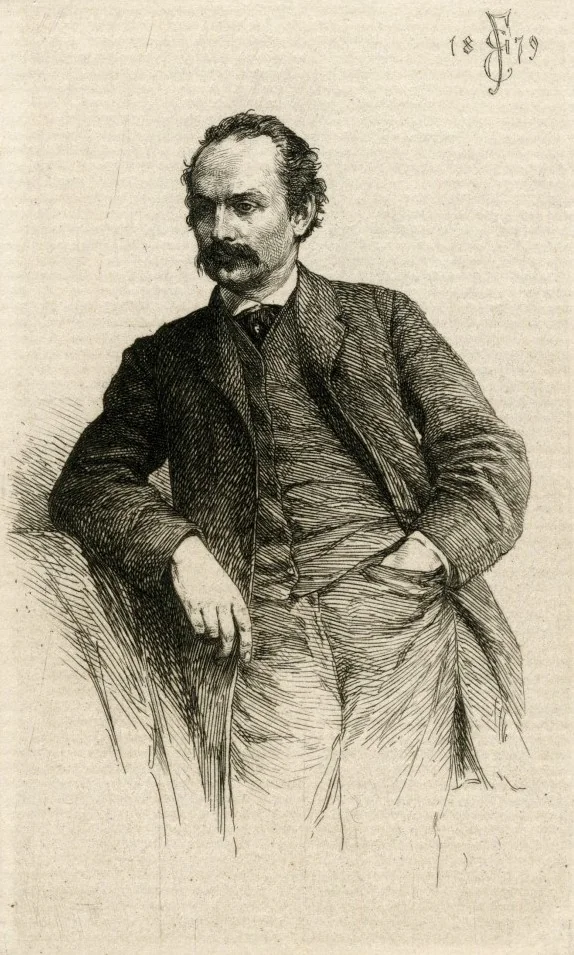
Image from Wikipedia
Image from Wikipedia
Hugo Harrer: The Quiet Master of the Düsseldorf School between Rome, Nuremberg, and the Longing for Light
An Artist's Life between Architecture, Nature Observation, and Italian Melancholy
Hugo Paul Harrer was a German landscape and architectural painter of the 19th century, whose work unfolds in the tradition of the Düsseldorf School while also presenting a unique perspective on cityscapes, ruins, and coastal landscapes. Born in 1836 and passing away in 1876 in Rome, he evolved from an aspiring architect to a self-taught painter who combined precise observation of nature with a keen sense of architectural forms and atmospheric effects. His artistic career journeyed through Nuremberg, Munich, Rome, and Düsseldorf, making him a notable figure in German-language painting of the 19th century. (deutsche-biographie.de)
From Architectural Studies to Painting: The Early Break as Artistic Gain
Harrer began an architectural education but soon turned to painting, where he found the freedom that would shape his later visual language. The Deutsche Biographie describes him as an artist who did not undergo a traditional art academy, but instead shaped himself through self-study, careful observation of nature, and exchange with friends. This biography explains the unpretentious, sober realism of his works, which does not shy away from virtuosity but never tips into decorative overload. (deutsche-biographie.de)
The first paintings emerged in Nuremberg, where Harrer was inspired by the historical buildings of the city to attempt early architectural paintings. Here, his central interest becomes evident: not just the motif, but the structure of the motif, the relationship of space, line, and light. From an architectural trainee, he became a painter who did not merely depict buildings but staged them as carriers of mood and history. (de.wikipedia.org)
Rome as a Workshop of Vision: Studies, Sketches, and the Gaze on the Everyday
A chest ailment led Harrer to Rome in 1861 or 1862, where he joined Ludwig Passini and began creating studies from nature. This Italian phase is one of the most productive periods of his career, as it sharpened his attention to street scenes, ruins, and coastal landscapes. Rome became not just a place of residence for him but a laboratory of painting that connects observation and memory while developing viable compositions from study images. (de.wikipedia.org)
Later, Harrer returned to Rome and amassed a significant collection of studies and sketches as templates for oil paintings. With these works, he participated in German art exhibitions and specialized in painterly depictions of street scenes, ruins, and Italian coastal landscapes. This thematic world reveals an artist who does not exoticize the foreign but transforms it into a precisely observed reality expressed through clear, calm visual thinking. (de.wikipedia.org)
Düsseldorf and the School of Landscape: Precision, Fidelity to Nature, and Academic Affinity
In the years 1867/1868, Harrer stayed in Düsseldorf and studied at the art academy in the landscape class of Oswald Achenbach. This step bound him to the Düsseldorf School of Painting, whose international influence was particularly strong in the 19th century and decisively shaped landscape and view painting. Harrer was a member of the Düsseldorf artists' association Malkasten from 1868 to 1872, thus moving within a central art metropolis of his time. (de.wikipedia.org)
The art historical classification of the Düsseldorf School helps to understand Harrer’s work more precisely: it was not a rigid style, but a milieu in which various forms of landscape, architecture, and genre painting developed. Harrer’s works represent a concrete, almost factual view of what is seen, combined with a secure composition and a fine sense of spatial depth. His painting is therefore directed more toward truthfulness than pathos. (de.wikipedia.org)
Thematic Worlds and Works: Cities, Ruins, and Mediterranean Light
Among the preserved works of Hugo Harrer are Old Hanse (1868), View of the Amalfi Coast at Dusk (1871), At the Theater of Marcellus in Rome (1876), Theater of Marcellus in Rome (1876), and A Jewish Street Vendor in a Street in Siena. These titles highlight the range of his interests: historical city views, Italian topography, ancient architecture, and scenes of everyday life. His art revolves around places where past and present, building and person, line and atmosphere intersect. (de.wikipedia.org)
Particularly the Roman motifs showcase Harrer’s strength in architectural painting. He was not solely interested in monumental effects, but in the quiet presence of walls, arches, and facades in changing light. The paintings gain from their restraint, as they rely on precise observation, clear structure, and that cheerful melancholy that characterizes many Italian images of the 19th century. (de.wikipedia.org)
Style and Artistic Hand: Modern Realism with Historical Sensitivity
The Deutsche Biographie explicitly describes Harrer as "a thoroughly modern realist" who sought to represent objects as he saw them. This formulation captures the essence of his artistic identity. Harrer did not idealize blindly but ordered, observed, and condensed; his images live from the balance between topographical accuracy and atmospheric mood. (deutsche-biographie.de)
His painting connects the architect's gaze with that of the landscape painter. As a result, his views gain a special quality: buildings do not appear as mere backdrops but as living carriers of cultural memory. In this combination of structure and sensation lies Harrer’s distinctiveness within the Düsseldorf School. (de.wikipedia.org)
Reception and Art Historical Significance
Harrer was not one of the loudest names of the 19th century, but his presence in German art exhibitions and his anchoring in the Düsseldorf School secure him a clear place in art history. His works demonstrate how strongly landscape and architectural painting at that time was influenced by travel, studies from nature, and a high sensitivity to light moods. Thus, he stands in line with those artists who did not merely depict the European space but made it experienceable as a cultural landscape. (de.wikipedia.org)
The differing information regarding birthplace and date of death cited in various sources also points to the critical distance from which Harrer's life must be examined today. The biography is passed down but not unequivocal in all details. This caution is particularly important for art historical texts, as it directs attention to the verifiable stations while simultaneously highlighting the archival conditions of the 19th century. (deutsche-biographie.de)
Conclusion: A Quiet Artist with a Lasting Gaze for Atmosphere and Form
Hugo Harrer fascinates as a painter of transition: from architect to artist, from the German studio to the Italian landscape, from precise form to poetic space. His images narrate observation, patience, and a pronounced sense of composition. Those interested in the Düsseldorf School, architectural painting, and European art of the 19th century will discover in Harrer an idiosyncratic, finely observant, and art historically significant name. His works deserve to be experienced anew in museums, exhibition catalogs, and through direct visual comparison. (de.wikipedia.org)
Official Channels of Hugo Harrer:
- Instagram: No official profile found
- Facebook: No official profile found
- YouTube: No official profile found
- Spotify: No official profile found
- TikTok: No official profile found