
Nora Abdel-Maksoud
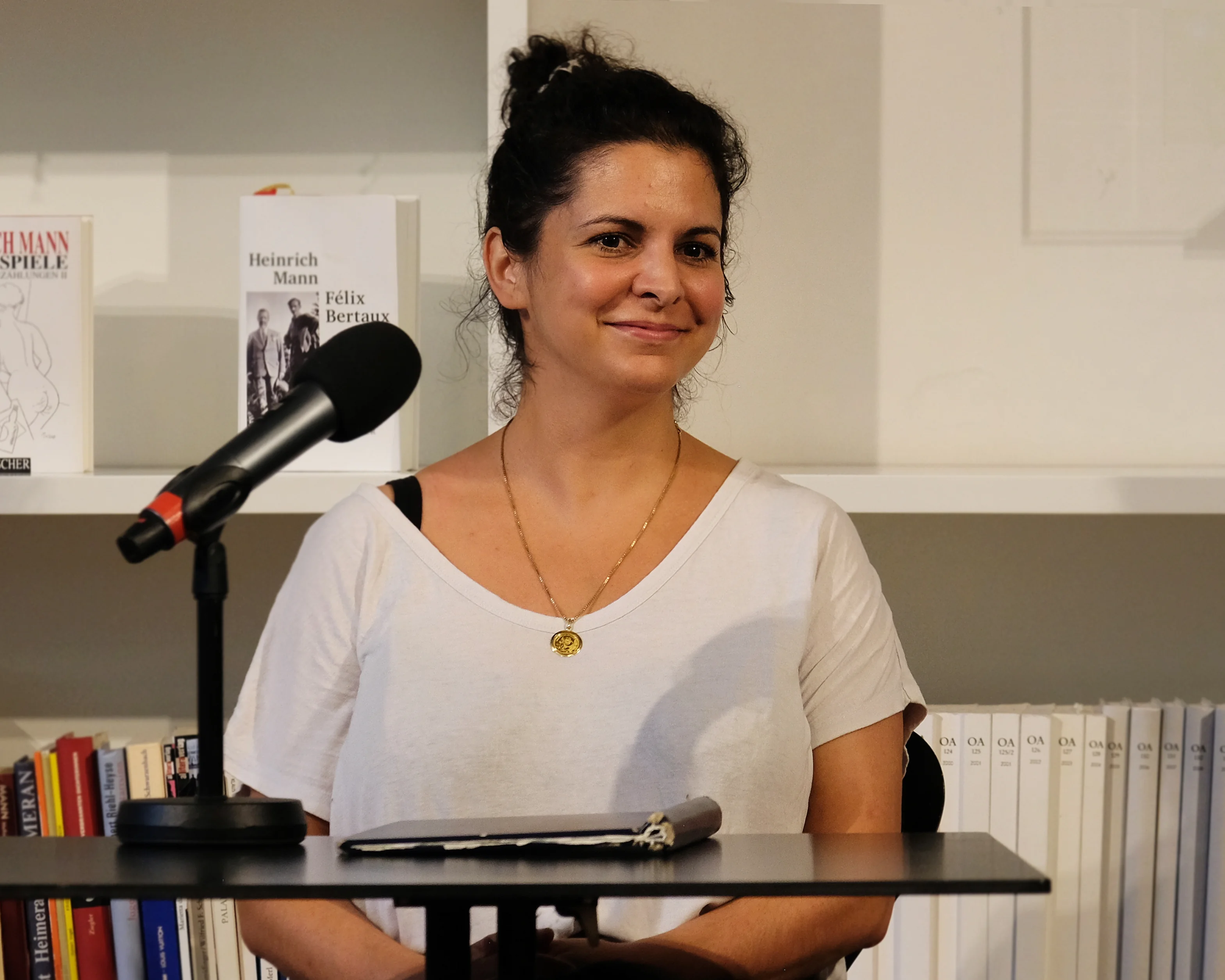
Image from Wikipedia
Image from Wikipedia
Nora Abdel-Maksoud
Satirical sharpness, breathless pace, grand theater: Nora Abdel‑Maksoud’s stage between comedy and criticism of capitalism
Nora Abdel-Maksoud, born in 1983 in Munich, is one of the defining voices of contemporary German-language theater. As a playwright, director, and actress, she merges pointed comedies with political depth. While she does not have a music career in the traditional sense, her stage works incorporate precise sound dramaturgies, live sound, and pop cultural references—elements that rhythmically charge her productions and amplify the stage presence of her ensemble. Her work revolves around social justice, classism, neoliberal performance logic, and the mechanics of the cultural sector. From her early acting years at the Ballhaus Naunynstraße to celebrated premieres at the Münchner Kammerspiele and the Maxim Gorki Theater, she has undergone an artistic development that sets standards in pace, timing, and satirical precision.
Origin, Education, and Artistic Development
Growing up in Munich, Abdel‑Maksoud brought dialects and linguistic diversity to the stage early on and began her acting studies in 2005 at the Hochschule für Film und Fernsehen "Konrad Wolf" in Potsdam-Babelsberg. After graduating, she quickly transitioned from classical acting roles to an independent position as a writer and director. Stage practice, precise timing, and physical comedy shape her experience; dramaturgical clarity and pointed dialogues form her expertise. Engagements took her to the Hans Otto Theater Potsdam, the Ballhaus Naunynstraße, and the Maxim Gorki Theater. Film and television roles supplemented her stage practice with additional media competency and narrative ranges.
From Actress to Writer-Director: The Path to Her Own Signature
In her initial phase of creation, she took on roles in contemporary plays and in post-migrant discursive theater. The turning point came in 2012 with her first directing and writing work, "Hunting von Trier," at the Ballhaus Naunynstraße: Here she already connects what later becomes her trademark—satirical sharpness, genre-sensitive composition, swift arrangements, and political sensibility. "Kings" (2014) continues along this line by dissecting the art market bubble: market mechanisms, the cult of authenticity, identity politics—all become material for a fast-paced comedy with precise beats. The musicality of her dialogues, the shift between off-beat punchlines, and the crescendo structure of the scenes shape a distinctive aesthetic signature.
Breakthrough with "The Making-of" and "The Sequel": Comedy as an Instrument of Knowledge
With "The Making-of" (premiere 2017, Studio Я/Maxim Gorki Theater), she achieves regional breakthrough: the production is invited to "radikal jung," and Abdel‑Maksoud is awarded "Young Director of the Year" in the Theater heute yearbook; she also receives the Kurt-Hübner Directing Prize. The production operates like a composition: exact timing, thematic motifs (power, role, image), abrupt breaks, and "cut" effects in real-time. "The Sequel" (2018) continues the deconstruction of superhero, film, and theater myths and is nominated for the Friedrich-Luft-Prize. Both works showcase her dramaturgical signature: satirical libretto, precisely set "breaks," sonic space dramaturgy, and a choreography of characters that resonate like voices in a multi-voiced score.
Trilogy of Class: "Café Populaire," "Jeeps," "Rabatt"
Since 2018, Abdel‑Maksoud sharpens a thematic cluster that establishes her as a leading satirical chronicler of social inequality. "Café Populaire" (premiere Neumarkt Zurich, 2018) is invited to major festivals and awarded the Hermann-Sudermann-Prize (2019)—a strong signal of authority and repertoire validity. The Berlin reworking "Café Populaire Royal" (Maxim Gorki Theater, 2024) relocates the story to the capital, focusing on classism and exposing the contradictions of the urban middle class. "Jeeps" (premiere 2021, Münchner Kammerspiele) negotiates inheritance as a systemic question: a fictional inheritance lottery, job center bureaucracies, anger, despair, and the desire for justice—delivered in 90 minutes that whip through a zeitgeist minefield like a well-mastered track. "Rabatt" (Gorki, 2022) translates poverty, burial politics, and dignity into a high-octane, pop-referential satire, described by critical press as sharp in punchlines, strong in performance, and intellectually resonant.
"Doping" (2024/25): Performance, Body, Power – a Wicked Comedy of the Present
With "Doping" (premiere April 5, 2024, Münchner Kammerspiele), Abdel‑Maksoud shifts focus to neoliberal performance logic—told as a farce about a local FDP politician active in Sylt, his team, and a secret private clinic. The production employs a three-part act structure, clear tempos, abrupt changes in dynamics, and a mix of slapstick, political farce, and dark humor. In 2025, "Doping" will open the 50th Mülheimer Theatertage, is nominated for the Mülheimer Dramatikpreis, and will be featured alongside works by Elfriede Jelinek, Dea Loher, and Bonn Park in a festival context—a seal of quality for relevance and contemporary accuracy. Further invitations to other prestigious forums underscore the authority of the piece and the stage presence of the ensemble.
Awards, Nominations, Recognition: Authority in the Field
Her artistic development is reflected in a series of awards and festival nominations. For "The Making-of," Abdel‑Maksoud receives the Kurt-Hübner Directing Prize in 2017 and is named "Young Director of the Year." "The Sequel" is nominated for the Friedrich-Luft-Prize. "Café Populaire" wins the Hermann-Sudermann-Prize in 2019 and proves to be a success with both audiences and critics. "Doping" marks another Mülheim nomination in 2025 and the opening of the anniversary edition of the Mülheimer Theatertage—a statement for the sustained impact of her satirical dramaturgy. Previously, her name had appeared in Mülheim alongside key contemporary authors—a long-term testament of trust from the scene.
Style, Composition, Production: Why These Comedies Groove
Abdel‑Maksoud writes comedies with score-like character. Scenes build like verses and choruses; running gags function as reprises; abrupt breaks set syncopated accents. The language is concise, rhythmic, precisely articulated; the punchline arrives on the beat, rarely too soon, never too late. Musical parameters—meter, pauses, crescendos, cadences—structure the dramaturgy. In production, she utilizes pop cultural references, live sound, sometimes band performances or sound designs that enhance the comedic "punch." The result: a stage that laughs, thinks, stirs again—and consistently breathes like a good arrangement.
Music Historical Context and Discourse
Although her work is anchored in theater, it operates at the boundary of musical performance and sound dramaturgy and aligns with satirical playwrights who sharpen the political discourse through form and rhythm. Her comedies are contemporary diagnoses that function like concept albums: recognizable motifs (class, work, performance, hypocrisy), recurring character topoi (advisors, influencers, politicians, cultural workers), a soundscape of fast speech, correction, self-contradiction. The cultural impact is evident in repertoire capacity, adaptations, festival invitations, and media debates on classism, cancel culture, and cultural economies. Theater as a resonance space—this is not a phrase here, but a production aesthetics.
Work Methodology and Stage Experience: Between Ensemble Management and Satirical Precision
As an experienced actress, Abdel‑Maksoud leads ensembles with a sure hand. She directs from the scene, tests timing in rehearsals, and places importance on "stage presence" in the literal sense: body, language, pauses, sight axes. Her focus on composition and arrangement combines scene detail with a macro-dramaturgical curve. Production teams—set design, costumes, music, dramaturgy—become collaborators in a total score. The press repeatedly highlighting precise timing, energy, and pace confirms the well-known truth in the music world: comedy is work in rhythm.
Current Projects 2024/2025: Repertoire, Festival, Reinterpretations
In 2024, "Doping" will celebrate its premiere and tour the festival circuit in 2025, particularly to Mülheim. Concurrently, the Maxim Gorki Theater strengthens the authorial position with the Berlin version of "Café Populaire Royal." "Jeeps" is newly produced at venues like the Hans Otto Theater and integrated into the program—an indicator of sustainable relevance. That "Doping" will open the anniversary edition of the Mülheimer Theatertage signals not only a present-day nerve but also curating trust: Abdel‑Maksoud's plays open debates—with wit, anger, and impact.
Discography? Dramaturgy! - Overview of Works (Selection)
Instead of a classic discography, a showcase of her works is appropriate: "Hunting von Trier" (2012) sets the trail. "Kings" (2014) examines the art market narrative. "The Story of Buffalo Jim" (2015/16), "Mad Madams" (UA Halle), and "They Called Him Tico" (UA Munich) refine tone and rhythm. "The Making-of" (2017) receives awards and "The Sequel" (2018) is nominated. "Café Populaire" (2018) wins the Hermann-Sudermann-Prize in 2019, "Rabatt" (2022) translates poverty politics into dark comedy, "Jeeps" (2021) dissects the inheritance system, "Café Populaire Royal" (2024) recontextualizes classism—and "Doping" (2024) sends the present into the consultation hour of satire. Each play varies motifs, adjusts form, and remains unique in production, arrangement, and scenic composition.
Critical Reception: Press, Awards, Audience
Reviews emphasize energy, linguistic precision, and the ability to transform discourses into entertainment. "The Making-of" is praised as "malicious satire" on the film and theater industry; the jury's rationale for the Kurt-Hübner-Prize highlights the rare mix of artificiality and truthfulness. "Rabatt" impresses with sharp punchlines, pop cultural appeals, and a strong performative axis; "Jeeps" is considered a scintillating, rapidly told zeitgeist comedy; "Café Populaire Royal" sharpens the focus on classism; "Doping" connects as a festival opening in Mülheim to major discourse stages. The sum of these resonances forms a reliable authority in the field of contemporary drama.
Conclusion: Why You Should See Nora Abdel‑Maksoud Now
Because her comedies hit hard without sounding hollow. Because the scenic music—the timing, the meter, the tempos—generates insights that go beyond simple agitation. Because her plays take the audience seriously, make them laugh, and then force them to think amidst laughter. Anyone wanting to experience contemporary theater with wit, audacity, and impact should see Abdel‑Maksoud’s works live: it is the rare combination of political precision, scenic elegance, and performative energy that lingers long after the evening.
Official Channels of Nora Abdel‑Maksoud:
- Instagram: No official profile found
- Facebook: No official profile found
- YouTube: No official profile found
- Spotify: No official profile found
- TikTok: No official profile found
Sources:
- Wikipedia – Nora Abdel‑Maksoud
- Maxim Gorki Theater – Ensemble Profile and Productions
- Maxim Gorki Theater – The Making‑of (UA 2017), Awards and Press Opinions
- Maxim Gorki Theater – The Sequel (UA 2018), Friedrich‑Luft-Prize Nomination
- Maxim Gorki Theater – Rabatt (UA 2022), Press Opinions
- Hans Otto Theater – Jeeps (Content and Reception)
- Der Tagesspiegel – Critique of "Jeeps"
- Münchner Kammerspiele – Doping (UA 5.4.2024)
- Mülheimer Theatertage – Jury Debate and Nominations 2025
- City of Mülheim an der Ruhr – Opening of the 50th Mülheimer Theatertage with "Doping"
- DIE ZEIT – Announcement of Festival Opening 2025 with "Doping"
- DIE ZEIT – Nominations Mülheimer Theatertage 2025
- Ruhrbarone – Overview of Nominations 2025
- Auf der Bühne – Review of "Café Populaire Royal"
- Die Welt – Review of "Café Populaire Royal"
- KULTURA‑EXTRA – Review of "Doping"
- Münchner Kammerspiele – Doping (easy to read version with festival notes)
- Munzinger – Biographical Overview
- schaefersphilippen – Author Profile, Awards, Projects
- Wikipedia: Image and Text Source
Upcoming Events
Jeeps – Play by Nora Abdel-Maksoud
The Making-Of
Jeeps
Jeeps
The Making-Of
The Making-Of
Jeeps
Doping
Doping