
Paul Signac
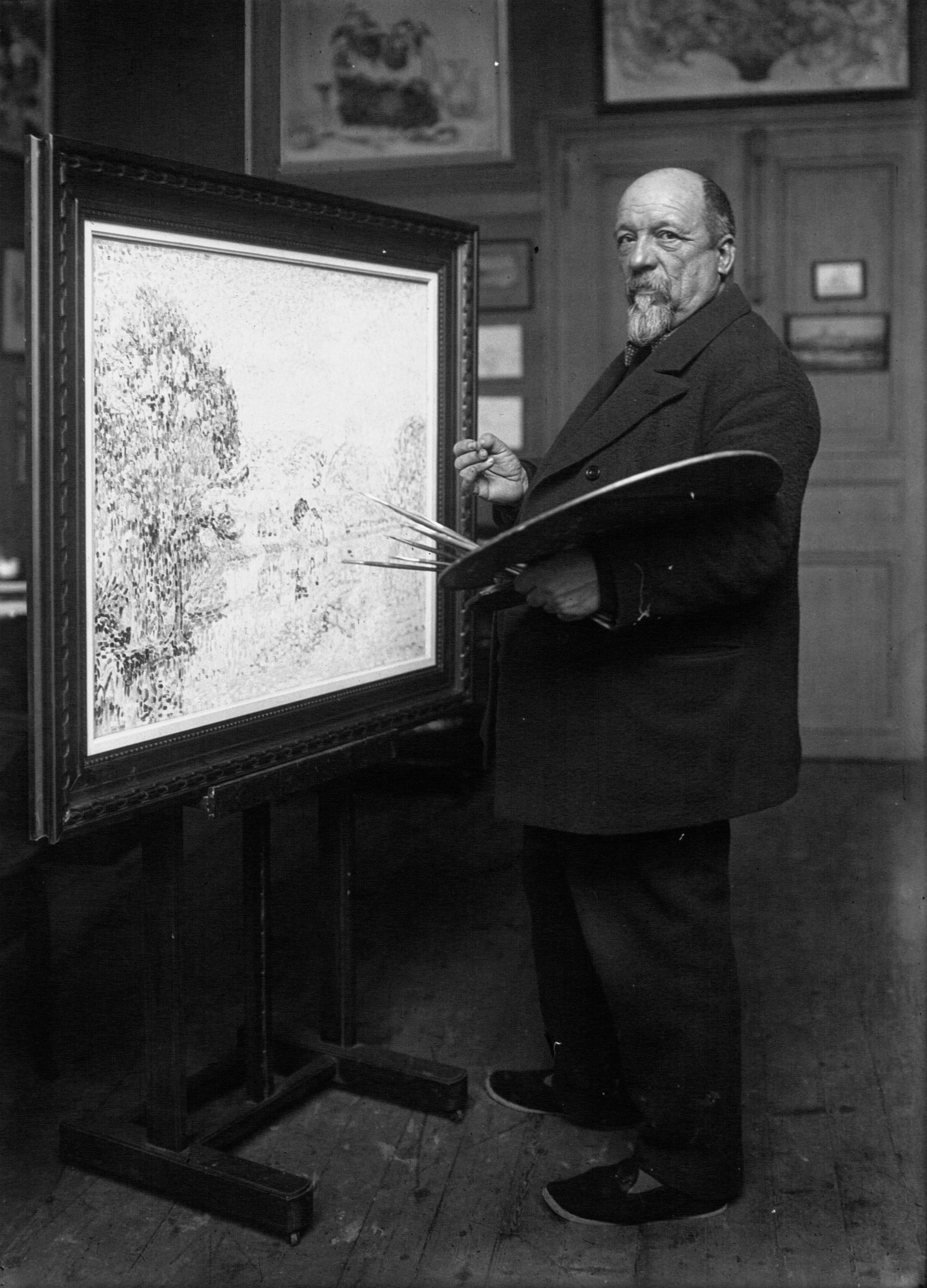
Image from Wikipedia
Image from Wikipedia
Paul Signac – Master of Neo-Impressionism and Poetic Architect of Light
An Artist's Life Between Sailing, Color, and Scientific Precision
Paul Signac was born on November 11, 1863, in Paris and died there on August 15, 1935. As a co-founder of Neo-Impressionism, alongside Georges Seurat, he shaped Pointillism like few others: a painting technique in which tiny, pure dots of color begin to shine on the canvas and blend in the eye of the viewer. Signac combined artistic development with theoretical clarity and a passion for sailing. While he did not have a musical career in the literal sense, his paintings became "symphonies of color," compositions that translate rhythm, tempo, and harmony into painting.
Early on, he was fascinated by Impressionism—particularly the works of Claude Monet—while simultaneously seeking a stricter, more analytical approach to color, light, and perception. This search led him to Seurat and the division of color into clearly defined, systematically placed points. In Saint-Tropez, along the Breton coast, and throughout French ports, Signac found his grand stages. From his studio and the deck of his boat, he created one of the most influential visual languages of modernity.
Biography: From Paris to Saint-Tropez – A Life Devoted to Color
Signac grew up in a bourgeois Parisian family and was initially supposed to study architecture. After formative encounters with Monet's painting, he consistently turned to art. In 1884, he exhibited for the first time at the Salon des Indépendants—an exhibition platform without a jury that allowed space for innovative trends and of which he was a co-founder. In this scene, he met Georges Seurat, whose research on optical contrasts, tonal values, and complementary colors profoundly influenced him. Their collaboration led to a new aesthetic: Neo-Impressionism as precisely controlled harmony of color and light.
Signac oscillated between Paris, Brittany, and the Mediterranean. In 1897, he moved into Hector Guimard's Castel Béranger and acquired the house "La Hune" in Saint-Tropez, where he established a large studio. As a passionate sailor, he made coasts, ports, and riverbanks the main subjects of his oeuvre. The years following Seurat's early death in 1891 are marked by Signac's distinctive handwriting: the brushstroke opens up, the dots grow into mosaics of pure color, and the nautical topography of France becomes a color-theoretical map.
Artistic Development: From Impressionism to Color-Theoretical Composition
Signac's artistic development is based on a dual movement: the adoption of Impressionist light observation and its transformation into a scientifically informed color composition. In Divisionism, he places pure pigments in fine, clearly defined dots next to each other, creating additive color mixtures in the visual process. This enhances luminosity, rhythmizes the surface, and creates a visual vibration that defines his stage presence within the pictorial space: atmosphere is created not through painterly mixing on the palette, but through optical resonance in viewing.
After the mid-1890s, Signac's application became freer; the dots stretched into angular, mosaic-like pieces. At the same time, the motif of harbor, ship, and quay came to the forefront. The composition remained clearly organized, often with an emphasized horizon and architectural structure; yet color took the lead. Signac composes color fields like chords, tensions, and resolutions reflecting musical gestures. His late work—especially the watercolors from the 1910s to the 1930s—displays this virtuosity in a reduced, crystalline clarity.
Institutional Role and Networks: President, Mediator, Visionary
Beyond his studio work, Signac shaped the art landscape organizationally and discursively. He was active in the Salon, or the Société des Artistes Indépendants, and became its president in 1908—a role he energetically and openly fulfilled for decades. In this capacity, he promoted young positions, supported radical visual languages, and created visibility for movements from Fauvism to Cubism. His curatorial practice served as an amplifier of modernity, and his stage was the exhibition institution itself as a place of artistic freedom.
His intellectual counterpart in the studio was the writing "D’Eugène Delacroix au Néo-Impressionnisme" (1899). In this manifesto, Signac analyzed composition, color, light, and the genealogy of modernity from Delacroix through Impressionism to the new school. The book became a reference text for the movement, bringing its principles into artistic circles and the public, helping to historically establish Neo-Impressionism.
Major Works and Phases: From Paris to Marseille, from Oil to Watercolor
Notable oil paintings by Signac include views of urban and maritime topographies—among them Avignon with the Palais des Papes, Mediterranean ports like Marseille, and scenes of Parisian riverbanks and bridges. At the Metropolitan Museum, "Paris: Pont Royal and the Gare d’Orsay" is documented as a finely nuanced combination of drawing and watercolor; at the Museum of Modern Art, "The Buoy (Saint Tropez Harbor)" is a key work of Signac's from the 1890s. The Musée d’Orsay gathers central paintings and watercolors that trace his evolution from early, closely set divisions to later, broader mosaic structures.
The watercolors form a distinct, steadily growing timbre in his discography of light—a visual travelogue through France’s coasts and inland ports. Here, his technical strengths condense: economical means, precise tonal value control, high color saturation. Particularly in these sheets, the design economy emerges, with which Signac translates the essence of a place into few, yet perfectly harmonized fields of color.
Style and Technique: Rhythm, Contrast, and Optical Harmony
Signac's style is based on the consistent separation of value, hue, and saturation. In production, he focused on clear edges of the dots, regular grids, and complementary contrasts. Composition for him meant a balance of structure and movement: the rigid quay meets liquid wave motives, masts rhythmize the pictorial space like bar lines, and facades set vertical chords. Painting becomes a score, whose performance occurs in the eye of the viewer—a stage where light becomes the protagonist.
His engagement with optics and perception physiology enabled a systematic color dramaturgy. The additive mixing not only enhances brilliance, it also decouples color from local associations: water can be purplish, sky lemon yellow, as long as the overall sound is right. This conscious arrangement expanded the expressive space of painting and prepared the transition to more expressive, Fauvist palettes in the early 20th century.
Cultural Influence: Impulses for Fauvism and Modernity
Signac's authority stemmed from practice, theory, and institutional work. His thoughts on color influenced artists such as Henri Matisse and André Derain; Neo-Impressionism thus became a bridge towards Fauvism. The idea that pure, side-by-side pigments can act autonomously and evoke moods energized a color-intensive, anti-naturalistic modernity. Exhibitions and retrospectives in museums across Europe and the USA established Signac as a key figure—not just as a renewer of painting technique but as a catalyst for a new aesthetic.
To this day, his reception remains vibrant: collections in Paris, New York, and elsewhere present his paintings, drawings, and watercolors; art historical studies, exhibition catalogs, and museum essays place his work within larger discourses on perception, urban planning, and maritime iconography. His visual language shapes curricula, research, and the practices of many painters who continue to think through his concepts.
Current Projects and Exhibitions: Signac in the Present
Even decades after his death, Signac remains present. In 2025/26, the Galerie de la Présidence in Paris will showcase a curated selection titled "Signac, du Noir à la Couleur," focusing on the development from drawing to the luminosity of color. For 2026, a major exhibition "Signac and Neo-Impressionism" is scheduled in Potsdam and Rotterdam—a cross-institutional project that reexamines his role in the network of modernity. Accompanying conferences will delve into the theoretical aspects of his approach and his impact on 20th-century art.
Such projects update Signac's relevance: they link historical research with current viewing habits and illustrate how precisely placed points, grids, and color fields can consider the digital age—from pixels to color science. The ongoing market and exhibition activity further demonstrates that his works continue to generate demand, scholarly interest, and collector appeal.
Reception and Criticism: Authority of Color, Precision of Form
The art press and museum writings commend Signac for the clarity of his compositions and the theoretical foundation of his practice. His "compositions of light" are seen as milestones of systematic color application; simultaneously, the poetic dimension with which he condenses waves, boats, and harbor architecture into visual music is emphasized. Critical assessments highlight that Signac maintained the balance between analysis and emotion: he pursued a strict concept without sacrificing the lyrical quality of color and atmosphere.
As a mediator, he enabled artistic careers, advanced discourses, and shaped exhibition policies. This multifaceted role—as painter, theorist, president, collector, and networker—supports his authority to this day. Museums use his works as teaching examples for color contrasts, optical mixing, and structural clarity in the pictorial surface.
Conclusion: Why Paul Signac Fascinates Today
Paul Signac fascinates because he conceptualizes art as a precisely composed experience: as the conductor of color, he unfolds orchestral luminosity, while as a theorist, he provides the score for it. His images possess an immediate, sensory impact—and simultaneously an intellectual depth that co-founded modernity. Those who look at his harbor views sense the rhythm, pulse, and breath of cities by the water; those who study his watercolors recognize economical elegance and enduring innovative power. Signac remains timely because he illustrates how great art emerges from research and intuition, arrangement and perception.
Experiencing his works live is worthwhile: the luminosity of the dots, the precision of the composition, and the serenity of his maritime spaces only reveal their full intensity in front of the original. Exhibitions and collection presentations offer the best opportunity to trace this artistic development directly—from the early, closely set divisions to the late, sovereign mosaics of color.
Official Channels of Paul Signac:
- Instagram: No official profile found
- Facebook: No official profile found
- YouTube: No official profile found
- Spotify: No official profile found
- TikTok: No official profile found
Sources:
- Wikipedia – Paul Signac
- Encyclopaedia Britannica – Paul Signac
- Musée d’Orsay – Paul Signac (Biography and Overview)
- Museum of Modern Art (MoMA) – Paul Signac: Works and Exhibitions
- The Metropolitan Museum of Art – Paul Signac: Paris: Pont Royal and the Gare d’Orsay
- Galerie de la Présidence – Signac, du Noir à la Couleur (Exhibition 2025/26)
- Museum Barberini – Conference: Symphonies of Color. Signac and Neo-Impressionism (Preparation for Exhibition 2026)
- Galerie de la Présidence – Paul Signac: Biography
- Wikipedia (EN) – Paul Signac, Work and Reception
- Musée d’Orsay – Signac, the Collector
- Wikipedia: Image and Text Source
Upcoming Events
Impressionism – Masterpieces of the Hasso Plattner Collection
Immerse in color and light: The Hasso Plattner Collection at Museum Barberini, Potsdam. 115 masterpieces, thoughtfully curated, accessible. April 1, 10 AM–7 PM. Discover, marvel, return. #Impressionism
Paul Signac. Symphony of Colors
Immerse yourself in the colorful world of Paul Signac and Neoimpressionism at Museum Barberini.
Paul Signac. Symphony of Colors
Visit the exhibition at the Museum Barberini and discover the fascinating color world of Paul Signac.
Symphony of Colors. Paul Signac and Neo-Impressionism
Visit the exhibition „Symphony of Colors“ featuring about 30 works by Paul Signac at the Museum Barberini from July 4, 2026.
Paul Signac. Symphony of Colors
Immerse yourself in Signac's luminous color sounds at Museum Barberini, Potsdam. Masterpieces of Neo-impressionism, international loans. July 4 – October 11, 2026, tickets from €18. Inspiring art experience – plan now! #SignacBarberini
Symphony of Colors. Paul Signac and Neo-Impressionism
Paul Signac's worlds of color shine at the Barberini Museum: experience Neo-Impressionism, coastal light, and international loans. Starting July 4, 2026. #SignacBarberini
Symphony of Colors: Paul Signac and Neo-Impressionism
At the Museum Barberini in Potsdam, you can experience the fascinating works of Paul Signac. An exhibition you shouldn't miss.
Symphony of Colors: Paul Signac and Neoimpressionism
Visit the exhibition of Paul Signac at the Barberini Museum in Potsdam. Experience the impressive world of Neoimpressionism.
Symphony of Colors: Paul Signac and Neoimpressionism
Experience Paul Signac's masterpieces and Neoimpressionism at the Museum Barberini Potsdam.
Symphony of Colors: Paul Signac and Neoimpressionism
Discover the fascinating world of Neoimpressionism and Paul Signac's works in Potsdam.