
The Ukulele Orchestra of Great Britain
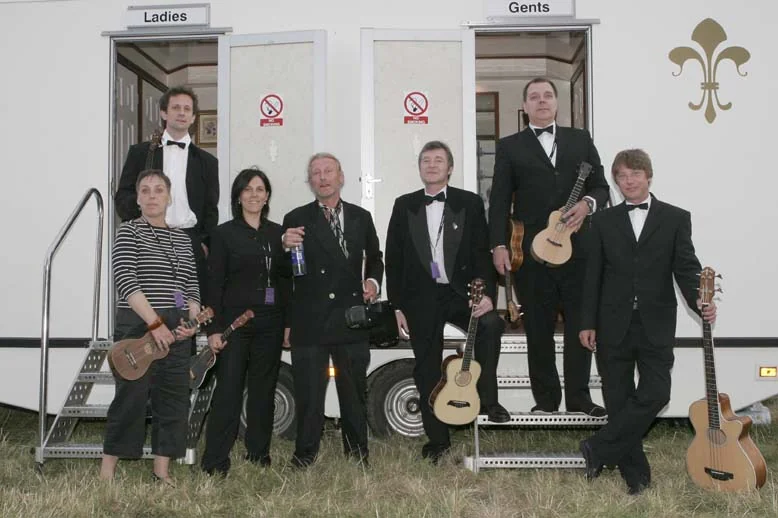
Image from Wikipedia
Image from Wikipedia
The Ukulele Orchestra of Great Britain – Four Strings, Endless Possibilities
From Quirkiness to Institution: How the “Ukes” Enchant Audiences Worldwide
The ukulele as a serious concert instrument? The Ukulele Orchestra of Great Britain has been proving since 1985 just how much groove, comedy, finesse, and cultural potential can be found in four strings. The ensemble from London has combined British humor with virtuosic musicality from the very beginning, transcending genre boundaries and writing a success story as an independent formation that has taken them from village halls to the Royal Albert Hall and Carnegie Hall. Their musical career intertwines artistic development, precise arrangements, and a stage presence that makes the joy of playing audible and visible in every beat.
Founding, Idea, Independence
The group originated when multi-instrumentalist and musicologist George Hinchliffe gifted a ukulele to his girlfriend, post-punk singer Kitty Lux – the spark that ignited a band seeing the instrument not as a joke, but as a versatile sound tool. Early on, the “Ukes” chose to sidestep the mechanisms of the traditional music business: no big label deals, instead opting for artistic autonomy, a distinctive profile, and direct contact with the audience. This attitude shaped a clear artistic identity and influenced the production, composition, and arrangement of their programs. (Sources: Wikipedia EN; Official Website)
Breakthrough and Milestones: From BBC Proms to Windsor Castle
Even the early years brought radio and TV appearances, festival debuts, and a rapidly growing tour life. The major breakthrough came in 2009 with a sold-out late-night appearance at the BBC Proms in the Royal Albert Hall, a moment when the band transformed their audience, along with their brought-along ukuleles, into a collective sonic experience. This was followed by guest performances at world-renowned venues – from Carnegie Hall in New York to the Sydney Opera House – and in 2016 a performance at Queen Elizabeth II's private birthday party at Windsor Castle. These career milestones showcase the dual DNA of the ensemble: concert readiness and comedy, virtuosity and approachability. (Sources: Wikipedia EN)
Sound & Style: Repertoire as Dramatic Journey
Style analysis: An UOGB evening resembles a curated dramaturgy of cover art, reinterpretation, and musical historiography. The musicians orchestrate ukuleles of all sizes – from sopranino to bass – into an ensemble sound that crackles percussively, shimmers transparently, and vocally glows with harmonies. Here, one encounters Wagner alongside the Sex Pistols, Tchaikovsky next to Nirvana, and Robert Palmer, Eurythmics, and Lady Gaga, seamlessly transitioning between styles. The composition style in the arrangement is crucial: themes are modulated, rhythms restructured, timbres shifted – thus, ironic reflections and heartfelt tributes emerge. Visually, tuxedos, bow ties, and stage arrangements parody the image of a classical symphonic orchestra, while the "deadpan" humor frames the program. (Sources: Wikipedia EN; La Jolla Music Society)
Discography & Chart Moment
Since the late 1980s, the ensemble has been developing an extensive discography – studio, live, and themed albums that translate their stage aesthetics into recorded format. Studio highlights include “The Ukulele Variations” (1988), “Hearts of Oak” (1990), “A Fist Full of Ukuleles” (1994), “Precious Little” (2007), “Christmas with the Ukulele Orchestra of Great Britain” (2008), and later releases such as “(Ever Such) Pretty Girls” (2015), “The Originals” (2016), and “By Request (Songs From The Set List)” (2018). Live recordings like “Prom Night – Live at the Royal Albert Hall” capture the stage energy. A pop culture wink came in 2005 when their quirky rendition of “Dy-Na-Mi-Tee” briefly hit the UK pop charts. This discography illustrates their production as an ongoing artistic development: maintaining repertoire, original compositions, and thematic projects. (Sources: Wikipedia EN)
Program Highlights: From “Ode to Joy” to “Anarchy in the U.K.”
Typical of the “Ukes” is their playful approach to genre codes. “Ode to Joy” becomes a sing-along happening, while "Anarchy in the U.K." takes on the guise of a folk campfire ballad; “Pinball Wizard” is taken apart in vaudeville shades and vocally reimagined. These rearrangements work because the band consciously shifts the parameters of key, meter, articulation, and texture, without revealing the musical core. The performance thus sharpens a listening experience between parody and reverence – a subversive reminder that genre is an arrangement and perception construct. (Sources: Wikipedia EN)
Current Projects, Tours, and Stage Presence 2024–2026
Even four decades after their founding, the ensemble remains on tour: in 2025, the 40th-Anniversary route includes stops in Dortmund; US concert series regularly mark their sustained popularity in North America. Additional stops are planned for 2026, including performances in San Diego (La Jolla Music Society) and at Pennsylvania State University (Eisenhower Auditorium). Furthermore, the “Ukes” will perform at European festivals, such as in Dresden. This density of schedules documents a stage presence that continuously brings the group closer to new generations of music fans – with programs that effortlessly blend pop, classical, rock, funk, and chanson. (Sources: City of Dortmund; La Jolla Music Society; Penn State; Dresden Music Festival)
Critical Reception & Reputation
In British and international music press, the "Ukes" are well-established as a "much-loved national institution" and "worldwide phenomenon." Reviews highlight the "consummate skill" of the musicians, their refined balance of wit and precision, rhythmic punch, and chamber music cohesion. This judgment aligns with the live experience: the ensemble's sound feels both earthy and noble, the timing of the gags sharpens the dramaturgy without overshadowing the musical substance. (Sources: Wikipedia EN)
Cultural Influence: The Ukulele Renaissance
The orchestra is often linked with the global ukulele renaissance. Less a trend and more a sustained mediation practice: workshops before concerts, educational projects, and bringing visibility to the instrument as an ensemble medium. The fact that the ukulele has replaced the recorder in many music classes reflects practical logic: affordable, portable, and quickly powerful in ensembles. The orchestra has thus embedded a new grammar for collective playing on four strings into pop and concert culture. (Sources: Wikipedia EN)
Cast, Voices, and Roles on Stage
For years, the formation has operated as a septet/octet with specialists for soprano, concert, tenor, baritone, and bass ukulele. The voice leading is clearly orchestrated: bass establishes foundation and groove, baritone colors the middle range, tenor and concert carry melody and fills, while the soprano registers highlight brilliance. The vocal work – from close harmony to unison punchline chorus – gives the repertoire a theatrical dimension that recalls revue, music hall, and pop concert simultaneously. (Sources: Wikipedia EN; Event Pages)
Legal Precedent: Protecting Artistic Identity
In 2014/2015, the group successfully defended itself in the UK against a “lookalike” formation performing under a similar name and nearly identical presentation style. The court recognized the risk of confusion and affirmed a detriment to the long-established artistic reputation of the "Ukes." The case underscored how strongly the brand of the orchestra is encoded through sound, image, repertoire, and humor – and how important control over their own artistic development remains. (Sources: Wikipedia EN)
Fans' Voices
The reactions from fans clearly show: The Ukulele Orchestra of Great Britain delights people worldwide. On Facebook, a listener writes: “So much musicality and humor in one evening – please come back every year!” On YouTube, a comment under a concert clip states: “How can something be so virtuosic, so funny, and so touching at the same time?” Another comment summarizes: “Four strings, yet a whole orchestra – simply wonderful.” (Source basis: official Facebook page; official YouTube channel)
Conclusion: Why You Should Experience the “Ukes” Live
This orchestra is more than a gag with bonsai guitars. It is a living testament to how arrangement, sound direction, and performance create a unique music culture. Anyone who delights in genre leaps, who loves compositional intricacies dressed in entertainment, and who wants to know how an ensemble can artistically grow independently for decades should experience the “Ukes” live. Their concerts unite timing, tonal culture, and theater – and they remind us how directly music can resonate in a space when presented with expertise, experience, and boundless joy of playing.
Official Channels of The Ukulele Orchestra of Great Britain:
- Instagram: No official profile found
- Facebook: https://www.facebook.com/UkuleleOrchestraofGB
- YouTube: https://www.youtube.com/user/UkuleleOrchestra
- Spotify: No official profile found
- TikTok: No official profile found
Sources:
- Ukulele Orchestra of Great Britain – Official Website
- La Jolla Music Society – Ukulele Orchestra of Great Britain (40th Anniversary Tour)
- Center for the Performing Arts at Penn State – Fortieth Anniversary Tour (2026)
- City of Dortmund – Concert Announcement (March 2, 2025)
- Music Festival – Program Information (Dresden, 2026)
- Official Facebook Presence
- Official YouTube Channel
- Wikipedia (German) – The Ukulele Orchestra of Great Britain
- Wikipedia (English) – Ukulele Orchestra of Great Britain (Discography, Proms, Legal Dispute)
- WIRED – Music Week: Geeking Out With the Ukulele (Context for the Ukulele Boom)
- Wikipedia: Image and Text Source
Upcoming Events
The Ukulele Orchestra of Great Britain – Stadttheater Fürth
The Ukulele Orchestra of Great Britain – Stadttheater Amberg
The Ukulele Orchestra of Great Britain
The Ukulele Orchestra of Great Britain – 40th Anniversary Tour

The Ukulele Orchestra of Great Britain – 40th Anniversary Tour